
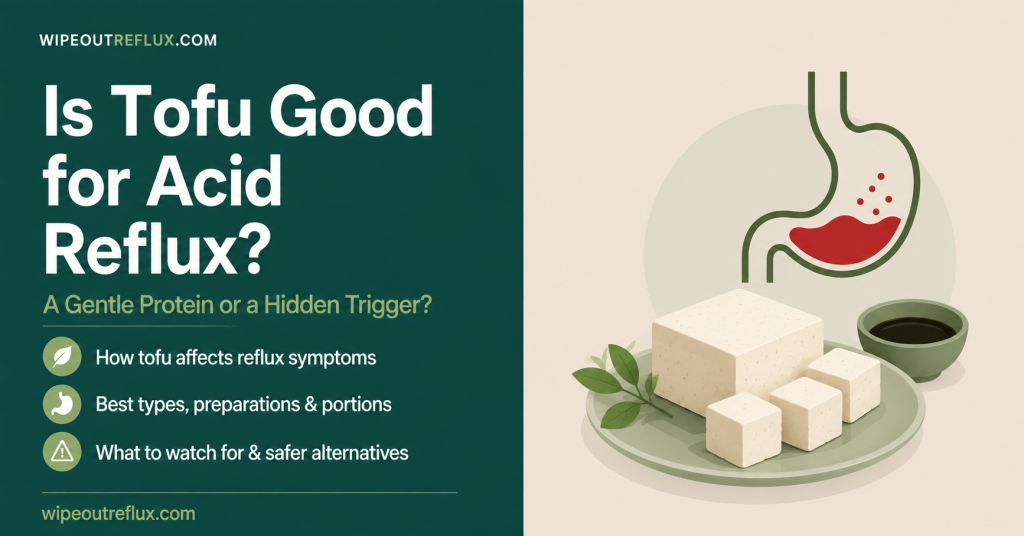
Yes — in its plain form, tofu is one of the better proteins you can eat with acid reflux. It’s a lean, plant-based protein that’s low in fat and close to neutral in pH, which is almost exactly the profile that leaves reflux alone. It’s bland, it isn’t acidic, and it doesn’t carry the heavy fat load that makes fatty meats such reliable triggers. That’s why tofu turns up on so many reflux-friendly and silent-reflux food lists.
The catch — and it’s the whole point of this article — is that tofu almost never arrives plain. It’s deep-fried until crisp, stir-fried in a slick of oil, or drowned in soy sauce, chilli and sticky sweet glazes. Prepared like that, a gentle food becomes a problem, and it isn’t the tofu’s fault. So the real answer to “is tofu good for acid reflux” is that the preparation decides it.
Here’s what makes tofu gentle, where it goes wrong, and how to cook it so it stays on your side.
Key Takeaways
- Plain tofu is lean, low-fat, plant-based protein that’s close to neutral in pH — a naturally reflux-friendly food.
- Because fat and calorie density, not acidity, are the main dietary drivers of reflux, low-fat tofu sits at the gentle end of the scale.
- Tofu is non-acidic, so it won’t irritate an inflamed throat or oesophagus the way citrus or tomato does — useful for silent reflux (LPR).
- Deep-fried and crispy tofu, and heavy oil stir-fries, add the fat that turns it into a trigger.
- The sauce is often the real problem: soy sauce is very salty, and chilli, teriyaki and sweet-chilli glazes add spice, sugar and sometimes acid.
- Firmer tofu is a touch higher in protein and fat than silken; both are gentle when cooked simply.
- Baked, steamed, grilled or lightly pan-fried tofu with mild seasoning is the reflux-friendly way to eat it.
Why Plain Tofu Is Gentle
Two things make tofu a good protein choice for reflux.
First, it’s low in fat. This matters most, because the most consistent dietary driver of reflux isn’t acidity — it’s fat and calorie density. In a controlled crossover study that separated the two, oesophageal acid exposure was significantly higher after calorie-dense meals, and the frequency of symptoms tracked with the fat percentage of the meal [Fox et al., Clinical Gastroenterology and Hepatology, 2007]. Plain tofu is modest in fat and light in calories, so it barely registers. Larger population data agree, tying higher total and saturated fat intake to more frequent reflux symptoms [El-Serag et al., Gut, 2005] — and tofu’s fat is unsaturated rather than the saturated kind found in fatty meat.
Second, it’s not acidic. Tofu sits close to neutral, so it won’t sting an already irritated oesophagus or throat. That makes it a natural fit for the wider LPR foods to eat approach and for a plant-based diet for acid reflux. As a lean, non-acidic protein it plays much the same role that chicken does for meat-eaters — a gentle base to build a meal around.
Tofu and Silent Reflux (LPR)
If your reflux is the throat-based, silent kind, the non-acidic quality carries extra weight. In LPR, pepsin — the stomach enzyme carried up with reflux — lodges in the throat tissue, where anything acidic you eat or drink can switch it back on and keep the irritation going. Human pepsin stays partly active well above the pH most people assume, which is the reasoning behind strict low-acid eating [Johnston et al., The Laryngoscope, 2007]. A low-acid diet removing everything below about pH 5 improved symptoms in the large majority of treatment-resistant LPR patients in one study [Koufman, Annals of Otology, Rhinology & Laryngology, 2011]. Plain tofu, being close to neutral, fits that low-acid framework comfortably. If pepsin is a new idea, what is pepsin is the place to start.
Where Tofu Goes Wrong: Preparation
Deep-frying and crisping
This is the big one. Deep-fried tofu, crispy tofu and agedashi tofu soak up oil, taking a lean food and wrapping it in fat. Fried food is one of the most reliably reported reflux triggers, for the same calorie-density reason as any fatty meal — more in is fried food bad for acid reflux. Crispy tofu is a completely different proposition from the same block baked or steamed.
Oil-heavy stir-fries
Tofu is porous and drinks up whatever it’s cooked in. A stir-fry swimming in oil undoes the low-fat advantage entirely. A light touch of oil is fine; a slick of it is not.
The sauces
This is where most of the trouble actually lives. Soy sauce is intensely salty; teriyaki and hoisin add sugar; sweet-chilli and sriracha glazes bring heat and often vinegar. Chilli-based sauces are a common trigger, particularly for the throat — see spicy food and acid reflux — and soy sauce’s acidity and salt are covered in is soy sauce acidic. The tofu is gentle; the glaze it’s wearing usually isn’t.
Does Soy Itself Cause Reflux?
For most people, no. Soy foods like tofu, edamame and soy milk are close to neutral and low in fat, and there’s no good evidence that soy protein triggers reflux in the way fat, acid and spice do. A minority of people find soy or legumes cause bloating, and bloating can make reflux feel worse by adding pressure — but that’s an individual sensitivity, not a general rule. If plain tofu sits fine with you, there’s no reason to avoid it on soy grounds alone.
Firm, Silken and the Rest
The type of tofu makes only a small difference for reflux:
- Firm and extra-firm. A little higher in protein and fat, and they hold together for baking, grilling and stir-frying. Gentle when cooked simply.
- Silken. Softer and slightly lower in fat, good blended into smoothies, sauces and puddings. Just as gentle.
- Smoked and marinated. Convenient, but check the marinade — some are salty, spicy or vinegary, which is where the reflux risk creeps in.
- Fried tofu puffs. Already deep-fried, so the fattiest form. Best kept occasional.
How to Cook Tofu for Reflux
A few habits keep tofu on the gentle side — the same cook-it-right thinking the Wipeout Diet Plan applies to the proteins you want to keep eating:
- Bake, steam, grill or lightly pan-fry rather than deep-frying. Baking gives a firm texture with barely any oil.
- Go easy on the oil. Because tofu absorbs it, a little goes a long way — use a non-stick pan and a light brush rather than a pool.
- Season gently. Herbs, garlic-infused oil, a little low-sodium soy or a mild marinade, rather than chilli glazes and sweet sticky sauces.
- Watch the salt. Soy sauce and miso are very salty — ask for or use low-sodium versions and keep the amount modest.
- Mind the portion and timing. Tofu is gentle, but a large, oily tofu dish late at night still works against you like any big meal before bed.
Conclusion
Tofu is genuinely one of the friendlier proteins for acid reflux — lean, low in fat, non-acidic and mild — and for silent reflux in particular that neutral pH makes it a reliable choice. The reason people sometimes react to it has almost nothing to do with the tofu and almost everything to do with how it’s served: deep-fried, oil-soaked, or coated in salty, spicy, sugary sauces. Bake, steam or grill it, keep the oil light and the seasoning mild, and tofu becomes a genuinely gentle way to build a meal.
Working out which foods are safe as they are and which just need cooking differently is exactly what the Wipeout Diet Plan is built to teach — it takes you through the real triggers, the gentle proteins and the swaps that let you keep eating the foods you enjoy. I designed it first and foremost around LPR and silent reflux, the stubborn throat-based form that medication so often fails to touch, but because it works on the same underlying mechanisms it helps GERD and everyday heartburn just as well. And the Wipeout Food Reference Guide is the practical companion for questions exactly like this one — which foods and drinks are safe for acid reflux and LPR, with their real pH values, so you can build a meal around tofu that works rather than one that costs you an evening.
Frequently Asked Questions
Is tofu good for acid reflux?
Yes, in its plain form. Tofu is lean, low in fat and close to neutral in pH, which makes it one of the gentler proteins for reflux. Problems come from deep-frying, oil-heavy cooking and salty, spicy or sugary sauces — not from the tofu itself. Baked, steamed or grilled tofu with mild seasoning is a safe choice.
Is tofu acidic?
No. Tofu sits close to neutral on the pH scale, so it doesn’t irritate an inflamed throat or oesophagus the way acidic foods like citrus, tomato or vinegar do. That non-acidic quality is part of what makes it suitable for silent reflux, where acidic foods can reactivate throat-bound pepsin.
Is fried tofu bad for acid reflux?
Yes, more than the tofu itself would suggest. Deep-frying and crisping load a lean food with oil, and fried, calorie-dense food is a common reflux trigger. The same tofu baked, steamed or grilled is far gentler, so the cooking method matters far more than the tofu.
Does soy cause acid reflux?
For most people, no. Soy foods like tofu and edamame are non-acidic and low in fat, and there’s no good evidence soy protein triggers reflux the way fat, acid and spice do. A minority find soy or legumes cause bloating, which can make reflux feel worse, but that’s an individual sensitivity rather than a general rule.
Is silken or firm tofu better for reflux?
Both are gentle, and the difference is small. Silken tofu is slightly lower in fat and blends well into smoothies and sauces; firm tofu is a little higher in protein and fat and holds up to baking and grilling. Either is fine — how you cook and season it matters far more than the type.
How should I season tofu if I have reflux?
Keep it mild: herbs, garlic-infused oil, a little low-sodium soy sauce, or a gentle marinade. Avoid chilli glazes, sriracha, sweet-chilli and heavy teriyaki, which add spice, sugar and sometimes vinegar. The blander the seasoning, the more tofu’s natural gentleness comes through.
Research & References
- Fox et al., Clinical Gastroenterology and Hepatology, 2007 — Randomised crossover study separating dietary fat from calorie density in people with reflux. Oesophageal acid exposure was greater after high-calorie meals and symptoms tracked the fat percentage — support for why lean, low-fat tofu is gentle and fried tofu is not.
- El-Serag et al., Gut, 2005 — Cross-sectional study of 371 people linking higher total and saturated fat intake with more frequent reflux symptoms — relevant to choosing low-fat, unsaturated-fat tofu over fatty, fried preparations.
- Johnston et al., The Laryngoscope, 2007 — Laboratory work showing human pepsin retains proteolytic activity well above pH 4, the basis for low-acid eating in silent reflux, where non-acidic foods such as plain tofu avoid reactivating throat-bound pepsin.
- Koufman, Annals of Otology, Rhinology & Laryngology, 2011 — Prospective study of treatment-resistant LPR patients on a strict low-acid diet (nothing below pH 5); 95% improved, supporting a low-acid approach into which neutral-pH tofu fits comfortably.

David Gray
12 years living with LPR · Consultant & researcher
I've lived with LPR for twelve years — the misdiagnoses, the PPI courses that did nothing, the slow work of figuring out what actually helps. Wipeout Reflux is where I translate the research into plain terms for people stuck in the same place. Every claim here is sourced to peer-reviewed work, and I consult one-to-one with LPR sufferers.