
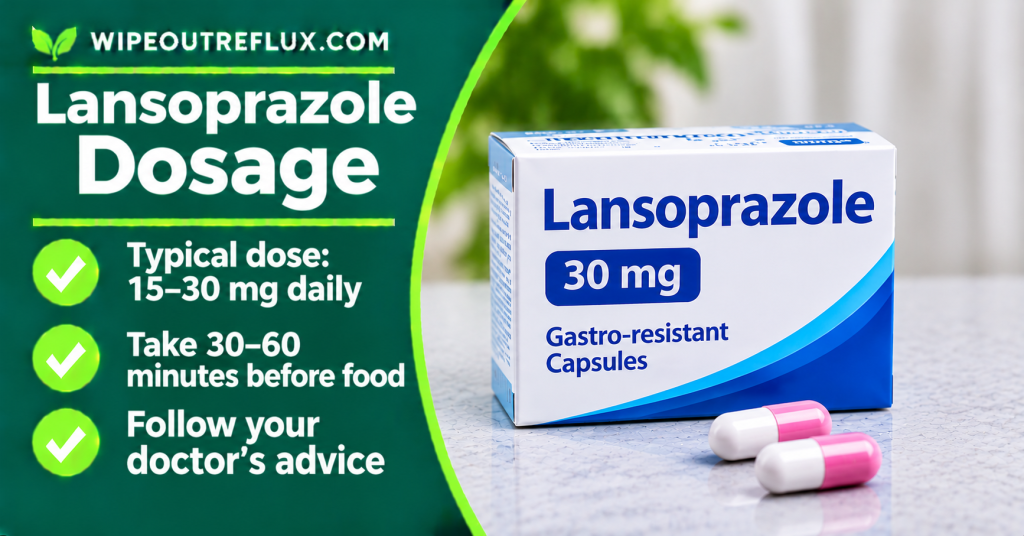
The usual lansoprazole (Prevacid) dose for acid reflux is 15 mg or 30 mg once a day, taken before a meal, usually breakfast. Over the counter, Prevacid 24HR is 15 mg once daily for a 14-day course. On prescription, 15 mg is the standard dose for reflux symptoms and for keeping things healed, while 30 mg is used to heal an inflamed esophagus or ulcer.
Higher doses, such as 30 mg twice daily, are used for H. pylori treatment and sometimes for stubborn reflux or silent reflux, and much higher doses are reserved for rare conditions under specialist care. For most people, though, the dose matters less than taking it before food, every day, for long enough to work.
Key Takeaways
- OTC Prevacid 24HR: 15 mg once daily for 14 days, repeatable every 4 months unless a doctor advises otherwise.
- Reflux symptoms without esophageal damage: 15 mg once daily for up to 8 weeks.
- Healing erosive esophagitis: 30 mg once daily for up to 8 weeks, with a further 8 weeks if needed.
- Maintenance after healing: 15 mg once daily. In a 12-month trial, 15 mg and 30 mg didn’t differ significantly.
- Take lansoprazole before eating. Taken before breakfast, it worked from day one in one study. Taken after breakfast, it needed longer to catch up.
- Lansoprazole 30 mg is roughly equivalent in strength to omeprazole 20 mg.
- Capsules can be opened onto applesauce, and orally disintegrating tablets dissolve on the tongue.
- Twice-daily lansoprazole was no better than placebo for persistent throat symptoms in the UK’s TOPPITS trial.
Lansoprazole Dosage Chart
These are the usual adult doses from the US prescribing information. Your doctor may tailor them to you.
- Frequent heartburn (OTC Prevacid 24HR): 15 mg once daily for 14 days.
- Symptomatic GERD (no erosions): 15 mg once daily for up to 8 weeks.
- Healing erosive esophagitis: 30 mg once daily for up to 8 weeks, with an additional 8 weeks if not healed.
- Maintaining healed esophagitis: 15 mg once daily.
- Duodenal ulcer: 15 mg once daily for 4 weeks.
- Stomach (gastric) ulcer: 30 mg once daily for up to 8 weeks.
- NSAID-related ulcer healing: 30 mg once daily for 8 weeks. Risk reduction: 15 mg once daily for up to 12 weeks.
- H. pylori eradication: 30 mg twice daily, combined with antibiotics, for 10 to 14 days.
- Zollinger-Ellison syndrome: starting at 60 mg once daily, adjusted by a specialist.
In the UK, lansoprazole comes as 15 mg and 30 mg capsules and as orally disintegrating tablets (previously sold as Zoton FasTab). UK guidance uses similar doses, typically 30 mg for healing and 15 mg to 30 mg for maintenance.
Lansoprazole 15 mg vs 30 mg
For healing: 30 mg
When there’s damage to heal, such as erosive esophagitis or a stomach ulcer, 30 mg is the standard. That’s because healing needs consistently low acid for weeks. For a sense of strength, an analysis of PPI pH studies found that lansoprazole 30 mg, omeprazole 20 mg and esomeprazole 20 mg are functionally equivalent [Graham and Tansel, Clinical Gastroenterology and Hepatology, 2018]. In a five-way crossover study, lansoprazole 30 mg kept stomach pH above 4 for an average of 11.5 hours a day, very close to omeprazole 20 mg at 11.8 hours [Miner et al., American Journal of Gastroenterology, 2003].
For staying healed: 15 mg is usually enough
Once the esophagus has healed, many people can drop to 15 mg. In a 12-month placebo-controlled trial, 79% of people on lansoprazole 15 mg and 90% on 30 mg stayed healed, compared with just 24% on placebo. The difference between 15 mg and 30 mg wasn’t statistically significant, and both doses controlled symptoms equally well [Robinson et al., Annals of Internal Medicine, 1996].
Another year-long trial found 67% of people on lansoprazole 15 mg remained healed, compared with only 13% on ranitidine 150 mg twice daily [Peura et al., Digestive Diseases and Sciences, 2009].
That said, the numbers in the Robinson trial leaned towards 30 mg, so people with severe esophagitis who relapse on 15 mg are often kept on 30 mg. US guidelines recommend using the lowest dose that keeps you well for long-term therapy [Katz et al., American Journal of Gastroenterology, 2022].
Is 30 mg of lansoprazole a high dose?
No. It’s the standard full dose, roughly equivalent to 20 mg of omeprazole. A high dose would be 30 mg twice daily or more.
When and How to Take Lansoprazole
Before food, ideally breakfast
Lansoprazole should be taken before eating. Like all PPIs, it can only switch off proton pumps that are active, and food is what activates them. The timing makes a clear difference early on.
In a crossover study, lansoprazole 30 mg taken half an hour before breakfast significantly reduced acid on the very first day of treatment, while taking it after breakfast didn’t. By day 15, both timings were working, so the effect of food matters most at the start [Brummer et al., Digestive Diseases and Sciences, 1997].
The simple rule is to take it 30 to 60 minutes before breakfast. If your symptoms are mainly at night, your doctor may suggest taking it before your evening meal instead.
Capsules
Swallow lansoprazole capsules whole with water. If you have trouble swallowing, you can open the capsule and sprinkle the granules onto a tablespoon of applesauce, then swallow straight away without chewing. Don’t crush the granules, because the coating protects the drug from stomach acid. My guide to trouble swallowing pills has more tips.
Orally disintegrating tablets
Prevacid SoluTab and other orally disintegrating versions dissolve on your tongue, after which you swallow the granules with saliva. They shouldn’t be chewed or crushed. They’re useful for people who can’t swallow capsules and can also be given through some feeding tubes.
Twice-Daily Lansoprazole
Twice-daily dosing (usually 30 mg before breakfast and 30 mg before the evening meal) is standard for H. pylori treatment and is sometimes used for reflux that doesn’t respond to once-daily dosing. Splitting the dose is more effective than taking one bigger dose. Graham and Tansel’s analysis found that increasing a once-daily PPI dose only raised acid control up to a point, while twice-daily dosing pushed it considerably higher [Graham and Tansel, Clinical Gastroenterology and Hepatology, 2018].
Lansoprazole Dosing for Silent Reflux (LPR)
This is where I’d urge caution. Twice-daily PPIs are commonly prescribed for throat symptoms, but the best trial specifically used lansoprazole, and the results were sobering.
In the UK’s TOPPITS trial, 346 people with persistent throat symptoms were randomized to lansoprazole 30 mg twice daily or placebo for 16 weeks. Throat symptom scores improved in both groups, but lansoprazole was no better than placebo [Wilson et al., Health Technology Assessment, 2021].
That fits with the mechanism. Lansoprazole lowers acid, but it doesn’t stop reflux reaching the throat, and it doesn’t deal with pepsin, the enzyme behind much of the irritation. I explain why in why PPIs don’t work for LPR. If you also have heartburn, lansoprazole can still help. But diet and meal timing do most of the work for throat symptoms, which is why I built the Wipeout Diet Plan around them.
Special Situations
Liver problems
Lansoprazole is broken down by the liver. In severe liver impairment, a lower dose (such as 15 mg daily) should be considered. Kidney problems don’t usually require a dose change.
Older adults
No routine dose change is needed, but it’s sensible to use the lowest effective dose, especially long term.
Children
Lansoprazole is used in children from 1 year old. In the US, children aged 1 to 11 typically take 15 mg (30 kg or under) or 30 mg (over 30 kg) once daily. Children’s dosing should always come from a doctor.
Other medications
Lansoprazole is one of the PPIs suggested as an alternative to omeprazole and esomeprazole for people taking clopidogrel [Johnson et al., Postgraduate Medicine, 2014]. Like other PPIs, it can reduce absorption of drugs that need stomach acid, and it can interact with tacrolimus, methotrexate and some HIV medicines. Always tell your pharmacist what else you take.
Missed Doses and Maximum Dose
If you miss a dose, take it as soon as you remember, unless your next dose is due soon. Don’t double up.
For reflux, 30 mg twice daily is generally the ceiling. For Zollinger-Ellison syndrome, specialists have used up to 90 mg twice daily. If 30 mg once daily isn’t controlling your symptoms, talk to your doctor rather than raising the dose yourself.
How Long Should You Take Lansoprazole?
A typical course is 4 to 8 weeks. After healing, some people need ongoing maintenance at 15 mg, while others can stop or switch to taking it only when needed.
If you’ve been on lansoprazole for more than a few weeks, taper rather than stopping suddenly, because rebound acid can make your symptoms seem worse for a while. My PPI taper schedule shows how. For side effects, including the link with microscopic colitis, see lansoprazole side effects, and for how it compares overall, lansoprazole for acid reflux.
Conclusion
Lansoprazole dosing comes down to a simple pattern. Use 15 mg for everyday reflux symptoms and to stay healed, 30 mg when there’s damage to heal, and twice-daily dosing for H. pylori or reflux that clearly needs more. Take it before breakfast, give it a few days to build up, and use the lowest dose that keeps you comfortable over the long term.
What no dose can do is stop reflux from happening. Lansoprazole makes what comes up less acidic, which is why it’s so effective for heartburn and esophagitis, and why, in the TOPPITS trial, it made no measurable difference to throat symptoms compared with placebo.
That’s the gap the Wipeout Diet Plan is designed to fill. It’s my complete, in-depth guide to the foods, meal timing and daily habits that reduce reflux at the source. It was originally built around silent reflux, but because it works on the same root causes, it’s just as effective for GERD and classic heartburn. Many readers use it alongside their PPI, and then work with their doctor to bring the dose down.
Frequently Asked Questions
What is the normal dose of lansoprazole?
15 mg or 30 mg once daily before a meal. Over the counter, Prevacid 24HR is 15 mg once daily for 14 days.
Is lansoprazole 15 mg or 30 mg better?
30 mg is used to heal esophagitis and ulcers. For maintenance after healing, 15 mg works almost as well and is the usual long-term dose.
What is the maximum dose of lansoprazole?
For reflux, usually 30 mg twice daily. Higher doses are used only under specialist care for rare conditions such as Zollinger-Ellison syndrome.
Can I take lansoprazole twice a day?
Only if your doctor prescribes it. It’s standard for H. pylori treatment and sometimes used for stubborn reflux.
Should I take lansoprazole in the morning or at night?
Most people take it 30 to 60 minutes before breakfast. If your symptoms are mainly at night, taking it before your evening meal may suit you better.
Can I open lansoprazole capsules?
Yes. Sprinkle the granules on a spoonful of applesauce and swallow straight away without chewing or crushing.
Is lansoprazole 30 mg stronger than omeprazole 20 mg?
They’re roughly equivalent. Studies comparing PPI potency put lansoprazole 30 mg and omeprazole 20 mg at about the same level of acid suppression.
Research & References
- [Graham and Tansel, Clinical Gastroenterology and Hepatology, 2018] — Analysis of PPI pH studies concluding lansoprazole 30 mg, omeprazole 20 mg and esomeprazole 20 mg are functionally equivalent, and that twice-daily dosing outperforms larger once-daily doses.
- [Miner et al., American Journal of Gastroenterology, 2003] — Five-way crossover study: lansoprazole 30 mg kept gastric pH above 4 for 11.5 hours a day, close to omeprazole 20 mg at 11.8 hours.
- [Robinson et al., Annals of Internal Medicine, 1996] — 12-month trial: 79% on lansoprazole 15 mg and 90% on 30 mg stayed healed versus 24% on placebo, with no significant difference between doses.
- [Peura et al., Digestive Diseases and Sciences, 2009] — At one year, 67% on lansoprazole 15 mg daily remained healed versus 13% on ranitidine 150 mg twice daily.
- [Katz et al., American Journal of Gastroenterology, 2022] — ACG guideline covering PPI timing, dose escalation and use of the lowest effective dose for long-term therapy.
- [Brummer et al., Digestive Diseases and Sciences, 1997] — Lansoprazole 30 mg before breakfast reduced acid on day 1, while post-breakfast dosing did not; by day 15 both timings were effective.
- [Wilson et al., Health Technology Assessment, 2021] — TOPPITS trial in 346 patients: lansoprazole 30 mg twice daily for 16 weeks was no better than placebo for persistent throat symptoms.
- [Johnson et al., Postgraduate Medicine, 2014] — Summarizes FDA labeling suggesting pantoprazole, rabeprazole, lansoprazole or dexlansoprazole rather than omeprazole or esomeprazole with clopidogrel.

David Gray
12 years living with LPR · Consultant & researcher
I've lived with LPR for twelve years — the misdiagnoses, the PPI courses that did nothing, the slow work of figuring out what actually helps. Wipeout Reflux is where I translate the research into plain terms for people stuck in the same place. Every claim here is sourced to peer-reviewed work, and I consult one-to-one with LPR sufferers.