
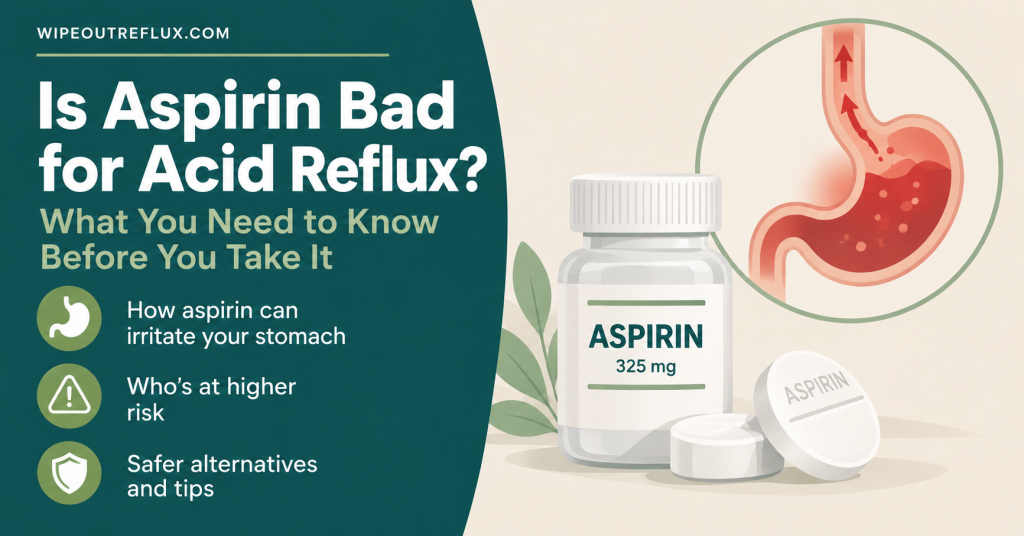
Yes — low-dose aspirin can cause heartburn, reflux and direct damage to the stomach and esophagus, and the “low dose” part doesn’t protect you the way people assume. In a meta-analysis of 35 trials covering 87,581 people, doses between 75 mg and 325 mg a day raised the odds of major gastrointestinal bleeding by 55% [Lanas et al., Clinical Gastroenterology and Hepatology, 2011].
But if you’re taking daily aspirin for cardiovascular reasons, “just stop it” isn’t an option, and that’s the conversation most articles on this topic refuse to have. Do not stop cardiovascular aspirin without speaking to your doctor — stopping abruptly carries a real rebound risk. What follows is what you can actually do about the burning while staying on it.
Short version: switching to enteric-coated almost certainly won’t help and may make your aspirin work less well; taking it with food helps the symptoms but not the damage; and for most people with genuine reflux on daily aspirin, the answer their doctor will reach for is adding acid suppression rather than changing the aspirin.
Key Takeaways
- Low-dose aspirin increased the odds of major gastrointestinal bleeding by 55% across 35 trials — there is no dose that’s free of risk.
- Enteric coating does not reduce gastrointestinal complications. A systematic review of six randomized trials found no additional protection.
- Worse, enteric coating causes erratic absorption: in 400 volunteers, up to 49% appeared aspirin-resistant on enteric-coated aspirin versus 0% on immediate-release.
- Aspirin damages the esophagus directly, not just the stomach — low-dose aspirin has been shown to cause esophageal mucosal injury.
- Taking aspirin with food reduces dyspepsia but doesn’t address the systemic prostaglandin effect that drives mucosal damage.
- PPI co-therapy works: in a 26-week trial, ulcer rates in at-risk aspirin users fell from 7.4% on placebo to 1.1–1.5% on esomeprazole.
- How you swallow the tablet matters — a full glass of water and 30 minutes upright prevents the pill esophagitis that causes a lot of “aspirin burn.”
Why Aspirin Burns: Two Separate Mechanisms
Understanding this is what lets you work out which fix applies to you, because the two mechanisms respond to completely different interventions.
1. The systemic effect — prostaglandin suppression
Aspirin irreversibly blocks cyclooxygenase-1, the enzyme that produces the prostaglandins your stomach lining depends on. Those prostaglandins maintain the mucus and bicarbonate layer, keep mucosal blood flow up, and drive repair. Suppress them and the lining becomes less able to defend itself against the acid that’s always there.
The critical point: this happens through your bloodstream. It does not matter where in your gut the aspirin dissolves. A tablet that dissolves in the small intestine still suppresses prostaglandin production in the stomach lining. This is precisely why the enteric coating idea fails.
2. The topical effect — direct contact injury
Aspirin is a weak acid. In the acidic environment of the stomach it becomes un-ionised, crosses into mucosal cells, and then becomes trapped there as the cell’s neutral pH ionises it. That’s local, concentrated chemical injury at the point of contact.
The same thing can happen higher up. If a tablet sits in the esophagus — because you took it with a small sip, or lay down shortly afterwards — it dissolves against the esophageal lining, which has none of the stomach’s defences. Aspirin is specifically named among the drugs that cause this kind of injury, alongside doxycycline, bisphosphonates and potassium chloride [Saleem and Sharma, StatPearls, 2023].
And this isn’t theoretical for low doses. Low-dose aspirin has been shown to produce esophageal mucosal injury directly, with the injury prevented by acid suppression [Sugimoto et al., The Journal of Clinical Pharmacology, 2010].
If your main symptom is a sharp retrosternal pain or pain on swallowing rather than classic heartburn, the topical esophageal mechanism is the likelier culprit — and that one is largely fixable by how you take the tablet. I’ve covered the acute version of this in pill stuck in throat.
Does Enteric-Coated Aspirin Help? Almost Certainly Not
This is the change most people make first, usually on a pharmacist’s suggestion, and the evidence against it is stronger than most people realize.
A systematic review of six randomized controlled trials covering 15,621 participants concluded that enteric-coated aspirin offers no additional gastrointestinal protection over plain aspirin. Ulcer incidence didn’t differ significantly, and in one large trial gastrointestinal bleeding actually occurred more often in the enteric-coated arm than on placebo [Kedir et al., International Journal of General Medicine, 2021].
That makes mechanistic sense. Coating moves where the tablet dissolves. It doesn’t touch the systemic prostaglandin suppression that does most of the damage.
The part that should worry you more
Enteric coating doesn’t just fail to protect — it interferes with what the aspirin is there to do. In a study of 400 healthy volunteers, variable absorption produced apparent aspirin resistance in up to 49% of people given a single dose of enteric-coated aspirin, versus 0% on immediate-release. Rigorous testing found no one with true pharmacological resistance; the “resistance” was an artefact of delayed and reduced absorption from the coating [Grosser et al., Circulation, 2013].
So the switch many people make for stomach comfort may leave them less protected against the very thing they’re taking aspirin for, while doing nothing for the stomach. If you’re currently on enteric-coated aspirin because of reflux, that’s worth raising with your doctor — not changing on your own.
Does Taking Aspirin With Food Help?
Partly, and it’s worth doing — but be clear about what it buys you.
Taking aspirin with or just after food does two useful things: it dilutes and buffers the tablet so less concentrated aspirin sits against one patch of mucosa, and it makes the tablet far less likely to lodge in the esophagus. Most people find it reduces the immediate burning.
What it doesn’t do is prevent ulcers, because it doesn’t touch the systemic mechanism. Food reduces the topical injury and the symptoms. It doesn’t restore your prostaglandins.
There’s also a trade-off nobody mentions: if you take aspirin at the end of a large meal and then sit down, you’ve combined maximum gastric distension with a tablet that irritates. Better to take it partway through a moderate meal and stay upright afterwards. And don’t lie down on it — see is lying down after eating bad.
How to Take Daily Aspirin Without the Burn
These are the mechanical changes worth making before anyone reaches for another medication:
- Take it with a full glass of water — 200 to 250 mL. Not a sip. The guidance for preventing drug-induced esophagitis is explicit about volume.
- Stay upright for at least 30 minutes afterwards. This alone resolves a lot of “aspirin reflux” that’s really pill esophagitis.
- Never take it last thing at night. Take it at least 30 minutes before lying down, and preferably in the morning or with an early evening meal.
- Take it with food, not on an empty stomach. Partway through a moderate meal is the sweet spot.
- Don’t crush or chew it unless told to. Chewed aspirin is for suspected heart attacks, not daily dosing — chewing concentrates the topical injury.
- Don’t add other NSAIDs on top. Ibuprofen, naproxen and diclofenac stack the same mechanism, and ibuprofen can also blunt aspirin’s antiplatelet effect. Paracetamol is the safer everyday painkiller here. More in does ibuprofen cause acid reflux.
- Watch alcohol. Alcohol and aspirin together increase mucosal injury, and alcohol independently worsens reflux.
When a PPI Gets Added — and Why
If the mechanical fixes aren’t enough and you can’t stop the aspirin, acid suppression is the standard answer, and the evidence behind it is solid.
In the OBERON trial, 2,426 at-risk patients on low-dose aspirin were randomized to esomeprazole or placebo for 26 weeks. Ulcer incidence was 7.4% on placebo versus 1.5% on 40 mg and 1.1% on 20 mg — roughly an 80–85% relative reduction [Scheiman et al., Heart, 2011].
Your doctor is more likely to co-prescribe if you have any of: a history of peptic ulcer or GI bleeding, age over 60–65, concurrent anticoagulants or clopidogrel, concurrent steroids or other NSAIDs, or H. pylori infection. That last one is worth raising specifically — it compounds aspirin’s ulcer risk, and it’s testable and treatable. See H. pylori and acid reflux.
Two honest caveats I’d want you to know:
- PPIs protect the stomach and esophagus, not the small bowel. Aspirin also injures the small intestine, where acid suppression doesn’t reach.
- Coming off a PPI later isn’t trivial. Rebound acid hypersecretion is real, so if a PPI is started, it’s worth agreeing a plan for how long. I’ve written about this in getting off PPIs and acid rebound, and on dosing in the best time of day to take omeprazole.
For occasional breakthrough symptoms rather than continuous protection, an alginate raft taken after the meal is a different tool with a different mechanism — covered in alginates for acid reflux.
What If Your Symptoms Are LPR Rather Than Heartburn?
This catches people out. If your aspirin-related symptoms are throat-based — a persistent throat clear, hoarseness, a lump sensation, a cough that won’t settle — you may not get heartburn at all, and it’s easy to conclude the aspirin isn’t the problem.
Two things are worth knowing. First, aspirin injures the esophageal lining directly, which lowers the threshold for irritation from any reflux that reaches it. Second, the throat symptoms of reflux are driven largely by pepsin rather than acid, and PPIs — the standard answer for aspirin-related gastric problems — are much less reliable for the throat presentation. I’ve explained why in why PPIs don’t work for LPR.
So if you’re on daily aspirin, have throat symptoms, and a PPI hasn’t helped, that combination isn’t a sign that aspirin is innocent. It’s a sign you may be treating the wrong mechanism. The Wipeout Diet Plan works on reducing the reflux events themselves rather than just neutralizing what arrives — which is the useful direction when you can’t remove the drug that’s making your lining vulnerable.
The Other Side of the Coin
It would be dishonest to write this without noting that aspirin’s relationship with the esophagus isn’t purely negative. There’s long-standing interest in aspirin as chemoprevention in Barrett’s oesophagus, and a large randomized factorial trial tested aspirin alongside high-dose esomeprazole in that population [Jankowski et al., The Lancet, 2018].
That’s a specialist question for people under surveillance for Barrett’s, and it doesn’t change anything for ordinary reflux. But it’s the reason your gastroenterologist may be relaxed about aspirin in a context where you’d expect them not to be. Background on the condition is in can silent reflux cause Barrett’s oesophagus.
When to Seek Help Urgently
Aspirin-related GI bleeding can be silent until it isn’t. Contact a doctor promptly, or go to an emergency department, if you have:
- Black, tarry stools, or blood in your stool
- Vomiting blood, or vomit that looks like coffee grounds
- Sudden severe abdominal pain
- Unexplained dizziness, breathlessness or unusual fatigue (possible anaemia from slow blood loss)
- Pain on swallowing that doesn’t settle within a few days
Distinguishing ulcer pain from reflux is covered in stomach ulcer or acid reflux.
Conclusion
If daily aspirin is burning, the useful moves are narrower than the internet suggests. Enteric coating doesn’t protect you and may undercut the drug’s whole purpose. Food helps the symptom, not the damage. What genuinely changes things is taking it properly — full glass of water, upright for half an hour, never at bedtime — and, if that isn’t enough, discussing acid suppression with the doctor who prescribed it. And the thing not to do, under any circumstances, is quietly stop taking it.
What you can control completely is how much reflux is happening in the first place. Aspirin makes your lining more vulnerable to acid and pepsin; it doesn’t generate the reflux events. Reduce the events and the same drug becomes much easier to live with. That’s exactly what the Wipeout Diet Plan is built to do — the complete protocol I developed over twelve years of managing this myself, working on meal composition, timing and the daily mechanics that determine how often your sphincter lets anything through. It was designed around LPR, the throat-based form that’s hardest to treat, but because it targets the same root mechanisms it works just as well for GERD and classic heartburn.
If you’d rather start smaller, the Wipeout Food Reference Guide is the essential companion — the foods and drinks that are safe with acid reflux and LPR, with their pH values, so you can take pressure off a lining that’s already working with one hand tied behind its back.
This article is general information, not medical advice. Never stop or change a prescribed cardiovascular medication without talking to your doctor.
Frequently Asked Questions
Can low-dose aspirin cause acid reflux?
Yes. It suppresses the prostaglandins that protect the stomach and esophageal lining, and it can also injure tissue directly on contact. Low-dose aspirin has been shown to cause esophageal mucosal injury, and the 75–325 mg range raised the odds of major GI bleeding by 55% across 35 trials.
Is enteric-coated aspirin easier on the stomach?
The evidence says no. A systematic review of six randomized trials found no additional GI protection from enteric coating. It also causes erratic absorption — up to 49% of volunteers appeared aspirin-resistant on a single enteric-coated dose versus none on immediate-release.
Should I take aspirin with food?
Yes, it’s worth doing. It reduces direct contact irritation and makes the tablet less likely to lodge in your esophagus. Just don’t expect it to prevent ulcers — food doesn’t affect the systemic prostaglandin suppression that drives the deeper damage.
What time of day should I take aspirin if I get reflux?
Morning, or with an early evening meal — and at least 30 minutes before lying down. Bedtime dosing is the pattern most likely to cause trouble, because the tablet can sit in the esophagus and you lose gravity’s help just as it dissolves.
Can I stop aspirin because of the heartburn?
Not on your own. If it was prescribed for cardiovascular protection, stopping carries a rebound risk of clotting events. Take the symptoms to your doctor — there are several options short of stopping, including adding acid suppression or reviewing whether you still need it.
Does a PPI make aspirin less effective?
Not for aspirin. The interaction debate concerns clopidogrel rather than aspirin, and even there the clinical significance is disputed. In trials, adding esomeprazole to low-dose aspirin cut ulcer rates from 7.4% to around 1% without compromising the aspirin.
Why does aspirin hurt my throat rather than my stomach?
Usually because the tablet is spending time in your esophagus — taken with too little water, or too close to lying down. That’s pill esophagitis, and it typically causes pain behind the breastbone or on swallowing. Take it with a full glass of water and stay upright for 30 minutes.
Research & References
- [Lanas et al., Clinical Gastroenterology and Hepatology, 2011] — Meta-analysis of 35 trials and 87,581 participants found low-dose aspirin (75–325 mg/day) increased the odds of major gastrointestinal bleeding by 55% (OR 1.55) and any GI bleeding by 31% (OR 1.31). Risk rose further when combined with clopidogrel or anticoagulants.
- [Kedir et al., International Journal of General Medicine, 2021] — Systematic review of six randomized trials in 15,621 participants concluding that enteric-coated aspirin provides no additional protection against gastrointestinal complications compared with plain aspirin.
- [Grosser et al., Circulation, 2013] — In 400 healthy volunteers, enteric coating caused variable absorption producing apparent aspirin resistance in up to 49% of subjects, versus 0% with immediate-release aspirin. No case of true pharmacological resistance was identified.
- [Sugimoto et al., The Journal of Clinical Pharmacology, 2010] — Demonstrated esophageal mucosal injury caused by low-dose aspirin, and its prevention with the proton pump inhibitor rabeprazole.
- [Scheiman et al., Heart, 2011] — The OBERON trial randomized 2,426 at-risk low-dose aspirin users; over 26 weeks peptic ulcer incidence was 7.4% on placebo versus 1.5% on esomeprazole 40 mg and 1.1% on 20 mg.
- [Saleem and Sharma, StatPearls, 2023] — Reviews drug-induced esophagitis, naming aspirin among the causative drugs and recommending 200–250 mL of water with the tablet, remaining upright for at least 30 minutes, and dosing at least 30 minutes before lying down.
- [Jankowski et al., The Lancet, 2018] — The AspECT randomized factorial trial tested aspirin and high-dose esomeprazole as chemoprevention in patients with Barrett’s oesophagus.

David Gray
12 years living with LPR · Consultant & researcher
I've lived with LPR for twelve years — the misdiagnoses, the PPI courses that did nothing, the slow work of figuring out what actually helps. Wipeout Reflux is where I translate the research into plain terms for people stuck in the same place. Every claim here is sourced to peer-reviewed work, and I consult one-to-one with LPR sufferers.