
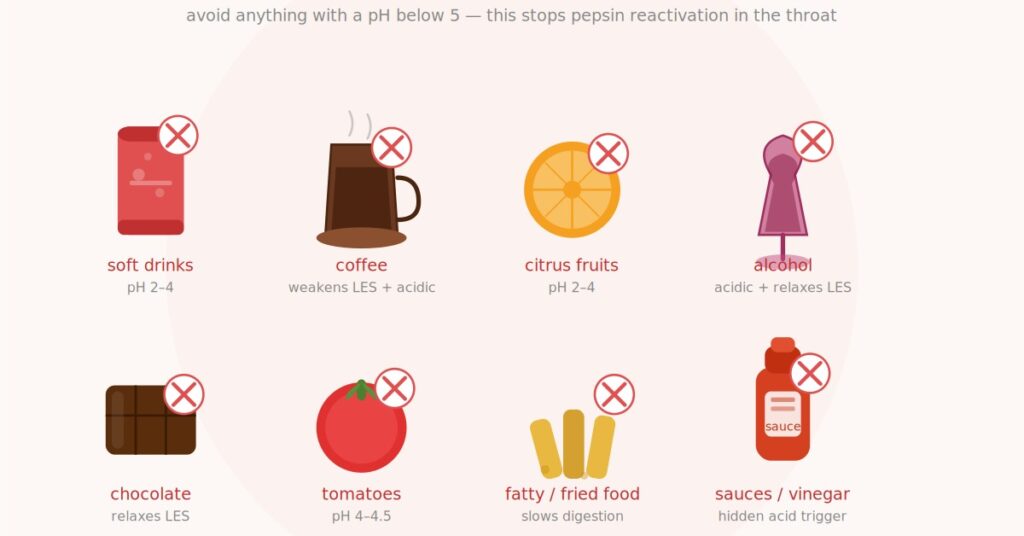
If you have LPR (silent reflux) the foods and drinks you’re consuming every day are almost certainly making your symptoms worse — and in some cases are the primary reason you’re not getting better. I’ve seen this so many times with people who come to me for consultations. They’ve made some changes, cut out the obvious things, but they’re still struggling because there are foods on this list they didn’t realise were a problem.
This guide covers everything you need to avoid, the reason why each one is problematic for LPR specifically, and what to eat instead. I’ll also cover the less obvious ones that most people miss — the ones that catch people out even when they think they’re eating well.
Key Takeaways:
- The golden rule for LPR is to avoid foods and drinks with a pH below 5 — this prevents pepsin reactivation in the throat
- Soft drinks, alcohol, coffee and citrus are the biggest offenders and need to be cut completely during the healing phase
- Fatty foods, chocolate and mint weaken the lower oesophageal sphincter (LES) and increase reflux frequency — even if they’re not acidic
- Many condiments, dressings and sauces are acidic enough to trigger symptoms even in small amounts
- A prospective study by Koufman (2011) found 95% of LPR patients improved on a strict low acid diet — including those who had failed PPI treatment
- A 2023 clinical study confirmed that LPR patients who switched to low-reflux-potential foods saw significant symptom reduction and improved quality of life
Why the Foods You Eat Matter So Much for LPR
Before getting into the list it’s worth quickly explaining why food matters so much for LPR specifically — because it’s different from regular acid reflux and GERD, and understanding the reason makes it easier to stick to the diet.
When you have LPR, a digestive enzyme called pepsin travels up from your stomach into your throat during reflux episodes. Once it’s there it can sit dormant in your throat cells for 24 to 48 hours. The problem is that anything acidic — anything with a pH of 5 or below — reactivates that pepsin and triggers your symptoms again, even if you haven’t refluxed. This is why LPR can feel so unpredictable. You might not have refluxed, but you had a coffee or an orange juice and the dormant pepsin flared up.
This is also why simply taking PPIs doesn’t work for most LPR patients. The pepsin is already in your throat and PPIs don’t touch it. The diet is what breaks the cycle. You can read more about this in my complete LPR guide.

The chart above shows how pepsin activity increases as pH drops below 5. Keep everything above pH 5 and you dramatically reduce the reactivation cycle that’s keeping you symptomatic. The obvious question is how you know where any given food sits. That’s what the Wipeout Reflux Food Reference Guide is for — foods and drinks listed with their pH and a rating for how safe each one actually is with reflux, so you can check anything that isn’t on the list below.
LPR Foods to Avoid — The Complete List
#1 Soft Drinks and Carbonated Drinks
Soft drinks are the worst thing you can consume with LPR — full stop. Most carbonated drinks have a pH of between 2 and 4 which makes them as acidic as stomach acid itself. Even diet versions are just as acidic. Every sip is directly reactivating pepsin in your throat.
This includes cola, lemonade, sparkling water, energy drinks, sports drinks and anything else carbonated. The carbonation itself is also a problem — the bubbles increase stomach pressure and trigger reflux independently of the acidity.
Sparkling water is something a lot of people don’t realise is a problem. It feels harmless but the CO2 creates carbonic acid which drops the pH significantly. Plain still water is fine — sparkling is not.
#2 Alcohol
Alcohol needs to go, at least during the healing phase. It’s problematic for LPR for two reasons. First, most alcoholic drinks are highly acidic — wine, beer and cider all sit well below pH 5. Second, alcohol directly relaxes the lower oesophageal sphincter (LES) — the valve above the stomach — which makes reflux much more likely regardless of what else you’re eating.
A 2023 clinical study confirmed that LPR patients consumed significantly more alcohol than healthy controls and that cutting alcohol alongside other dietary changes significantly reduced symptoms and improved quality of life.
Some spirits like certain vodkas and gins are less acidic than wine or beer, which I cover in more depth in the Wipeout Diet Plan. But during the initial healing phase it’s best to cut alcohol entirely.
#3 Coffee and Caffeinated Drinks
Coffee is one that people find really hard to give up and I completely understand that — I felt the same way. But it’s important for LPR for a couple of reasons. Coffee is acidic — typically pH 4 to 5 — which puts it right in the danger zone for pepsin reactivation. It also contains caffeine which weakens the LES in the same way alcohol does, making reflux more likely.
This applies to regular and decaffeinated coffee. Even decaf is acidic enough to cause problems. It also applies to caffeinated teas like black tea and strong green tea. Chamomile tea is a great alternative — it’s naturally alkaline and anti-inflammatory, and I personally drank it throughout my recovery. For more on drink choices check my article on what you can drink with acid reflux.
#4 Citrus Fruits and Juices
Citrus fruits are among the most acidic foods you can eat — oranges, lemons, limes and grapefruit all have a pH of between 2 and 4. They need to be avoided completely. This includes fresh fruit, juices, smoothies with citrus in them, and any foods or dressings that use citrus as an ingredient.
Orange juice in particular is something a lot of people have in the morning thinking it’s healthy — but for someone with LPR it’s an extremely acidic start to the day that reactivates pepsin right from the off.
The good news is there are plenty of fruits you can still enjoy — bananas, melon, watermelon, pear and papaya are all fine. For more on fruit check my article on LPR foods to eat.
#5 Fatty and Fried Foods
High-fat foods are a problem for LPR for a specific reason — they slow down gastric emptying. When food sits in your stomach for longer it creates more opportunity for reflux to occur, and puts more pressure on the LES over a sustained period. Fatty foods also trigger the release of cholecystokinin, a hormone that further relaxes the LES.
This means avoiding things like deep-fried food, fast food, fatty cuts of meat, full-fat dairy, cream-based sauces and anything heavily oiled. The Lechien et al. cross-over study (2022) specifically identified a low-fat diet as one of the most effective dietary interventions for LPR — and this is the reason why.
It’s also part of why a Mediterranean diet for acid reflux, naturally lower in saturated fat, works well for LPR.
#6 Tomatoes and Tomato-Based Products
Tomatoes are highly acidic — typically pH 4 to 4.5. This includes raw tomatoes, tinned tomatoes, tomato sauce, ketchup, salsa, pizza sauce and anything else tomato-based. These are things that turn up in a huge number of everyday meals which is why a lot of people find their LPR is hard to manage without realising tomatoes are a constant hidden trigger.
Cooked tomatoes are slightly less acidic than raw but not enough to make them safe for LPR. Avoid all forms during the healing phase.
#7 Chocolate
Chocolate is one that surprises people because it doesn’t taste particularly acidic. The main problem with chocolate isn’t its acidity — it’s a substance called methylxanthine that it contains. Methylxanthine causes muscle relaxation throughout the body, including the LES. When the LES relaxes it doesn’t close properly and acid and pepsin can escape upward much more easily.
Dark chocolate is marginally better than milk chocolate because it has less sugar and dairy, but it still contains methylxanthine. For most people with LPR it’s best to avoid all chocolate during the healing phase. You can read more about the LES and its role in LPR here.
#8 Spicy Food
Spicy food irritates already inflamed and damaged throat tissue directly. The capsaicin in chilli and spicy ingredients stimulates the oesophagus and throat in a way that worsens symptoms significantly, particularly for people who are in the early stages of recovery. It also increases the production of stomach acid.
This includes chilli, hot sauces, cayenne pepper, black pepper in significant amounts, and any strongly spiced dish. There are plenty of other flavours and seasonings you can use — ginger, cumin, fennel, coriander and fresh herbs are all fine.
If you’re short of ideas for cooking without the heat, the best acid reflux cookbooks are a good place to start.
#9 Raw Onions and Garlic
Raw onions and garlic are both highly acidic and irritating to the throat. They’re also known to weaken the LES. Raw onion in particular seems to be a significant trigger for a lot of people with reflux — even a small amount in a salad or sandwich can cause a noticeable flare.
The important distinction here is raw vs cooked. Cooked sweet onion is generally fine and is a good way to get some onion flavour without the reflux risk. Cooked garlic in small amounts is also usually tolerated much better than raw garlic. So you don’t have to give these up entirely — just avoid them raw.
Onion and garlic are also two of the highest-FODMAP foods there are, which is why some people do better on a low FODMAP diet for acid reflux.
#10 Mint and Peppermint
Mint is another one that catches people out. Like chocolate, mint — specifically the menthol it contains — relaxes the LES which allows reflux to occur more easily. This includes peppermint tea, spearmint tea, fresh mint, mint-flavoured products and even some chewing gums.
If you want a hot drink, chamomile or marshmallow root are much better alternatives. For more check my article on chamomile tea and acid reflux.
#11 Processed Foods
Processed foods are generally problematic for LPR for two reasons — they tend to be high in fat which slows digestion, and they contain preservatives and additives that increase the acidity of the food. Things like ready meals, packaged snacks, cured meats, processed cheese and fast food all fall into this category.
Eating whole, unprocessed food wherever possible is one of the simplest changes you can make and it makes a real difference. A study by Zalvan et al. (JAMA, 2017) found a plant-based whole-food diet outperformed PPIs for LPR symptom reduction — and moving away from processed food is a big part of why that works.
Foods That Are Less Obvious — The Ones That Catch People Out
These are the foods and drinks that people commonly miss even when they think they’re following an LPR-friendly diet. If you’re doing everything right and still not improving, check this list carefully.
Condiments, Dressings and Sauces
Most condiments are highly acidic. Vinegar is one of the worst things you can consume with LPR — not just because of its acidity but because it passes directly over the throat. Ketchup, mustard, mayonnaise, most salad dressings, soy sauce, Worcester sauce and hot sauces all typically contain vinegar or are made from a tomato or citrus base. Check every label and avoid anything that lists vinegar or citrus as an ingredient.
Vinegar
Worth calling out separately because it turns up in so many unexpected places — pickled foods, some breads, most shop-bought dressings, many crisps and snacks, certain health foods and even some drinks marketed as healthy. Apple cider vinegar in particular is promoted as a health product and some people with reflux try it thinking it will help. It won’t — it’s highly acidic and will directly reactivate pepsin in the throat.
Fruit Juices and Smoothies
Even when made from “good” fruits, most fruit juices and smoothies are acidic enough to cause problems. Apple juice, grape juice, cranberry juice and most commercial smoothies all sit below pH 5. Blending acidic fruits doesn’t make them less acidic — it just makes them easier to drink in quantity. If you want to have smoothies, build them around banana, melon or mango with almond milk as a base — this keeps the pH in a safe range.
Most Fizzy Water and Flavoured Water
As mentioned earlier, sparkling water creates carbonic acid and drops the pH. Flavoured waters — including many marketed as “healthy” — often contain citric acid as a preservative which makes them acidic. Always check the label and stick to still plain water as your default. Alkaline water with a pH of 8 or above is even better — check my article on alkaline water for LPR.
Certain Herbal Teas
Not all herbal teas are LPR-friendly. Peppermint tea and spearmint tea relax the LES. Hibiscus tea is highly acidic (pH around 3). Rosehip tea is also acidic. Stick to chamomile, marshmallow root, ginger or liquorice root tea.
Bought Bread and Baked Goods
Many commercial breads, pastries and baked goods contain vinegar, citric acid or other preservatives that bump up acidity. Plain oat-based products, homemade bread and plain crackers are generally fine. Check the ingredients of anything packaged.
What About the Wipeout Diet Plan?
If you want a complete structured approach that takes all the guesswork out of the food side — exactly what to eat, what to avoid, what to drink, pH guidance for specific foods and a meal structure you can actually follow — check the Wipeout Diet Plan. I created it specifically for people with LPR and GERD based on the same approach that healed me, and it goes into far more detail than any article can.
And if you want tailored advice on your specific situation — particularly if you’ve been following the diet and still not improving — a private consultation is the most direct way to figure out what’s going on and what needs to change.
Frequently Asked Questions
What is the worst food for LPR?
Soft drinks and carbonated beverages are probably the worst — most have a pH of 2 to 4 which makes them extremely acidic and directly reactivates pepsin in the throat. Coffee, citrus juice and alcohol are close behind. If you do nothing else, cutting these four things will make a noticeable difference.
Can I ever eat these foods again?
For most people, yes — once you’ve fully healed you can reintroduce some foods in moderation and find your personal threshold. The strict avoidance list is primarily for the healing phase, which typically takes 2 to 6 months. Long term most people need to keep obvious triggers like soft drinks and alcohol in check but can tolerate a wider range of food than the acute-phase diet requires.
Does eating acidic food cause LPR?
Acidic food doesn’t cause LPR in the first place — but it significantly worsens symptoms if you already have it, by reactivating dormant pepsin in the throat. The cause of LPR is reflux — typically from a weakened lower oesophageal sphincter. The diet controls the symptomatic cycle rather than addressing the mechanical cause of reflux. That’s why diet works best combined with Gaviscon Advance and lifestyle changes rather than alone.
Is fruit bad for LPR?
Most fruits are too acidic for LPR — particularly citrus fruits, berries, apples, pineapple and grapes. The safe fruits are banana, melon (cantaloupe and honeydew), watermelon, pear and papaya. Berries can be made safer by blending them with almond milk which neutralises some of their acidity. For more on this check my article on LPR foods to eat.
Is coffee really that bad for LPR?
Yes — for most people with LPR, coffee is one of the worst things to keep in the diet. It’s acidic (pH 4 to 5), it weakens the LES through its caffeine content, and it directly irritates inflamed throat tissue. Decaf is slightly better but still acidic enough to cause problems. Chamomile tea is the best replacement during the healing phase.
Why is the pH threshold 5 specifically?
Research — particularly Koufman’s 2011 study — established that human pepsin remains significantly active up to a pH of around 6.5 but is most potently reactivated by pH below 5. Avoiding foods and drinks below pH 5 dramatically reduces reactivation without making the diet impossible to follow. Some people go stricter — avoiding anything below pH 6 — but pH 5 is the generally accepted clinical threshold.
Conclusion
The foods you avoid are just as important as the foods you eat when it comes to recovering from LPR. The key things to cut are soft drinks, alcohol, coffee, citrus, fatty foods, tomatoes, chocolate, spicy food, mint and raw onions — and to watch out for the hidden offenders like condiments, vinegar and flavoured waters that people commonly miss.
Get these right consistently for 6 to 8 weeks alongside Gaviscon Advance and the lifestyle changes and you’ll give your throat the best possible chance to heal properly. For the complete diet approach check my LPR diet guide and the Wipeout Diet Plan.
Related articles:
- LPR Diet — What to Eat, What to Avoid and What to Drink
- LPR Foods to Eat — The Best Choices
- What Can You Drink with Acid Reflux
- Silent Reflux Treatment — What Actually Works
- The Complete Guide to LPR
- Alkaline Water for LPR
- Gaviscon Advance for LPR
- Chamomile Tea and Acid Reflux
- Natural Remedies for LPR
- How I Cured My Silent Reflux
References
- Koufman JA. (2011) “Low-acid diet for recalcitrant laryngopharyngeal reflux: therapeutic benefits and their implications.” Annals of Otology, Rhinology and Laryngology, 120(5):281-287. PubMed
- Lechien JR et al. (2022) “Is Diet Sufficient as Laryngopharyngeal Reflux Treatment?” The Laryngoscope, 132:1916-1923. PubMed
- Zalvan CH et al. (2017) “A Comparison of Alkaline Water and Mediterranean Diet vs Proton Pump Inhibition for Treatment of Laryngopharyngeal Reflux.” JAMA Otolaryngology-Head and Neck Surgery, 143(10):1023-1029. PMC
- Kowalik K et al. (2023) “The Impact of Nutrition on the Onset, Course of Disease and Quality of Life of Patients with Laryngopharyngeal Reflux.” Journal of Clinical Medicine. PMC
- Gelardi M et al. (2025) “Efficacy of dietary modifications and mucosal protectors in the treatment of laryngopharyngeal reflux: a multicenter study.” Frontiers in Medicine, 12:1488323. PMC
- Lechien JR et al. (2024) “The Dubai definition and diagnostic criteria of laryngopharyngeal reflux: the IFOS consensus.” The Laryngoscope, 134(4):1614-1624. PubMed

David Gray
12 years living with LPR · Consultant & researcher
I've lived with LPR for twelve years — the misdiagnoses, the PPI courses that did nothing, the slow work of figuring out what actually helps. Wipeout Reflux is where I translate the research into plain terms for people stuck in the same place. Every claim here is sourced to peer-reviewed work, and I consult one-to-one with LPR sufferers.
After having broncitis for 2 months and horrible cough that I Had another month I ended up with LPR. I take prilosec every day for IBS which I have had for years. I am aware of the foods that cause GERD and have been able to control my acid reflux but I am having a hard time controling my LPR. Are the rules for each disease different or the same. I get painful swelling in my neck limpnodes when my LPR is bothering me is this normal?
Not really the same though there is some overlap between the 2 problems. Like certain things may trigger LPR or worsen it than will not affect GERD at all. Yeah it is normal to affect the lymp nodes, there is no research on that but I have experienced it myself and others with LPR so I believe that’s the correlation.
I eat blueberries everyday in my oatmeal made with coconut milk and am a pescatarian. I usually treat myself to a couple of pieces of dark chocolate daily and one or two cups of decaf coffee. I don’t eat gluten or soy, only eat pistachios and pecans. So no berries, citrus, garlic, decaf coffee, no salad dressing, no tomatoes, no garlic. I feel a little defeated.
Haven’t officially been diagnosed, still in the testing phase, although it was mentioned after examination of my voice box, throat, post nasal drip etc… ugh…
Yeah there a quite of few things you are doing which might worsen your acid reflux. Even though your diet it quite good there may need to be some more adjusments for healing. Email me at David@wipeoutreflux.com for more information.
Do you think that smoking marijuana can be making the LPR worse? If so, can you explain why that would be. I was also wondering if having a viral and or bacterial infection of the lower/upper respiratory tract induce LPR?
Yes it can make it worse because smoking in carinogenic. It’s not natural and will prevent healing and likely make things worse. I have heard stories similar to that yes so I would say it could possibily induce it.
I was diagnosed with LPR, Barrett’s Esophagus, GERD, and BMS. I also have Oral Lichen Planus. The burning mouth/tongue and oral swelling are absolute misery. I’ve been to ~15 doctors/specialists, and have taken all sorts of drugs and nothing helps. This is affecting my ability to work and my overall quality of life. Help.
I’d need to know more details to be able to help you better. Send me an email or consider booking a consultation with me.
It has been recently suggested by a new E N T that the scarring in my throat and symptoms are the result of LPR.
I am in my early 70’s.
I love spicy foods; so this will become a big lifestyle change.
My question is whether my vocal chords are permanently damaged?
My singing range has changed from soprano to low alto and I have started using this lower range . Can I get my normal range back, or is this permanent?
Thank you.
It’s hard to say without actually seeing your vocal cords but from my knowledge when you are treating the condition properly you should see an improvement and I’d imagine that your vocal cords will start to feel better and likely back to normal once you have the right treatment regime.
I find it interesting that your voice went from high to low. I experience the opposite; my voice has gone from low to high. Most of the time it sounds like i am stressed. My voice is high, tight, and hoarse. I’m waiting for my ENT appointment and have maybe another 8 more weeks.
That actually makes a lot of sense, and it’s very common with LPR.
A “high, tight, stressed” sounding voice is usually caused by **laryngeal irritation + muscle tension**. When the vocal cords and surrounding tissue are inflamed (often from reflux), your body compensates by tightening the throat muscles to protect the area, which pushes the voice higher and makes it sound strained/hoarse.
While you wait for ENT, the best things you can do are: **avoid throat clearing**, stay well hydrated, reduce acidic/fatty trigger foods, don’t eat late at night, and consider using something like **Gaviscon Advance after meals and before bed**. Most importantly, don’t panic — this is a classic LPR pattern and often improves once the inflammation settles down.
With LPR, do you have to stay on this diet forever? or is it just until symptoms resolve and then you can go back to eating the trigger foods again?
It depends on each person. For some they will have to be more strict to the diet whereas for others they might be able to return to a normal diet again.
Hi David,
Just diagnoses with LRP and my throat really hurts. Can I take aspirin, Tylenol or Advil or will they make it worse?
If yes, what can I take for this horrible sore throat!!
Hi Kelly,
If you want to take painkillers I would suggest paracetamol because it’s more gentle on the stomach than most other painkillers.
I have tried ground cloves crushed and boiled in water and also clove powder in water and they seem to soothe my throat very much. Would it be OK to drink these regular? Has anyone else found cloves to be soothing?
So cloves should be fine to take. Just make sure it’s just cloves and nothing else added. I imagine it should be fine to take regularly if you don’t notice any negative effect after taking it.
Hello David,
Thank you for the info.
I have had LPR for a number of years. Right now I’m in a bad flareup. Just wondering — is the Wipeout Diet much different than the Acid Watcher Diet? I tried the AWD, but it was hard to do because I have an egg allergy and a number of the meals included eggs.
Thanks
T
Hi Laura,
As you might expect there is some overlap to the diets as would be expected with any acid reflux diet. I think the devils in the details and that’s why I have focused on the smaller details that some other diet plans don’t cover. Most of the meals plans included do not use eggs so I imagine it should be easy to follow for yourself.
Does graviscon advance help with lpr?
Yes it should help.