
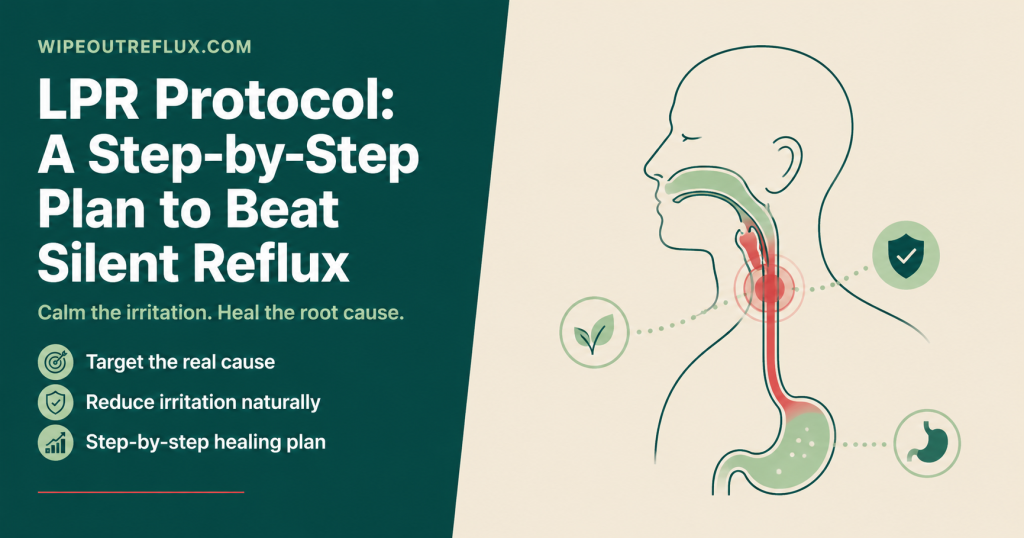
An LPR protocol is a structured, step-by-step plan for calming laryngopharyngeal reflux (silent reflux) — the type of reflux where stomach contents travel all the way up to your throat and voice box instead of causing classic heartburn. Because LPR is driven largely by pepsin reaching your throat rather than acid burning your chest, the goal isn’t just suppressing acid. It’s reducing reflux events, neutralising pepsin, protecting your throat lining, and giving inflamed tissue time to heal.
After more than eight years living with LPR myself, I’ve learned that the people who recover fastest aren’t the ones chasing a single miracle fix. They’re the ones who follow a consistent daily routine that stacks several small changes together. That’s what a protocol is: a repeatable system rather than a scattered list of tips.
The protocol below is built around four pillars — diet, timing and lifestyle, throat protection, and healing support. It’s the same framework I return to whenever my symptoms flare, and it’s grounded in the strongest LPR research available.
Key Takeaways
- LPR is driven by pepsin reaching the throat, so an effective protocol targets reflux events and pepsin — not just stomach acid.
- A strict low-acid diet is the single most powerful intervention, improving symptoms in the large majority of patients in clinical studies.
- Meal timing matters enormously: finishing eating at least 3 hours before lying down dramatically reduces night-time reflux.
- Alginate therapy (like Gaviscon Advance) forms a physical raft that blocks reflux and has real clinical evidence in LPR.
- Recovery is slow — the throat lining often needs 2 to 6 months of consistency before symptoms settle fully.
- The protocol works best when the steps are followed together, daily, rather than picked individually.
Why LPR Needs Its Own Protocol (It’s Not Just Heartburn)
Most standard reflux advice is written for GERD — the burning-chest, acid-in-the-oesophagus version. LPR is different, and treating it like GERD is exactly why so many people stay stuck for years.
The key difference is pepsin. Pepsin is a digestive enzyme that hitches a ride up with reflux and deposits itself on the delicate tissue of your throat and larynx. Here’s the critical part: pepsin was once thought to be inactive above pH 4, but human pepsin has been shown to remain active up to around pH 6.5, and laryngeal biopsies from LPR patients contain tissue-bound pepsin [Koufman, Annals of Otology, Rhinology & Laryngology, 2011]. That means every time you eat something acidic, you can effectively “reactivate” pepsin that’s already sitting in your throat.
This is why acid-suppressing drugs alone so often disappoint in LPR. Several randomised trials of proton pump inhibitors have shown little benefit over placebo for LPR-type throat symptoms. A protocol built around pepsin — reducing reflux, avoiding acidic triggers, and physically protecting the throat — addresses the actual mechanism. If you want the full breakdown of how the two conditions differ, my guide on GERD vs LPR covers it in detail.
The LPR Protocol: 4 Core Pillars
Here’s the framework. Work through all four pillars rather than treating them as a menu — they reinforce each other.
Pillar 1: Adopt a Strict Low-Acid Diet
This is the foundation, and the evidence behind it is genuinely strong. In Dr Jamie Koufman’s prospective study, a strict low-acid diet improved symptoms in the large majority of patients with stubborn, PPI-resistant LPR [Koufman, Annals of Otology, Rhinology & Laryngology, 2011]. A later cross-over study confirmed that a low-fat, alkaline, high-protein diet worked as an effective standalone treatment for LPR [Lechien et al., The Laryngoscope, 2022].
The core principles are simple:
- Avoid acidic foods and drinks (below roughly pH 5) — citrus, tomatoes, vinegar, sodas, and fruit juices are the big offenders.
- Cut fatty and fried foods, which relax the valve between your stomach and oesophagus and slow stomach emptying.
- Reduce carbonation, caffeine, alcohol, chocolate, and mint — all common LPR aggravators.
- Lean into low-acid, whole foods — oats, bananas, melon, most vegetables, lean proteins, and non-citrus, non-tomato options.
For the specifics, my lists of LPR foods to avoid and LPR foods to eat give you a full working list to build meals around.
Pillar 2: Fix Your Meal Timing and Lifestyle
What you eat matters, but when you eat can matter just as much for silent reflux — especially the throat symptoms that show up overnight or first thing in the morning.
- Stop eating 3–4 hours before bed. Lying down with food still in your stomach is one of the fastest routes to night-time reflux reaching your throat.
- Elevate the head of your bed by 6–8 inches (raise the frame, don’t just stack pillows, which bends you at the waist and can make things worse).
- Eat smaller, more frequent meals. Large meals distend the stomach and push contents upward.
- Avoid tight waistbands and don’t lie down or exercise hard right after eating.
Night-time reflux is such a common driver of morning hoarseness and throat-clearing that I’ve written a dedicated guide on the best sleeping position for silent reflux if this is your main problem area.
Pillar 3: Protect Your Throat With Alginate Therapy
This is the step most people miss, and it’s one of the most useful. Alginate products — Gaviscon Advance being the best-known in the UK — form a gel raft that floats on top of your stomach contents, physically blocking reflux and helping keep pepsin away from your throat.
Unlike PPIs, this has solid LPR-specific evidence. In a randomised controlled trial, patients taking liquid alginate suspension (Gaviscon Advance) showed significant improvement in both symptom scores and clinical findings compared to controls [McGlashan et al., European Archives of Oto-Rhino-Laryngology, 2009]. The typical approach is 10ml after each meal and again at bedtime — the bedtime dose being especially important for overnight protection.
I’ve covered exactly how to use it, and why the “Advance” formulation matters for LPR specifically, in my Gaviscon Advance guide.
Pillar 4: Support Healing and Neutralise Pepsin
Once you’ve reduced reflux and protected the throat, the final pillar is giving inflamed tissue the conditions to heal. This is where slightly alkaline water and soothing agents come in.
Alkaline water (around pH 8.8) has been shown in lab research to irreversibly deactivate human pepsin, which is the rationale for sipping it between meals to help clear residual pepsin from the throat. It’s a low-risk, easy addition — I explain the mechanism in my piece on how to neutralise pepsin in the throat.
Beyond that, staying well hydrated, avoiding throat irritants like smoke, and being patient with the timeline all matter. If you want gentle, natural options to layer in, my guide to natural remedies for LPR walks through the ones with the best evidence.
Putting It Together: A Sample Daily Protocol
Here’s what a typical day looks like when you stack all four pillars:
- Morning: Low-acid breakfast (oats with banana and almond milk). Sip alkaline water between meals, not with food.
- After each meal: 10ml Gaviscon Advance. Stay upright — no lying down or slumping on the sofa.
- Throughout the day: Smaller low-acid meals, no acidic drinks, no snacking late.
- Evening: Finish your last meal 3–4 hours before bed.
- Bedtime: Final 10ml dose of Gaviscon Advance, sleep on an elevated bed frame, ideally on your left side.
Consistency is everything. LPR tissue heals slowly, and a good week followed by an acidic weekend can undo real progress.
How Long Does an LPR Protocol Take to Work?
This is the question I get asked most, and the honest answer is: longer than you’d like. Some people notice reduced throat-clearing or globus sensation within a couple of weeks, but full symptom resolution commonly takes 2 to 6 months of consistent effort. A 2025 prospective study found that diet and lifestyle changes alone significantly reduced LPR symptoms and clinical findings over a 6–12 week window [Lechien et al., Journal of Voice, 2025].
The reason is simple: the throat lining is delicate, and repeated pepsin exposure over months or years takes time to reverse. If your symptoms have been building for a while, plan for a marathon, not a sprint. My article on acid reflux sore throat healing time sets realistic expectations for tissue recovery.
Frequently Asked Questions
Can I follow an LPR protocol without medication?
Yes — and for many people, diet and lifestyle changes plus alginate therapy are enough on their own. Research has shown a low-acid, high-protein diet can work as a standalone LPR treatment. That said, if you’re on a PPI, don’t stop abruptly, as this can cause acid rebound. Taper carefully and ideally with medical guidance — my guide on getting off PPIs and acid rebound explains how.
What’s the single most important step in the protocol?
If I had to pick one, it’s the strict low-acid diet combined with the 3-hour no-food-before-bed rule. Those two changes address the largest share of pepsin exposure — the diet reduces daytime triggers, and the timing rule prevents the overnight reflux that damages your throat while you sleep.
Do I need alkaline water for LPR to improve?
It’s helpful but not essential. Alkaline water helps deactivate pepsin and is very low-risk, but the diet, timing, and alginate pillars do the heavy lifting. Think of alkaline water as a useful supporting player rather than the star.
Why isn’t my acid reflux medication working for my throat symptoms?
Because PPIs reduce acid but don’t address pepsin or the physical reflux events reaching your throat — the two main drivers of LPR. This is extremely common and doesn’t mean something is wrong with you. I cover the reasons in detail in why acid reflux medication isn’t working.
Can silent reflux come back after the protocol works?
It can, especially if you drift back to old eating habits. Most people find they can gradually loosen the strictness once symptoms settle, but a core of good habits — sensible meal timing, limiting the worst trigger foods, not eating late — is worth keeping permanently to prevent relapse.
Conclusion
An LPR protocol works because it treats silent reflux for what it actually is — a pepsin problem, not just an acid problem. By stacking a strict low-acid diet, smart meal timing, alginate throat protection, and healing support, you address every stage of the process that lets reflux reach and irritate your throat. None of these steps is dramatic on its own, but together, followed consistently, they’re what turns months of frustrating symptoms into genuine recovery.
The hardest part isn’t understanding the protocol — it’s doing it consistently, day after day, especially the diet. That’s exactly why I created the Wipeout Diet Plan. It takes the guesswork out of the low-acid diet with a structured, done-for-you eating plan built specifically around LPR recovery, so you’re never left wondering whether a food is safe. It’s the natural next step if you want to put the most important pillar of this protocol on autopilot.
To make daily food choices even easier, the Wipeout Food Reference Guide is an essential companion — it lists the foods and drinks that are safe for acid reflux and LPR along with their pH values, so you can check anything at a glance. Think of the Food Reference Guide as your quick daily lookup, and the Wipeout Diet Plan as the deeper, more complete roadmap to actually getting better. Follow the protocol, be patient with the timeline, and give your throat the consistency it needs to heal.
Research and References
- [Koufman, Annals of Otology, Rhinology & Laryngology, 2011] — A strict low-acid diet improved symptoms in the large majority of patients with PPI-resistant LPR, and confirmed human pepsin remains active up to pH 6.5.
- [Lechien et al., The Laryngoscope, 2022] — A cross-over study showing a low-fat, alkaline, high-protein diet is an effective standalone treatment for LPR.
- [McGlashan et al., European Archives of Oto-Rhino-Laryngology, 2009] — A randomised controlled trial demonstrating liquid alginate suspension (Gaviscon Advance) significantly improved LPR symptom and clinical scores versus control.
- [Lechien et al., Journal of Voice, 2025] — A prospective study finding diet and lifestyle changes alone significantly reduced LPR symptoms and findings over 6–12 weeks.

David Gray
12 years living with LPR · Consultant & researcher
I've lived with LPR for twelve years — the misdiagnoses, the PPI courses that did nothing, the slow work of figuring out what actually helps. Wipeout Reflux is where I translate the research into plain terms for people stuck in the same place. Every claim here is sourced to peer-reviewed work, and I consult one-to-one with LPR sufferers.