
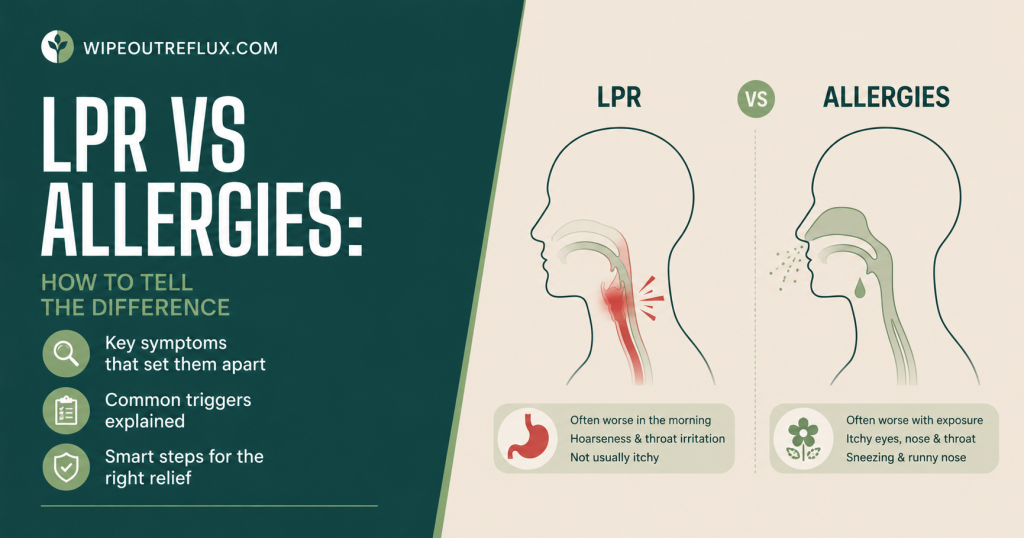
If you’ve got a constant post-nasal drip, a throat you keep clearing, and a nagging cough, it’s easy to blame allergies — and easy to be wrong. Silent reflux (LPR) produces almost the exact same throat and nasal symptoms, which is why so many people spend months on antihistamines and nasal sprays that never quite work. The two conditions overlap heavily, and to make it trickier, they often show up together.
The short version: allergies tend to come with itching, sneezing, and watery eyes and follow a seasonal or trigger-based pattern, while LPR tends to bring hoarseness and a lump-in-the-throat feeling, flares after meals and when lying down, and doesn’t budge with allergy medication. Below is how to actually tell them apart — and why it’s worth getting right, since researchers have shown that assuming throat symptoms are one when they’re really the other leads to a lot of mistreatment.
Key Takeaways
- LPR (silent reflux) and allergies share many symptoms: post-nasal drip, throat clearing, cough, congestion, and a lump-in-the-throat feeling.
- Allergy-specific clues are itching, sneezing, watery/itchy eyes, and a clear seasonal or trigger pattern.
- LPR-specific clues are hoarseness, a globus (lump) sensation, symptoms worse after meals and when lying down, and often worse in the morning.
- Allergies usually respond to antihistamines and nasal steroids; LPR does not — a lack of response is a strong hint it’s reflux.
- The two frequently coexist, so having one doesn’t rule out the other — and that overlap is exactly why single treatments often fail.
- Getting the diagnosis right matters: relying on throat findings alone, without considering allergies, leads to overdiagnosis of LPR.
- Persistent throat or nasal symptoms deserve a proper assessment rather than months of guesswork.
Why LPR and Allergies Get Confused
The confusion isn’t your fault — the symptoms genuinely overlap, because both conditions irritate the same stretch of your upper airway.
With allergies, an allergen inflames the lining of your nose, which swells, runs, and drips mucus down the back of your throat. With silent reflux (LPR), stomach acid and pepsin travel up past the throat and irritate the same tissues from below. Both leave you with a dripping, tickly, irritated throat that you clear constantly — and neither necessarily comes with the obvious signature you’d expect (heartburn for reflux, a runny nose for allergies). In fact, post-nasal drip is one of the most consistent LPR symptoms, and one of the most frequently misattributed to allergies.
Studies confirm the tangle. Throat clearing and the globus (lump-in-throat) sensation are among the most common symptoms shared by both conditions, and people with LPR symptoms are markedly more likely to also have allergic rhinitis — one large survey found that having LPR-type symptoms roughly doubled the odds of allergic rhinitis being present too Kakaje et al., Scientific Reports, 2021. A separate clinical study found a significant positive correlation between the two, meaning they really do travel together Alharethy et al., BioMed Research International, 2018. So the goal isn’t always to pick one — sometimes it’s to recognize you have both.
LPR vs Allergies: The Key Differences
While the overlap is real, each condition has its own tell-tale signs. Here’s what points toward one versus the other.
Signs that point to allergies
- Itching — itchy nose, eyes, palate, or throat. Itch is very much an allergy signature and rare in reflux.
- Sneezing — frequent, repeated sneezing fits.
- Watery, red, or itchy eyes — eye involvement strongly suggests allergy.
- A clear trigger or seasonal pattern — symptoms that spike in spring or autumn, around pets, dust, or pollen.
- A runny, congested nose as the leading complaint, often with clear thin mucus.
- Relief from antihistamines or nasal steroid sprays.
Signs that point to LPR (silent reflux)
- Hoarseness or a rough, tired voice — a hallmark of reflux irritating the voice box, not typical of allergies.
- A persistent lump-in-the-throat (globus) feeling that doesn’t go away when you swallow.
- Symptoms worse after meals, especially large, fatty, or late ones.
- Symptoms worse when lying down or first thing in the morning, after a night flat.
- The sensation of mucus or drip without an actual runny nose — the throat feels coated but the nose isn’t streaming.
- No itching, no sneezing, no eye symptoms.
- No improvement from allergy medication — often the biggest clue of all.
The single most useful test: does allergy treatment work?
If you’ve genuinely tried antihistamines and a nasal steroid spray correctly for a few weeks and your throat symptoms haven’t improved, that’s one of the strongest signs you’re dealing with reflux rather than allergies. Allergy-driven symptoms usually respond to allergy treatment; LPR simply doesn’t, because you’re treating the wrong cause. A lingering cough, throat-clearing, or congestion that shrugs off allergy meds should move reflux to the top of your list.
How Each One Is Diagnosed
Because the symptoms overlap so much, doctors lean on different tools for each. Allergies are confirmed with skin-prick testing or blood tests for specific allergens, alongside the pattern of itch, sneezing, and triggers. LPR is assessed differently — there’s no simple blood test. Specialists often use a symptom questionnaire called the Reflux Symptom Index, a validated nine-item score that captures throat symptoms like hoarseness, throat-clearing, and globus Belafsky et al., Journal of Voice, 2002, sometimes combined with a look at the larynx or pH testing.
Here’s the important catch: the throat findings doctors use to diagnose LPR aren’t as specific as once thought, and allergies can produce similar-looking irritation. One study found that diagnosing LPR from laryngeal appearance and history alone — without checking for allergic rhinitis — leads to overdiagnosis and overtreatment of reflux Eren et al., European Archives of Oto-Rhino-Laryngology, 2014. In other words, a thorough work-up should consider both possibilities rather than jumping to one. That’s a strong reason to see a doctor rather than self-diagnosing from a symptom list.
What If You Have Both?
This is common, and worth planning for. Because allergies and LPR frequently coexist, treating just one can leave you half-better and frustrated — you calm the allergies but the reflux keeps your throat raw, or vice versa. If your symptoms only partly improve on allergy treatment, that residual throat-clearing, hoarseness, or drip is often reflux that still needs addressing. Tackling both at once is frequently what finally settles a stubborn throat. This guide to stopping constant throat-clearing is useful whichever way your picture leans.
How to Settle the Reflux Side
If the clues point toward LPR — or you’ve realized reflux is part of a combined picture — the good news is that it responds well to the right changes. The foundation is reducing how much acid and pepsin reach your throat in the first place.
That means tightening your diet (easing off fatty, fried, acidic, and late-night food), not eating within three hours of bed, raising the head of your bed, and keeping meals smaller — the systematic version of which is what the Wipeout Diet Plan walks you through. Because pepsin can keep irritating your throat even when reflux isn’t very acidic, diet and habits often do more than acid pills alone — there’s more in this guide to neutralizing pepsin in the throat and this overview of silent reflux treatment. A structured reset like the 2-week acid reflux diet is a practical way to test how much of your throat trouble is reflux.
The Bottom Line
LPR and allergies are two of the great mimics of each other. They irritate the same upper airway, produce the same post-nasal drip, throat-clearing, cough, and congestion, and often turn up together — which is exactly why so many people spend months treating the wrong one. The way to separate them is to look for the signatures each condition adds on top: itching, sneezing, watery eyes, and a seasonal pattern point to allergies, while hoarseness, a lump-in-the-throat feeling, symptoms after meals and when lying down, and a stubborn lack of response to allergy medication point to reflux.
The most practical clue of all is what happens when you treat it. If allergy medication genuinely isn’t helping your throat, reflux deserves a serious look — and because the two so often coexist, it’s worth being open to the answer being “both.” Given how easily throat findings alone can mislead, this is a case where a proper assessment with a doctor beats guessing from symptoms.
If reflux turns out to be part of your picture, the biggest lever is your everyday diet, because it decides how much acid and pepsin reach your throat. A great place to start is the Wipeout Food Reference Guide, an essential reference covering which foods and drinks are safe for acid reflux and LPR along with their pH values — so you can build a throat-friendly diet with confidence. And if you want the complete, step-by-step system for calming silent reflux for good, the Wipeout Diet Plan goes far deeper — it’s the ultimate guide to settling the reflux at its source so your throat can finally clear. For the fuller picture, the complete guide to LPR ties it all together.
Frequently Asked Questions
How can I tell if my post-nasal drip is from LPR or allergies?
Look at the extras. If it comes with itching, sneezing, watery eyes, or a seasonal pattern, allergies are likely. If it comes with hoarseness, a lump-in-the-throat feeling, symptoms worse after meals or when lying down, and no response to allergy medication, silent reflux (LPR) is more likely. The two can also occur together.
Can silent reflux be mistaken for allergies?
Very often. LPR produces post-nasal drip, throat-clearing, cough, and congestion that closely mimic allergic rhinitis, and it usually comes without heartburn, so it’s frequently misread as allergies or sinus trouble. Many people only discover reflux is the cause after allergy treatment fails to help.
Will antihistamines help if my symptoms are actually reflux?
Generally no. Antihistamines and nasal steroid sprays target allergic inflammation, not stomach acid and pepsin, so they don’t resolve reflux-driven throat symptoms. A genuine lack of improvement after a proper trial of allergy medication is one of the strongest clues that reflux is the real cause.
Can you have both LPR and allergies at the same time?
Yes, and it’s common — research shows the two are significantly correlated and frequently coexist. That overlap is a major reason single treatments often only partly work. If allergy treatment helps a bit but doesn’t fully clear your throat, the leftover symptoms may be reflux that still needs addressing.
How is LPR diagnosed if there’s no simple test?
Doctors often use a validated symptom questionnaire called the Reflux Symptom Index, sometimes alongside an examination of the voice box or pH monitoring. Because throat findings alone can be misleading and overlap with allergies, a careful assessment considers both reflux and allergy rather than assuming one.
Should I see a doctor or just try treating it myself?
Because the symptoms overlap so much and throat findings can mislead, persistent throat or nasal symptoms are worth having assessed properly, especially hoarseness lasting more than a few weeks. A doctor can check for allergies, reflux, or both and steer you toward the treatment that will actually work.
Research & References
- Kakaje et al., Scientific Reports, 2021 — Large cross-sectional study finding that having symptoms suggestive of LPR was associated with roughly doubled odds of allergic rhinitis, with throat-clearing and globus among the most commonly shared symptoms.
- Alharethy et al., BioMed Research International, 2018 — Clinical study reporting a significant positive correlation between allergic rhinitis and laryngopharyngeal reflux, supporting their frequent coexistence.
- Eren et al., European Archives of Oto-Rhino-Laryngology, 2014 — Found that diagnosing LPR from laryngeal findings and history alone, without accounting for allergic rhinitis, leads to overdiagnosis and overtreatment of reflux.
- Belafsky et al., Journal of Voice, 2002 — Developed and validated the Reflux Symptom Index, the nine-item questionnaire widely used to assess laryngopharyngeal reflux symptoms.

David Gray
12 years living with LPR · Consultant & researcher
I've lived with LPR for twelve years — the misdiagnoses, the PPI courses that did nothing, the slow work of figuring out what actually helps. Wipeout Reflux is where I translate the research into plain terms for people stuck in the same place. Every claim here is sourced to peer-reviewed work, and I consult one-to-one with LPR sufferers.