
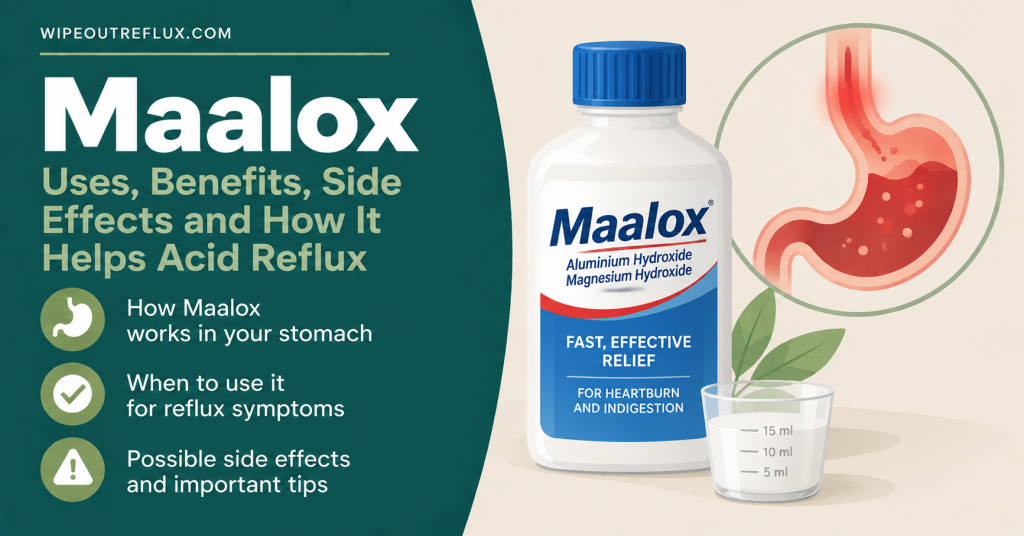
Maalox is a liquid antacid that works by neutralizing stomach acid on contact. The classic formula combines three active ingredients: aluminum hydroxide and magnesium hydroxide (the two acid-neutralizers, deliberately paired so their opposite effects on the bowel cancel out) plus simethicone to break up trapped gas. It’s fast — relief in minutes — but short-lived, which tells you exactly what it’s good for and what it isn’t.
For an occasional bout of heartburn or indigestion, Maalox or its generic equivalent does the job well. What it won’t do is heal anything or stop reflux from happening, and if your symptoms are frequent or reaching your throat, an antacid is the wrong tool. There’s also one genuinely important safety wrinkle worth knowing before you buy: not everything with “Maalox” on the label is the same drug, and the mix-up was serious enough to draw an FDA warning.
Here’s how Maalox actually works, the correct dose, its side effects, what the generic is, and where it fits — and doesn’t — in managing acid reflux.
Key Takeaways
- Classic Maalox liquid contains aluminum hydroxide, magnesium hydroxide and simethicone — two antacids plus an anti-gas agent.
- It neutralizes existing stomach acid within minutes but only lasts around 20–60 minutes, so it’s for occasional flares, not daily control.
- The aluminum and magnesium are paired on purpose: aluminum tends to constipate, magnesium tends to loosen, and together they roughly balance out.
- Usual adult dose is about 10–20 mL of liquid up to four times a day; don’t self-treat for more than two weeks without seeing a doctor.
- The generic for Maalox is simply “aluminum hydroxide / magnesium hydroxide / simethicone” suspension — identical formula, far cheaper.
- Watch the name: “Maalox Total Relief” was a completely different drug (bismuth subsalicylate, an aspirin relative), and the FDA acted over dangerous confusion with regular Maalox.
- Maalox does nothing to stop reflux reaching the throat — for silent reflux, an alginate raft is a far better fit.
What Is Maalox?
Maalox is a long-established over-the-counter antacid brand. In its classic liquid form it’s a combination of aluminum hydroxide and magnesium hydroxide — both alkaline salts that neutralize hydrochloric acid in the stomach — with simethicone added to collapse gas bubbles and ease bloating.
It belongs to the oldest and simplest class of reflux medicine. Antacids don’t switch off acid production the way a proton pump inhibitor does, and they don’t block the histamine signal the way famotidine does. They react chemically with acid that’s already there, raise the pH of the stomach contents, and are then used up. That’s why the effect is quick but brief — a review of antacid pharmacology puts the practical window at roughly 20 minutes to an hour depending on whether you’ve eaten [Maton and Burton, Drugs, 1999].
Is Maalox still available, and what’s its other name?
This trips a lot of people up. In the US the classic Maalox liquid has become hard to find under the Maalox name — the brand went through manufacturing problems and several changes of ownership over the years. The good news is that the formula itself is alive and well: it’s sold everywhere as inexpensive generic aluminum hydroxide / magnesium hydroxide / simethicone antacid suspension. So if you’re hunting for Maalox and can’t find it, you’re not missing out — the generic is Maalox, minus the brand markup.
Maalox Ingredients and Active Ingredients
The classic liquid’s active ingredients are:
- Aluminum hydroxide — neutralizes acid slowly and steadily; on its own it tends to cause constipation.
- Magnesium hydroxide — neutralizes acid quickly; on its own it tends to cause loose stools or diarrhea.
- Simethicone — not an antacid at all. It’s an anti-foaming agent that merges small gas bubbles into larger ones you can burp out, which is why Maalox helps with bloating and gas as well as acid.
Pairing aluminum with magnesium is the clever part. Each has an awkward bowel side effect, and they pull in opposite directions, so combining them gives you effective acid neutralization while roughly cancelling each other’s tendency to constipate or loosen [Maton and Burton, Drugs, 1999].
One thing to note: some Maalox-branded chewable tablets sold in the US used calcium carbonate rather than the aluminum-magnesium liquid formula. If you’re comparing products, check the active-ingredient panel rather than assuming every “Maalox” is the same recipe — which brings us to a much more important labelling issue.
The Name Trap: Maalox vs Maalox Total Relief
This is the detail the pharmacy pages tend to skip, and it matters. A product called Maalox Total Relief was not an antacid at all. Its active ingredient was bismuth subsalicylate — the same drug as in Pepto-Bismol, and a chemical relative of aspirin.
That’s a problem, because salicylates can cause bleeding and are risky for anyone with a history of stomach or intestinal ulcers, a bleeding disorder, or who’s already taking aspirin or blood thinners. In 2010 the FDA warned that people were confusing Maalox Total Relief with regular Maalox antacid and getting the wrong drug, after reports of serious medication errors. The manufacturer agreed to drop “Maalox” from the Total Relief name and change the packaging to make the two clearly different [FDA Drug Safety Communication, 2010].
The practical takeaway: read the active-ingredient panel, not just the brand. If it says aluminum/magnesium hydroxide, it’s an acid-neutralizing antacid. If it says bismuth subsalicylate, it’s an aspirin-relative aimed at upset stomach and diarrhea — a different drug with different risks, closer to Pepto-Bismol than to a reflux antacid.
What Is Maalox Used For?
Classic Maalox is used for the short-term relief of:
- Heartburn and acid indigestion
- Sour stomach and dyspepsia
- Bloating and gas pressure (thanks to the simethicone)
It’s a symptom reliever, full stop. It doesn’t heal an inflamed esophagus, it doesn’t reduce how often you reflux, and it isn’t designed for daily long-term use. Think of it as a fire extinguisher for an occasional flare, not a maintenance medicine.
Maalox for Heartburn and Acid Reflux
For an occasional episode of heartburn, Maalox works and works fast. Acid is already in your esophagus, Maalox neutralizes it, the burning settles within minutes. That immediacy is its whole selling point — nothing that suppresses acid production can match an antacid for speed.
The limits show up when reflux is frequent. Because each dose is used up within the hour, controlling day-long or nightly reflux with Maalox alone means dosing constantly, and you still haven’t addressed why the acid is coming up in the first place. That’s where longer-acting options come in — my guide to the best over-the-counter medicine for acid reflux covers where antacids sit against H2 blockers and PPIs.
And there’s a specific situation where Maalox is the wrong tool entirely: silent reflux (LPR), where refluxed material reaches the throat and voice box. Neutralizing acid in the stomach does little to stop the reflux event itself travelling up to the larynx, and the throat damage in LPR is driven largely by pepsin, which a plain antacid doesn’t touch. For that, a barrier makes more sense than a neutralizer — more on that below.
Maalox Dose
For the classic liquid, the usual adult dose is 10 to 20 mL taken up to four times a day — typically between meals and at bedtime, or when symptoms strike. Exact maximums depend on the concentration of the specific product (regular versus extra-strength), so the bottle’s own directions override any general figure. Chewable tablets should be chewed thoroughly before swallowing.
Two rules matter more than the exact millilitres:
Don’t use it for more than two weeks of continuous self-treatment without seeing a doctor. Needing an antacid daily for a fortnight isn’t a sign to buy a bigger bottle — it’s a sign the underlying problem needs a proper look.
Separate it from other medicines by about two hours. Antacids change stomach pH and can bind to other drugs, reducing how much you absorb — this affects certain antibiotics, thyroid medication, iron and more. Space them out.
Maalox Side Effects
For occasional use, Maalox is well tolerated. The effects worth knowing:
- Bowel changes: the aluminum-magnesium balance usually keeps things even, but tipping toward too much can cause either constipation or loose stools.
- Magnesium and aluminum build-up in kidney disease: healthy kidneys clear both minerals easily, but if your kidney function is impaired they can accumulate to harmful levels. Anyone with kidney disease should not take magnesium- or aluminum-containing antacids without medical advice [Maton and Burton, Drugs, 1999].
- Drug interactions: as above, antacids can reduce absorption of other medicines taken at the same time.
- Acid rebound is minimal compared with acid-suppressing drugs — antacids don’t cause the rebound hypersecretion that stopping a PPI can.
Maalox for Gastritis
People often reach for Maalox with gastritis (inflammation of the stomach lining), and it can ease the burning symptoms in the short term by neutralizing acid against an already-irritated surface. But it doesn’t treat the cause — and the most common cause of gastritis is H. pylori infection, which needs antibiotics, not antacids. Masking gastritis symptoms with Maalox while an infection or an NSAID habit continues underneath is a recipe for it dragging on. If burning stomach pain is your main issue rather than reflux, it’s worth understanding how gastritis differs from acid reflux before self-treating.
Maalox With Benadryl, and Maalox With Lidocaine
Two combinations come up a lot in searches, and both are medical mixtures rather than something to improvise at home.
Maalox with Benadryl (diphenhydramine) is the basis of “magic mouthwash,” a compounded rinse used for mouth and throat pain — often for mouth ulcers or the sores caused by chemotherapy. The antacid coats, the antihistamine soothes, and some versions add a numbing agent. It’s a topical mouth treatment prescribed for specific conditions, not a reflux remedy.
Maalox with lidocaine is the antacid-plus-numbing-gel core of a “GI cocktail,” the mixture used in emergency departments for upper-gut pain. Worth knowing: good trials show the lidocaine adds no extra pain relief over the antacid alone — the Maalox is the part that works. And viscous lidocaine is prescription-only, so this isn’t a home recipe.
Maalox During Pregnancy
Heartburn in pregnancy is extremely common, and simple antacids are usually the first thing recommended. Aluminum-, magnesium- and calcium-based antacids are generally considered acceptable in pregnancy, while a few agents are singled out for caution — high-dose sodium bicarbonate (fluid overload) and, near term, magnesium-containing products and magnesium trisilicate [Richter, Alimentary Pharmacology and Therapeutics, 2005]. Because guidance shifts across the trimesters, and because “Maalox” can mean different formulas, the safest move in pregnancy is to check the specific product with your midwife, doctor or pharmacist rather than assume. Anyone pregnant should certainly avoid the bismuth-subsalicylate “Total Relief” type product, as salicylates are not recommended in pregnancy. My overview of acid reflux and pregnancy goes into the wider picture.
A Better Fit for Reflux That Keeps Coming Back
If you find yourself taking Maalox again and again, the honest conclusion is that an antacid isn’t matched to your problem. Two better-evidenced routes exist.
For reflux that reaches the throat, an alginate beats a plain antacid. Alginates (the active ingredient in Gaviscon Advance) form a gel raft that floats on top of the stomach contents and physically blocks reflux, rather than just neutralizing acid that’s already escaped. A systematic review and meta-analysis found alginate therapy significantly more effective than antacids or placebo for controlling reflux symptoms [Leiman et al., Diseases of the Esophagus, 2017]. If you’re currently comparing options, Tums versus Gaviscon lays out the difference between neutralizing and rafting.
And for reflux that keeps returning at all, the real fix is reducing the number of reflux events — which no antacid does. That’s the territory the Wipeout Diet Plan works in.
Conclusion
Maalox is a solid, fast-acting antacid: aluminum and magnesium hydroxide to neutralize acid, simethicone for gas, with the two minerals paired to keep your bowels even. For the occasional heartburn flare it’s genuinely useful and cheap — and if you can’t find the brand, the generic aluminum/magnesium/simethicone suspension is the identical drug. Just read the active-ingredient panel every time, because “Maalox Total Relief” was a different medicine entirely, and take the two-week self-treatment limit seriously: needing it daily is a signal, not a routine.
What Maalox can’t do is change how often you reflux. It neutralizes acid that’s already escaped; it doesn’t keep it down, and it does almost nothing for throat-based silent reflux. That gap is exactly what the Wipeout Diet Plan is built to close — a mechanism-first approach to meal size, timing, fat load and trigger foods that cuts the number and force of reflux events, so you’re not reaching for an antacid several times a day. I designed it first around LPR and silent reflux, the throat-based form where antacids disappoint most, but because it works on the same underlying mechanisms it helps classic GERD and everyday heartburn just as well. And if you want a concrete starting point, the Wipeout Food Reference Guide is the essential companion — every food and drink that’s safe for acid reflux and LPR with its actual pH value, so you’re working from numbers rather than guesswork.
Reach for the antacid when you need it. Then work on the reason you keep needing it.
Frequently Asked Questions
What are the ingredients in Maalox?
Classic Maalox liquid contains aluminum hydroxide and magnesium hydroxide (two antacids that neutralize stomach acid) plus simethicone (an anti-gas agent). Some Maalox chewable tablets used calcium carbonate instead, so always check the active-ingredient panel on the specific product.
What is the generic for Maalox?
The generic is simply “aluminum hydroxide / magnesium hydroxide / simethicone” oral suspension. It’s the identical formula to classic Maalox liquid, sold under store brands and generic labels for a fraction of the price.
How much Maalox can I take?
The usual adult dose is about 10–20 mL of liquid up to four times a day, though the exact maximum depends on the product’s strength — follow the label. Don’t self-treat continuously for more than two weeks without seeing a doctor, and separate Maalox from other medicines by about two hours.
Is Maalox good for acid reflux?
For occasional heartburn, yes — it neutralizes acid within minutes. But it only lasts around 20–60 minutes and does nothing to reduce how often you reflux, so it’s not suited to frequent or throat-based (silent) reflux. For those, an alginate or a dietary approach works far better.
What is the difference between Maalox and Maalox Total Relief?
They’re different drugs. Regular Maalox is an aluminum/magnesium antacid. “Maalox Total Relief” contained bismuth subsalicylate, an aspirin relative aimed at upset stomach and diarrhea, which carries bleeding risks for some people. The FDA acted over confusion between the two, and the Total Relief product was renamed to drop “Maalox.”
Can I take Maalox during pregnancy?
Simple aluminum-, magnesium- or calcium-based antacids are generally considered acceptable in pregnancy and are often first-line for heartburn, but guidance varies by trimester and by product. Check the specific product with your doctor, midwife or pharmacist, and avoid the bismuth-subsalicylate “Total Relief” type, as salicylates aren’t recommended in pregnancy.
Does Maalox help gastritis?
It can ease the burning of gastritis short-term by neutralizing acid, but it doesn’t treat the cause. Gastritis is often driven by H. pylori infection or NSAID use, which need proper treatment. Using Maalox to mask ongoing symptoms can let the real problem continue.
Research & References
- Review of the clinical pharmacology of antacids, covering onset and duration of action, the pairing of aluminum and magnesium to balance bowel effects, and cautions in renal impairment [Maton and Burton, Drugs, 1999].
- Systematic review and meta-analysis finding alginate therapy significantly more effective than antacids or placebo for controlling gastroesophageal reflux symptoms [Leiman et al., Diseases of the Esophagus, 2017].
- Review of the management of heartburn in pregnancy and lactation, outlining which antacids are considered acceptable and which agents warrant caution [Richter, Alimentary Pharmacology and Therapeutics, 2005].
- FDA Drug Safety Communication on product confusion between Maalox Total Relief (bismuth subsalicylate) and regular Maalox liquid antacids, describing the bleeding risk and the resulting name and packaging changes [FDA Drug Safety Communication, 2010].

David Gray
12 years living with LPR · Consultant & researcher
I've lived with LPR for twelve years — the misdiagnoses, the PPI courses that did nothing, the slow work of figuring out what actually helps. Wipeout Reflux is where I translate the research into plain terms for people stuck in the same place. Every claim here is sourced to peer-reviewed work, and I consult one-to-one with LPR sufferers.