
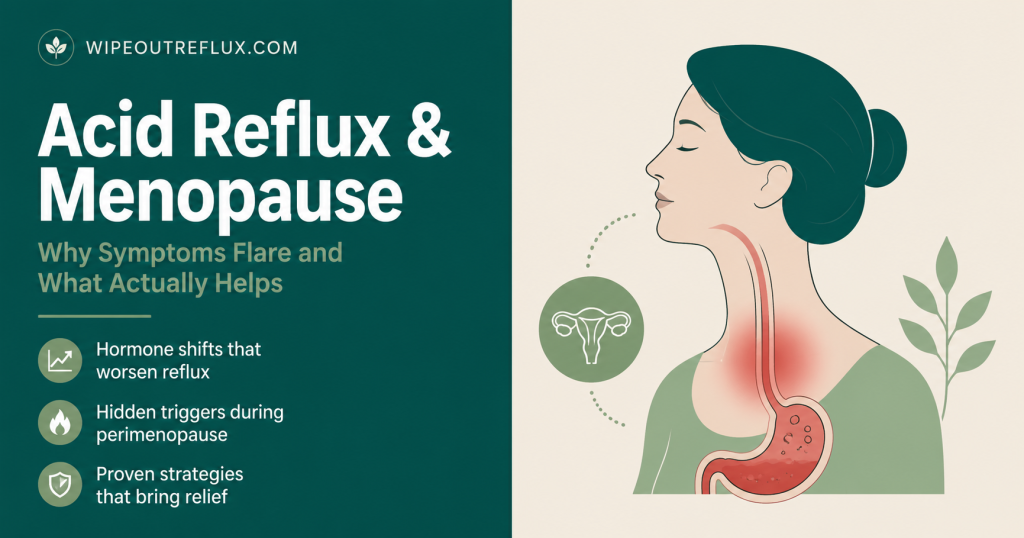
Yes — menopause can directly cause or significantly worsen acid reflux and GERD. As oestrogen levels fall during perimenopause and menopause, the lower oesophageal sphincter (LES) — the valve that prevents stomach acid from rising into the oesophagus — becomes more prone to dysfunction. The result is acid reflux that may appear for the first time in women who’ve never had it before, or existing reflux that becomes noticeably harder to control.
Research shows that approximately half of women going through perimenopause and menopause experience reflux symptoms. And for a significant number of those women, the symptom isn’t classic heartburn — it’s a persistent cough, a lump in the throat, chronic hoarseness, or constant throat clearing. That’s silent reflux (LPR), and it shares exactly the same hormonal trigger as GERD.
This article covers the science behind menopause-related reflux, when symptoms typically begin, whether HRT actually helps, and what evidence-based management looks like for this specific stage of life.
Key Takeaways
- Menopause is a significant independent risk factor for GERD — research suggests post-menopausal women are substantially more likely to develop reflux than pre-menopausal women, with menopause outranking smoking, alcohol, and diabetes as risk factors
- Approximately 42% of perimenopausal women and 47% of menopausal women report GERD symptoms, many with no prior history of reflux
- Declining oestrogen contributes to LES weakening, slower gastric emptying, and abdominal weight changes — all of which increase reflux risk
- Symptoms often begin during perimenopause, sometimes years before the final menstrual period
- Hormone replacement therapy (HRT) is not a reliable fix for reflux — a large 2023 meta-analysis found HRT associated with higher GERD risk, not lower
- Silent reflux (LPR) is common in menopausal women and frequently missed because symptoms appear in the throat rather than the chest
- Diet, weight management, meal timing, and sleep positioning remain the most effective long-term management approaches
- Persistent symptoms that don’t respond to lifestyle changes warrant GP or gastroenterology review
Can Menopause Cause Acid Reflux?
Yes — and the data makes a compelling case. A survey of nearly 500 women found that approximately 42% of those in perimenopause and 47% of those in menopause reported reflux symptoms. Strikingly, around 80% of those women had never been diagnosed with any upper gastrointestinal condition before [Infantino M., Journal of the American Academy of Nurse Practitioners, 2008].
Research presented at the American College of Gastroenterology found that menopausal status was a stronger independent risk factor for GERD than smoking, alcohol consumption, or diabetes — three conditions routinely cited in patient education about reflux risk [Shibli F. et al., American Journal of Gastroenterology, 2021].
This matters because it reframes menopause-related reflux as a distinct physiological issue — not simply the result of eating badly or drinking too much coffee. Many women in midlife are doing everything right and still developing reflux for the first time. Understanding why requires looking at what oestrogen actually does in the digestive system.
Why Menopause Triggers Reflux: The Oestrogen Connection
The relationship between oestrogen and reflux is genuinely complex, and the evidence points in multiple directions. What is clear is that the menopausal transition consistently increases reflux risk through several overlapping mechanisms.
LES Tone and Oestrogen Signalling
The lower oesophageal sphincter (LES) is the ring of muscle that acts as a one-way valve between the oesophagus and the stomach. Oestrogen appears to influence the smooth muscle tone of this valve. Research suggests that both elevated and declining oestrogen levels can affect LES function through nitric oxide signalling — a pathway that directly regulates smooth muscle relaxation in the gastrointestinal tract [Kang A. et al., Cureus, 2020]. During menopause, the loss of stable hormonal regulation appears to tip the balance toward increased LES relaxation and more frequent reflux episodes. For more on how this valve functions and why it matters for reflux, see my guide to the stomach sphincter and LPR.
Gastric Emptying and Motility
Hormonal changes during menopause can slow gastric emptying — the rate at which the stomach moves food into the small intestine. When food lingers in the stomach longer, pressure builds and increases the chance of acid escaping upward through a weakened LES. This is compounded by age-related reductions in oesophageal motility that can occur independently of hormonal changes.
Abdominal Weight Gain
Menopause is associated with increased central fat deposition, even in women whose overall body weight remains similar. Abdominal fat increases intra-abdominal pressure, which directly pushes against the stomach and promotes reflux. For many women, weight management becomes one of the most impactful interventions available.
Stress, Cortisol, and Gut Sensitivity
Hormonal fluctuations during the menopausal transition can affect cortisol output and heighten gut sensitivity, meaning that even modest reflux episodes may be experienced more intensely. Stress hormones can also independently reduce LES pressure and affect gastric motility, creating a secondary driver that compounds the oestrogen-related mechanisms above.
Perimenopause vs Menopause: When Symptoms Start
A common assumption is that menopause-related digestive changes begin only after periods stop entirely. In practice, symptoms often start earlier — sometimes significantly so — during perimenopause, the transitional phase that can span several years before the final menstrual period.
Perimenopause is defined by erratic hormonal fluctuations rather than a steady decline. Oestrogen levels can swing considerably from cycle to cycle, and these fluctuations are sufficient to trigger or worsen reflux in a meaningful proportion of women — reflected in that 42% perimenopausal figure [Infantino M., Journal of the American Academy of Nurse Practitioners, 2008].
If you’re in your 40s and noticing new or worsening reflux — particularly alongside other perimenopausal symptoms like irregular periods, sleep disruption, or mood changes — the hormonal connection is worth exploring before assuming the issue is purely diet-related. Many women spend months adjusting their diet without improvement, simply because the underlying driver isn’t food.
Does HRT Help or Worsen Acid Reflux?
This is one of the most important — and most counterintuitive — findings in the menopause and reflux literature. Many women hope that HRT will settle their reflux along with other menopausal symptoms. The evidence suggests it usually won’t, and for some women, it may make things worse.
A 2023 systematic review and meta-analysis published in the journal Menopause pooled data from over one million women across five studies and found that HRT use was associated with 29% higher odds of developing GERD overall (adjusted OR 1.29; 95% CI 1.17–1.42) [Aldhaleei W.A. et al., Menopause, 2023]. Looking at individual hormone types:
- Oestrogen-only HRT: 41% higher odds of GERD (aOR 1.41)
- Progestogen-only HRT: 39% higher odds (aOR 1.39)
- Combined HRT: 16% higher odds (aOR 1.16)
The proposed mechanism involves both oestrogen and progesterone affecting LES tone through nitric oxide pathways, which can promote relaxation of the sphincter even as they address other menopausal symptoms [Kang A. et al., Cureus, 2020]. It’s a somewhat paradoxical situation — the same hormones whose decline causes reflux can, when reintroduced, also worsen it through a different mechanism.
This doesn’t mean HRT is the wrong choice overall. It has real, documented benefits for bone health, cardiovascular risk markers, vasomotor symptoms, and quality of life. But if you’re already managing reflux and considering HRT — or if you’ve started HRT and your reflux has worsened — it’s worth raising this directly with your prescribing GP. Adjusting the formulation, route of delivery (transdermal vs oral), or type of progestogen may help reduce the GI impact. You can also explore why reflux medication sometimes fails and what alternatives exist.
Silent Reflux and Menopause: The Throat Symptoms Few Talk About
Most articles on menopause and reflux focus entirely on heartburn. But there’s a large group of menopausal women experiencing a different type of reflux — one that doesn’t produce chest symptoms at all. Laryngopharyngeal reflux (LPR), also called silent reflux, is common in this population and remains significantly underdiagnosed.
With LPR, stomach acid and pepsin travel beyond the oesophagus into the throat. Unlike the oesophagus, the throat has minimal mucus protection against acid damage. The resulting symptoms are throat-focused rather than chest-focused:
- Chronic throat clearing
- Hoarseness or subtle voice changes
- A lump or tightening sensation in the throat (globus)
- Persistent cough, often worse in the mornings
- Post-nasal drip or excess mucus at the back of the throat
- Occasional difficulty swallowing
For a full breakdown of how these symptoms develop, see my guide to LPR symptoms. It’s also worth understanding how silent reflux differs from GERD, since the two require somewhat different treatment approaches.
The same LES weakening that occurs during menopause also affects the upper oesophageal sphincter (UES), the second valve that guards the throat. When both are compromised, pepsin — the digestive enzyme produced in the stomach — reaches the throat and embeds in the tissue. Pepsin is particularly damaging because it reactivates every time the local pH drops below 4, causing ongoing inflammation even between active reflux episodes. My guide on neutralising pepsin in the throat explains the mechanism and what helps.
For menopausal women, the clinical picture is often frustrating: years of throat symptoms, multiple ENT appointments, and no mention of reflux as a cause — simply because heartburn isn’t present. If the symptom cluster above sounds familiar, pursuing a reflux investigation (rather than treating symptoms in isolation) is the more productive path. You can find more detail in my guide to lump-in-throat from reflux and in the article on stopping constant throat clearing.
How to Manage Menopausal Acid Reflux
The evidence-based management principles for reflux apply here as anywhere — but a few deserve particular emphasis in the menopausal context.
Diet Modification
Acidic, fatty, spicy, and high-sugar foods all increase reflux severity. Caffeine, alcohol, carbonated drinks, chocolate, and peppermint are particularly common LES relaxants. For women dealing with new-onset reflux during menopause, identifying and removing the key personal triggers is an essential first step. The Wipeout Diet Plan provides a structured approach to this, covering not just what to avoid but how to structure eating to reduce pressure on the LES throughout the day.
Meal Timing and Portion Size
Large meals significantly increase intra-abdominal pressure. Eating smaller portions more frequently, and avoiding food within three hours of lying down, can substantially reduce night-time and early-morning reflux — a pattern that’s particularly common during menopause.
Sleep Positioning
Elevating the head of the bed by 15–20 cm (or using a dedicated reflux wedge pillow) reduces nocturnal reflux significantly. Lying on the left side also takes advantage of the stomach’s anatomical position and is associated with reduced reflux compared to right-side sleeping. See my detailed guide to the best sleeping position for silent reflux for more on this.
Weight Management
Even modest weight loss of 5–10% of body weight has been shown to reduce GERD severity. Given the menopausal tendency toward central fat gain, this is particularly relevant — though it can also feel particularly difficult at this stage. A low-inflammatory, high-fibre diet tends to support both reflux management and weight control simultaneously.
Alginate-Based Treatments
For LPR specifically, standard antacids and many PPIs offer incomplete relief because they don’t address pepsin. Alginate preparations like Gaviscon Advance form a physical raft on top of stomach contents, blocking both acid and pepsin from reaching the throat. My detailed Gaviscon Advance guide covers how and when to use it effectively.
When to See a Doctor
New reflux coinciding with menopause deserves a GP review — both to confirm the diagnosis and to rule out other causes. Seek prompt attention for difficulty swallowing, unintentional weight loss, persistent vomiting, or any sign of blood in vomit or stool, as these require investigation regardless of suspected reflux.
Frequently Asked Questions
Can acid reflux start during menopause even if I’ve never had it before?
Yes — this is one of the most commonly reported patterns. Many women develop reflux for the first time during perimenopause or menopause, with no prior history of GERD. The hormonal changes during this transition directly affect the LES and digestive motility, creating a genuine physiological basis for new-onset reflux.
Does perimenopause cause acid reflux?
Yes. Reflux frequently begins or worsens during perimenopause rather than after menopause itself. Erratic hormone fluctuations during this phase affect LES tone in the same way as the later hormonal decline. Research shows approximately 42% of perimenopausal women report GERD symptoms.
Is HRT a treatment for menopause-related acid reflux?
No — and the evidence suggests the opposite. A 2023 meta-analysis found HRT was associated with meaningfully higher odds of developing GERD. If you’re on HRT and your reflux has worsened, it’s worth raising this with your prescribing doctor. Switching formulation or adjusting progestogen type may help.
Can menopause cause throat symptoms without heartburn?
Yes. Silent reflux (LPR) is common in menopausal women and produces symptoms in the throat — hoarseness, chronic throat clearing, lump sensation, or persistent cough — without classic chest heartburn. It’s frequently misattributed to post-nasal drip, allergies, or vocal cord issues.
Does menopause worsen existing GERD?
In most cases, yes. Women who had manageable reflux before the menopausal transition often find symptoms escalate during and after it. This is consistent with menopause acting as an independent structural risk factor for GERD, not just a modifier of existing symptoms.
How long does menopause-related reflux last?
This varies considerably. For some women, symptoms improve as hormonal levels stabilise at their post-menopausal baseline. For others, the structural changes that occurred — particularly LES weakening and weight gain — mean reflux persists long-term. Addressing it proactively during the transition gives the best outcomes.
What helps with acid reflux during menopause?
Diet modification, weight management, meal timing, and sleep positioning are the highest-leverage interventions. Alginate preparations like Gaviscon Advance are particularly useful for LPR. PPIs remain medically first-line for erosive GERD. If standard approaches aren’t working, a structured silent reflux treatment approach may be needed.
Conclusion
Menopause is one of the most underappreciated drivers of acid reflux in women — and the research is clear that this isn’t simply a coincidence of age. From the LES changes that follow hormonal decline to the abdominal pressure increases that accompany central weight gain, the menopausal transition creates a genuine physiological environment for reflux to emerge or worsen. And that disruption frequently shows up not just as heartburn, but as throat symptoms, hoarseness, and chronic cough that can persist for years before the connection to reflux is even considered.
The encouraging part is that these physiological changes respond well to the right management approach. Diet, meal timing, weight management, sleep positioning, and targeted barrier treatments can all make a meaningful difference — often without escalating to long-term medication. The key is understanding what’s actually driving the reflux so the response is targeted rather than generic.
If you want a structured starting point, the Wipeout Diet Plan covers the full dietary framework for managing acid reflux and LPR — including which foods support recovery and how to structure eating to reduce daily reflux load. And for a practical, at-a-glance reference, the Wipeout Reflux Food Reference Guide lists the foods and drinks that are safe for acid reflux and LPR with their pH values — so you’re never guessing about what’s on your plate.
Menopause-related reflux is manageable. It just takes understanding what’s actually driving it — and responding with the right tools.
Research & References
Infantino M. (2008). The prevalence and pattern of gastroesophageal reflux symptoms in perimenopausal and menopausal women. A survey of 497 women aged 25–60 found that 42% of perimenopausal and 47% of menopausal participants reported GERD symptoms, with menopausal women significantly more likely to experience reflux than premenopausal counterparts. [Infantino M., Journal of the American Academy of Nurse Practitioners, 2008]
Shibli F., El Mokahal A., Saleh S., Fass R. (2021). Menopause is an important risk factor for GERD and its complications in women. This analysis reported that menopausal status was a larger independent risk factor for GERD than smoking, alcohol consumption, or diabetes in a population-based cohort. [Shibli F. et al., American Journal of Gastroenterology, 2021]
Kang A., Khokare R., Awolumate O.J., Fayyaz H., Cancarevic I. (2020). Is estrogen a curse or a blessing in disguise? Role of estrogen in gastroesophageal reflux disease. This review examined the bidirectional relationship between oestrogen and GERD, including effects on LES smooth muscle tone via nitric oxide signalling, and the complex interaction between hormonal levels and reflux risk. [Kang A. et al., Cureus, 2020]
Aldhaleei W.A., Bhagavathula A.S., Wallace M.B., DeVault K.R., Faubion S.S. (2023). The association between menopausal hormone therapy and gastroesophageal reflux disease: a systematic review and meta-analysis. Pooling data from over 1 million participants across five studies, this analysis found HRT use associated with 29% higher odds of GERD overall; oestrogen-only use with 41% higher odds and progestogen-only use with 39% higher odds. [Aldhaleei W.A. et al., Menopause, 2023]

David Gray
12 years living with LPR · Consultant & researcher
I've lived with LPR for twelve years — the misdiagnoses, the PPI courses that did nothing, the slow work of figuring out what actually helps. Wipeout Reflux is where I translate the research into plain terms for people stuck in the same place. Every claim here is sourced to peer-reviewed work, and I consult one-to-one with LPR sufferers.