
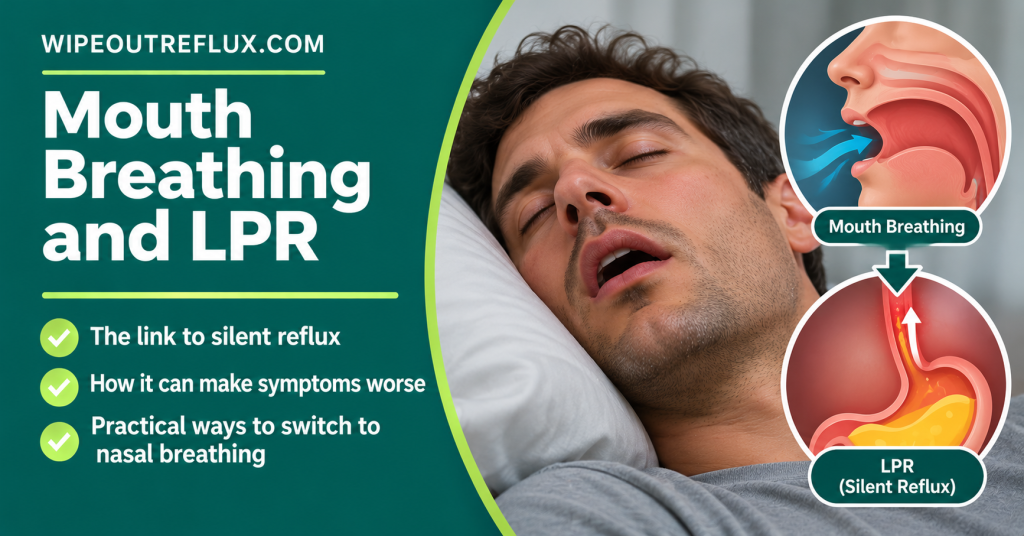
Mouth breathing doesn’t cause reflux on its own, but it can make LPR symptoms noticeably worse, and the two often feed each other. Breathing through your mouth, especially at night, dries out the throat and vocal cords, makes a dry mouth more likely, and leaves already-irritated tissue more sensitive. In the meantime, the nasal blockage that usually drives mouth breathing has been linked to more reflux in pH studies. LPR itself can cause postnasal drip and congestion, which pushes you toward mouth breathing in the first place.
That’s why so many people with silent reflux wake up with a dry, sore, croaky throat. If that sounds familiar, fixing your breathing (clearing your nose, humidifying your bedroom and retraining nasal breathing) is a useful partner to reflux treatment, not a replacement for it.
Key Takeaways
- There’s no good evidence that mouth breathing directly causes reflux. Its effect on LPR is mostly about making the throat drier and more vulnerable.
- Just 15 minutes of mouth breathing has been shown to dry the surface of the vocal cords and increase the effort needed to speak.
- Mouth breathing at night usually means a dry mouth. Saliva is one of your main defenses against acid, so dryness weakens your throat’s protection.
- Nasal obstruction, such as a deviated septum, has been linked to more reflux episodes on pH monitoring.
- LPR can cause postnasal drip and nasal congestion, creating a cycle where reflux leads to mouth breathing and mouth breathing makes reflux symptoms feel worse.
- Snoring and sleep apnea, often linked to mouth breathing, are also associated with reflux.
- The fix works on both sides: treat the reflux, clear the nose, humidify, and gradually retrain nasal breathing.
Can Mouth Breathing Cause LPR?
Let’s be clear about what the evidence does and doesn’t show. I haven’t found a study proving that mouth breathing by itself causes laryngopharyngeal reflux. Reflux happens when stomach contents get past your esophageal sphincters, and that’s driven by things like meal size, trigger foods, a weak lower sphincter, a hiatal hernia and pressure on the stomach.
But mouth breathing affects LPR in two important ways. It makes the effects of reflux worse by drying out and weakening your throat’s defenses. And it usually comes with other conditions, such as nasal obstruction, snoring and sleep apnea, that are themselves linked to more reflux. In practice, that means mouth breathers with LPR often have a harder time than people who breathe through their nose.
How Mouth Breathing Makes LPR Symptoms Worse
1. It dries out your throat and vocal cords
Your nose isn’t just a passageway. It warms, filters and humidifies air before it reaches your throat. Breathing through your mouth skips that step, so dry air flows straight over the back of your throat and your vocal cords.
The effect is surprisingly quick. In a controlled study, just 15 minutes of mouth breathing increased the pressure needed to start the voice and the effort people felt they were using to speak, while nasal breathing didn’t. People with a history of vocal problems were affected even more [Sivasankar and Fisher, Journal of Speech, Language, and Hearing Research, 2003]. The researchers linked this to drying of the thin liquid layer that coats the vocal cords.
If your throat is already inflamed from reflux, adding a layer of drying on top makes hoarseness, throat clearing and that scratchy, raw feeling worse. My article on dry throat at night goes into this in more detail.
2. It reduces your saliva protection
Saliva is one of the most underrated reflux defenses. It contains bicarbonate, which neutralizes acid, and every time you swallow it, it washes refluxed material back down. Research on acid clearance shows that after peristalsis empties most of the acid from the esophagus, the remaining acid is neutralized by swallowed saliva, mostly thanks to its bicarbonate [Helm, Journal of Clinical Gastroenterology, 1986]. I’ve covered this in more depth in saliva, bicarbonate and acid reflux.
Saliva production already falls during sleep, and the same research notes that acid clearance can be markedly delayed if you fall asleep before it’s complete. Breathing through your mouth all night dries out whatever saliva you do produce, leaving your throat and esophagus with even less protection exactly when nighttime reflux is most likely. That’s one reason dry mouth and acid reflux so often go together.
3. It makes the throat more sensitive
Dry, irritated tissue is more reactive. When reflux does reach the throat, a dry larynx is likely to feel it more, and the urge to clear your throat or cough gets stronger. Every throat clear slams the vocal cords together and irritates them further, which keeps the cycle going. My guide to stopping constant throat clearing has practical ways to break that loop.
Why a Blocked Nose and Reflux Often Go Together
Most people don’t breathe through their mouth by choice. They do it because their nose is blocked. And nasal obstruction itself appears to be linked to reflux.
In a study of 40 people with a deviated septum and 40 controls, pH monitoring found significantly more total reflux episodes in the people with nasal obstruction. The authors concluded that nasal obstruction may play a role in reflux [Cakar et al., Annals of Medical Research, 2019]. A separate study found that people who needed septoplasty for nasal obstruction were about twice as likely to be taking PPIs as a comparison group [Wong et al., European Journal of Rhinology and Allergy, 2020].
These are small studies and they can’t prove cause and effect. One theory is that breathing against a blocked nose takes more effort, increasing pressure changes in the chest that can draw stomach contents upward. The same pressure effect is thought to explain part of the link between sleep apnea and acid reflux.
The LPR and Mouth Breathing Cycle
This is the part I see most often with readers. LPR doesn’t only affect the throat. Reflux, and the irritation it causes, can trigger mucus production, postnasal drip and nasal congestion. A stuffed-up nose pushes you into mouth breathing, especially at night. Mouth breathing then dries and sensitizes the throat, so the reflux that comes up feels worse.
The cycle looks like this:
- Reflux irritates the throat and nasal passages.
- Congestion and postnasal drip block the nose.
- You switch to mouth breathing, especially when asleep.
- Your throat dries out and saliva protection drops.
- Nighttime reflux hits a drier, more sensitive throat.
- You wake up hoarse, dry and clearing your throat, and the irritation continues.
Breaking the cycle usually means working on both ends at once.
Signs You’re Mouth Breathing at Night
- Waking up with a very dry mouth or throat
- Morning hoarseness that improves through the day
- Snoring (often reported by a partner)
- Drooling on your pillow
- Bad breath in the morning
- Waking up tired despite enough hours in bed
- Chapped lips
- A blocked nose most nights
If you snore heavily, wake up gasping or choking, or feel exhausted all day, get checked for sleep apnea. It’s common, treatable and strongly linked to reflux. My articles on snoring and acid reflux and waking up choking from acid reflux cover the warning signs.
How to Stop Mouth Breathing and Protect Your Throat
Clear your nose
- Saline rinses or sprays before bed help clear mucus and postnasal drip.
- Treat allergies if they’re part of the picture. Allergic congestion is a common hidden driver of mouth breathing.
- Get structural problems checked. If one side of your nose is always blocked, an ENT can check for a deviated septum, enlarged turbinates or nasal polyps.
- Try nasal strips if your nostrils collapse inward when you breathe in.
Humidify and hydrate
- Run a humidifier in your bedroom, especially in winter or with central heating. My guide to the best humidifiers for a dry, itchy throat compares options.
- Sip water through the day so your throat tissue stays well hydrated.
- Go easy on alcohol and caffeine in the evening. Both dry you out and are also reflux triggers.
Retrain nasal breathing
- Practice during the day. Notice when your mouth drops open and gently close it, breathing through your nose.
- Try diaphragmatic breathing. It encourages slow nasal breathing and has its own reflux benefits. In a randomized study, abdominal breathing training improved reflux-related quality of life and reduced acid exposure [Eherer et al., American Journal of Gastroenterology, 2012]. See my guide to breathing exercises for acid reflux.
- Be cautious with mouth taping. It’s popular online, but it isn’t safe for everyone, especially if your nose is blocked or you might have sleep apnea. I’ve weighed up the pros and cons in is mouth taping safe for acid reflux.
Reduce the reflux itself
- Stop eating at least three hours before bed. An empty stomach at bedtime means less to reflux into a dry throat.
- Raise the head of your bed. It helps both reflux and nasal drainage.
- Take an alginate at bedtime. A raft-forming alginate like Gaviscon Advance helps stop reflux reaching your throat overnight.
- Change your diet. Cutting acidic, fatty and trigger foods reduces the reflux load that’s causing the throat irritation and nasal symptoms in the first place. The Wipeout Diet Plan takes you through it step by step.
When to See a Specialist
See an ENT if your nose is blocked most of the time, if one side is always worse, if you have frequent nosebleeds or loss of smell, or if your hoarseness lasts more than three to four weeks. A sleep study is worth asking about if you snore loudly, stop breathing during sleep (as noticed by a partner) or feel unrested despite a full night in bed. If you’re not sure who to see, my guide to whether to see an ENT or gastroenterologist for LPR can help.
Conclusion
Mouth breathing isn’t the root cause of LPR, but it’s a powerful aggravator. It dries the throat and vocal cords within minutes, strips away the saliva that normally neutralizes and clears reflux, and leaves an already-inflamed larynx more sensitive. It also tends to travel with conditions linked to more reflux, such as nasal obstruction, snoring and sleep apnea. And because LPR can block your nose, the two easily get stuck in a cycle.
The good news is that cycle can be broken from both ends. Clearing your nose, humidifying your bedroom and retraining nasal breathing protect your throat. Reducing reflux, especially in the hours before bed, removes the irritation that keeps your nose and throat inflamed.
That second part is where diet makes the biggest difference. The Wipeout Diet Plan is my complete, step-by-step guide to calming throat reflux. It was built first for LPR and silent reflux, the throat-based kind that leaves you dry and croaky every morning, but because it targets the same root causes, it works just as well for GERD and everyday heartburn. Combine it with better breathing habits, and most people find their mornings get a lot easier.
Frequently Asked Questions
Can mouth breathing cause acid reflux?
There’s no strong evidence that mouth breathing directly causes reflux. But it can make reflux symptoms worse by drying the throat and reducing saliva, and it often goes along with nasal obstruction and sleep apnea, which are linked to more reflux.
Why does my throat feel worse in the morning with LPR?
Nighttime reflux reaches the throat more easily when you’re lying flat, and saliva production drops during sleep. If you also mouth breathe, your throat dries out on top of that, which is why hoarseness and dryness are often worst first thing.
Can LPR cause a blocked nose?
Yes. LPR is associated with postnasal drip, excess mucus and nasal congestion. A blocked nose then makes mouth breathing more likely, creating a cycle.
Does a deviated septum make reflux worse?
Small studies have linked nasal obstruction from a deviated septum with more reflux episodes on pH testing and higher PPI use. The evidence isn’t strong enough to prove cause and effect, but it’s worth getting persistent one-sided blockage checked.
Is mouth taping a good idea for LPR?
It can help some people, but it isn’t safe for everyone. Don’t tape your mouth if your nose is blocked or if you might have sleep apnea. Get your nasal airway and sleep checked first.
Will a humidifier help silent reflux?
It won’t reduce reflux itself, but it can ease the dryness and irritation that make LPR symptoms feel worse, especially if you breathe through your mouth at night.
How do I stop mouth breathing while sleeping?
Start by clearing your nose with saline and treating any allergies, use a humidifier, and try nasal strips if your nostrils collapse. Practice nasal breathing during the day, and see an ENT if your nose stays blocked or you suspect sleep apnea.
Research & References
- [Sivasankar and Fisher, Journal of Speech, Language, and Hearing Research, 2003] — Fifteen minutes of obligatory oral breathing, but not nasal breathing, increased phonation threshold pressure and vocal effort, with larger effects in people with a history of vocal problems.
- [Helm, Journal of Clinical Gastroenterology, 1986] — Review of esophageal acid clearance. Residual acid is neutralized by swallowed saliva, mainly through bicarbonate, and clearance can be markedly delayed during sleep.
- [Cakar et al., Annals of Medical Research, 2019] — pH-monitoring study of 40 patients with septal deviation and 40 controls. Total reflux episodes were significantly higher in the nasal obstruction group.
- [Wong et al., European Journal of Rhinology and Allergy, 2020] — Retrospective cohort study finding patients undergoing septoplasty were about twice as likely to use PPIs as controls (odds ratio 1.97).
- [Eherer et al., American Journal of Gastroenterology, 2012] — Randomized controlled study showing abdominal breathing training improved quality of life and reduced acid exposure in GERD.

David Gray
12 years living with LPR · Consultant & researcher
I've lived with LPR for twelve years — the misdiagnoses, the PPI courses that did nothing, the slow work of figuring out what actually helps. Wipeout Reflux is where I translate the research into plain terms for people stuck in the same place. Every claim here is sourced to peer-reviewed work, and I consult one-to-one with LPR sufferers.