
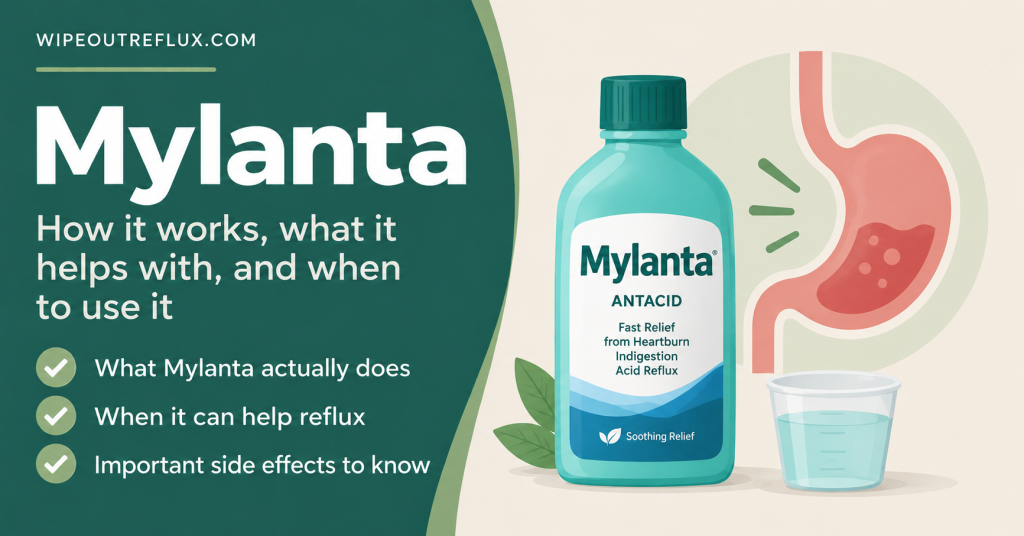
Mylanta is a liquid antacid that relieves heartburn by neutralizing stomach acid on contact — and it works fast, usually within about five minutes. The maximum-strength liquid combines aluminum hydroxide and magnesium hydroxide (the two acid-neutralizers) with simethicone to break up gas, and the usual adult dose is 10–20 mL taken between meals and at bedtime.
That speed is the whole point of an antacid. What Mylanta trades for it is staying power: relief lasts roughly 20 minutes to an hour, then the dose is used up. So it’s excellent for the occasional flare and poorly suited to controlling reflux that happens every day. Here’s the full picture — the dose, how fast it works, the side effects (including the constipation-versus-diarrhea question people ask most), and where it fits for acid reflux.
Key Takeaways
- Mylanta Maximum Strength liquid contains aluminum hydroxide, magnesium hydroxide and simethicone — two antacids plus an anti-gas agent.
- It works within about 5 minutes but only lasts around 20–60 minutes, so it’s for occasional relief, not daily control.
- Usual adult dose is 10–20 mL between meals and at bedtime; follow the product’s stated 24-hour maximum and don’t self-treat beyond two weeks.
- The aluminum and magnesium roughly balance each other’s bowel effects — aluminum constipates, magnesium loosens — so most people have neither.
- It can loosen stools in some people because of the magnesium, which is why “does Mylanta make you poop” is a common question.
- Simple antacids are generally considered acceptable in pregnancy, but check the specific product with your doctor.
- Mylanta doesn’t reduce how often you reflux and does little for throat-based silent reflux — an alginate or a dietary approach suits those better.
What Is Mylanta and What Is It Used For?
Mylanta is a long-standing over-the-counter antacid used for the short-term relief of heartburn, acid indigestion, sour stomach, and the bloating and pressure of trapped gas. It sits in the oldest, simplest class of reflux medicine: antacids react chemically with acid that’s already in your stomach and neutralize it, raising the pH for a short window.
That makes it fundamentally different from acid-suppressing drugs. An H2 blocker like famotidine reduces how much acid you produce; a proton pump inhibitor shuts acid production down almost entirely over days. Mylanta doesn’t touch production at all — it mops up what’s there. That’s why it’s fast but brief, and why it’s a reliever rather than a controller.
Mylanta Ingredients
The classic Mylanta Maximum Strength liquid, per 10 mL dose, contains:
- Aluminum hydroxide 800 mg — neutralizes acid steadily; on its own tends to cause constipation.
- Magnesium hydroxide 800 mg — neutralizes acid quickly; on its own tends to loosen stools.
- Simethicone 80 mg — not an antacid, but an anti-foaming agent that merges small gas bubbles into larger ones you can pass, easing bloating.
Pairing aluminum with magnesium is deliberate: each has an opposite effect on the bowel, so combining them gives effective acid neutralization while roughly cancelling out the constipation-or-diarrhea problem [Maton and Burton, Drugs, 1999].
Worth knowing: not every Mylanta product uses that formula. Some in the range — certain tablets and the night-time version — are built on calcium carbonate (the same active as Tums) with magnesium hydroxide instead of aluminum. So check the active-ingredient panel on the specific product rather than assuming all Mylanta is identical. This is the same class of antacid you’ll find under other brands too; my comparison of Maalox versus Mylanta covers just how similar the classic formulas are.
Mylanta Dose for Adults
For the liquid, the usual adult dose is 10 to 20 mL, taken between meals and at bedtime or when symptoms strike. Shake the bottle first, and don’t exceed the maximum number of doses in 24 hours printed on your specific product — the ceiling depends on the strength, so the label overrides any general figure. Chewable tablets should be chewed thoroughly.
Two habits matter more than the exact millilitres:
Don’t self-treat continuously for more than two weeks without seeing a doctor. Needing an antacid every day for a fortnight isn’t a dosing question — it’s a sign the underlying problem needs proper assessment.
Separate Mylanta from other medicines by about two hours. Antacids change stomach pH and can bind to other drugs, reducing absorption — this affects certain antibiotics, thyroid medication, iron and others.
How Long Does Mylanta Take to Work?
Fast — that’s its main advantage. Because it neutralizes acid on direct contact, most people feel relief within about five minutes. Nothing that suppresses acid production can match an antacid for speed; a PPI can take days to reach full effect, while Mylanta acts almost immediately.
The trade-off is duration. A single dose lasts only around 20 minutes to an hour before it’s neutralized and used up [Maton and Burton, Drugs, 1999]. Taking it on an empty stomach gives an even shorter effect than taking it after food. That short window is exactly why Mylanta suits occasional heartburn but struggles to control reflux that recurs through the day — you’d be re-dosing constantly. If your symptoms are lasting for hours or coming back day after day, it’s worth understanding how long acid reflux usually lasts and why persistent symptoms call for a different approach.
Mylanta Side Effects
For occasional use, Mylanta is well tolerated. The effects worth knowing:
- Bowel changes — the balanced aluminum-magnesium formula usually keeps things even, but tipping one way can cause either loose stools or constipation (more on this below).
- Build-up in kidney disease — healthy kidneys clear aluminum and magnesium easily, but if kidney function is impaired they can accumulate to harmful levels. Anyone with kidney disease should not take magnesium- or aluminum-containing antacids without medical advice [Maton and Burton, Drugs, 1999].
- Drug interactions — as above, spacing other medicines apart avoids reduced absorption.
- Minimal acid rebound — unlike stopping a PPI, stopping an antacid doesn’t trigger rebound acid over-production.
Does Mylanta Cause Constipation or Diarrhea? (And “Does Mylanta Make You Poop?”)
This is the question people ask most, and the answer is: it depends which way the formula tips for you. The magnesium hydroxide in Mylanta is the same type of magnesium used in milk of magnesia, and it has a mild laxative effect — it draws water into the bowel. The aluminum hydroxide pulls the other way and tends to constipate. In the balanced aluminum-magnesium liquid, they largely offset, so most people notice neither.
But the balance isn’t perfect for everyone. Some people find Mylanta loosens their stools or makes them need the toilet — that’s the magnesium showing through, and it’s more likely at higher or more frequent doses. Others, particularly on aluminum-heavier products, lean toward constipation. If regular use is upsetting your bowels in either direction, that’s a sign you’re using it too often for the job it’s meant to do — an occasional reliever — and that a different treatment would serve you better.
Mylanta in Pregnancy
Heartburn is extremely common in pregnancy, and simple antacids are usually recommended first. Aluminum-, magnesium- and calcium-based antacids are generally considered acceptable in pregnancy, while a few agents warrant caution — high-dose sodium bicarbonate, and near term, magnesium-containing products and magnesium trisilicate [Richter, Alimentary Pharmacology and Therapeutics, 2005]. Because guidance shifts across the trimesters and Mylanta comes in more than one formula, the safest move is to check the specific product with your midwife, doctor or pharmacist rather than assume. My overview of acid reflux and pregnancy covers the wider picture.
When Mylanta Isn’t Enough
If you’re reaching for Mylanta again and again, the honest conclusion is that an antacid isn’t matched to your problem. Two better-evidenced options exist.
For reflux that reaches the throat, an alginate beats a plain antacid. Alginates (the active in Gaviscon Advance) form a gel raft that floats on the stomach contents and physically blocks reflux, rather than just neutralizing acid that has already escaped. A systematic review and meta-analysis found alginate therapy significantly more effective than antacids or placebo for reflux symptoms [Leiman et al., Diseases of the Esophagus, 2017]. That matters most for silent reflux (LPR), where the throat damage is driven by pepsin that a plain antacid doesn’t address. If you’re weighing options, Tums versus Gaviscon and my guide to the best over-the-counter medicine for acid reflux lay out the full ladder.
And for reflux that keeps returning at all, the real fix is reducing how often you reflux — which no antacid does. That’s the territory the Wipeout Diet Plan works in.
Conclusion
Mylanta is a fast, reliable antacid: aluminum and magnesium hydroxide to neutralize acid within about five minutes, simethicone for gas, with the two minerals balanced to keep your bowels even. For an occasional heartburn flare it does exactly what you want — quick relief — and the main things to get right are simple: 10–20 mL as needed, stay within the label’s daily maximum, keep it away from other medicines by a couple of hours, and don’t lean on it daily for more than two weeks.
What Mylanta can’t do is change how often you reflux. It neutralizes acid that’s already escaped; it doesn’t keep it down, and it does little for throat-based silent reflux. That gap is exactly what the Wipeout Diet Plan is built to close — a mechanism-first approach to meal size, timing, fat load and trigger foods that cuts the number and force of reflux events, so you’re not reaching for an antacid several times a day. I designed it first around LPR and silent reflux, the throat-based form where antacids disappoint most, but because it works on the same underlying mechanisms it helps classic GERD and everyday heartburn just as well. And if you want a concrete starting point, the Wipeout Food Reference Guide is the essential companion — every food and drink that’s safe for acid reflux and LPR with its actual pH value, so you’re working from numbers instead of guesswork.
Use Mylanta for the flare. Then work on the reason the flares keep coming.
Frequently Asked Questions
How much Mylanta can I take?
The usual adult dose is 10–20 mL of liquid between meals and at bedtime, but the 24-hour maximum depends on the product’s strength — follow the label. Don’t self-treat continuously for more than two weeks without seeing a doctor, and keep Mylanta about two hours apart from other medicines.
How fast does Mylanta work?
Usually within about five minutes, because it neutralizes stomach acid on contact. The relief is short-lived, though — roughly 20 minutes to an hour — so it’s best for occasional heartburn rather than all-day control.
Does Mylanta make you poop or cause diarrhea?
It can loosen stools in some people, because the magnesium hydroxide in it has a mild laxative effect (the same magnesium used in milk of magnesia). The aluminum component pulls the other way toward constipation, so the balanced formula leaves most people with neither — but higher or frequent doses can tip you toward loose stools.
Does Mylanta cause constipation?
It can, in people for whom the aluminum component dominates, or with aluminum-heavier products. In the balanced aluminum-magnesium liquid this is uncommon because the magnesium offsets it. If Mylanta is regularly constipating you, you’re likely using it more often than an occasional reliever is meant to be used.
How often can you take Mylanta?
Typically up to four times a day, between meals and at bedtime, but always within the specific product’s stated 24-hour maximum. If you consistently need it that often, that’s a signal to move to a longer-acting treatment rather than dosing an antacid repeatedly.
Can I take Mylanta while pregnant?
Simple aluminum-, magnesium- or calcium-based antacids are generally considered acceptable in pregnancy and are often first-line for heartburn, but guidance varies by trimester and by product. Check the specific Mylanta product with your doctor, midwife or pharmacist before using it regularly.
Is Mylanta good for acid reflux?
For occasional heartburn, yes — it works within minutes. But it only lasts around 20–60 minutes and does nothing to reduce how often you reflux, so it’s not suited to frequent or throat-based (silent) reflux. For those, an alginate or a dietary approach is far more effective.
Research & References
- Review of the clinical pharmacology of antacids, covering rapid onset and short duration of action, and the pairing of aluminum and magnesium to balance bowel effects, with cautions in renal impairment [Maton and Burton, Drugs, 1999].
- Review of the management of heartburn in pregnancy, outlining which antacids are considered acceptable and which agents warrant caution [Richter, Alimentary Pharmacology and Therapeutics, 2005].
- Systematic review and meta-analysis finding alginate therapy significantly more effective than antacids or placebo for controlling gastroesophageal reflux symptoms [Leiman et al., Diseases of the Esophagus, 2017].

David Gray
12 years living with LPR · Consultant & researcher
I've lived with LPR for twelve years — the misdiagnoses, the PPI courses that did nothing, the slow work of figuring out what actually helps. Wipeout Reflux is where I translate the research into plain terms for people stuck in the same place. Every claim here is sourced to peer-reviewed work, and I consult one-to-one with LPR sufferers.