
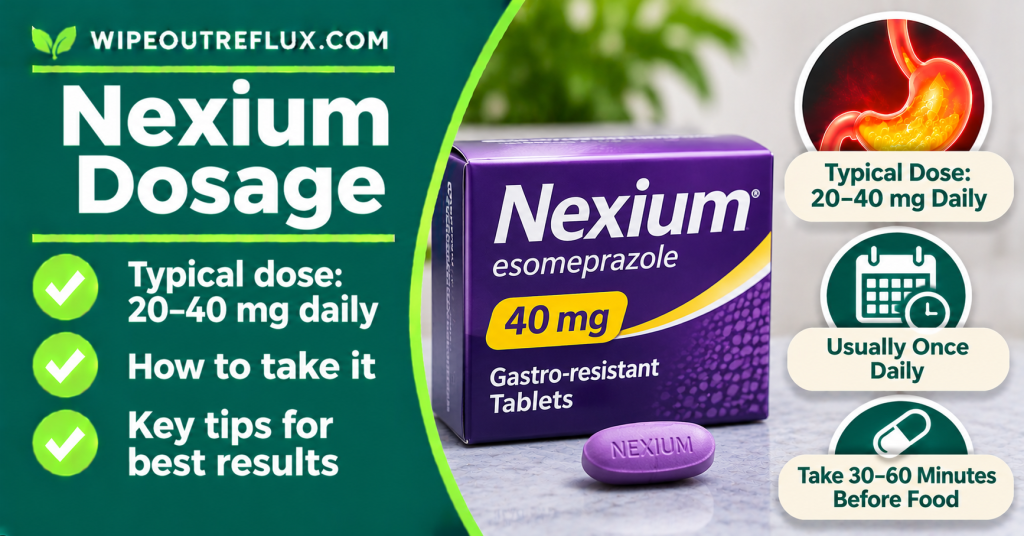
The standard Nexium (esomeprazole) dose for acid reflux is 20 mg or 40 mg once a day, taken at least an hour before a meal, usually breakfast. Over the counter, Nexium 24HR is 20 mg once daily for a 14-day course. Prescription doses depend on the condition: 20 mg for everyday reflux symptoms and for keeping things healed, and 40 mg for healing an inflamed esophagus.
Higher doses exist for rarer conditions, up to 40 mg twice daily and beyond under specialist care. But for most people, the bigger factor isn’t the number of milligrams. It’s taking Nexium at the right time relative to food, which can make a real difference to how well it works.
Key Takeaways
- OTC Nexium 24HR: 20 mg once daily for 14 days, repeatable every 4 months unless a doctor advises otherwise.
- Reflux symptoms without esophageal damage: usually 20 mg once daily for 4 weeks.
- Healing erosive esophagitis: 20 or 40 mg once daily for 4 to 8 weeks. In trials, 40 mg healed about 94% of patients by 8 weeks.
- Maintenance after healing: 20 mg once daily works almost as well as 40 mg. 10 mg was much weaker.
- Take Nexium at least one hour before eating. Taking it just before a high-fat meal cut the amount absorbed substantially.
- If once daily isn’t enough, splitting into twice daily is usually more effective than raising the single dose.
- People with severe liver impairment shouldn’t exceed 20 mg a day.
- Nexium isn’t recommended with clopidogrel. Pantoprazole is a common alternative.
Nexium Dosage Chart
These are the usual adult doses from the US prescribing information. Your doctor may adjust them.
- Frequent heartburn (OTC Nexium 24HR): 20 mg once daily for 14 days.
- Symptomatic GERD (no erosions): 20 mg once daily for 4 weeks, with a further 4 weeks if symptoms haven’t settled.
- Healing erosive esophagitis: 20 or 40 mg once daily for 4 to 8 weeks, with a further 4 to 8 weeks if not healed.
- Maintaining healing: 20 mg once daily.
- Reducing NSAID-related ulcer risk: 20 or 40 mg once daily for up to 6 months.
- H. pylori eradication: 40 mg once daily for 10 days, combined with two antibiotics.
- Zollinger-Ellison syndrome and other hypersecretory states: starting at 40 mg twice daily, adjusted by a specialist.
In the UK, Nexium is sold over the counter as Nexium Control 20 mg, and prescription esomeprazole comes as 20 mg and 40 mg tablets. The dosing principles are the same.
Nexium 20 mg vs 40 mg
This is the question I get asked most. The answer depends on whether you’re healing damage or keeping symptoms under control.
For healing, 40 mg is the strongest standard PPI dose
In a trial of 2,425 people with erosive esophagitis, esomeprazole 40 mg healed 93.7% of patients by week 8, compared with 84.2% on omeprazole 20 mg [Richter et al., American Journal of Gastroenterology, 2001]. A network analysis of all the FDA-licensed PPI doses for erosive esophagitis came to the same conclusion: esomeprazole 40 mg gave the highest healing and heartburn relief rates [Li et al., Medicine, 2017].
That’s also why 40 mg is usually chosen for more severe (grade C or D) esophagitis. If that’s you, my guide to erosive esophagitis explains the grades.
For staying healed, 20 mg is usually enough
Once the esophagus has healed, the dose can usually come down. In a six-month trial, healing was maintained in 93.6% of people on 40 mg and 93.2% on 20 mg, essentially identical. On 10 mg it fell to 57.1%, and on placebo to 29.1% [Johnson et al., American Journal of Gastroenterology, 2001].
So for long-term use, 20 mg is the sensible default. The current US guideline from the American College of Gastroenterology recommends using the lowest effective dose for long-term PPI therapy and trying to stop where possible if you don’t have erosive esophagitis or Barrett’s esophagus [Katz et al., American Journal of Gastroenterology, 2022].
Is 40 mg of Nexium a high dose?
It’s the upper end of the standard range, not an unusually high dose. In terms of acid suppression it’s one of the strongest once-daily PPI doses available. In a five-way crossover study, esomeprazole 40 mg kept stomach pH above 4 for an average of 14.0 hours a day, compared with 10.1 to 12.1 hours for standard doses of other PPIs [Miner et al., American Journal of Gastroenterology, 2003]. If you’re comparing with omeprazole, see omeprazole dosage: is 40 mg a high dose?
OTC Nexium 24HR Dosing
Nexium 24HR is 20 mg esomeprazole and is designed as a 14-day course for frequent heartburn, meaning heartburn on two or more days a week. Take one tablet or capsule each morning before eating, every day for 14 days, even if you feel better sooner.
In two trials of people likely to self-treat, a 14-day course of 20 mg produced significantly more heartburn-free days than placebo, and the benefit showed up within the first four days [Peura et al., Postgraduate Medicine, 2014].
Don’t repeat the course more often than every four months unless a doctor tells you to. If you need it more often than that, your reflux needs a proper assessment.
When to Take Nexium
The prescribing information says to take Nexium at least one hour before a meal. This isn’t arbitrary.
Nexium can only switch off proton pumps that are active, and your pumps switch on when food arrives. Taking it ahead of a meal means the drug is in your bloodstream just as the pumps fire up. Food also affects absorption: when esomeprazole 40 mg was taken just 15 minutes before a high-fat meal, the amount absorbed fell substantially compared with taking it fasting [Sostek et al., British Journal of Clinical Pharmacology, 2007].
For most people that means taking Nexium when you wake up and having breakfast an hour later. If your symptoms are mainly at night, your doctor may suggest taking it before your evening meal instead. I compare the options in the best time of day to take Nexium.
Twice-Daily Nexium
If 40 mg once a day isn’t controlling your symptoms, the usual next step is to split the dosing rather than take a bigger single dose. An analysis of pH studies across all the main PPIs found that raising a once-daily dose only increases acid control up to a point, while switching to twice-daily dosing pushes it considerably further [Graham and Tansel, Clinical Gastroenterology and Hepatology, 2018].
Twice-daily Nexium means a dose before breakfast and another before your evening meal. This is commonly prescribed for stubborn GERD and often for LPR. For rare high-acid conditions like Zollinger-Ellison syndrome, specialists go much higher. In one 12-month study, doses were titrated up to a maximum of 240 mg a day to control acid output [Metz et al., American Journal of Gastroenterology, 2007]. That’s a specialist situation, not something to try at home.
Nexium Dosing for Silent Reflux (LPR)
For silent reflux, doctors often prescribe 40 mg twice daily for two to three months. I’d encourage you to go in with realistic expectations.
Esomeprazole reduces the acid in what comes up, but it doesn’t stop reflux events, and it doesn’t stop pepsin from reaching your throat. Trials of PPIs for throat symptoms have been disappointing. In the UK’s TOPPITS trial, twice-daily lansoprazole did no better than placebo for persistent throat symptoms [Wilson et al., Health Technology Assessment, 2021]. The same limitation applies to Nexium. I explain why in why PPIs don’t work for LPR.
That doesn’t mean Nexium is useless for LPR, especially if you also have heartburn. But diet and meal timing do a lot of the heavy lifting, which is why I built the Wipeout Diet Plan around them.
Special Situations
Liver problems
Esomeprazole is processed by the liver. In severe liver impairment (Child-Pugh class C), the daily dose shouldn’t exceed 20 mg. No adjustment is usually needed for mild to moderate liver disease or for kidney problems.
Children
Nexium is approved for children from one month old, with doses based on age and weight. Adolescents aged 12 to 17 typically take 20 or 40 mg once daily. Children’s dosing should always come from a doctor.
Trouble swallowing capsules
Nexium capsules can be opened and the pellets mixed into a tablespoon of applesauce, then swallowed straight away without chewing. Don’t crush the pellets, because the coating protects the drug from stomach acid. There’s also a granule form for oral suspension.
Taking clopidogrel
Nexium and omeprazole interfere with the activation of clopidogrel, and US labeling recommends avoiding them together. Pantoprazole, lansoprazole, rabeprazole or dexlansoprazole are suggested instead [Johnson et al., Postgraduate Medicine, 2014]. For more on that alternative, see pantoprazole for acid reflux.
Missed Doses and Taking Too Much
If you miss a dose, take it as soon as you remember, unless it’s nearly time for your next one. Don’t take two doses to make up for a missed one. An occasional extra dose is unlikely to cause harm, but contact a pharmacist or poison control if you’ve taken much more than prescribed.
How Long Should You Take Nexium?
For symptomatic reflux, a typical course is 4 to 8 weeks. For erosive esophagitis, healing takes up to 8 weeks, and some people need ongoing maintenance at 20 mg. Long-term use is reasonable when there’s a clear reason, but it’s worth reviewing with your doctor every so often.
If you’re stopping after more than a few weeks, taper rather than quitting suddenly, because rebound acid can make you think you still need it. My PPI taper schedule walks through how. For how quickly it starts working, see how long does Nexium take to work, and for side effects, esomeprazole side effects.
Conclusion
Nexium dosing is simpler than it looks. Use 20 mg for everyday reflux symptoms and for staying healed. Use 40 mg when there’s damage to heal. Move to twice daily only when once daily clearly isn’t enough. And whatever the dose, take it a good hour before you eat, because timing affects how well it works as much as the number on the box.
The thing a higher dose can’t do is stop reflux from happening. Nexium makes what comes up less acidic, which is why it’s so effective for heartburn and esophagitis, and why it often falls short for throat symptoms. The long-term goal should be the lowest dose that keeps you comfortable, or none at all.
That’s where the Wipeout Diet Plan comes in. It’s my complete guide to reducing reflux at the source through food choices, meal timing and evening habits. I originally designed it around silent reflux, but since it targets the same root causes, it works equally well if your symptoms are classic heartburn. Many readers use it alongside their PPI first, then work with their doctor to step the dose down.
Frequently Asked Questions
What is the normal dose of Nexium?
20 mg or 40 mg once daily, taken at least an hour before a meal. OTC Nexium 24HR is 20 mg once daily for 14 days.
Is Nexium 20 mg or 40 mg better?
40 mg heals erosive esophagitis better. For maintenance after healing, 20 mg works almost as well as 40 mg, so it’s the usual long-term dose.
What is the maximum dose of Nexium per day?
For reflux, 40 mg twice daily is usually the top of the range. Specialists have used up to 240 mg a day for Zollinger-Ellison syndrome. In severe liver impairment, the limit is 20 mg a day.
Can I take Nexium twice a day?
Only if your doctor prescribes it. Twice-daily dosing is used for stubborn GERD and sometimes LPR, and it controls acid better than a larger single dose.
Should Nexium be taken in the morning or at night?
Most people take it in the morning, an hour before breakfast. If your symptoms are mainly at night, an hour before your evening meal can work better.
Can I take Nexium with food?
It’s best taken at least an hour before eating. Taking it right before a high-fat meal significantly reduces how much is absorbed.
Can I stop taking Nexium suddenly?
After a short course, usually yes. After longer use, tapering is better to avoid rebound acid. Talk to your doctor first if it was prescribed for esophagitis or Barrett’s esophagus.
Research & References
- [Richter et al., American Journal of Gastroenterology, 2001] — In 2,425 patients with erosive esophagitis, esomeprazole 40 mg healed 93.7% by week 8 versus 84.2% with omeprazole 20 mg.
- [Li et al., Medicine, 2017] — Network meta-analysis of 25 trials finding esomeprazole 40 mg gave the highest healing and heartburn relief rates among FDA-licensed PPI doses.
- [Johnson et al., American Journal of Gastroenterology, 2001] — Six-month maintenance trial: healing was maintained in 93.6% on 40 mg, 93.2% on 20 mg, 57.1% on 10 mg and 29.1% on placebo.
- [Katz et al., American Journal of Gastroenterology, 2022] — ACG guideline for GERD, including recommendations on PPI timing, dose escalation and attempting to discontinue long-term therapy.
- [Miner et al., American Journal of Gastroenterology, 2003] — Five-way crossover study: esomeprazole 40 mg kept gastric pH above 4 for 14.0 hours a day, longer than standard doses of four other PPIs.
- [Peura et al., Postgraduate Medicine, 2014] — Two trials showing a 14-day OTC regimen of esomeprazole 20 mg increased heartburn-free days versus placebo, with benefit in the first four days.
- [Sostek et al., British Journal of Clinical Pharmacology, 2007] — Taking esomeprazole 40 mg 15 minutes before a high-fat meal reduced absorption compared with fasting.
- [Graham and Tansel, Clinical Gastroenterology and Hepatology, 2018] — Analysis of PPI pH studies showing once-daily dose increases plateau, while twice-daily dosing gives substantially more acid control.
- [Metz et al., American Journal of Gastroenterology, 2007] — In hypersecretory states including Zollinger-Ellison syndrome, esomeprazole titrated up to 240 mg/day controlled acid output over 12 months.
- [Wilson et al., Health Technology Assessment, 2021] — The TOPPITS trial: lansoprazole 30 mg twice daily for 16 weeks was no better than placebo for persistent throat symptoms.
- [Johnson et al., Postgraduate Medicine, 2014] — Summarizes FDA labeling recommending that omeprazole and esomeprazole be avoided in patients taking clopidogrel.

David Gray
12 years living with LPR · Consultant & researcher
I've lived with LPR for twelve years — the misdiagnoses, the PPI courses that did nothing, the slow work of figuring out what actually helps. Wipeout Reflux is where I translate the research into plain terms for people stuck in the same place. Every claim here is sourced to peer-reviewed work, and I consult one-to-one with LPR sufferers.