
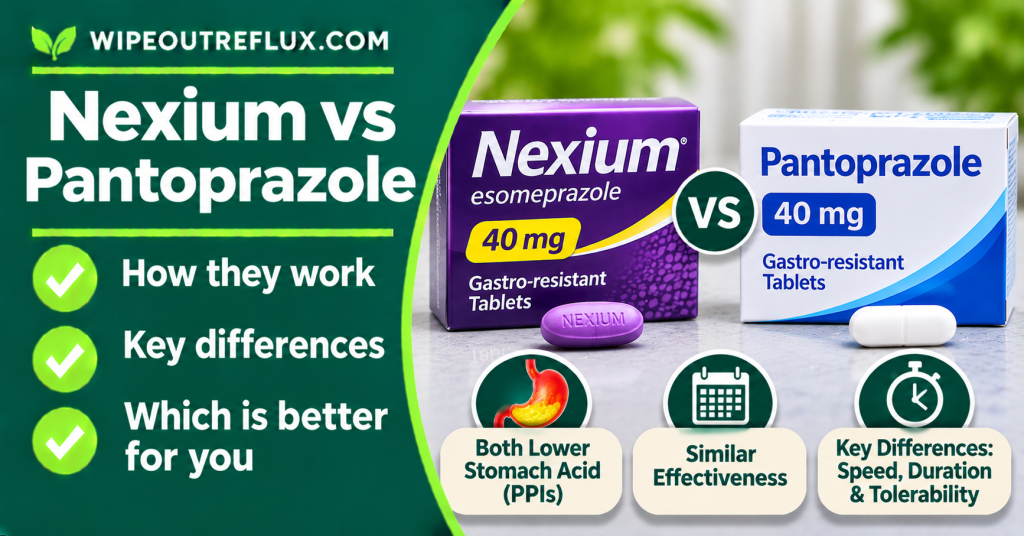
Nexium (esomeprazole) is the stronger of the two. At standard doses it suppresses acid for longer, heals an inflamed esophagus slightly more often, and resolves heartburn a couple of days sooner than pantoprazole (Protonix). Pantoprazole’s advantages are elsewhere: it has fewer drug interactions, it’s the preferred choice if you take the blood thinner clopidogrel, and it’s usually the cheaper option.
For most people with everyday reflux, both work well and the difference is modest. The gap matters more if you have moderate to severe esophagitis, or if pantoprazole isn’t quite controlling your symptoms.
Key Takeaways
- Both are proton pump inhibitors (PPIs). Nexium is esomeprazole, and pantoprazole is sold as Protonix.
- At standard doses, Nexium 40 mg kept stomach pH above 4 for 14.0 hours a day, versus 10.1 hours for pantoprazole 40 mg.
- In the 3,170-patient EXPO trial, esomeprazole 40 mg healed 96% of erosive esophagitis at 8 weeks versus 92% for pantoprazole 40 mg.
- Sustained heartburn relief came at a median of 6 days on Nexium and 8 days on pantoprazole.
- For keeping esophagitis healed over six months, esomeprazole 20 mg kept 87% in remission versus 75% on pantoprazole 20 mg.
- Pantoprazole is slower on day one but largely catches up within a few days.
- Pantoprazole has very few drug interactions and is recommended over Nexium for people taking clopidogrel.
- Neither stops reflux or pepsin, which is why silent reflux often responds poorly to both.
How Nexium and Pantoprazole Work
Both drugs work the same way. They bind to the proton pumps in your stomach lining, the final step in acid production, and switch them off until your body makes new pumps. Because they can only disable pumps that are active, both work best when taken before a meal and build up their full effect over several days.
The differences come down to how much of the drug reaches your bloodstream, how long it stays there, and how your liver processes it. Esomeprazole is the purified, more active half of omeprazole, which gives it more consistent blood levels than its parent drug. If you want that background, I cover it in omeprazole vs esomeprazole.
Acid Control: Nexium Is Stronger
The clearest comparison comes from a five-way crossover study in 34 people with reflux symptoms, who took each PPI at its standard dose for five days. On day five, stomach pH stayed above 4 (the threshold that matters for reflux) for:
- 14.0 hours with esomeprazole 40 mg
- 12.1 hours with rabeprazole 20 mg
- 11.8 hours with omeprazole 20 mg
- 11.5 hours with lansoprazole 30 mg
- 10.1 hours with pantoprazole 40 mg
Esomeprazole was significantly better than all the others [Miner et al., American Journal of Gastroenterology, 2003]. Pantoprazole came last, even though 40 mg is its standard dose.
The day-one difference
The gap is bigger at the very start of treatment. In a study comparing four PPIs, pantoprazole 40 mg kept pH above 4 for 35% of the first day, compared with 54% for esomeprazole 40 mg. By day five, they were much closer (59% versus 67%) [Çelebi et al., Turkish Journal of Gastroenterology, 2016]. So if pantoprazole seems slow in the first few days, that’s expected. See how long pantoprazole takes to work and how long Nexium takes to work for the full timelines.
Healing Esophagitis: Nexium Edges Ahead
The biggest head-to-head trial of these two drugs is the EXPO study. It randomized 3,170 people with erosive esophagitis to esomeprazole 40 mg or pantoprazole 40 mg. Esomeprazole healed more patients at both 4 weeks (81% versus 75%) and 8 weeks (96% versus 92%). Heartburn also settled faster, with a median of 6 days to sustained relief on esomeprazole and 8 days on pantoprazole [Labenz et al., Alimentary Pharmacology & Therapeutics, 2005].
Pooled analyses agree. A comparison of the European-licensed PPI doses for severe esophagitis found esomeprazole 40 mg was the only one with significantly higher healing rates than omeprazole 20 mg [Edwards et al., Alimentary Pharmacology & Therapeutics, 2009]. A network meta-analysis of FDA-licensed doses also ranked esomeprazole 40 mg top, while noting that esomeprazole 40 mg, pantoprazole 40 mg, esomeprazole 20 mg and lansoprazole 30 mg all offered a good balance of effectiveness and tolerability [Li et al., Medicine, 2017].
Worth noting: 92% healing on pantoprazole is still very good. Most of the difference shows up in more severe esophagitis.
Staying Healed: Nexium Again
The EXPO study continued with a maintenance phase. 2,766 people whose esophagitis had healed took either esomeprazole 20 mg or pantoprazole 20 mg for six months. 87.0% stayed in endoscopic and symptomatic remission on esomeprazole, compared with 74.9% on pantoprazole [Labenz et al., Alimentary Pharmacology & Therapeutics, 2005].
That’s a bigger gap than the healing phase, which makes sense. Pantoprazole 20 mg is a fairly low dose in acid-suppression terms. Many people on long-term pantoprazole stay on 40 mg for this reason. See pantoprazole dosage for the details.
Drug Interactions: Pantoprazole Wins
This is pantoprazole’s strongest card. Both drugs are processed by liver enzymes, mainly CYP2C19, but pantoprazole has much less tendency to interfere with other drugs.
A review of pantoprazole’s interaction studies found it didn’t affect the pharmacokinetics or effects of a long list of medicines, including warfarin, phenytoin, diazepam, digoxin, carbamazepine and a hormonal contraceptive [Steinijans et al., International Journal of Clinical Pharmacology and Therapeutics, 1996].
The most important practical example is clopidogrel (Plavix), a blood thinner used after heart attacks and stents. Omeprazole and esomeprazole reduce clopidogrel’s conversion to its active form, and US labeling recommends avoiding them together. Pantoprazole is one of the suggested alternatives [Johnson et al., Postgraduate Medicine, 2014]. If you take clopidogrel, that alone usually settles the choice in pantoprazole’s favor.
Side Effects
The side effect profiles are very similar. Both commonly cause headache, diarrhea, nausea and stomach pain, and both carry the same long-term considerations as other PPIs, including lower magnesium and B12, fracture risk and certain infections. There’s no strong evidence that either is safer than the other in the long run.
For the specifics, see esomeprazole side effects and pantoprazole side effects.
Timing and How to Take Them
Both should be taken before food, usually 30 to 60 minutes before breakfast. Nexium’s label specifically says at least one hour before a meal. Food can reduce how much esomeprazole you absorb: taking it 15 minutes before a high-fat meal significantly lowered absorption compared with taking it fasting [Sostek et al., British Journal of Clinical Pharmacology, 2007].
Pantoprazole tablets should be swallowed whole, not crushed or chewed. Nexium capsules can be opened and the pellets sprinkled on applesauce if you struggle with swallowing pills.
Cost and Availability
Both are available as cheap generics. In the US, Nexium 24HR (esomeprazole 20 mg) is sold over the counter, while pantoprazole is prescription-only. In the UK, both are prescription medicines at standard doses, with Nexium Control 20 mg and pantoprazole 20 mg both available from pharmacies for short-term use. Pantoprazole is often the cheaper generic, which is partly why it’s so widely prescribed.
Which Should You Choose?
- Taking clopidogrel: pantoprazole.
- On several other medications: pantoprazole is the lower-interaction option.
- Moderate to severe erosive esophagitis: Nexium 40 mg has the edge for healing.
- Pantoprazole isn’t quite controlling your symptoms: switching to Nexium, or moving to twice-daily dosing, are both reasonable next steps to discuss with your doctor.
- Everyday reflux that’s well controlled: stick with whichever is working. The difference is small.
Switching between them is straightforward. You simply take the new PPI the next morning in place of the old one, with no gap needed. Do it with your doctor’s input if the PPI was prescribed.
What About Silent Reflux (LPR)?
Nexium’s stronger acid control doesn’t translate into better results for throat symptoms, and the reason is mechanical. Both drugs reduce acid, but neither stops reflux from reaching your throat, and neither stops pepsin, the enzyme behind much of the irritation in LPR. Trials of PPIs for throat symptoms have been disappointing in general. I explain why in why PPIs don’t work for LPR and proton pump inhibitors for LPR.
If you have LPR, the choice of PPI matters much less than what you eat, when you eat and how you sleep. That’s what the Wipeout Diet Plan focuses on.
Conclusion
On the numbers, Nexium beats pantoprazole. It suppresses acid for longer, heals esophagitis slightly more often, relieves heartburn a couple of days sooner and keeps people in remission better at low doses. But pantoprazole is no slouch. It still heals the vast majority of esophagitis, it has the cleanest interaction profile of the common PPIs, and it’s the right pick for anyone taking clopidogrel. For everyday reflux that’s under control, the “best” PPI is simply the one that’s working for you.
What neither drug does is reduce how often reflux happens. That’s why so many people end up switching from one PPI to another, or raising the dose, without ever feeling truly on top of their symptoms.
The Wipeout Diet Plan tackles the part that tablets can’t. It’s my complete guide to the foods, meal timing and daily habits that cut reflux at the source. It was designed primarily around LPR, the stubborn throat-based form, but the same approach works just as well for GERD and classic heartburn. For many readers, it’s what finally makes it possible to talk to their doctor about stepping the dose down.
Frequently Asked Questions
Is Nexium stronger than pantoprazole?
Yes. At standard doses, esomeprazole 40 mg suppresses acid for several hours longer per day than pantoprazole 40 mg and heals esophagitis slightly more often.
Is pantoprazole safer than Nexium?
Their side effects are very similar. Pantoprazole has fewer drug interactions, which makes it the safer choice if you take clopidogrel or several other medications.
Can I switch from pantoprazole to Nexium?
Yes. Take the new one the next morning in place of the old one. If pantoprazole was prescribed, check with your doctor first.
Is Nexium 20 mg the same as pantoprazole 40 mg?
Not exactly, but they’re closer in strength than the numbers suggest. Pantoprazole is less potent per milligram, which is why its standard dose is higher.
Which works faster, Nexium or pantoprazole?
Nexium. It suppresses more acid on the first day, and in the EXPO trial sustained heartburn relief came about two days sooner.
Which is better for silent reflux?
Neither has a clear advantage. Both reduce acid but don’t stop reflux or pepsin reaching the throat, so diet and lifestyle changes matter more.
Can I take Nexium and pantoprazole together?
No. They do the same job, and taking two PPIs together adds side-effect risk without a clear benefit. If one isn’t enough, your doctor may increase the dose or add a bedtime H2 blocker instead.
Research & References
- [Miner et al., American Journal of Gastroenterology, 2003] — Five-way crossover study: gastric pH stayed above 4 for 14.0 hours with esomeprazole 40 mg versus 10.1 hours with pantoprazole 40 mg.
- [Çelebi et al., Turkish Journal of Gastroenterology, 2016] — On day 1, pantoprazole 40 mg kept pH above 4 for 35% of the time versus 54% for esomeprazole 40 mg; by day 5 the figures were 59% and 67%.
- [Labenz et al., Alimentary Pharmacology & Therapeutics, 2005] — EXPO healing trial in 3,170 patients: esomeprazole 40 mg healed 96% versus 92% for pantoprazole 40 mg at 8 weeks, with faster heartburn resolution.
- [Labenz et al., Alimentary Pharmacology & Therapeutics, 2005] — EXPO maintenance phase: 87.0% remained in remission on esomeprazole 20 mg versus 74.9% on pantoprazole 20 mg over six months.
- [Edwards et al., Alimentary Pharmacology & Therapeutics, 2009] — Mixed treatment comparison showing esomeprazole 40 mg was the only licensed PPI dose with significantly higher healing than omeprazole 20 mg in severe esophagitis.
- [Li et al., Medicine, 2017] — Network meta-analysis of 25 trials ranking esomeprazole 40 mg highest for healing, with pantoprazole 40 mg also performing well on effectiveness and acceptability.
- [Steinijans et al., International Journal of Clinical Pharmacology and Therapeutics, 1996] — Review finding pantoprazole did not alter the pharmacokinetics or effects of a wide range of commonly used drugs.
- [Johnson et al., Postgraduate Medicine, 2014] — Summarizes FDA labeling recommending avoidance of omeprazole and esomeprazole with clopidogrel, with pantoprazole among the suggested alternatives.
- [Sostek et al., British Journal of Clinical Pharmacology, 2007] — Esomeprazole absorption was reduced when taken 15 minutes before a high-fat meal compared with fasting.

David Gray
12 years living with LPR · Consultant & researcher
I've lived with LPR for twelve years — the misdiagnoses, the PPI courses that did nothing, the slow work of figuring out what actually helps. Wipeout Reflux is where I translate the research into plain terms for people stuck in the same place. Every claim here is sourced to peer-reviewed work, and I consult one-to-one with LPR sufferers.