
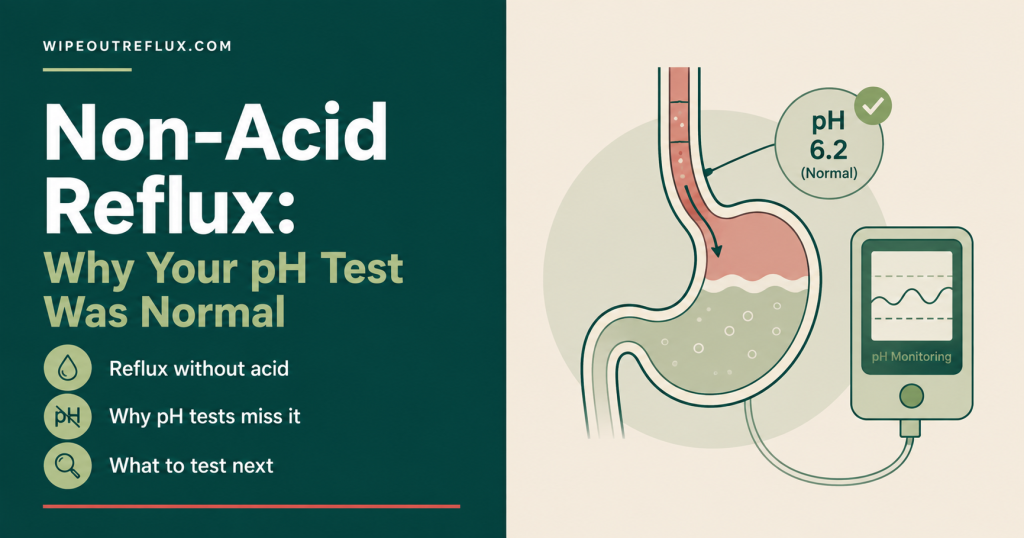
If your reflux symptoms are real but your pH test came back normal, there’s a good chance you have non-acid reflux — reflux that’s happening, but isn’t acidic enough for a standard pH test to register. The test wasn’t wrong. It was just measuring the wrong thing.
A conventional pH probe only flags reflux when it turns the esophagus acidic (below pH 4). But reflux isn’t only acid. It also carries pepsin, bile and partly-digested food, and when that mixture is weakly acidic or non-acidic — which is exactly what happens once acid-suppressing medication is in the picture — it can still travel up, still irritate your throat and esophagus, and still cause every symptom you’re feeling, all while sailing straight past a pH-only test.
This is one of the most common reasons people are told “your reflux tests are normal” while they clearly still have reflux. Here’s what non-acid reflux actually is, why the standard test misses it, the test that catches it, and why the treatment is different.
Key Takeaways
- Non-acid reflux is reflux that’s weakly acidic or non-acidic — real reflux that a standard pH test doesn’t detect because it only measures acid (below pH 4).
- A “normal” pH test doesn’t mean you don’t have reflux; it may mean your reflux simply isn’t acidic.
- PPIs reduce the acid in reflux but don’t stop the reflux itself — they effectively convert acid reflux into non-acid reflux, which is why symptoms can persist on medication.
- Non-acid reflux still causes damage and symptoms, mainly through pepsin (active even in weakly acidic conditions) and bile.
- Around a third of people with reflux symptoms that persist despite PPIs have non-acid reflux driving those symptoms.
- The test that detects it is impedance-pH monitoring (MII-pH), which senses reflux by movement, regardless of acidity.
- It’s especially relevant to LPR (silent reflux) and to anyone whose symptoms don’t respond to acid suppression.
- Because it isn’t an acid problem, more acid suppression usually isn’t the answer — reducing reflux itself is.
What non-acid reflux actually is
Reflux is graded by how acidic it is. Acid reflux is strongly acidic (below pH 4) — that’s the classic, burning kind a pH test is built to catch. But stomach contents aren’t always that acidic when they come up, and reflux is sorted into three bands:
- Acid reflux — pH below 4. The type standard testing detects.
- Weakly acidic reflux — pH between 4 and 7. Real reflux, but not acidic enough to trip a pH probe’s threshold.
- Weakly alkaline (non-acid) reflux — pH above 7. Often carries bile from further down the digestive tract.
“Non-acid reflux” is usually shorthand for that second and third group together — reflux that’s happening just as physically as the acidic kind, but without the low pH. The material still refluxes up. It still contains irritants. It just doesn’t announce itself as acid.
Why your pH test came back normal
This is the crux of it, and it’s worth understanding clearly.
A traditional pH study — whether a catheter or a Bravo capsule — works by detecting when the pH in your esophagus drops into acidic territory. Every acid reflux event shows up as a dip below pH 4. It’s genuinely good at what it does. But it has a blind spot baked into its design: if a reflux event is weakly acidic or non-acidic, the pH never drops far enough to be counted. To a pH-only test, non-acid reflux is invisible — not because nothing happened, but because the test only listens for one signal.
So a “normal” pH result really means “not much acid reflux was detected.” That’s a very different statement from “you don’t have reflux.” If your symptoms are convincing but your pH test is clean, non-acid reflux is one of the first things a specialist should consider — it’s a common piece of the puzzle when reflux treatment isn’t adding up.
The PPI paradox: how acid suppression creates non-acid reflux
Here’s the part that surprises people most, and it explains a lot of frustrating treatment stories.
Proton pump inhibitors (PPIs) don’t stop reflux — they only reduce the acid in it. The valve is still weak, the stomach contents still travel up; they’re just less acidic on the way. In effect, a PPI converts your acid reflux into non-acid reflux. The reflux keeps happening, and so, often, do the symptoms — which is exactly why so many people feel no better on medication and are then told their pH test (done on the drug) looks fine.
The research bears this out. In patients whose symptoms persisted despite acid suppression, impedance-pH monitoring showed that ongoing reflux — much of it non-acidic — was still associated with their symptoms Mainie et al., Gut, 2006. And a review of the refluxate makes the point directly: while acid drives most reflux symptoms off medication, among people on PPIs with persistent symptoms the majority of those symptoms are now caused by weakly acidic or bile reflux instead Richter, American Journal of the Medical Sciences, 2009. This is a big part of why PPIs so often underperform in LPR.
If it isn’t acidic, why does it still hurt?
A fair question — if the acid’s been taken out, what’s left to cause trouble? Two things, mainly.
Pepsin. This is the key one. Pepsin is a stomach enzyme that comes up with every reflux event, acidic or not, and it clings to the lining of the throat and esophagus. Crucially, it isn’t only active in strong acid — it remains enzymatically active in weakly acidic conditions and can be reactivated by even small dips in pH, damaging tissue as it goes Bardhan et al., International Journal of Otolaryngology, 2012. In non-acid and throat-based reflux, pepsin — not acid — is the principal agent of harm, which is why understanding pepsin is so central to silent reflux.
Bile. Non-acid reflux, especially the weakly alkaline kind, often carries bile that’s travelled up from the small intestine. Bile acids are irritating in their own right and can be caustic to the esophageal lining at more neutral pH, which is why bile reflux is its own distinct problem. Combined with pepsin, it can do real damage without a drop of strong acid involved.
The test that actually catches it: impedance-pH monitoring
If a pH test can’t see non-acid reflux, what can? The answer is multichannel intraluminal impedance-pH monitoring (MII-pH, or impedance-pH testing).
Instead of only measuring acidity, impedance measures movement. Sensors along a thin catheter detect any bolus of liquid or gas travelling up the esophagus by the way it changes electrical resistance — regardless of whether it’s acidic, weakly acidic or non-acidic. Paired with a pH sensor, it can tell not just that reflux happened but what kind. That’s what makes it able to catch the reflux a pH-only test misses, and to link your symptoms to reflux events even when those events aren’t acidic.
Impedance-pH testing is particularly valuable when it’s done on your PPI — because that’s precisely when reflux is likely to be non-acidic. It’s become a key tool for making sense of symptoms that persist despite acid suppression, and it sits alongside the other pieces of a proper reflux work-up. If your symptoms are throat-based, a pepsin (Peptest) test can add another angle by detecting pepsin in what you cough up.
Why the treatment is different
This is the practical payoff of the whole diagnosis. If your reflux isn’t acidic, then piling on more acid suppression is fighting the wrong battle. Doubling the PPI dose doesn’t help non-acid reflux, because there’s little acid left to suppress — you’re already seeing the result of that in your normal pH test.
What actually helps non-acid reflux is reducing the reflux itself — the volume and the number of events — rather than just its acidity. In practice that means:
- A physical barrier. Alginates form a raft on top of the stomach contents that blocks reflux mechanically — acidic or not — and can help sweep pepsin away, which is why they’re often more useful here than another acid drug.
- Neutralising pepsin. Since pepsin is the main aggressor, strategies aimed at managing pepsin in the throat matter more than chasing acid.
- Reducing reflux at the source. The levers that lower how much your body refluxes in the first place — meal size and timing, not lying down after eating, weight where relevant, and above all the triggers in your diet — work regardless of the refluxate’s pH.
- Rethinking the PPI. If a PPI genuinely isn’t helping, that’s a conversation to have with your doctor rather than a dose to keep raising — though never stop abruptly, given the risk of acid rebound.
Conclusion
A normal pH test with abnormal symptoms is one of the most misread results in reflux care. It rarely means nothing is wrong — far more often it means your reflux simply isn’t acidic, and a test built to detect acid was never going to find it. Non-acid reflux is real reflux: the same weak valve, the same stomach contents travelling up, the same pepsin and bile doing damage — just without the low pH that lights up a standard probe. And because acid-suppressing medication strips the acid out of reflux without stopping the reflux, it’s often the very thing turning your reflux non-acidic in the first place.
The two things worth taking from this: if your symptoms persist despite a clean pH test or a PPI that isn’t working, ask about impedance-pH testing, which can actually see what’s happening. And recognise that the fix isn’t more acid suppression — it’s reducing how much you reflux at all, and dealing with the pepsin that’s driving the harm.
That’s exactly where diet does the heavy lifting, because it lowers reflux itself rather than just neutralising acid. The Wipeout Food Reference Guide is the essential reference for which foods and drinks are safe with acid reflux and LPR, and their pH values, so you can strip out what’s provoking reflux in the first place. And for the complete, structured approach, the Wipeout Diet Plan goes much deeper. It was built first and foremost around LPR — the throat-based, pepsin-driven reflux where non-acid reflux matters most and where acid tests so often read normal — but because it works on the same underlying mechanisms, it’s just as effective for classic GERD and heartburn. When the problem isn’t the acid, the answer isn’t more acid suppression — it’s giving your body less to reflux.
Frequently Asked Questions
Can you have reflux with a normal pH test?
Yes, very commonly. A standard pH test only detects acidic reflux (below pH 4). If your reflux is weakly acidic or non-acidic — which is typical on acid-suppressing medication — it won’t register, so the test can look normal even though reflux is clearly happening and causing symptoms.
What is non-acid reflux?
Non-acid reflux is reflux that is weakly acidic (pH 4–7) or weakly alkaline (pH above 7) rather than strongly acidic. The stomach contents still travel up and still contain irritants like pepsin and bile, but without the low pH, so a conventional acid-based test doesn’t detect it.
Why do I still have reflux symptoms on a PPI?
Because PPIs reduce the acid in reflux but don’t stop the reflux itself. The stomach contents still come up, just less acidic — effectively non-acid reflux — and pepsin and bile can keep causing symptoms. Studies show that in people with persistent symptoms on PPIs, most of those symptoms are due to weakly acidic or bile reflux.
What test detects non-acid reflux?
Impedance-pH monitoring (MII-pH). It detects reflux by sensing the movement of liquid and gas up the esophagus regardless of acidity, then uses a pH sensor to classify each event. Unlike a standard pH test, it can catch non-acid reflux and link it to your symptoms, and it’s most informative when done while you’re on your PPI.
Is non-acid reflux dangerous?
It can still cause tissue irritation and symptoms, mainly through pepsin, which stays active in weakly acidic conditions, and through bile. It’s a genuine problem rather than a harmless finding, which is why identifying it matters — the treatment differs from standard acid reflux.
How do you treat non-acid reflux?
By reducing reflux itself rather than just its acidity. That means physical barriers like alginates, strategies to manage pepsin, and lowering reflux at the source through diet, meal timing, weight and posture. More acid suppression usually doesn’t help, since there’s little acid left to suppress.
Research & References
- Multicentre study using combined impedance-pH monitoring in patients with persistent symptoms despite acid-suppressive therapy, showing that ongoing reflux — including non-acid reflux — remained associated with symptoms and could be detected when pH monitoring alone would not Mainie et al., Gut, 2006.
- Review of the role of acid, weakly acidic and bile components of the refluxate, noting that while acid drives most reflux symptoms off medication, among patients on proton pump inhibitors with persistent symptoms the majority of symptoms are due to weakly acidic or bile reflux Richter, American Journal of the Medical Sciences, 2009.
- Review advancing the role of pepsin, describing how pepsin carried up in low- or non-acidic reflux remains enzymatically active in weakly acidic conditions and is the principal agent of tissue damage in extraesophageal (throat-based) reflux Bardhan et al., International Journal of Otolaryngology, 2012.

David Gray
12 years living with LPR · Consultant & researcher
I've lived with LPR for twelve years — the misdiagnoses, the PPI courses that did nothing, the slow work of figuring out what actually helps. Wipeout Reflux is where I translate the research into plain terms for people stuck in the same place. Every claim here is sourced to peer-reviewed work, and I consult one-to-one with LPR sufferers.