
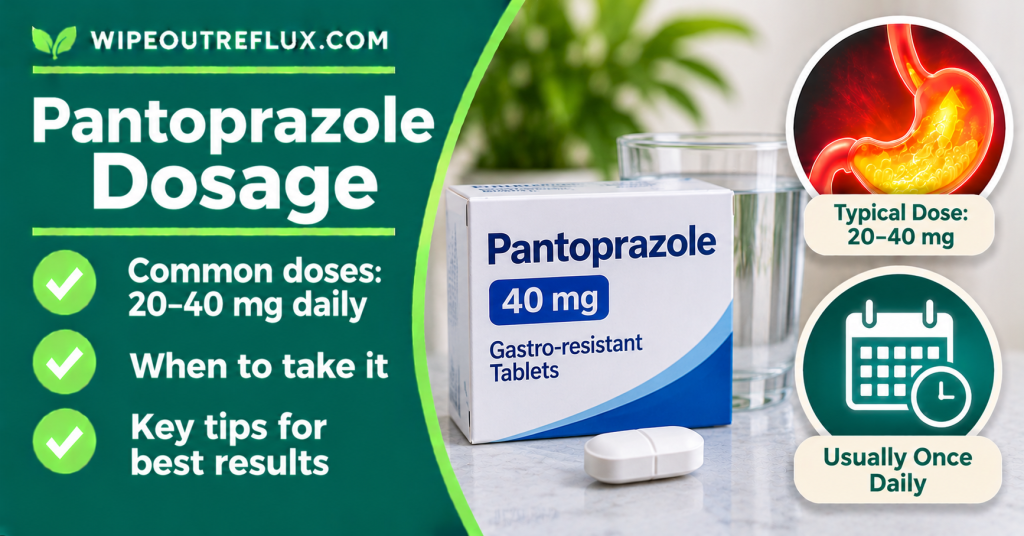
The standard adult dose of pantoprazole for acid reflux is 40 mg once a day, usually for up to 8 weeks to heal an inflamed esophagus. In the US, 40 mg is the only adult strength on the label. In the UK and Europe, 20 mg once a day is also widely used for milder reflux and for keeping symptoms under control long term.
Take it once a day, ideally about 30 minutes before breakfast, and swallow the tablet whole. If you miss a dose, take it when you remember unless your next dose is nearly due, and never double up. Below I’ll go through 20 mg vs 40 mg, how long a course usually lasts, the best time to take it, and what to do if it isn’t working.
Key Takeaways
- The usual adult dose is 40 mg once daily for up to 8 weeks to heal erosive esophagitis, then 40 mg once daily if maintenance is needed.
- 20 mg is a common dose in the UK and Europe for mild reflux, on-demand use and long-term maintenance. In the US, 20 mg tablets are labeled for children.
- 40 mg heals the esophagus faster than 20 mg. In one trial, 72% were healed at 4 weeks on 40 mg vs 55% on 20 mg.
- Take it about 30 minutes before your first meal. PPIs work best when your stomach’s acid pumps are being switched on by food.
- Swallow the tablet whole. Don’t split, crush or chew it.
- If you miss a dose, take it as soon as you remember, unless your next dose is nearly due. Never take two doses at once.
- Guidelines recommend the lowest dose that controls your symptoms and a regular review of whether you still need it.
- Higher doses, such as twice daily, are often used for LPR, but the evidence that they help throat symptoms is weak.
Pantoprazole Dosage Chart
Here’s how the official US prescribing information sets out the dose by condition [Protonix Prescribing Information, Pfizer]:
- Erosive esophagitis from GERD (healing): 40 mg once daily for up to 8 weeks.
- Maintenance of healing: 40 mg once daily.
- Zollinger-Ellison syndrome and other high-acid conditions: starting at 40 mg twice daily.
- Children aged 5 and over with erosive esophagitis: 20 mg once daily if they weigh 15 to under 40 kg, or 40 mg once daily if 40 kg or more, for up to 8 weeks.
UK and European product information adds 20 mg once daily for adults with symptomatic reflux, for long-term management to prevent relapse, and for protecting the stomach in people who need to take anti-inflammatory painkillers (NSAIDs) [Pantoprazole 20 mg Summary of Product Characteristics, emc].
Your doctor may prescribe something different from these standard doses based on your situation. Always follow the instructions on your prescription.
Pantoprazole 20 mg vs 40 mg
The main difference is strength. 40 mg suppresses more acid and heals damage faster. 20 mg is gentler and is often enough for people whose main problem is symptoms rather than visible damage to the esophagus.
For healing an inflamed esophagus, 40 mg wins
The key dose-finding trial randomized 603 people with erosive esophagitis to pantoprazole 10, 20 or 40 mg, or placebo. The healing rates were [Richter and Bochenek, The American Journal of Gastroenterology, 2000]:
- At 4 weeks: 72% on 40 mg, 55% on 20 mg, 42% on 10 mg and 14% on placebo
- At 8 weeks: 88% on 40 mg, 78% on 20 mg, 59% on 10 mg and 33% on placebo
The 40 mg dose healed more people, and healed them sooner, regardless of how severe the damage was. That’s why 40 mg is the standard dose for erosive esophagitis.
For keeping things healed, 40 mg also holds up better
In the maintenance trials on the US label, 86% of people on 40 mg were still healed after 12 months in one study, versus 70% on 20 mg [Protonix Prescribing Information, Pfizer]. Both doses did far better than the older acid reducer ranitidine.
For milder reflux, 20 mg is often enough
If you have heartburn but no significant damage on endoscopy (non-erosive reflux) or only mild inflammation, 20 mg is commonly used outside the US. UK guidance says symptom relief on 20 mg is generally achieved within 2 to 4 weeks, with a further 4 weeks if needed [Pantoprazole 20 mg Summary of Product Characteristics, emc].
In a study of people with mild reflux, 87.3% had relief from heartburn after 4 weeks of pantoprazole 20 mg once daily. Those who were symptom-free then switched to taking 20 mg only when they needed it, which controlled symptoms as well as on-demand esomeprazole [Scholten et al., Clinical Drug Investigation, 2007].
How does pantoprazole 40 mg compare with other PPIs?
Milligram for milligram, pantoprazole is one of the weaker PPIs, which is why its standard dose is higher. Pantoprazole 40 mg is generally treated as roughly equivalent to omeprazole 20 mg for GERD [Graham and Tansel, Clinical Gastroenterology and Hepatology, 2018]. So 40 mg of pantoprazole isn’t a “high dose” in the way 40 mg of omeprazole is. I explain how the drugs compare in pantoprazole vs omeprazole and is omeprazole 40 mg a high dose?
When to Take Pantoprazole
The US label says pantoprazole tablets can be taken with or without food. Food can delay absorption by up to two hours but doesn’t change how much of the drug you absorb [Protonix Prescribing Information, Pfizer]. So why do doctors and pharmacists still say to take it before breakfast?
It comes down to how PPIs work. They can only switch off acid pumps that are actively working, and the biggest wave of pumps switches on when you eat. If the drug is in your bloodstream as that happens, it can catch the most pumps. A crossover study of PPIs found that taking the dose before breakfast left stomach acid in the damaging range for 17.2% of the day, compared with 42.0% when the same dose was taken without a meal following it [Hatlebakk et al., Alimentary Pharmacology and Therapeutics, 2000].
So my practical advice is:
- Once a day: take it 30 minutes or so before breakfast.
- Twice a day: take one dose before breakfast and one before your evening meal.
- Night-time symptoms: some people do better with the dose before their evening meal. Ask your doctor before switching.
The same logic applies across the PPIs. I go into more detail in the best time of day to take omeprazole.
How to Take Pantoprazole
- Swallow it whole with water. Pantoprazole tablets have a special coating that protects the drug from stomach acid. Splitting, crushing or chewing breaks that protection.
- Can’t swallow a 40 mg tablet? The US label says two 20 mg tablets can be taken instead. There’s also a granule form, which is taken about 30 minutes before a meal mixed with applesauce or apple juice [Protonix Prescribing Information, Pfizer].
- Antacids are fine. They don’t affect how pantoprazole is absorbed, so you can use them for breakthrough symptoms.
- Take it at the same time each day. PPIs build up their effect over several days, and consistency matters.
What If I Miss a Dose?
Take the missed dose as soon as you remember. If it’s nearly time for your next dose, skip the missed one and carry on as normal. Never take two doses at once to make up for it [Protonix Prescribing Information, Pfizer].
Missing a single dose isn’t a big deal. The acid-reducing effect of each dose lasts more than 24 hours, so you won’t lose all your protection overnight. You may notice some symptoms creep back if you miss several doses in a row.
How Long Should You Take Pantoprazole?
For erosive esophagitis, the standard course is up to 8 weeks. For milder reflux treated with 20 mg, UK guidance suggests most people get relief within 2 to 4 weeks. After that, the right length depends on why you’re taking it.
The American College of Gastroenterology recommends PPIs as the main medical treatment for GERD, but advises using the lowest effective dose and regularly reassessing whether you still need it [Katz et al., The American Journal of Gastroenterology, 2022]. Some people genuinely need long-term treatment, such as those with severe esophagitis or Barrett’s esophagus. Many others can step down, switch to on-demand use, or stop.
If you are on it long term, the safety data for pantoprazole specifically is reassuring. In a randomized trial of 17,598 people who took pantoprazole 40 mg or placebo for a median of three years, the only clear difference was a small increase in gut infections [Moayyedi et al., Gastroenterology, 2019]. I cover the full list in my guide to pantoprazole side effects.
Coming off pantoprazole
Don’t stop suddenly after a long course. Your stomach adapts to the drug by building extra acid-making capacity, and stopping abruptly can cause a rebound. In healthy volunteers with no reflux, 44% developed acid symptoms after stopping eight weeks of a PPI, compared with 15% on placebo [Reimer et al., Gastroenterology, 2009]. A common approach is to drop from 40 mg to 20 mg, then to every other day, then to as-needed. See my PPI taper schedule and getting off PPIs and acid rebound for a step-by-step plan.
Dosing for Silent Reflux (LPR)
This is where things get messy. LPR is often treated with higher doses, frequently twice daily for two to three months, on the theory that the throat is more sensitive than the esophagus and needs more acid suppression.
The trouble is that the evidence doesn’t strongly support it. In a large UK trial, 346 people with persistent throat symptoms took lansoprazole 30 mg twice daily or placebo for 16 weeks. There was no benefit on throat symptoms at 16 weeks or at 12 months [Wilson et al., Health Technology Assessment, 2021].
The reason, I believe, is pepsin. In LPR, the damage comes largely from pepsin, a digestive enzyme that reaches the throat in reflux and can be reactivated by any acid, even weak acid from food and drink. A PPI reduces acid but doesn’t stop reflux reaching your throat, and doesn’t remove pepsin already there. I explain this in more detail in why PPIs don’t work for LPR and PPIs for LPR.
That doesn’t mean a PPI is useless for LPR. Some people do respond, especially if they also have heartburn. But it works far better alongside changes that cut out acidic and pepsin-activating foods, which is the core of the Wipeout Diet Plan.
Special Situations
- Older adults: Blood levels of pantoprazole are somewhat higher in people over 65, but healing rates are similar and no dose change is needed [Protonix Prescribing Information, Pfizer].
- Kidney problems: No dose change is needed, even in severe kidney impairment.
- Liver problems: Pantoprazole is cleared more slowly in cirrhosis. UK guidance says not to exceed 20 mg a day in severe liver impairment [Pantoprazole 20 mg Summary of Product Characteristics (Sandoz), emc].
- Other medications: Pantoprazole can affect the absorption of drugs that need stomach acid, such as some HIV medicines, certain antifungals and iron. It may also raise levels of methotrexate at high doses. Make sure your doctor and pharmacist know everything you take. My article on omeprazole drug interactions covers the main PPI interactions.
What If Your Dose Isn’t Working?
Before anyone ups your dose, check the basics:
- Timing. Are you taking it 30 minutes before a meal? Taking it at bedtime on an empty stomach is one of the most common reasons it underperforms.
- Consistency. PPIs need several days of daily dosing to reach full effect. Taking it “when I remember” won’t work as well.
- Time. Healing takes weeks, and throat symptoms can take months. Give it a fair trial.
- Diagnosis. Not every burning or throat symptom is acid reflux. If you’ve done everything right and nothing has changed, it may be worth testing.
If those are sorted, your doctor may suggest twice-daily dosing, a different PPI, or an alternative such as vonoprazan. I cover the options in acid reflux medication not working. For breakthrough symptoms, an alginate such as Gaviscon Advance can sit alongside your PPI. See my guide to alginates for acid reflux.
See your doctor promptly if you have difficulty swallowing, unexplained weight loss, vomiting, or black or bloody stools, whatever dose you’re on.
Conclusion
For most adults, the pantoprazole dose is simple: 40 mg once a day, taken about 30 minutes before breakfast, swallowed whole. That’s the dose with the best healing rates in clinical trials, and it’s the standard course for up to 8 weeks for erosive esophagitis. If you’re in the UK or Europe, or your reflux is milder, 20 mg once a day or on demand is often enough, and many people find relief within 2 to 4 weeks.
The bigger question isn’t usually 20 mg vs 40 mg, but how long, and what else you’re doing. Guidelines are clear that you should be on the lowest dose that controls your symptoms, with regular check-ins about whether you still need it. When you do come off, taper slowly to avoid rebound acid. And if you have LPR, be realistic: a higher dose often isn’t the answer, because acid isn’t the whole problem.
That’s exactly why I created the Wipeout Diet Plan. Medication lowers acid, but diet decides how often you reflux and how much pepsin gets activated in your throat. The plan takes you through which foods to remove, how long for, and how to bring them back without losing control, based on 12 years of managing reflux myself. It was built primarily around silent reflux, the throat-based kind, but because it targets the same underlying mechanisms it works just as well for GERD and heartburn. For many people, it’s what makes stepping down from 40 mg to 20 mg, or off altogether, a realistic goal to work toward with their doctor.
Frequently Asked Questions
What is the normal dose of pantoprazole?
For adults with GERD and erosive esophagitis, the normal dose is 40 mg once daily for up to 8 weeks. In the UK and Europe, 20 mg once daily is also commonly used for milder reflux and long-term maintenance.
Is pantoprazole 40 mg a high dose?
No. 40 mg is the standard adult dose of pantoprazole. Because pantoprazole is less potent per milligram than omeprazole, 40 mg is roughly equivalent to omeprazole 20 mg. A high dose would be 40 mg twice daily.
Can I take pantoprazole twice a day?
Only if your doctor prescribes it. Twice-daily dosing is used for Zollinger-Ellison syndrome and sometimes for severe GERD or LPR. If prescribed, take one dose before breakfast and one before your evening meal.
Is it better to take pantoprazole in the morning or at night?
Morning, before breakfast, for most people. PPIs work best when taken before a meal, because food switches on the acid pumps the drug needs to block. If your symptoms are mainly at night, ask your doctor about taking it before your evening meal instead.
Can I cut pantoprazole in half?
No. Pantoprazole tablets have a protective coating, and splitting, crushing or chewing them can stop the drug working properly. If you need a lower dose, ask for 20 mg tablets.
What is the maximum dose of pantoprazole?
For reflux, doses rarely go above 40 mg twice daily. Higher doses are only used under specialist care for rare conditions that produce excessive acid, such as Zollinger-Ellison syndrome.
How long can you stay on pantoprazole?
For erosive esophagitis, an initial course is up to 8 weeks. Some people need long-term maintenance, which has been studied for years with reassuring results. Guidelines recommend reviewing the need for it regularly and using the lowest effective dose.
Research & References
- [Protonix Prescribing Information, Pfizer] — Official US labeling giving doses by indication, administration with or without food, missed-dose instructions, maintenance trial results for 20 mg vs 40 mg, and use in older adults and kidney and liver impairment.
- [Pantoprazole 20 mg Summary of Product Characteristics, emc] — UK product information listing 20 mg indications for symptomatic reflux and long-term maintenance, with symptom relief generally within 2 to 4 weeks.
- [Pantoprazole 20 mg Summary of Product Characteristics (Sandoz), emc] — UK product information advising that a daily dose of 20 mg should not be exceeded in severe liver impairment.
- [Richter and Bochenek, The American Journal of Gastroenterology, 2000] — Dose-response trial of 603 patients with erosive esophagitis: 4-week healing was 72%, 55%, 42% and 14% for pantoprazole 40, 20 and 10 mg and placebo, with 40 mg the most effective dose.
- [Scholten et al., Clinical Drug Investigation, 2007] — In mild GERD, 87.3% had heartburn relief after 4 weeks of pantoprazole 20 mg daily, and on-demand pantoprazole 20 mg was comparably effective to on-demand esomeprazole 20 mg over 6 months.
- [Graham and Tansel, Clinical Gastroenterology and Hepatology, 2018] — Analysis of PPI relative potency noting that omeprazole 20 mg and pantoprazole 40 mg have been classed as equivalent for GERD.
- [Hatlebakk et al., Alimentary Pharmacology and Therapeutics, 2000] — Crossover trial showing a PPI taken before breakfast left gastric pH below 4 for 17.2% of the daytime, versus 42.0% when taken without a following meal.
- [Katz et al., The American Journal of Gastroenterology, 2022] — ACG clinical guideline recommending PPIs as the medical treatment of choice for GERD, at the lowest effective dose with periodic reassessment.
- [Moayyedi et al., Gastroenterology, 2019] — Randomized trial of 17,598 patients on pantoprazole 40 mg or placebo for a median of three years, finding no significant harms apart from a small excess of enteric infections.
- [Reimer et al., Gastroenterology, 2009] — After eight weeks of a PPI and withdrawal, 44% of healthy volunteers developed acid-related symptoms versus 15% on placebo, demonstrating rebound acid hypersecretion.
- [Wilson et al., Health Technology Assessment, 2021] — Placebo-controlled trial of 346 patients with persistent throat symptoms finding lansoprazole 30 mg twice daily for 16 weeks gave no benefit at 16 weeks or 12 months.

David Gray
12 years living with LPR · Consultant & researcher
I've lived with LPR for twelve years — the misdiagnoses, the PPI courses that did nothing, the slow work of figuring out what actually helps. Wipeout Reflux is where I translate the research into plain terms for people stuck in the same place. Every claim here is sourced to peer-reviewed work, and I consult one-to-one with LPR sufferers.