
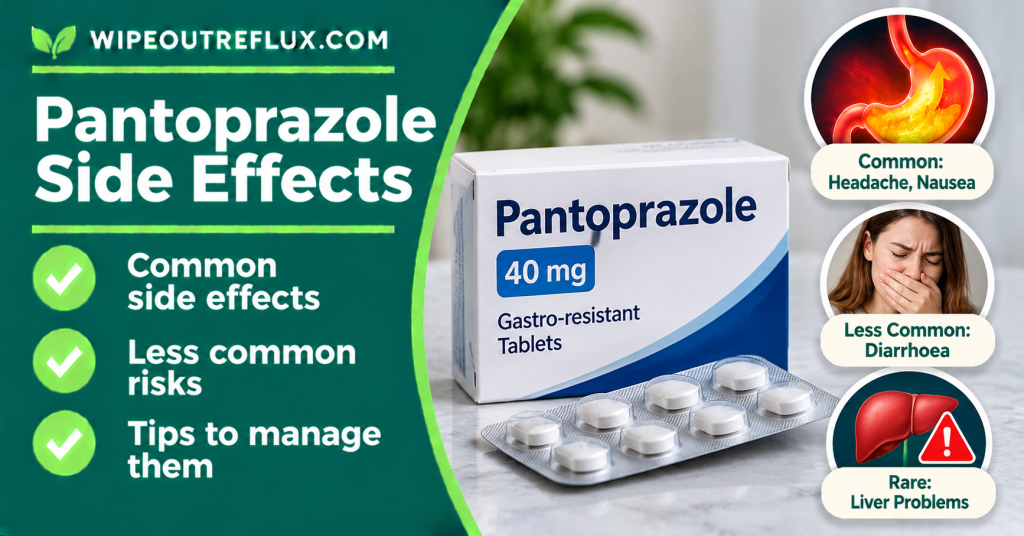
Most people take pantoprazole without any noticeable side effects. When side effects do show up, the most common ones are headache, diarrhea, nausea, stomach pain, gas and dizziness. They’re usually mild, and in clinical trials several of them turned up almost as often in people taking a placebo.
The rarer, more serious risks are kidney inflammation, a gut infection called C. difficile, skin reactions including drug-induced lupus, and low magnesium or vitamin B12. Most of these build up with long-term use rather than appearing in the first few weeks. Below I’ll walk through what’s common, what’s rare, what long-term use actually does, and when a symptom is worth a call to your doctor.
Key Takeaways
- Pantoprazole (brand name Protonix) is generally well tolerated. Headache and diarrhea are the most common side effects in clinical trials.
- Many “side effects” in the trials were close to placebo rates. Nausea was actually reported more often on placebo than on pantoprazole.
- Serious reactions are uncommon but real: kidney inflammation (interstitial nephritis), C. difficile diarrhea, severe skin reactions and drug-induced lupus.
- Low magnesium and vitamin B12 deficiency are slow-building risks that mainly matter after a year or more of daily use.
- In the largest randomized trial of long-term PPI use, 17,598 people took pantoprazole 40 mg or placebo for about three years. The only clear difference was a small rise in gut infections.
- Pantoprazole has fewer drug interactions than omeprazole, which is one reason doctors often choose it for people on clopidogrel.
- Pantoprazole can cause a false-positive urine drug test for THC.
- Stopping suddenly after weeks of use can trigger rebound acid and a temporary flare of symptoms. Tapering helps.
How Pantoprazole Works (and Why That Matters for Side Effects)
Pantoprazole is a proton pump inhibitor, or PPI. It switches off the “proton pumps” in your stomach lining, the tiny pumps that push acid into your stomach. Fewer working pumps means less acid, which gives an inflamed esophagus a chance to heal.
Almost every side effect of pantoprazole traces back to one of three things:
- Less stomach acid. Acid isn’t just a nuisance. It kills bacteria you swallow and helps you absorb vitamin B12, magnesium, iron and calcium. Turn it down for long enough and those jobs suffer.
- Changes in the gut. A less acidic stomach lets more bacteria survive the trip downstream, which is linked to diarrhea, gut infections and small intestinal bacterial overgrowth (SIBO).
- Immune or allergic reactions. These are rare and unpredictable. They include kidney inflammation, skin reactions and drug-induced lupus.
Keeping these three buckets in mind makes the list below far less scary. You can see why a side effect happens, and that usually tells you whether it’s likely to settle, build up over time, or need action straight away.
Common Pantoprazole Side Effects
The official prescribing information pools the clinical trials of adults with GERD (1,473 people on pantoprazole). These are the side effects reported in more than 2% of people, alongside the placebo group for comparison [Protonix Prescribing Information, Pfizer]:
- Headache: 12.2% on pantoprazole vs 8.5% on placebo
- Diarrhea: 8.8% vs 4.9%
- Nausea: 7.0% vs 9.8%
- Abdominal pain: 6.2% vs 6.1%
- Vomiting: 4.3% vs 2.4%
- Gas (flatulence): 3.9% vs 3.7%
- Dizziness: 3.0% vs 1.2%
- Joint pain (arthralgia): 2.8% vs 1.2%
Two things jump out. First, these numbers are low. Second, look at the placebo column. Nausea was more common on the dummy pill, and stomach pain and gas were essentially the same. People with reflux feel rough to begin with, so some of what gets blamed on the tablet is really the condition itself. The placebo group was small (82 people), so I wouldn’t lean on the exact figures, but the pattern is clear.
Headache
Headache is the most reported side effect of pantoprazole and of PPIs in general. It’s usually mild and often fades within the first week or two. If it doesn’t, or it’s severe, it’s worth mentioning to your doctor, because switching to a different PPI sometimes solves it.
Diarrhea and other gut changes
Loose stools are the side effect most clearly linked to the drug in the trial data. Mild diarrhea in the first couple of weeks is common and usually settles. Diarrhea that is watery, persistent or comes with fever and cramping is different, and I cover that in the serious section below. Some people get the opposite problem: if constipation is your issue, I’ve written about whether acid reducers cause constipation.
Dizziness and joint pain
Both were uncommon but did show up more on pantoprazole than placebo. They’re rarely a reason to stop, but if they’re bothering you, they’re worth raising at your next appointment.
Serious Side Effects of Pantoprazole
These are rare. I’m including them because knowing the warning signs is what keeps a rare problem from becoming a serious one. The prescribing information lists the following as serious risks [Protonix Prescribing Information, Pfizer].
Kidney inflammation (acute interstitial nephritis)
This is an immune reaction in the kidneys. It can happen at any point during treatment and the symptoms are vague: tiredness, fever, rash, feeling generally unwell, or passing less urine. In a population study of nearly 300,000 older adults starting a PPI, acute kidney injury and interstitial nephritis were more common than in matched non-users, although the absolute risk stayed low [Antoniou et al., CMAJ Open, 2015]. If it’s caught, stopping the drug usually lets the kidneys recover. The bigger question of long-term kidney disease is covered in my article on PPIs and kidney disease.
C. difficile diarrhea
Clostridioides difficile is a bacterium that can cause severe, watery diarrhea, especially after antibiotics. Observational studies link PPIs to a higher risk, and the label carries a warning. Interestingly, a 2025 meta-analysis of randomized trials (nearly 30,000 people) found no significant difference between PPI and control groups [Floria et al., Gut Microbes, 2025]. So the true risk is probably smaller than early studies suggested. Still, diarrhea that won’t stop, especially with fever or stomach cramps, needs to be checked.
Skin reactions and drug-induced lupus
Severe skin reactions such as Stevens-Johnson syndrome are very rare, but any blistering rash, peeling skin or mouth sores means stop and get help that day.
A subtler one is subacute cutaneous lupus: a scaly, ring-shaped rash on sun-exposed skin, often months after starting the drug. In the largest case series, 24 episodes of PPI-induced lupus were identified, and the rash appeared on average 8 months after starting treatment. Pantoprazole caused 2 of them, while lansoprazole caused 12 [Sandholdt et al., British Journal of Dermatology, 2014]. It usually clears within a few months of stopping the PPI.
Liver problems and other rare reports
Post-marketing reports (problems reported after a drug is on sale, which don’t prove cause) include liver damage, low blood counts, low sodium, muscle breakdown, changes in taste, confusion and insomnia [Protonix Prescribing Information, Pfizer]. Yellowing skin or eyes, dark urine, or unexplained muscle pain and weakness are reasons to call your doctor.
Microscopic colitis
Microscopic colitis is inflammation of the large bowel that causes chronic watery diarrhea, and it’s only visible under a microscope. A Danish study of over 10,000 cases found an association with every PPI, with the strongest link for lansoprazole [Bonderup et al., Alimentary Pharmacology and Therapeutics, 2018]. If you’ve developed ongoing watery diarrhea on pantoprazole, ask your doctor whether this could be the cause.
Long-Term Side Effects of Pantoprazole
This is the part most people really want to know about. I’ve covered each of these risks in depth in separate articles, so here’s the short version of each with a link to the full breakdown.
The most reassuring evidence comes from pantoprazole itself. The COMPASS trial randomized 17,598 people to pantoprazole 40 mg or placebo and followed them for a median of three years. There was no significant difference in pneumonia, fractures, chronic kidney disease, dementia, cancer or death. The one signal was a small rise in gut infections, 1.4% vs 1.0% [Moayyedi et al., Gastroenterology, 2019]. Randomized trials like this are far better than the observational studies behind most of the scary headlines.
- Kidneys. Observational studies link long-term PPIs to chronic kidney disease, but COMPASS didn’t confirm it. Read more on PPIs and kidney disease.
- Bones. Lower acid can reduce calcium absorption, and the label warns of fracture risk with high doses and long-term use. The evidence is mixed. Read more on PPIs and bone density.
- Dementia. Large observational studies give conflicting results, and the randomized evidence doesn’t support a causal link. Read more in do PPIs cause dementia?
- Nutrients. Vitamin B12, magnesium, iron and calcium can all drop with long-term acid suppression. Read more on what nutrients PPIs deplete.
- Infections. Gut infections were the one consistent signal. Read more on PPIs and infection risk.
- Stomach polyps. Benign fundic gland polyps become more likely after about a year. Read more on PPIs and stomach polyps.
Two nutrient issues are worth knowing by their symptoms. Low magnesium usually appears after about a year of treatment and can cause muscle cramps, tremor, palpitations or an irregular heartbeat. A meta-analysis put the odds of low magnesium on PPIs at roughly 1.8 times higher [Cheungpasitporn et al., Renal Failure, 2015]. Low B12 builds up even more slowly. Two or more years of PPI use was linked to 65% higher odds of B12 deficiency [Lam et al., JAMA, 2013]. That can show up as tiredness, pins and needles or a sore tongue.
Does Pantoprazole Have Fewer Side Effects Than Other PPIs?
In terms of everyday side effects, the PPIs are broadly similar. Where pantoprazole stands out is drug interactions. It relies less on the CYP2C19 liver enzyme than omeprazole does, so it interferes less with other medications.
The best-known example is clopidogrel (Plavix). In a randomized crossover trial in heart attack patients, omeprazole significantly reduced clopidogrel’s anti-clotting effect, while pantoprazole didn’t [Fontes-Carvalho et al., European Journal of Gastroenterology and Hepatology, 2011]. That’s why pantoprazole is often the go-to PPI for people on blood thinners. I compare the two drugs in detail in pantoprazole vs omeprazole, and you can see how the side effect profiles line up in my guides to omeprazole side effects and esomeprazole (Nexium) side effects.
Pantoprazole and False-Positive Drug Tests
This one catches people out. PPIs, including pantoprazole, have been linked to false-positive urine screens for THC, the active compound in cannabis. The label advises using a different confirmatory test to check any positive result [Protonix Prescribing Information, Pfizer]. If you’re facing a workplace or sports drug test, tell the tester you take pantoprazole beforehand.
What Happens When You Stop Pantoprazole?
After weeks of acid suppression, your stomach adapts by making more acid-producing capacity. Stop suddenly and that extra capacity is suddenly unopposed. This is rebound acid hypersecretion.
In one trial, healthy volunteers with no reflux at all took a PPI (esomeprazole) for eight weeks and then stopped. 44% developed heartburn, acid regurgitation or indigestion in the following weeks, compared with 15% on placebo [Reimer et al., Gastroenterology, 2009]. That’s a crucial point: symptoms after stopping don’t always mean your reflux is back. Sometimes it’s withdrawal, and it settles.
For that reason I’d never stop pantoprazole cold turkey after a long course. A gradual taper, with an alginate to cover the flare, works far better. My guide to getting off PPIs and acid rebound and my PPI taper schedule walk you through it.
Side Effects vs. “It’s Just Not Working”
Sometimes what feels like a side effect is actually the drug not doing its job. That’s especially common in LPR, or silent reflux, where the throat is the problem. Pantoprazole reduces acid, but it doesn’t stop reflux happening. It changes what comes up.
The irritant behind much of the throat damage is pepsin, a digestive enzyme that can lodge in throat tissue and get reactivated by acid later. A PPI doesn’t remove pepsin, which is why so many people with throat symptoms see little benefit. I explain this in why PPIs don’t work for LPR. If you’re putting up with side effects from a drug that isn’t helping, that’s a conversation worth having with your doctor. Diet changes, alginates and the habits in the Wipeout Diet Plan tackle reflux from a different angle and can make it easier to come down to the lowest dose you actually need.
When to Call Your Doctor
Contact your doctor promptly if you notice:
- Watery diarrhea that lasts more than a couple of days, especially with fever or stomach cramps
- Passing much less urine, or swelling, fever or a rash alongside feeling unwell
- A scaly or ring-shaped rash on sun-exposed skin, or joint pain that’s new
- Muscle cramps, tremor, palpitations or an irregular heartbeat (possible low magnesium)
- Pins and needles, unusual tiredness or a sore, red tongue (possible low B12)
- Yellowing skin or eyes, or dark urine
Get emergency help for a blistering or peeling rash, swelling of the face or throat, or difficulty breathing.
Also see your doctor if your reflux symptoms continue despite treatment, or if you have trouble swallowing, unexplained weight loss, vomiting blood or black stools. Don’t stop a prescribed PPI or change your dose without talking to your doctor first, particularly if you take it to protect your stomach from other medication.
Conclusion
For most people, pantoprazole is one of the gentler reflux medications. The common side effects, headache and diarrhea, are usually mild, and the trial data shows a fair chunk of what gets blamed on the pill happens on placebo too. The serious reactions are rare, and knowing the warning signs is enough to catch them early.
The long-term picture is more reassuring than the headlines suggest. The biggest randomized trial of a PPI ever run used pantoprazole, and after three years the only clear difference was a small increase in gut infections. That said, the slow-building issues are real: low magnesium, low B12 and rebound acid when you stop. The sensible approach is the lowest dose that controls your symptoms, a regular check on whether you still need it, and a taper rather than a sudden stop.
Where I’d push back is on the idea that a PPI is the whole answer. It lowers acid, but it does nothing about why you’re refluxing in the first place, and it barely touches pepsin, which matters most if your symptoms are in your throat. That’s the gap the Wipeout Diet Plan fills. It’s the complete, step-by-step version of everything I’ve learned in 12 years of managing reflux: which foods to cut and when, how to bring them back, and the meal timing and habits that reduce reflux at the source. I built it first for LPR, the stubborn throat-based kind, but because it targets the same root causes it works just as well for GERD and everyday heartburn. For many people, getting their diet right is what makes it possible to step down their dose safely, with their doctor’s support.
Frequently Asked Questions
What are the most common side effects of pantoprazole?
Headache and diarrhea are the most common. Nausea, stomach pain, vomiting, gas, dizziness and joint pain were each reported by fewer than 1 in 10 people in clinical trials, and several of them were nearly as common on placebo.
Do pantoprazole side effects go away?
Mild side effects like headache, nausea and loose stools often settle within the first week or two as your body adjusts. If they persist or are hard to live with, your doctor may suggest a different PPI or a different approach.
Is pantoprazole safe to take long-term?
In the COMPASS trial, about three years of pantoprazole 40 mg showed no significant increase in pneumonia, fractures, kidney disease, dementia, cancer or death compared with placebo, apart from a small rise in gut infections. Long-term use can still lower magnesium and B12, so it should be reviewed regularly and kept at the lowest dose that works.
Can pantoprazole cause anxiety or trouble sleeping?
Insomnia, confusion and, rarely, hallucinations are listed among post-marketing reports, meaning they were reported after the drug went on sale but aren’t proven to be caused by it. They appear to be rare. If you notice new mood or sleep problems after starting pantoprazole, tell your doctor.
Can pantoprazole cause weight gain?
Weight changes are listed as a post-marketing report but aren’t a common trial finding. Some people may eat more once reflux pain eases. I cover the evidence in more detail in can omeprazole cause weight gain?, which applies to PPIs generally.
Is pantoprazole easier on the body than omeprazole?
Their everyday side effects are similar. Pantoprazole’s main advantage is fewer drug interactions, which is why it’s often preferred for people taking clopidogrel and other medicines processed by the CYP2C19 liver enzyme.
Why do I feel worse after stopping pantoprazole?
Likely rebound acid. After weeks on a PPI, your stomach temporarily overproduces acid when the drug is withdrawn. Even people without reflux develop symptoms. It usually eases over a few weeks, and tapering slowly with an alginate for cover makes it much easier.
Research & References
- [Protonix Prescribing Information, Pfizer] — Official labeling listing adverse reactions in adult GERD trials (headache 12.2%, diarrhea 8.8% vs 8.5% and 4.9% on placebo), warnings for interstitial nephritis, C. difficile, fractures, lupus, B12 and magnesium, and false-positive THC urine screens.
- [Moayyedi et al., Gastroenterology, 2019] — Randomized trial of 17,598 patients on pantoprazole 40 mg or placebo for a median of three years, finding no significant difference in pneumonia, fractures, kidney disease, dementia, cancer or mortality, with a small excess of enteric infections (1.4% vs 1.0%).
- [Antoniou et al., CMAJ Open, 2015] — Population-based cohort of 290,592 older adults starting a PPI and matched controls, finding higher rates of acute kidney injury and acute interstitial nephritis, though absolute risks remained low.
- [Floria et al., Gut Microbes, 2025] — Meta-analysis of eight randomized controlled trials including 29,880 participants, finding no significant difference in C. difficile infection between PPI and control groups.
- [Sandholdt et al., British Journal of Dermatology, 2014] — Largest case series of PPI-induced subacute cutaneous lupus: 24 episodes (lansoprazole 12, omeprazole 6, esomeprazole 4, pantoprazole 2), with an average onset of 8 months and resolution around 3 months after stopping.
- [Bonderup et al., Alimentary Pharmacology and Therapeutics, 2018] — Danish case-control study of 10,652 microscopic colitis cases, finding an association with all PPIs and the strongest with current lansoprazole use.
- [Cheungpasitporn et al., Renal Failure, 2015] — Meta-analysis of observational studies finding PPI use associated with roughly 1.8 times higher odds of low magnesium.
- [Lam et al., JAMA, 2013] — Case-control study linking two or more years of PPI use with 65% higher odds of vitamin B12 deficiency.
- [Fontes-Carvalho et al., European Journal of Gastroenterology and Hepatology, 2011] — Randomized crossover trial after heart attack showing omeprazole reduced clopidogrel’s antiplatelet effect while pantoprazole did not.
- [Reimer et al., Gastroenterology, 2009] — Randomized trial in 120 healthy volunteers: after eight weeks of a PPI and withdrawal, 44% developed acid-related symptoms versus 15% on placebo, demonstrating rebound acid hypersecretion.

David Gray
12 years living with LPR · Consultant & researcher
I've lived with LPR for twelve years — the misdiagnoses, the PPI courses that did nothing, the slow work of figuring out what actually helps. Wipeout Reflux is where I translate the research into plain terms for people stuck in the same place. Every claim here is sourced to peer-reviewed work, and I consult one-to-one with LPR sufferers.