
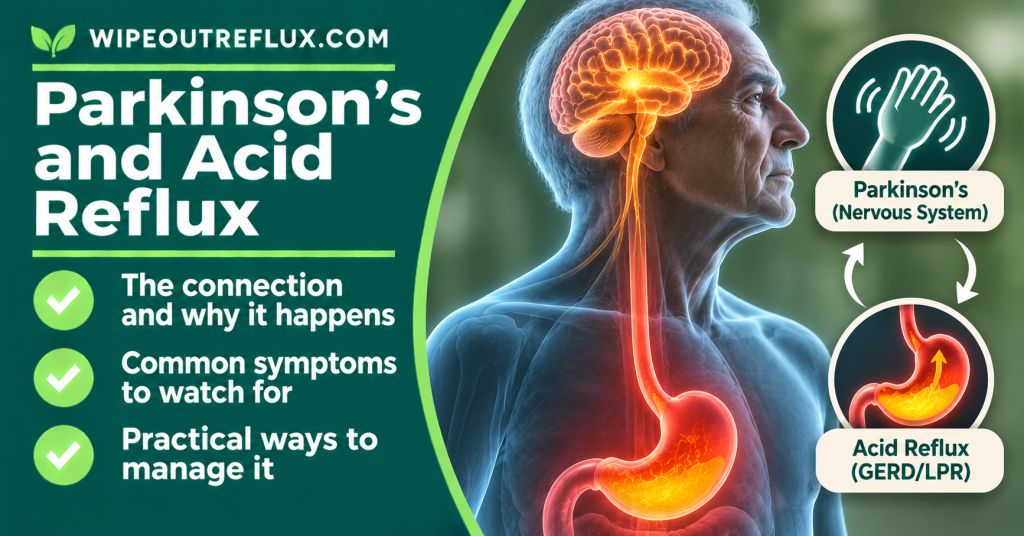
Acid reflux is much more common in people with Parkinson’s disease than in the general population. One study found reflux in about 1 in 4 people with Parkinson’s, roughly four times the rate in people of the same age without it. The reason is that Parkinson’s affects the nerves of the gut as well as the brain, slowing the esophagus and stomach, weakening swallowing, and reducing the saliva that normally helps clear acid. A stooped posture and some Parkinson’s medications can add to the problem.
Reflux in Parkinson’s deserves more attention than it usually gets. It’s linked with worse daily functioning, it can interfere with how well levodopa works, and reflux combined with swallowing problems raises the risk of aspiration. The good news is that most of what helps is practical: meal size and timing, staying upright, smart medication timing, swallowing therapy, and choosing reflux treatments that are safe with Parkinson’s.
Key Takeaways
- In one study, 26.5% of people with Parkinson’s had GERD, with about four times the odds of people without Parkinson’s.
- Parkinson’s affects the gut’s own nervous system, slowing esophageal movement and stomach emptying.
- Swallowing problems are very common: about a third of people with Parkinson’s report them, and around 80% show them on testing.
- Less frequent swallowing and reduced saliva mean acid takes longer to clear from the esophagus.
- Slow stomach emptying can delay levodopa absorption and contribute to “wearing off” episodes.
- Metoclopramide (Reglan) should generally be avoided in Parkinson’s because it blocks dopamine in the brain.
- Small meals, staying upright after eating, an alginate, and a speech and swallowing assessment are key parts of management.
How Common Is Acid Reflux in Parkinson’s?
Gut problems are among the most common non-motor symptoms of Parkinson’s disease, and reflux is a big part of that. A Japanese study compared 102 people with Parkinson’s with 49 people without it. GERD was found in 26.5% of those with Parkinson’s, and they had four times the odds of reflux. People with Parkinson’s who had reflux also tended to have a more stooped posture, more “wearing off” of their medication, and worse scores for daily living activities and quality of life [Maeda et al., Parkinson’s Disease, 2013].
That last point is important. Reflux isn’t just an annoying extra symptom. It’s associated with people feeling and functioning worse overall, and because it’s treatable, it’s worth looking for.
Why Parkinson’s Causes Acid Reflux
Parkinson’s is usually thought of as a brain disease, but the same protein deposits (alpha-synuclein) that affect the brain are also found throughout the gut’s nervous system. A major review in The Lancet Neurology describes the whole digestive tract as affected, from drooling and swallowing problems through to delayed stomach emptying and constipation [Fasano et al., The Lancet Neurology, 2015]. Several of these problems feed directly into reflux.
1. A sluggish esophagus
Your esophagus moves food down with waves of muscle contraction, and the same waves sweep refluxed acid back into the stomach. In a German study using high-resolution manometry, 95% of people with Parkinson’s had at least minor problems with esophageal movement, and almost a third had major motility disorders. These problems appeared at every stage of the disease, not just in advanced Parkinson’s [Suttrup et al., Neurogastroenterology and Motility, 2017].
When the esophagus doesn’t clear well, acid and pepsin sit against its lining for longer, causing more damage and more symptoms. I explain this in more detail in esophageal motility and acid reflux.
2. Slow stomach emptying
Delayed gastric emptying occurs in both early and advanced Parkinson’s, and it’s often missed in routine care [Marrinan et al., Movement Disorders, 2014]. When food sits in the stomach longer, there’s more pressure pushing up against the lower esophageal sphincter, and more opportunity for reflux. It also causes early fullness, bloating and nausea. The mechanism is the same as the one I cover in gastroparesis and acid reflux.
3. Less swallowing and less saliva clearance
People normally swallow hundreds of times a day without noticing, and each swallow carries a little bicarbonate-rich saliva down to neutralize any acid in the esophagus. Parkinson’s reduces how often people swallow automatically, which is why drooling is common. Fewer swallows means acid stays put for longer. I explain saliva’s protective role in saliva, bicarbonate and acid reflux.
4. Stooped posture
The forward-flexed posture common in Parkinson’s increases pressure on the abdomen, and the Japanese study above found it more often in people with Parkinson’s who had reflux [Maeda et al., Parkinson’s Disease, 2013]. Bending forward is a well-known reflux trigger, as I explain in heartburn when bending over.
5. Constipation
Constipation is one of the most common symptoms of Parkinson’s, and it often starts years before diagnosis. A backed-up bowel increases pressure inside the abdomen and may slow the whole digestive tract, adding to reflux.
How Parkinson’s Medications Play a Role
Parkinson’s medications are essential, so this isn’t about stopping them. But it helps to know how they can affect your digestion.
- Levodopa (carbidopa-levodopa): commonly causes nausea, especially when starting or increasing the dose. Nausea and reflux symptoms can be hard to separate.
- Dopamine agonists (such as pramipexole, ropinirole and rotigotine): nausea is a common side effect.
- Anticholinergic drugs (such as trihexyphenidyl): these reduce saliva and slow gut movement, which can make reflux clearance worse.
- Other medications often used alongside Parkinson’s, such as some antidepressants, sleep medications and pain relievers, may also affect reflux. See medications that make acid reflux worse.
The levodopa absorption problem
Levodopa is absorbed in the small intestine, not the stomach. If the stomach empties slowly, the tablet sits there and can’t get to where it’s absorbed. This contributes to delayed “on” times, unpredictable responses and “wearing off” between doses [Marrinan et al., Movement Disorders, 2014]. The Lancet Neurology review also notes that small intestinal bacterial overgrowth and H. pylori infection can interfere with how well Parkinson’s medications are absorbed [Fasano et al., The Lancet Neurology, 2015].
So treating slow digestion and reflux can sometimes help Parkinson’s symptoms too. If you’ve noticed that your medication works less predictably after big meals, mention it to your neurologist.
Swallowing Problems, Reflux and Aspiration
Swallowing difficulty (dysphagia) is extremely common in Parkinson’s. A meta-analysis found that about 35% of people with Parkinson’s report swallowing problems, but when swallowing is measured objectively, around 82% are affected. That suggests many people don’t notice or mention it until asked [Kalf et al., Parkinsonism and Related Disorders, 2012].
This matters for reflux because the two combine. Reflux brings stomach contents up toward the throat, and an impaired swallow makes it harder to protect the airway. Dysphagia is considered the main cause of aspiration pneumonia in Parkinson’s, which is a leading cause of death in the condition [Troche et al., Neurology, 2010].
Signs that swallowing or reflux may be affecting the airway include:
- Coughing or throat clearing during or after meals
- A wet or gurgly voice after eating or drinking
- Food sticking in the throat or chest
- Pills getting stuck (see trouble swallowing pills)
- Frequent chest infections or unexplained fever
- Coughing or choking when lying down at night
Any of these are a good reason to ask for a referral to a speech and language therapist (speech-language pathologist) for a swallowing assessment. In a randomized trial, a four-week program of expiratory muscle strength training (breathing out against resistance through a handheld device) improved swallow safety in people with Parkinson’s [Troche et al., Neurology, 2010]. For more on the reflux side of swallowing problems, see dysphagia.
Is There a Link Between Reflux and Developing Parkinson’s?
This is an area of active research. There’s a growing theory that Parkinson’s may start in the gut in some people, years before movement symptoms appear. A large US study followed more than 9,000 people for about 15 years after an endoscopy. Those who had mucosal damage, such as esophagitis, erosions or ulcers, were more likely to develop Parkinson’s later, even after adjusting for other factors [Chang et al., JAMA Network Open, 2024].
That’s an association, not proof that reflux causes Parkinson’s, and the absolute risk remains small. Most people with reflux will never develop Parkinson’s. But it’s another sign of how closely the gut and the brain are connected.
Treating Acid Reflux in Parkinson’s
Eating and posture
- Eat smaller, more frequent meals. With slow stomach emptying, large meals sit around longer and push up against the valve.
- Keep meals lower in fat. Fat slows stomach emptying further and relaxes the lower esophageal sphincter.
- Stay upright for at least 30 to 60 minutes after eating. Sitting well supported, rather than slumped, reduces pressure on the stomach.
- Finish eating three hours before bed, and raise the head of the bed if night-time symptoms are a problem.
- Take small sips and small bites, and follow any texture advice from a swallowing therapist.
- Manage constipation with fluids, fiber and movement, plus any treatment your doctor recommends.
Medication timing
Many people take levodopa 30 to 60 minutes before meals to help absorption, because protein in a meal can compete with it. Talk to your neurologist or pharmacist about the best timing for you, especially if your reflux, nausea or medication response varies with meals.
Reflux medications: what’s safe with Parkinson’s
- Alginates (like Gaviscon Advance) form a barrier on top of the stomach contents and reduce how much reflux comes up. They’re a sensible first option, especially at bedtime. See alginates for acid reflux.
- PPIs and H2 blockers can help with heartburn and esophagitis. Your doctor will weigh the benefits against long-term side effects.
- Metoclopramide (Reglan) should generally be avoided. It blocks dopamine in the brain and can worsen Parkinson’s symptoms [Lertxundi et al., American Journal of Health-System Pharmacy, 2008]. I cover this drug in metoclopramide (Reglan) for acid reflux.
- Domperidone doesn’t cross into the brain as easily and is sometimes used in Parkinson’s for nausea and slow stomach emptying in countries where it’s available, but it has heart-rhythm cautions and isn’t approved in the US. See domperidone for acid reflux.
Always check with your doctor or pharmacist before adding any reflux medication, including over-the-counter ones, because of possible interactions with Parkinson’s treatment.
Diet
Beyond meal size and timing, avoiding the most common triggers, like alcohol, coffee, chocolate, mint, fatty and fried foods and very acidic drinks, can make a real difference. If you or someone you care for wants a structured, step-by-step approach, the Wipeout Diet Plan lays out exactly what to eat and when.
For more on reflux in later life generally, see acid reflux in older adults.
When to Get Medical Help
Contact your doctor or care team if you notice:
- New or worsening coughing or choking when eating or drinking
- Recurrent chest infections or fever
- Unintentional weight loss or eating much less
- Pain when swallowing, or food repeatedly sticking
- Vomiting, black stools or vomiting blood
- Parkinson’s medication becoming less effective or less predictable
Conclusion
Acid reflux is common in Parkinson’s disease, and it’s not a coincidence. Parkinson’s affects the nerves of the digestive tract, slowing the esophagus and stomach, reducing swallowing and saliva clearance, and often bringing constipation and a stooped posture that add pressure from below. Some Parkinson’s medications contribute through nausea or reduced saliva, and slow stomach emptying can in turn interfere with how well levodopa works.
Because reflux and swallowing problems often occur together in Parkinson’s, they’re worth taking seriously. Ask for a swallowing assessment if there’s any coughing or choking with meals, avoid metoclopramide, check medication timing with your neurologist, and focus on the everyday habits that make the biggest difference: smaller, lower-fat meals, staying upright after eating, and an early evening meal.
If you’d like a complete plan for that last part, the Wipeout Diet Plan is my in-depth guide to calming reflux through food choices, meal timing and daily routines. I designed it first for silent reflux, the throat-based form that’s especially relevant when swallowing is affected, but because it works on the same root mechanisms, it helps GERD and everyday heartburn just as well.
Frequently Asked Questions
Is acid reflux common in Parkinson’s disease?
Yes. In one study about 26.5% of people with Parkinson’s had GERD, with roughly four times the odds of people without Parkinson’s.
Can Parkinson’s medication cause acid reflux?
Levodopa and dopamine agonists commonly cause nausea, and anticholinergic drugs reduce saliva and slow the gut, which can worsen reflux. Don’t stop any medication without speaking to your doctor.
Can acid reflux affect levodopa?
Reflux itself doesn’t, but the slow stomach emptying that often comes with it can delay levodopa absorption and contribute to wearing off.
What reflux medication is safe with Parkinson’s?
Alginates, PPIs and H2 blockers are generally used. Metoclopramide (Reglan) should generally be avoided because it can worsen Parkinson’s symptoms. Always check with your doctor or pharmacist.
Why does Parkinson’s cause swallowing problems?
Parkinson’s affects the muscles and nerves that coordinate swallowing. Problems are found on testing in about 80% of people with Parkinson’s, though many don’t notice them.
Can Parkinson’s cause silent reflux?
Yes. Reduced swallowing, slow esophageal clearance and posture changes can let reflux reach the throat, causing throat clearing, coughing and hoarseness without heartburn.
Does reflux cause Parkinson’s disease?
There’s no proof that it does. One large study linked upper GI mucosal damage with a higher later risk of Parkinson’s, but that’s an association, and the absolute risk is small.
Research & References
- [Maeda et al., Parkinson’s Disease, 2013] — GERD was found in 26.5% of 102 Parkinson’s patients (odds ratio 4.05 vs controls) and was linked to stooped posture, wearing-off and worse daily functioning.
- [Fasano et al., The Lancet Neurology, 2015] — Review describing gut involvement across the whole digestive tract in Parkinson’s, and noting SIBO and H. pylori can interfere with drug absorption.
- [Suttrup et al., Neurogastroenterology and Motility, 2017] — High-resolution manometry in 65 Parkinson’s patients found minor esophageal body impairment in 95% and major motor disorders in nearly a third, across all disease stages.
- [Marrinan et al., Movement Disorders, 2014] — Review showing delayed gastric emptying occurs in early and advanced Parkinson’s, is underdetected, and contributes to levodopa response fluctuations.
- [Kalf et al., Parkinsonism and Related Disorders, 2012] — Meta-analysis estimating dysphagia at 35% by self-report and 82% by objective testing in Parkinson’s, about three times the rate in controls.
- [Troche et al., Neurology, 2010] — Randomized sham-controlled trial in which four weeks of expiratory muscle strength training improved swallow safety in people with Parkinson’s.
- [Lertxundi et al., American Journal of Health-System Pharmacy, 2008] — Review noting metoclopramide blocks central dopamine receptors and worsens parkinsonian symptoms, while very little domperidone crosses the blood-brain barrier.
- [Chang et al., JAMA Network Open, 2024] — Cohort of 9,350 endoscopy patients followed ~15 years: upper GI mucosal damage was associated with a higher adjusted risk of later Parkinson’s diagnosis (HR 1.76).

David Gray
12 years living with LPR · Consultant & researcher
I've lived with LPR for twelve years — the misdiagnoses, the PPI courses that did nothing, the slow work of figuring out what actually helps. Wipeout Reflux is where I translate the research into plain terms for people stuck in the same place. Every claim here is sourced to peer-reviewed work, and I consult one-to-one with LPR sufferers.