
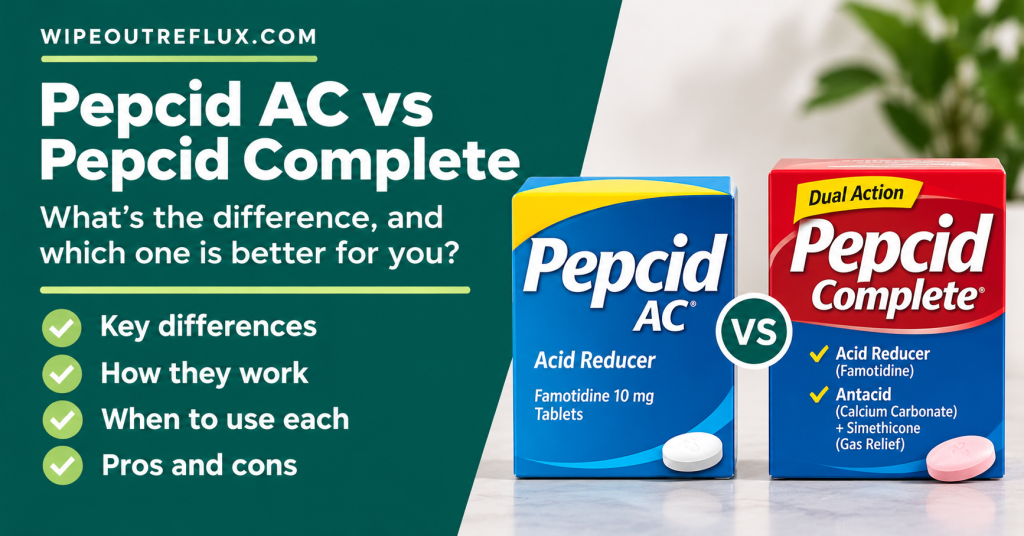
The difference between Pepcid AC and Pepcid Complete is the antacid. Pepcid AC contains only famotidine (10 mg, or 20 mg in Maximum Strength), an acid reducer that starts working in about an hour and lasts up to 12 hours. Pepcid Complete combines a lower 10 mg dose of famotidine with two antacids, calcium carbonate and magnesium hydroxide. The antacids neutralize acid within minutes, and the famotidine then takes over for longer-lasting relief. Choose Complete when you have heartburn right now. Choose AC when you want to prevent heartburn before a meal, or want the stronger 20 mg dose.
The two boxes sit side by side on the shelf, look almost the same, and are both “Pepcid”, so it’s no surprise people mix them up. Below I compare them side by side, explain what the research shows about speed and duration, cover dosing, pregnancy and who should avoid each one, and look at how they fit if your reflux is the silent, throat-based kind.
Key Takeaways
- Pepcid AC: famotidine only, 10 mg (Original Strength) or 20 mg (Maximum Strength). It’s swallowed whole and can be taken before meals to prevent heartburn.
- Pepcid Complete: famotidine 10 mg plus calcium carbonate 800 mg and magnesium hydroxide 165 mg. It’s a chewable tablet for heartburn you already have.
- Antacids start neutralizing acid within minutes but last only about an hour. Famotidine takes about 90 minutes to kick in but lasts about 9 hours or more.
- Pepcid Complete gives you both: fast relief plus longer-lasting acid suppression.
- Don’t take more than 2 tablets of either product in 24 hours, and don’t combine Pepcid AC with Pepcid Complete or other acid reducers.
- Over-the-counter use is for up to 14 days. Heartburn that needs more than that, or that has lasted more than 3 months, needs a doctor’s review.
- Famotidine has a reassuring pregnancy safety record, but check with your provider before using either product in pregnancy.
- Neither product stops pepsin reaching the throat, so for silent reflux (LPR) they’re only part of the picture.
Pepcid AC vs Pepcid Complete at a Glance
| Pepcid AC | Pepcid Complete | |
|---|---|---|
| Active ingredients | Famotidine 10 mg (Original) or 20 mg (Maximum Strength) | Famotidine 10 mg + calcium carbonate 800 mg + magnesium hydroxide 165 mg |
| Type | H2 blocker (acid reducer) | H2 blocker + antacid |
| How you take it | Swallow with water. Don’t chew. | Chew completely before swallowing |
| Starts working | About 60 to 90 minutes | Within minutes (antacid), then famotidine takes over |
| Lasts | Up to about 12 hours | Up to about 12 hours |
| Prevention before meals | Yes: 10 to 60 minutes before trigger food or drink (Maximum Strength label) | No. It’s labeled to relieve symptoms. |
| Maximum in 24 hours | 2 tablets | 2 tablets |
| Age | 12 and over | 12 and over |
| Best for | Preventing predictable heartburn, or the stronger 20 mg dose | Heartburn happening right now |
Ingredients and directions are from the US Drug Facts labels for Pepcid AC Maximum Strength and Pepcid Complete [Pepcid AC Maximum Strength label; Pepcid Complete label].
How Each One Works
Famotidine: slower, but lasts
Famotidine is an H2 blocker. It blocks histamine receptors on the stomach’s acid-producing cells, which tells them to make less acid. Because it reduces production, it doesn’t touch the acid that’s already there, so it takes a while to work. See Pepcid (famotidine) for silent reflux.
Antacids: fast, but brief
Calcium carbonate (the active ingredient in Tums) and magnesium hydroxide (milk of magnesia) are bases that chemically neutralize acid already in the stomach. That’s why they work almost immediately. They’re also used up quickly. See what is an antacid?
The two antacids are paired for a reason. Calcium tends to constipate and magnesium tends to loosen stools, so together they partly cancel each other out.
What the research shows
A well-designed study measured stomach acid directly after a meal in 18 healthy volunteers. Calcium carbonate (Tums, 1,000 mg) began neutralizing acid within the first 30 minutes, but its effect lasted only about 60 minutes. Famotidine (Pepcid AC, 10 mg) didn’t start working until about 90 minutes, but its effect lasted at least 540 minutes, or 9 hours [Feldman, JAMA, 1996].
That’s the case for Pepcid Complete in one result: the antacid covers the first hour while the famotidine gets going.
For real-world heartburn episodes, a large trial of 565 people found that famotidine 10 mg relieved about 70% of episodes, compared with 62% for an antacid and 41% for placebo [Simon et al., American Journal of Therapeutics, 1995].
Which One Should You Choose?
Choose Pepcid Complete if:
- You have heartburn now and want it gone quickly
- Your heartburn is occasional and unpredictable
- You’d otherwise take a Tums and then a Pepcid separately
Choose Pepcid AC if:
- You know a meal will set you off (a big dinner out, a holiday meal) and want to prevent it. Take it 10 to 60 minutes beforehand.
- You want the stronger 20 mg famotidine dose (Maximum Strength)
- You’re watching your calcium intake or have been told to avoid magnesium
- You get night-time symptoms and want an evening dose. See why take famotidine at night?
Don’t take both together. Pepcid Complete already contains famotidine, and the labels say not to combine famotidine with other acid reducers. If you need fast relief while on Pepcid AC, a plain antacid or an alginate is the usual add-on. See Tums vs Gaviscon and Pepcid vs Gaviscon.
Dosing and Directions
Pepcid AC
- To relieve symptoms: swallow 1 tablet with a glass of water. Don’t chew.
- To prevent symptoms: take 1 tablet 10 to 60 minutes before eating food or drinking beverages that cause heartburn (Maximum Strength label).
- Maximum: 2 tablets in 24 hours
Pepcid Complete
- To relieve symptoms: chew 1 tablet completely before swallowing. Don’t swallow it whole.
- Maximum: 2 tablets in 24 hours
Both labels say to stop and ask a doctor if heartburn continues or worsens, or if you need the product for more than 14 days. Ask before starting if you’ve had heartburn for more than 3 months.
Daily use and tolerance
H2 blockers lose some of their effect when taken every day. In healthy volunteers taking standard daily doses, acid suppression weakened noticeably over a few weeks, especially overnight [Nwokolo et al., Alimentary Pharmacology & Therapeutics, 1990]. That’s one reason over-the-counter Pepcid works best on demand, and why frequent heartburn needs a proper plan rather than more tablets. See famotidine vs omeprazole and alternatives to famotidine.
Side Effects and Who Should Be Careful
Common side effects
- Famotidine: usually well tolerated. Headache, dizziness and constipation or diarrhea are the most common. Some people notice anxiety or sleep changes. See can famotidine cause anxiety?
- Antacids in Pepcid Complete: constipation (calcium), loose stools (magnesium), and gas or burping (calcium carbonate releases carbon dioxide). See do antacids cause burping and gas?
Kidney disease
The Pepcid AC label says not to use it with kidney disease unless a doctor directs you to, and the Pepcid Complete label says to ask a doctor first. Famotidine is cleared by the kidneys, and magnesium can build up when kidney function is reduced.
Too much calcium
Regularly taking large amounts of calcium carbonate can cause milk-alkali syndrome, a combination of high blood calcium, alkalosis and kidney injury. It became a leading cause of hospital admissions for high calcium as calcium carbonate was promoted for heartburn and bone health [Beall & Scofield, Medicine, 1995]. At the labeled maximum of 2 Pepcid Complete tablets a day, the risk is low, but watch your total intake if you also take calcium supplements or Tums.
Medication interactions
The antacids in Pepcid Complete can reduce absorption of some medicines, including certain antibiotics, thyroid medication and iron. Ask a pharmacist if you take prescription drugs, and space other medicines a couple of hours away. See reflux medication interactions.
Pepcid AC vs Pepcid Complete in Pregnancy
Heartburn is very common in pregnancy, and both products come up often. On famotidine itself, a meta-analysis covering about 2,400 pregnancies exposed to H2 blockers and nearly 120,000 unexposed found no increase in birth defects, miscarriage, preterm birth or low birth weight [Gill et al., Digestive Diseases and Sciences, 2009].
Calcium carbonate antacids are commonly used in pregnancy. Magnesium-containing antacids are generally fine occasionally but best not used heavily or long term. Most providers start with lifestyle changes and a calcium-based antacid, then add famotidine if needed. Always check with your obstetric provider first. See which antacids are safe in pregnancy? and can you take Tums while pregnant?
What If Your Reflux Is Silent Reflux (LPR)?
If your symptoms are mainly in the throat (hoarseness, throat clearing, a lump sensation, post-nasal drip or chronic cough), neither Pepcid product will do much on its own.
With LPR, the damage is driven by pepsin reaching the throat. Reducing acid doesn’t stop reflux from happening. It only makes what comes up less acidic, and pepsin already in the throat can still be reactivated by acidic food and drink. That’s why acid reducers often disappoint people with LPR. See PPIs for LPR.
Famotidine at bedtime can still be useful for night-time reflux, often alongside an alginate such as Gaviscon Advance, which forms a physical barrier against reflux. But the biggest lever for LPR is diet. See the LPR diet.
When to See a Doctor
- Heartburn on more than 2 days a week, or needing Pepcid for more than 14 days
- Heartburn for more than 3 months
- Difficulty or pain swallowing, vomiting blood, or black stools
- Unexplained weight loss
- Chest pain with lightheadedness, sweating, breathlessness, or pain spreading to the arm, jaw or neck. These can be heart symptoms. See heartburn or heart attack?
Conclusion
Pepcid AC is famotidine alone: slower to start, but long-lasting, available at 10 mg or 20 mg, and usable before meals to prevent heartburn. Pepcid Complete adds calcium carbonate and magnesium hydroxide to a 10 mg famotidine dose, so you get relief within minutes and protection that lasts for hours. Use Complete for heartburn you have now, use AC to prevent heartburn you can see coming, and don’t take both together.
If you’re reaching for either one most weeks, the tablets are treating the symptom rather than the cause. What you eat, and when, decides how much reflux you have in the first place. The Wipeout Diet Plan gives you a step-by-step, low-acid way to eat that reduces reflux at the source. I built it around LPR, the hardest form of reflux to control, and it works just as well for GERD and everyday heartburn.
Frequently Asked Questions
Is Pepcid Complete stronger than Pepcid AC?
Not in famotidine. Pepcid Complete has 10 mg, the same as Original Strength Pepcid AC and half of Maximum Strength (20 mg). Complete adds antacids for faster relief, so it works quicker, but Pepcid AC Maximum Strength has more acid-reducing medication.
Can I take Pepcid AC and Pepcid Complete together?
No. Both contain famotidine, and the labels say not to use famotidine with other acid reducers. If you need faster relief, ask a pharmacist about a plain antacid or an alginate instead.
Which works faster, Pepcid AC or Pepcid Complete?
Pepcid Complete. Its antacids neutralize acid within minutes, while famotidine alone takes about an hour or more to start working.
Can I take Pepcid Complete every day?
The label allows up to 2 tablets a day for up to 14 days. If you need it longer, see a doctor. Daily use of H2 blockers also becomes less effective over time.
Is Pepcid Complete safe during pregnancy?
Famotidine and calcium carbonate both have reassuring safety data in pregnancy, but check with your provider before using it, and avoid heavy or long-term use of magnesium antacids.
Is Pepcid Complete a PPI?
No. It contains famotidine, an H2 blocker, plus antacids. PPIs such as omeprazole (Prilosec) are a different, stronger class of acid reducer.
Does Pepcid Complete help with silent reflux?
It may ease throat burning for a while, but it doesn’t stop reflux or deal with pepsin in the throat. For LPR, diet changes and an alginate at bedtime usually matter more.
Research & References
- The US Drug Facts label for Pepcid AC Maximum Strength (famotidine 20 mg), including relief and prevention directions, the 2-tablet daily maximum and the 14-day limit [Pepcid AC Maximum Strength label].
- The US Drug Facts label for Pepcid Complete (famotidine 10 mg, calcium carbonate 800 mg, magnesium hydroxide 165 mg), including chewing directions and the 2-tablet daily maximum [Pepcid Complete label].
- A randomized, double-blind crossover trial in 18 volunteers finding that calcium carbonate neutralized acid within 30 minutes but lasted about 60 minutes, while famotidine 10 mg began working after about 90 minutes and lasted at least 540 minutes [Feldman, JAMA, 1996].
- A randomized, placebo-controlled trial of 565 people with episodic heartburn finding that famotidine 10 mg relieved 70% of episodes, compared with 62% for an antacid and 41% for placebo [Simon et al., American Journal of Therapeutics, 1995].
- A study showing that tolerance to the acid-suppressing effect of H2 blockers, including famotidine, develops over 29 days of continuous dosing, most noticeably overnight [Nwokolo et al., Alimentary Pharmacology & Therapeutics, 1990].
- A meta-analysis of 2,398 H2 blocker-exposed and 119,892 unexposed pregnancies finding no increased risk of congenital malformations, miscarriage, preterm birth or small-for-gestational-age babies [Gill et al., Digestive Diseases and Sciences, 2009].
- A report of 7 patients and a prevalence estimate showing that milk-alkali syndrome from calcium carbonate became a leading cause of hospitalization for hypercalcemia [Beall & Scofield, Medicine, 1995].

David Gray
12 years living with LPR · Consultant & researcher
I've lived with LPR for twelve years — the misdiagnoses, the PPI courses that did nothing, the slow work of figuring out what actually helps. Wipeout Reflux is where I translate the research into plain terms for people stuck in the same place. Every claim here is sourced to peer-reviewed work, and I consult one-to-one with LPR sufferers.