
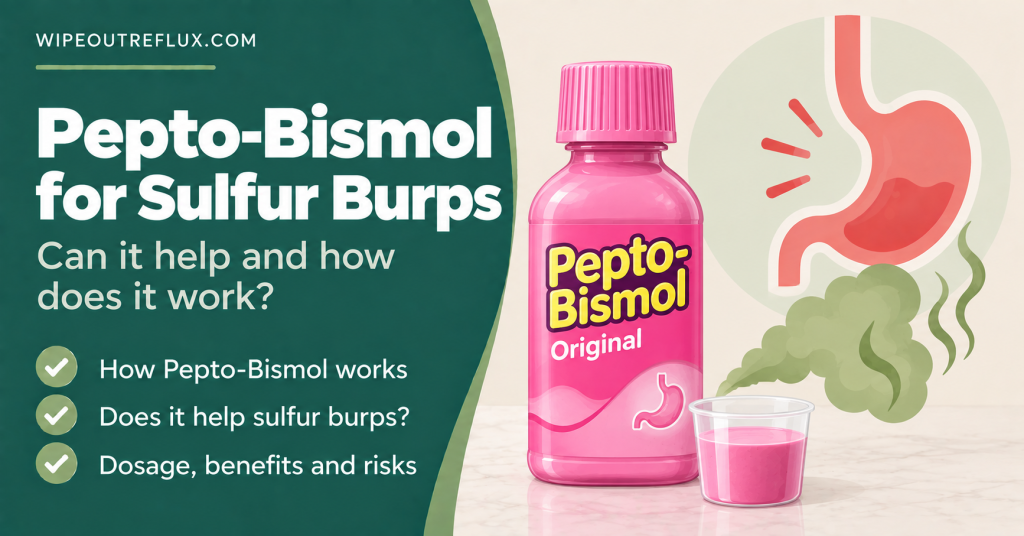
Yes. Pepto-Bismol is probably the best over-the-counter option for sulfur burps, and unlike most stomach remedies it has a real mechanism against the smell. Its active ingredient, bismuth subsalicylate, reacts with hydrogen sulfide (the rotten-egg gas) in the gut and locks it up as bismuth sulfide, which has no smell. A controlled study found it markedly reduced hydrogen sulfide release in the human gut, and two older randomized trials found it relieved belching and other symptoms after overindulgence faster than placebo.
For adults, the usual dose is 30 mL of Original liquid (or 15 mL of Ultra, or two Original caplets) every 30–60 minutes as needed, with no more than 8 doses in 24 hours and no more than 2 days of use. It isn’t for everyone, though. Bismuth subsalicylate releases a salicylate related to aspirin, so skip it if you’re allergic to aspirin, take blood thinners, are pregnant, or are under 12. Also, Pepto-Bismol deals with the gas, not the cause. If sulfur burps keep coming back, something is making them.
Key Takeaways
- Pepto-Bismol binds hydrogen sulfide directly, turning it into odorless bismuth sulfide. That’s why it’s the one OTC remedy that targets the smell itself.
- A controlled study showed bismuth subsalicylate markedly reduced hydrogen sulfide release in the human gut.
- Randomized trials from the 1980s and 1990 found it relieved belching, nausea, fullness and flatulence after overindulgence faster than placebo.
- There are no trials specifically on sulfur burps. The case rests on a solid mechanism plus related symptom trials.
- Adult dose: 30 mL Original / 15 mL Ultra / 2 caplets every 30–60 minutes, max 8 doses in 24 hours, max 2 days. Always follow your product’s label.
- Black stool and a black tongue are harmless and expected. That’s the bismuth sulfide.
- Avoid it with aspirin allergy, blood thinners, pregnancy, bleeding ulcers, in children under 12, and in teens recovering from flu or chickenpox.
- It’s a short-term fix. Recurring sulfur burps need the cause addressed.
Why Pepto-Bismol Works on Sulfur Burps: The Chemistry
Sulfur burps smell like rotten eggs because they contain hydrogen sulfide, made when gut bacteria break down sulfur from foods like eggs, meat, broccoli, garlic and protein shakes. I explain the full picture, and why the smell sometimes comes up as a burp instead of going down as gas, in my main guide to sulfur burps.
Bismuth subsalicylate splits into two parts in the stomach. The bismuth part is barely absorbed and stays in the gut, where it binds bacterial toxins, has a mild antimicrobial effect, and reacts with hydrogen sulfide to form bismuth sulfide [Budisak et al., StatPearls, National Center for Biotechnology Information, 2024]. Bismuth sulfide is a black, insoluble, odorless compound. It’s the reason your stool and sometimes your tongue turn black after taking Pepto. That black color is the same reaction that neutralizes the smell.
This isn’t just theory. In a study at the University of Minnesota, bismuth subsalicylate markedly reduced the release of hydrogen sulfide from human fecal samples and in the colon of volunteers who took it [Suarez et al., Gastroenterology, 1998]. That study measured sulfide at the lower end of the gut, so it’s direct evidence for sulfur-smelling gas, and the same chemistry applies wherever bismuth meets sulfide in the gut.
Nothing else on the pharmacy shelf does this. Antacids neutralize acid, simethicone merges gas bubbles, and alginates form a raft on top of the stomach. None of them touch hydrogen sulfide.
What the Evidence Actually Shows
I want to be clear about where the evidence is strong and where it isn’t.
Strong: the mechanism. Bismuth binds hydrogen sulfide, and the gut study above showed it reduces sulfide release in people, not just in a test tube.
Supportive: two randomized trials on related symptoms. In a double-blind crossover trial, 48 adults treated several episodes of indigestion with either bismuth subsalicylate or placebo. It gave faster and greater relief of nausea, fullness, heartburn, bloating and flatulence [Hailey and Newsom, Archives of Internal Medicine, 1984]. In a second trial, volunteers deliberately overindulged at a simulated dinner party, and those who developed stomach upset got significantly better and faster relief of symptoms, including belching, with bismuth subsalicylate [Berkowitz, Journal of International Medical Research, 1990]. That overindulgence setting is close to the real-life scenario where many people get sulfur burps.
Missing: a trial that recruited people specifically for sulfur burps and measured the smell. It hasn’t been done. So the honest summary is that Pepto-Bismol has a well-supported mechanism and good related trial evidence, but no dedicated sulfur-burp study.
How to Take Pepto-Bismol for Sulfur Burps
Dose for adults
US adult directions for bismuth subsalicylate are:
- Original liquid: 30 mL (525 mg) per dose
- Ultra liquid: 15 mL (525 mg) per dose, since it’s double strength
- Original caplets or chewables: 2 per dose
- Ultra caplets: 1 per dose
Take one dose every 30 to 60 minutes as needed, no more than 8 doses in 24 hours, and don’t use it for more than 2 days without speaking to a doctor. Formulations and strengths vary between brands and countries, including the UK, so the label on your specific bottle is the one to follow.
Timing
For most people, one or two doses are enough. Because Pepto-Bismol works by reacting with the gas in your gut, it helps most when you take it once the burps start, or after a meal you know is a trigger, like a big egg breakfast, a steak dinner or a night of beer. If the next dose isn’t needed, don’t take it. More doses don’t mean more benefit, and they do mean more salicylate.
How fast does it work?
There’s no study timing relief from sulfur burps specifically. In the overindulgence trials, bismuth subsalicylate worked faster than placebo, with relief building over the first hour or two of dosing. Most people notice the eggy taste easing within a few hours. If you’ve taken two or three doses and nothing has changed, more Pepto probably isn’t the answer.
Who Shouldn’t Take Pepto-Bismol
This is the important part, and most sulfur-burp articles skip it. The salicylate half of bismuth subsalicylate is absorbed into your bloodstream. In a pharmacokinetic study, a single 60 mL dose delivered around 500 mg of absorbed salicylate, about the same as a couple of regular aspirin tablets [Feldman et al., Clinical Pharmacology and Therapeutics, 1981]. That means the same cautions as aspirin apply. Avoid Pepto-Bismol, or check with a pharmacist first, if you:
- Are allergic to aspirin or other salicylates
- Take blood thinners like warfarin or apixaban, or daily aspirin
- Have a stomach ulcer, a bleeding disorder, or black or bloody stools that aren’t from Pepto itself
- Are pregnant or breastfeeding
- Are under 12, or are a teenager recovering from flu or chickenpox, because of the risk of Reye’s syndrome
- Take medicines for diabetes, gout or arthritis, or high-dose NSAIDs, which can interact with salicylate
- Have kidney disease, which affects how both bismuth and salicylate are cleared
Salicylates also belong to the drug family that can aggravate reflux. That’s one reason I don’t recommend Pepto-Bismol as a reflux treatment, which I cover in does Pepto-Bismol help acid reflux, and why I’d keep it for occasional sulfur burps rather than daily use. See also medications that make acid reflux worse.
Side effects to expect
- Black stool and black tongue. Harmless and temporary, usually gone within a couple of days. The catch is that black stool can also be a sign of bleeding in the upper gut, so if it continues after you stop Pepto, or you feel faint or have stomach pain, get checked.
- Constipation, particularly with repeated doses.
- Ringing in the ears, a sign of too much salicylate. Stop taking it and seek advice.
- Bismuth buildup is rare and linked to prolonged high-dose use, which is another reason to stick to short courses.
Pepto-Bismol for Sulfur Burps With Diarrhea
This is where Pepto-Bismol fits best, because it’s licensed as an antidiarrheal and also binds the sulfur gas. For a short bout of sulfur burps with loose stools after a heavy meal, a stomach bug or traveler’s diarrhea, it covers both problems. Bismuth’s antimicrobial action is one reason it has been used for traveler’s diarrhea for decades [Bierer, Reviews of Infectious Diseases, 1990].
The caution is that Pepto can hide a problem that needs treatment. Sulfur burps with diarrhea that lasts more than a few days, especially after travel, camping or drinking untreated water, can be giardia, and giardia needs a stool test and prescription treatment. Pepto may ease the symptoms without clearing the parasite. The same goes for hydrogen sulfide–type SIBO, where the bacteria will keep producing gas as soon as you stop.
Pepto-Bismol for Sulfur Burps on Ozempic or Mounjaro
This is a very common situation. GLP-1 drugs slow stomach emptying, so food sits and ferments for longer, and sulfur burps often follow, especially after protein-heavy meals. Pepto-Bismol can take the edge off during a bad patch, and there’s no known direct interaction between bismuth subsalicylate and semaglutide or tirzepatide.
Still, if you’re getting sulfur burps several days a week on these drugs, you’d be taking Pepto far too often. The better fix is smaller meals, lighter protein portions spread through the day, less fat, and walking after meals. Talk to your prescriber if symptoms are severe or come with vomiting. I cover the reflux side in Ozempic and reflux.
Pepto-Bismol vs Other Remedies for Sulfur Burps
- Gas-X (simethicone): merges small gas bubbles into bigger ones so they pass more easily. It may ease bloating, but it doesn’t remove the sulfur smell. See Gas-X and acid reflux.
- Antacids (Tums, Rolaids): neutralize stomach acid but do nothing to hydrogen sulfide.
- Alka-Seltzer and baking soda: release carbon dioxide, so you’ll burp more, and Alka-Seltzer’s original formula also contains aspirin. Not a good pick here. See baking soda for heartburn.
- Activated charcoal: often suggested, but the evidence for gut gas is weak, and it binds medications taken at the same time.
- Probiotics: a slower, longer-term approach with mixed evidence. I’ve gone through the research in probiotics for sulfur burps.
- Generic bismuth subsalicylate: store-brand “pink bismuth” and Kaopectate (in the US) contain the same active ingredient. Check the strength on the label.
If reflux is also part of the picture, an alginate is a better match than Pepto-Bismol. It forms a raft that physically holds stomach contents down. See alginates for acid reflux.
When Pepto-Bismol Isn’t Enough
Pepto-Bismol deals with the gas you already have. It doesn’t stop your gut from making more. If you’re reaching for it more than once in a while, work on the cause instead:
- Cut back on sulfur-heavy foods (eggs, red meat, crucifers, garlic, onion, beer) and review protein shakes and sulfur supplements like NAC and MSM.
- Eat smaller meals, eat slowly, and walk afterward.
- Talk to your doctor about long-term PPIs, which raise the risk of SIBO, and about GLP-1 drugs if you’re on one.
- Get tested for giardia, SIBO or H. pylori if your symptoms point that way.
One more note: bismuth is used in prescription combination therapy for H. pylori, which current US guidelines recommend as a first-line option [Chey et al., American Journal of Gastroenterology, 2024]. That’s a specific prescribed regimen with antibiotics and acid suppression, though. Pepto-Bismol on its own won’t clear H. pylori.
Conclusion
Pepto-Bismol works for sulfur burps, and for a clear reason: bismuth binds hydrogen sulfide in the gut and turns it into odorless bismuth sulfide. That’s the same reaction that turns your stool black. Human gut studies back up the mechanism, and trials in overindulgence showed faster relief of belching and related symptoms than placebo. Take a dose when the burps start, stay within 8 doses in 24 hours and 2 days of use, and skip it if you’re allergic to aspirin, on blood thinners, pregnant, or under 12.
But Pepto is the short-term fix. Sulfur burps keep coming back when the same meals keep feeding them: big protein loads, heavy dinners, slow stomach emptying. That’s where the Wipeout Diet Plan comes in. It’s a structured, mechanism-first plan for meal size, timing, fat and protein load, and trigger foods, so your stomach has less to deal with at once and less ends up fermenting or coming back up. I built it first around LPR and silent reflux, the stubborn throat-based kind, but because it works on the same digestive mechanisms, it helps GERD, heartburn and the gassy, burpy side of reflux just as well.
If you’d prefer a lighter first step, the Wipeout Food Reference Guide is the essential companion. It lists the foods and drinks that suit acid reflux and LPR, with their pH values, so you can swap heavy, sulfur-rich meals for gentler ones.
Use Pepto for the bad day. Then work out why you’re having them.
Frequently Asked Questions
Does Pepto-Bismol help sulfur burps?
Yes. The bismuth in Pepto-Bismol reacts with hydrogen sulfide, the gas behind the rotten-egg smell, and turns it into odorless bismuth sulfide. Studies show it reduces hydrogen sulfide release in the gut, and trials found it relieved belching after overindulgence faster than placebo. No trial has looked at sulfur burps specifically.
How much Pepto-Bismol should I take for sulfur burps?
For adults in the US, one dose is 30 mL of Original liquid, 15 mL of Ultra, or two Original caplets, taken every 30–60 minutes as needed. Don’t take more than 8 doses in 24 hours or use it for more than 2 days without medical advice. Always follow your specific product’s label, since strengths vary.
How long does Pepto-Bismol take to work for sulfur burps?
There’s no study that times it for sulfur burps specifically, but most people notice the eggy taste easing within a few hours of the first dose or two. If two or three doses haven’t helped, more Pepto is unlikely to, and it’s worth looking for the cause.
Is Pepto-Bismol or Gas-X better for sulfur burps?
Pepto-Bismol. Gas-X (simethicone) only merges gas bubbles so they pass more easily, and it doesn’t touch the sulfur smell. Pepto-Bismol binds hydrogen sulfide directly, which is what causes the rotten-egg taste.
Why does Pepto-Bismol turn my stool black?
The bismuth reacts with sulfur in your gut to form bismuth sulfide, which is black. It’s harmless and fades within a few days of stopping. It’s also the same reaction that removes the sulfur smell. If black stool continues after you stop, or comes with dizziness or stomach pain, see a doctor, as it can also be a sign of bleeding.
Can I take Pepto-Bismol for sulfur burps on Ozempic or Mounjaro?
There’s no known direct interaction, and it can help with an occasional bad patch. If you’re getting sulfur burps often on a GLP-1 drug, smaller meals, lighter protein portions and walking after meals are better long-term fixes than regular Pepto. Tell your prescriber if symptoms are severe.
Who shouldn’t take Pepto-Bismol?
Avoid it if you’re allergic to aspirin, take blood thinners or daily aspirin, have an ulcer or bleeding disorder, are pregnant or breastfeeding, have kidney disease, or are under 12. Teenagers recovering from flu or chickenpox shouldn’t take it because of the risk of Reye’s syndrome. Check with a pharmacist if you take diabetes, gout or arthritis medication.
Research & References
- Study showing bismuth subsalicylate markedly reduces hydrogen sulfide release in the human colon by binding sulfide [Suarez et al., Gastroenterology, 1998].
- Clinical overview of bismuth subsalicylate: how it splits into poorly absorbed bismuth and absorbed salicylate, its antimicrobial and antisecretory actions, and the formation of black bismuth sulfide [Budisak et al., StatPearls, National Center for Biotechnology Information, 2024].
- Randomized, double-blind crossover trial in 48 adults showing bismuth subsalicylate gave faster and greater relief than placebo for nausea, fullness, heartburn, bloating and flatulence during episodes of indigestion [Hailey and Newsom, Archives of Internal Medicine, 1984].
- Randomized trial of induced overindulgence showing bismuth subsalicylate relieved nausea, fullness, heartburn, belching, stomach pain and flatulence faster and better than placebo [Berkowitz, Journal of International Medical Research, 1990].
- Pharmacokinetic study showing more than 90% of the salicylate in bismuth subsalicylate is absorbed, around 500 mg from a 60 mL dose [Feldman et al., Clinical Pharmacology and Therapeutics, 1981].
- Review of bismuth subsalicylate’s history, antimicrobial actions and use in traveler’s diarrhea [Bierer, Reviews of Infectious Diseases, 1990].
- American College of Gastroenterology guideline recommending bismuth quadruple therapy as a first-line option for H. pylori eradication [Chey et al., American Journal of Gastroenterology, 2024].

David Gray
12 years living with LPR · Consultant & researcher
I've lived with LPR for twelve years — the misdiagnoses, the PPI courses that did nothing, the slow work of figuring out what actually helps. Wipeout Reflux is where I translate the research into plain terms for people stuck in the same place. Every claim here is sourced to peer-reviewed work, and I consult one-to-one with LPR sufferers.