
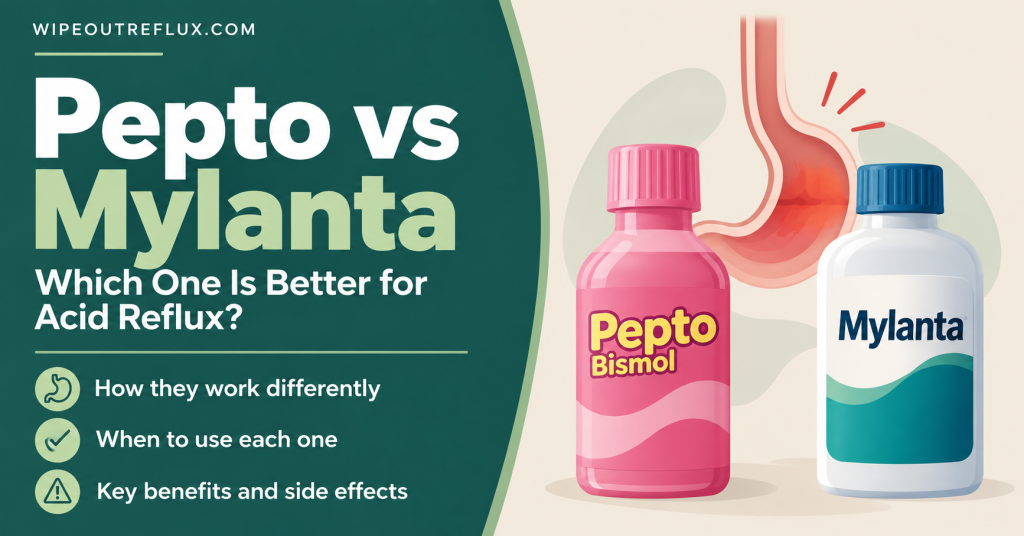
If you’re standing in the pharmacy aisle trying to choose between Pepto-Bismol and Mylanta, here’s the answer up front: for heartburn and acid reflux, Mylanta is the better pick. It’s a true antacid — aluminum hydroxide and magnesium hydroxide that chemically neutralize stomach acid within minutes. Pepto-Bismol isn’t really an antacid at all. Its active ingredient, bismuth subsalicylate, is an aspirin relative built for upset stomach, nausea and diarrhea, and there are no trials of it in GERD or silent reflux.
So the choice isn’t about which is “stronger.” It’s about which symptom you’re treating. Burning chest or sour acid in your throat? Mylanta. Queasy, crampy stomach with loose bowels? Pepto. And if your symptoms are throat-based — hoarseness, throat clearing, a lump sensation — neither is the right tool, which I’ll explain below.
Key Takeaways
- Mylanta is an acid neutralizer: aluminum hydroxide + magnesium hydroxide, plus simethicone for gas.
- Pepto-Bismol is bismuth subsalicylate — a coating, antimicrobial, anti-diarrheal agent with very little acid-neutralizing power.
- For heartburn and acid indigestion, Mylanta works faster and more directly.
- For nausea, upset stomach and diarrhea, Pepto-Bismol is the better match.
- Most of Pepto’s salicylate is absorbed, so it carries aspirin-style cautions: bleeding risk, blood thinners, aspirin allergy, and Reye’s syndrome in children and teens.
- Pepto turns your tongue and stool black — harmless, but it can mimic or mask a GI bleed.
- Neither forms an alginate raft, so neither does much for silent reflux (LPR).
- Both are for short-term use only. Needing either regularly is a sign to address the cause.
Pepto vs Mylanta at a Glance
- Active ingredients: Pepto-Bismol — bismuth subsalicylate (262 mg per 15 mL in the original liquid). Mylanta Maximum Strength — aluminum hydroxide 800 mg, magnesium hydroxide 800 mg and simethicone 80 mg per 10 mL.
- Drug class: Pepto — bismuth compound and salicylate. Mylanta — antacid.
- Neutralizes acid? Pepto — minimally. Mylanta — yes, strongly and quickly.
- Best for: Pepto — nausea, upset stomach, diarrhea, traveler’s diarrhea. Mylanta — heartburn, acid indigestion, sour stomach, gas.
- Main side effects: Pepto — black tongue and stool, constipation, salicylate risks. Mylanta — loose stools or constipation, chalky taste.
- Who should avoid it: Pepto — children and teens, anyone allergic to aspirin, people on blood thinners, pregnancy. Mylanta — people with kidney disease unless their doctor approves.
How Mylanta Works
Mylanta is chemistry in its simplest form. Stomach acid is hydrochloric acid; aluminum hydroxide and magnesium hydroxide are bases. When they meet, they react to form water and salts, and the pH in your stomach rises. Less acid in the stomach means whatever refluxes into your esophagus burns less.
The two minerals are paired on purpose. Magnesium works fast but loosens stools; aluminum works more slowly and tends to constipate. Together they balance each other’s bowel effects while still neutralizing acid effectively [Maton and Burton, Drugs, 1999]. The simethicone is a bonus — it’s not an antacid, but it helps break up gas bubbles if bloating comes along with your heartburn. I cover dosing and the full formula in my guide to Mylanta for acid reflux, and if you’re wondering how it stacks up against its near-twin, see Maalox vs Mylanta.
The catch with any neutralizer is duration. Relief comes within minutes but typically fades within an hour or so on an empty stomach, because the stomach simply keeps making acid and empties the antacid out.
How Pepto-Bismol Works
Pepto-Bismol works in an entirely different way. In the stomach, bismuth subsalicylate splits into two parts that do two different jobs:
- Bismuth stays almost entirely in the gut. It coats the stomach lining, binds bacterial toxins, has direct antibacterial activity, and helps firm up stools [Budisak and Abbas, StatPearls, 2023].
- Salicylate is the aspirin-like half, and it’s readily absorbed into the bloodstream. It has anti-secretory and anti-inflammatory effects in the gut, which is a big part of why Pepto helps diarrhea [Bierer, Reviews of Infectious Diseases, 1990].
Notice what’s missing: meaningful acid neutralization. Pepto’s label lists heartburn and indigestion among its uses, and some people do feel better after taking it, likely from the coating effect. But it doesn’t raise stomach pH the way Mylanta does, and there are no trials testing it in GERD, reflux esophagitis or LPR. I go through that evidence gap in detail in does Pepto-Bismol help acid reflux?
Which Is Better for Heartburn and Acid Reflux?
Mylanta, clearly. If your problem is acid — a burning feeling behind your breastbone, sour liquid coming up, that “acid stomach” feeling after a heavy meal — you want something that directly neutralizes acid, and that’s exactly what Mylanta is designed to do. Pepto is at best an indirect, unproven option for the same job.
There’s also a subtle irony in reaching for Pepto when you have reflux. Salicylates are chemical relatives of aspirin, and aspirin and other NSAIDs are well known for irritating the upper GI tract. I’d rather not add a salicylate to an already irritated esophagus — more on that in my piece on aspirin and acid reflux.
Which Is Better for Upset Stomach, Nausea and Diarrhea?
Here Pepto wins. Mylanta does nothing for diarrhea — in fact, its magnesium can loosen stools further. Pepto’s bismuth and salicylate work together to reduce fluid secretion in the gut and settle an irritated stomach, which is why it’s a go-to for traveler’s diarrhea and stomach bugs.
It’s worth knowing the difference between these symptom patterns, because they often get lumped together. Indigestion and acid reflux overlap but aren’t the same thing, and nausea can itself be a reflux symptom — I explain that link in silent reflux and nausea.
The Salicylate Problem With Pepto-Bismol
This is the part most comparison pages skim over. Pepto feels like a gentle pink stomach coater, but pharmacologically it behaves a lot like aspirin. Studies measuring blood levels after taking it found that the salicylate is substantially absorbed [Feldman et al., Clinical Pharmacology and Therapeutics, 1981]. A full day of dosing can deliver a salicylate load comparable to several aspirin tablets.
That means Pepto carries aspirin-style cautions:
- Children and teenagers should not take it, especially when recovering from flu or chickenpox, because of the risk of Reye’s syndrome.
- Anyone allergic to aspirin or NSAIDs should avoid it.
- People on blood thinners (warfarin and others) or other salicylates risk added bleeding.
- Pregnancy and breastfeeding — salicylates are generally avoided; check with your doctor. Mylanta is usually the easier choice here, and my guide to acid reflux in pregnancy covers safer options.
- Anyone with a suspected ulcer or a history of GI bleeding should speak to a doctor first. If you’re unsure which you’re dealing with, see stomach ulcer or acid reflux?
Then there’s the black tongue and black stool. When bismuth reacts with small amounts of sulfur in your saliva and gut, it forms bismuth sulfide, which is black. It’s harmless and fades within days of stopping [Cohen, Journal of Drugs in Dermatology, 2009]. The problem is that black, tarry stool is also the classic sign of bleeding in the upper GI tract, so Pepto can mask a real bleed. If you have black stool with dizziness, weakness, vomiting blood or abdominal pain, don’t assume it’s the Pepto.
Mylanta’s Downsides
Mylanta is simpler, but it’s not risk-free:
- Kidney disease: healthy kidneys clear the small amounts of absorbed aluminum and magnesium. Impaired kidneys can’t, so people with kidney problems should only use it with medical advice [Maton and Burton, Drugs, 1999].
- Bowel changes: the aluminum-magnesium balance isn’t perfect; some people get looser stools, others mild constipation.
- Drug interactions: antacids reduce the absorption of some medications, including certain antibiotics, thyroid medication and iron. Space them at least 2 hours apart.
- Rebound and masking: frequent use can hide a problem that needs proper treatment.
Pepto shares that interaction issue — bismuth also binds certain antibiotics — so the spacing rule applies to both.
Can You Take Pepto-Bismol and Mylanta Together?
There’s no known dangerous interaction between the two for most healthy adults, and they work on different things, so some people do use Mylanta for the heartburn and Pepto for the queasy stomach during a rough bout of indigestion. That said, taking both is rarely necessary. Pick the one that matches your main symptom first. If you do use both, space them a couple of hours apart, stick to the label limits, and don’t combine Pepto with any other aspirin-containing product. If you need both at once, your symptoms probably deserve a proper look from a doctor.
Where Pepto-Bismol Genuinely Earns Its Place: H. pylori
Bismuth has one role that Mylanta can’t touch. Because it directly damages H. pylori bacteria, bismuth is part of “bismuth quadruple therapy,” one of the recommended first-line regimens for eradicating the infection in international guidelines [Malfertheiner et al., Gut, 2022]. That’s a prescribed regimen with antibiotics and an acid blocker — not something you replicate with a bottle of Pepto — but it’s a reminder that the two products really are in different leagues. If you suspect H. pylori is behind your symptoms, my article on H. pylori and acid reflux explains testing and treatment.
Pepto vs Mylanta for Silent Reflux (LPR)
This is where I’d push back on both. In silent reflux (LPR), refluxed stomach contents travel all the way up to the throat and voice box. The damage there is driven largely by pepsin, a digestive enzyme that lodges in throat tissue and reactivates whenever it meets acid — even the weak acid in food and drinks.
Mylanta neutralizes acid in the stomach for a short while, but it doesn’t stop reflux events from climbing, and it does nothing about the pepsin already sitting in your throat. Pepto doesn’t even neutralize much acid. Neither forms a barrier.
What does form a barrier is an alginate. Products like Gaviscon Advance react with stomach acid to create a gel raft that sits on top of the stomach contents and physically blocks reflux. A systematic review found alginates significantly more effective than antacids or placebo for reflux symptoms [Leiman et al., Diseases of the Esophagus, 2017]. For throat symptoms, an alginate after meals and at bedtime is a far better fit than either Pepto or Mylanta — and cutting the number of reflux events in the first place with diet is better still. That’s the core of the Wipeout Diet Plan, which I built around exactly this pepsin-driven problem.
So Which Should You Choose?
- Occasional heartburn or acid indigestion: Mylanta.
- Upset stomach, nausea or diarrhea: Pepto-Bismol (if you’re an adult with no salicylate cautions).
- Heartburn plus bloating and gas: Mylanta, thanks to its simethicone.
- Pregnant, on blood thinners, or buying for a child: skip Pepto; ask a pharmacist about Mylanta or alternatives.
- Throat symptoms, frequent reflux or nighttime reflux: neither — look at an alginate and your diet.
And if you’re reaching for either more than a couple of times a week, or for longer than two weeks, it’s time to step up. My guide to the best over-the-counter medicine for acid reflux lays out the full ladder, from antacids through alginates to acid blockers. See a doctor promptly if you have trouble swallowing, unintended weight loss, vomiting, black or bloody stools, or chest pain you’re unsure about.
Conclusion
Pepto-Bismol and Mylanta sit on the same shelf, but they’re built for different problems. Mylanta is a genuine antacid — aluminum and magnesium hydroxide that neutralize stomach acid within minutes — which makes it the logical choice for heartburn and acid indigestion. Pepto-Bismol is bismuth subsalicylate, an aspirin relative that shines for nausea, upset stomach and diarrhea but has little acid-neutralizing power and no evidence base in reflux. It also carries real salicylate cautions that its friendly pink color hides.
What they share is more important: both treat the moment, not the pattern. Neither reduces how often you reflux, and neither protects your throat from pepsin. If you keep coming back to the antacid aisle, the Wipeout Diet Plan is where I’d point you first. It’s the complete, mechanism-first approach to meal size, timing, fat load and trigger foods that reduces the number and force of reflux events so you’re not relying on rescue medicines. I originally designed it for silent reflux, the stubborn throat-based form where antacids help least, but because it targets the same root causes, it works just as well for classic heartburn and GERD.
If you want a simpler place to start, the Wipeout Food Reference Guide is the essential companion — every food and drink that’s safe for acid reflux and LPR, with its actual pH value, so you can build meals from numbers instead of guesswork.
Keep Mylanta for the occasional flare, keep Pepto for the stomach bug, and put your real effort into why the flares keep happening.
Frequently Asked Questions
Is Pepto-Bismol or Mylanta better for heartburn?
Mylanta. It directly neutralizes stomach acid with aluminum and magnesium hydroxide, usually within minutes. Pepto-Bismol has very little acid-neutralizing power and hasn’t been tested in trials for GERD or acid reflux.
Is Pepto-Bismol an antacid?
Not really. Its active ingredient, bismuth subsalicylate, works by coating the stomach, fighting bacteria and reducing fluid secretion in the gut. It’s labeled for heartburn and indigestion, but it doesn’t neutralize acid the way true antacids like Mylanta, Maalox or Tums do.
Can I take Pepto-Bismol and Mylanta at the same time?
There’s no well-known dangerous interaction for healthy adults, but it’s rarely necessary. Choose the one that matches your main symptom. If you use both, space them a couple of hours apart, follow label limits, and avoid other aspirin-containing products while taking Pepto.
Which is better for nausea and diarrhea?
Pepto-Bismol. Its bismuth and salicylate work together to settle an upset stomach and reduce diarrhea. Mylanta doesn’t help diarrhea, and its magnesium can loosen stools further.
Is Pepto-Bismol safe if I take aspirin or blood thinners?
Speak to your doctor or pharmacist first. Pepto contains salicylate, most of which is absorbed, so it adds to the effect of aspirin and can raise bleeding risk with anticoagulants such as warfarin. Mylanta is usually the safer choice in that situation.
Which is safer during pregnancy?
Mylanta is generally considered the more appropriate short-term option, while salicylate-containing Pepto-Bismol is usually avoided in pregnancy. Always check with your midwife, doctor or pharmacist before taking either.
Do Pepto-Bismol or Mylanta help silent reflux (LPR)?
Not much. Neither forms a barrier against reflux, and neither deals with pepsin in the throat, which drives LPR damage. An alginate such as Gaviscon Advance, combined with dietary changes that reduce reflux events, is a far better approach for throat symptoms.
Research & References
- [Maton and Burton, Drugs, 1999] — Review of antacid pharmacology explaining how aluminum- and magnesium-based antacids neutralize acid, why they’re combined to balance bowel effects, and why caution is needed in kidney impairment.
- [Budisak and Abbas, StatPearls, 2023] — Clinical overview of bismuth subsalicylate covering its antimicrobial, anti-secretory and anti-diarrheal mechanisms, indications, adverse effects and contraindications.
- [Bierer, Reviews of Infectious Diseases, 1990] — Review of the history, chemistry and safety of bismuth subsalicylate, describing how it separates into bismuth and salicylate in the gut and their separate actions.
- [Feldman et al., Clinical Pharmacology and Therapeutics, 1981] — Pharmacokinetic study showing that salicylate from a bismuth subsalicylate preparation is substantially absorbed into the bloodstream.
- [Cohen, Journal of Drugs in Dermatology, 2009] — Case report and review describing black tongue caused by bismuth subsalicylate and its resolution after stopping the drug.
- [Malfertheiner et al., Gut, 2022] — The Maastricht VI/Florence consensus report on managing H. pylori infection, including bismuth-based quadruple therapy as a recommended treatment regimen.
- [Leiman et al., Diseases of the Esophagus, 2017] — Systematic review and meta-analysis finding alginate therapy significantly more effective than antacids or placebo for controlling reflux symptoms.

David Gray
12 years living with LPR · Consultant & researcher
I've lived with LPR for twelve years — the misdiagnoses, the PPI courses that did nothing, the slow work of figuring out what actually helps. Wipeout Reflux is where I translate the research into plain terms for people stuck in the same place. Every claim here is sourced to peer-reviewed work, and I consult one-to-one with LPR sufferers.