
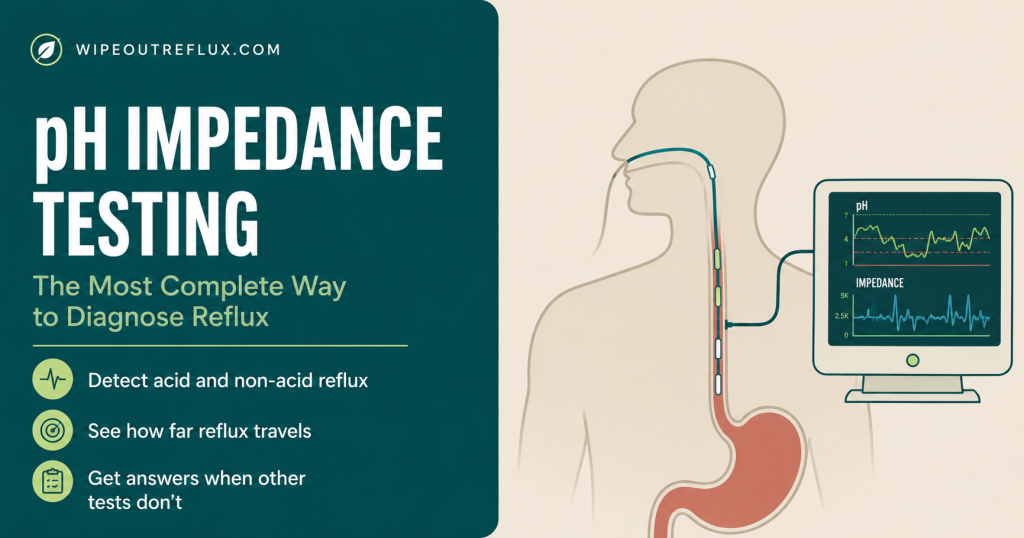
pH-impedance testing is the one reflux test that catches reflux no matter how acidic it is. A standard pH study only sees reflux when the material coming up is acidic — below pH 4. pH-impedance adds a second sensor that detects the movement of liquid and gas up the oesophagus regardless of its pH, so it registers acid reflux, weakly acidic reflux, and fully non-acid reflux alike. That’s the whole point of it, and it’s why it exists.
This matters more than it sounds. The moment you start a proton pump inhibitor (PPI), you don’t stop refluxing — you just stop the reflux being acidic. The same volume still washes up; it’s simply been de-acidified. A pH-only test goes quiet, but the reflux is still happening and can still cause symptoms. pH-impedance is the test that can actually see it, which is exactly why it’s the go-to when someone is still symptomatic despite acid-suppressing medication.
Below is what the test involves, how the impedance sensor sees what pH alone can’t, what the numbers on the report mean, when it’s the right test to ask for, and its real limitations — including why it’s still an imperfect tool for throat-based silent reflux. It’s written US-first, with UK terms flagged where they differ.
Key Takeaways
- pH-impedance monitoring detects all reflux — acid, weakly acidic and non-acid — because impedance senses the bolus moving, not its pH.
- It’s the reflux test of choice when symptoms persist despite PPIs, because PPIs convert acid reflux into non-acid reflux that a pH-only study can’t detect.
- A thin catheter sits through the nose for 24 hours, measuring reflux at several levels of the oesophagus while you keep a symptom and meal diary.
- It measures acid exposure time, the number and type of reflux episodes, and whether your symptoms line up with reflux events in time.
- Newer impedance metrics like mean nocturnal baseline impedance add information about the health of the oesophageal lining.
- It can be done off medication to establish whether you have reflux at all, or on medication to see whether breakthrough (usually non-acid) reflux explains ongoing symptoms.
- It’s the test that can confirm regurgitation and PPI-resistant symptoms are still reflux — or prove they aren’t.
- For silent reflux (LPR) it’s more informative than a barium swallow, but a normal oesophageal study still doesn’t fully rule out throat-level reflux.
What pH-Impedance Testing Actually Is
The full name is 24-hour multichannel intraluminal impedance-pH monitoring — usually shortened to MII-pH or just “impedance-pH.” A very thin, flexible catheter is passed through one nostril and down the oesophagus until the tip sits just above the stomach. Along that catheter are two kinds of sensor: a pH electrode that measures acidity at the lower oesophagus, and several pairs of impedance rings spaced up its length.
Impedance measures how easily a tiny electrical current passes between two rings. Air, liquid and the oesophageal wall all conduct differently: gas has very high impedance, liquid has very low impedance, and the resting wall sits in between. So when a swallow or a reflux event passes a pair of rings, the impedance dips or spikes in a recognisable pattern — and because the rings are stacked up the oesophagus, the software can tell which direction the bolus is travelling. A swallow moves top-to-bottom; reflux moves bottom-to-top. That directionality is the trick that lets impedance separate reflux from swallowing without caring about pH at all.
You wear the recorder on a strap for 24 hours and go about a fairly normal day — eating your usual meals, lying down to sleep — while pressing buttons to log symptoms and marking meals and body position in a diary. The catheter is the part people dread, and it is mildly uncomfortable to have something in your nose and throat for a day, but it’s well tolerated by most and the discomfort settles once it’s in place. It usually pairs naturally with the tests around it, and the catheter is often positioned using landmarks from oesophageal manometry done just beforehand.
How Impedance Sees Reflux That pH Misses
Here’s the core idea, and it’s worth getting clearly. Reflux gets sorted by acidity into three buckets:
- Acid reflux — the refluxed material drops the oesophageal pH below 4.
- Weakly acidic reflux — pH between 4 and 7. Still refluxate, still potentially symptomatic, but a pH-only test doesn’t flag it.
- Non-acid (weakly alkaline) reflux — pH above 7, often containing bile and pancreatic juice rather than stomach acid.
A conventional pH study — including a wireless Bravo pH capsule — only registers that first bucket. Everything at pH 4 or above is invisible to it. Impedance sees the bolus itself, so it captures all three, and it also tells you whether each episode was liquid, gas, or a mix — which is why it’s the only practical way to study non-acid reflux and gas reflux in a real person going about their day.
That’s the entire reason the test was developed: to make the two-thirds of reflux that isn’t acidic visible. If your only tool is a pH probe, a huge amount of what’s actually happening in the oesophagus simply doesn’t show up.
Why Non-Acid Reflux Matters: The PPI Paradox
This is the part that reframes how a lot of people think about their reflux. PPIs don’t stop reflux — they neutralise the acid in it. The physical event, the backflow of stomach contents past the valve, carries on exactly as before; the chemistry just changes.
A classic impedance study showed this vividly. In heartburn patients studied before and after a week of omeprazole, the number of reflux episodes barely changed, but the composition flipped: acid reflux fell from about 45% of episodes to just 3%, while non-acid reflux rose from around 55% to 97% — and non-acid reflux still produced heartburn and regurgitation Vela et al., Gastroenterology, 2001. In other words, the drug didn’t stop the reflux; it just made it stop showing up on a pH test.
That single fact explains a great deal of frustration. If your reflux is mainly a regurgitation problem, or if it’s bile-based rather than acid-based, acid suppression can leave you feeling barely helped — and a pH test on treatment will look reassuringly normal while you still feel awful. When symptoms continue despite twice-daily PPIs, impedance testing has repeatedly shown that a meaningful share of those persistent symptoms line up in time with non-acid reflux — something a pH-only study, by definition, cannot register Mainie et al., Gut, 2006. This is the same mechanism behind why PPIs so often disappoint in LPR. It also reframes the fix: if stripping the acid out of your reflux doesn’t stop the symptoms, the lever that’s left is cutting how often you reflux at all — which is exactly what the Wipeout Diet Plan is built around.
What the Test Actually Measures
The report can look dense, but it comes down to a few core numbers.
Acid exposure time (AET). The percentage of the 24 hours that your lower oesophagus spent below pH 4. This is the single most important number. Under the widely used Lyon Consensus thresholds, an AET above 6% is conclusive evidence of reflux disease, below 4% is evidence against it, and 4–6% is a grey zone that needs the other metrics to settle Gyawali et al., Gut, 2018.
Number and type of reflux episodes. The total count of reflux events, and how they split into acid, weakly acidic and non-acid, and into liquid versus gas. As a rough guide, fewer than 40 episodes a day is considered physiological and more than 80 is abnormal, with the range between being indeterminate.
Symptom association. Because you’re logging symptoms in real time, the software can test whether your reflux events and your symptoms actually coincide, using measures like the symptom index and symptom association probability. This is uniquely powerful: it can show that your cough or chest discomfort reliably follows reflux — or that it doesn’t, which is just as useful, because it redirects the search elsewhere.
Mucosal integrity markers. Newer impedance measures, chiefly mean nocturnal baseline impedance (MNBI), gauge the baseline conductivity of the oesophageal lining overnight. A low baseline suggests a lining that’s been chronically exposed to reflux and has become “leaky,” and the updated consensus leans on it to push borderline cases one way or the other Gyawali et al., Gut, 2024.
On Medication or Off? It Depends What Question You’re Asking
One of the things that confuses people is that the test is run in two quite different ways depending on the goal.
Off medication (PPIs stopped for about a week beforehand) is used when the question is simply “do I actually have reflux disease?” Testing off treatment gives the cleanest read on your true acid exposure and is how a formal diagnosis is established when reflux is suspected but not yet proven Katz et al., The American Journal of Gastroenterology, 2022.
On medication is used when reflux disease is already established but you’re still symptomatic, and the question is “why isn’t treatment working?” Here the whole value is in impedance: testing on a PPI can reveal ongoing non-acid reflux breaking through, which is precisely the situation a pH-only test can’t evaluate. If you’re weighing this up, it’s worth reading about what to do when reflux medication isn’t working first, and never stop a PPI on your own to prep for a test — stopping abruptly causes acid rebound and should be planned with the clinician ordering it.
Who Should Have pH-Impedance Testing
It isn’t a first-line test for everyday heartburn. It comes into its own in specific situations:
- Symptoms that persist despite PPIs. The single biggest use — to find out whether ongoing symptoms are non-acid reflux, inadequately controlled acid reflux, or not reflux at all.
- Regurgitation as the main complaint. Regurgitation responds poorly to acid suppression because it’s a volume-and-valve problem, not an acid problem, so impedance is the sensible way to characterise it.
- Before anti-reflux surgery. Objective confirmation that reflux is genuinely present, and that symptoms track with it, is standard before committing to an operation.
- Unproven, atypical or throat-based symptoms. When endoscopy is normal and the diagnosis is genuinely unclear, direct reflux monitoring is the next step, and impedance adds the non-acid dimension.
If your reflux work-up has so far consisted of a normal endoscopy and a medication that isn’t helping, this is often the test that finally provides an answer — even when that answer is “your symptoms aren’t reflux,” which spares you years of pointless acid suppression.
pH-Impedance vs Bravo vs Barium: Which Answers What
It’s easiest to see these as answering different questions rather than competing. A Bravo capsule is a catheter-free way to measure acid exposure over several days — more comfortable and longer-recording, but blind to non-acid reflux. The choice between them really turns on your question: if you need days of acid data and can tolerate no catheter, Bravo fits; if you need to see non-acid reflux or you’re symptomatic on a PPI, impedance is the only one that works, because it’s the only one with the second sensor. A barium swallow, by contrast, images the anatomy and can’t measure reflux at all. Impedance-pH is the only member of the group that captures the full reflux picture regardless of chemistry.
pH-Impedance and Silent Reflux (LPR): Better, But Not Perfect
If your symptoms are throat-based — chronic throat clearing, a lump sensation, hoarseness, post-nasal drip, a nagging cough — impedance is a step up from a barium swallow or a standard pH probe, because at least in principle it can detect the weakly acidic and non-acid reflux thought to drive a lot of LPR, and the higher impedance sensors can register reflux reaching the upper oesophagus.
But it isn’t a clean answer for LPR either. The amount of refluxate reaching the throat in silent reflux is often tiny and gaseous, symptom-to-reflux correlation is weaker for throat symptoms than for heartburn, and a normal oesophageal study doesn’t fully exclude reflux at the level of the larynx. So many people with genuine LPR still get an oesophageal impedance study that reads normal. That’s why, for throat-dominant symptoms, clinicians often add tools aimed higher up: the Reflux Symptom Index, pharyngeal pH monitoring such as Restech, or salivary pepsin testing like Peptest. Impedance is the best single oesophageal test for non-acid reflux; it just isn’t the last word on what’s happening in your throat.
What to Expect: Prep and Tolerability
Prep. You’ll be told whether to stop or continue your PPI — and that instruction is the whole design of the test, so follow it exactly and query it if it’s unclear. You’ll usually fast for four to six hours before the catheter goes in.
Placement. A local anaesthetic gel or spray numbs the nostril, the catheter is passed while you sip water to help it down, and it’s taped to your cheek. There’s a brief gagging sensation as it goes past the throat, which passes once it’s in position.
The 24 hours. The key to a useful study is behaving normally — eat your usual meals at usual times, lie down when you’d normally lie down, and above all keep the diary accurate, pressing the button every time you get a symptom. A perfect recording of an unusually careful day tells the clinician very little; an honest ordinary day tells them everything. The catheter comes out the next day in seconds, and there are no after-effects beyond a slightly sore nose or throat.
Conclusion
pH-impedance testing exists to answer one question the older tests couldn’t: is reflux still happening even when it isn’t acidic? For anyone stuck on a PPI that half-works, or whose main problem is regurgitation rather than burning, that question is the whole ballgame — and this is the test that settles it, by measuring the reflux event itself instead of just its acidity. Sometimes the answer confirms non-acid reflux; sometimes it proves the symptoms aren’t reflux at all. Either way, you finally stop guessing.
And here’s the thread that runs through all of it. Whether your reflux turns out to be acid, weakly acidic or fully non-acid, acid-suppressing drugs were only ever aimed at one of those — which is why the real progress comes from reducing the reflux events rather than just the acid in them. That’s exactly what the Wipeout Diet Plan is built to do: a structured, mechanism-first way to cut how often and how forcefully you reflux in the first place, which helps whatever the pH of that reflux happens to be. I designed it primarily around LPR and silent reflux — the throat-based form where non-acid reflux does so much of the damage and medication disappoints most — but because it targets the same underlying valve-and-volume problem, it works just as well for GERD and classic heartburn. And if you want a concrete starting point today, the Wipeout Food Reference Guide is the essential companion — the full list of which foods and drinks are safe for acid reflux and LPR, with their actual pH values, so you’re working from numbers instead of guesswork.
Frequently Asked Questions
What is the difference between pH monitoring and pH-impedance monitoring?
Standard pH monitoring only detects reflux that’s acidic — below pH 4. pH-impedance adds sensors that detect the physical movement of liquid and gas up the oesophagus regardless of acidity, so it catches acid, weakly acidic and non-acid reflux. If you’re on a PPI or your main problem is regurgitation, impedance is the one that can actually see what’s happening.
What is non-acid reflux?
It’s reflux where the material coming up has a pH of 4 or higher — often because a PPI has neutralised the stomach acid, or because the refluxate is bile rather than acid. It can still cause regurgitation, cough and throat symptoms, and a pH-only test can’t detect it, which is exactly why pH-impedance testing exists.
Should the test be done on or off my reflux medication?
It depends on the question. To find out whether you have reflux disease at all, it’s done off medication for the cleanest reading. To find out why you’re still symptomatic despite treatment, it’s done on medication so it can catch breakthrough non-acid reflux. Always let the clinician decide — never stop a PPI on your own, as that causes rebound symptoms.
Is pH-impedance testing uncomfortable?
The catheter through the nose is the unpleasant part, and having it there for 24 hours takes some getting used to, but it’s mildly uncomfortable rather than painful and most people tolerate it fine. Placement takes a minute or two, with a brief gag as it passes the throat, and removal the next day is almost instant.
Why do I still have symptoms on a PPI if my pH test was normal?
Because PPIs don’t stop reflux — they de-acidify it. The backflow still happens, it’s just no longer acidic, so a pH-only test looks normal while non-acid reflux continues to cause symptoms. pH-impedance testing is designed to catch exactly this situation.
Can pH-impedance testing diagnose silent reflux (LPR)?
It’s better than a barium swallow or a plain pH probe because it can detect non-acid reflux and reflux reaching the upper oesophagus, but it’s still imperfect for LPR. The refluxate reaching the throat is often tiny, and a normal oesophageal study doesn’t rule out laryngeal reflux, so it’s usually combined with throat-focused tools like the Reflux Symptom Index, pharyngeal pH monitoring or salivary pepsin testing.
How long does the test take?
The catheter stays in for a full 24 hours to capture a complete day and night, including meals and sleep. Placement and removal each take only a couple of minutes; the rest is you going about an ordinary day while logging symptoms.
What happens if the test shows my symptoms aren’t reflux?
That’s a genuinely useful result, not a dead end. It means acid suppression and anti-reflux surgery won’t help, and it redirects the search toward other causes — oesophageal hypersensitivity, a motility problem, or a functional condition — which is a far better place to be than years of ineffective reflux treatment.
Research & References
- Vela et al., Gastroenterology, 2001 — Simultaneous intraoesophageal impedance and pH study showing that after omeprazole the number of reflux episodes was unchanged but acid reflux fell from about 45% to 3% of episodes while non-acid reflux rose from about 55% to 97%, and non-acid reflux still produced heartburn and regurgitation.
- Mainie et al., Gut, 2006 — Multicentre study using combined ambulatory impedance-pH monitoring in patients with symptoms persisting despite acid-suppressive therapy, showing that persistent symptoms can be associated with acid or non-acid reflux and establishing the importance of detecting non-acid reflux in patients taking PPIs.
- Gyawali et al., Gut, 2018 — The Lyon Consensus on the modern diagnosis of GERD, defining acid exposure time above 6% as conclusive evidence of reflux disease and below 4% as evidence against it, with reflux episode counts and baseline impedance as supportive metrics.
- Gyawali et al., Gut, 2024 — Lyon Consensus 2.0, refining the diagnostic framework and underscoring the role of mean nocturnal baseline impedance and other impedance-based parameters as complementary tools for improving diagnostic precision, including on-therapy testing in refractory patients.
- Katz et al., The American Journal of Gastroenterology, 2022 — ACG clinical guideline for the diagnosis and management of GERD, recommending reflux monitoring off therapy to establish the diagnosis when GERD is unproven, and impedance-pH monitoring on therapy to evaluate ongoing symptoms in patients with established reflux disease.

David Gray
12 years living with LPR · Consultant & researcher
I've lived with LPR for twelve years — the misdiagnoses, the PPI courses that did nothing, the slow work of figuring out what actually helps. Wipeout Reflux is where I translate the research into plain terms for people stuck in the same place. Every claim here is sourced to peer-reviewed work, and I consult one-to-one with LPR sufferers.