
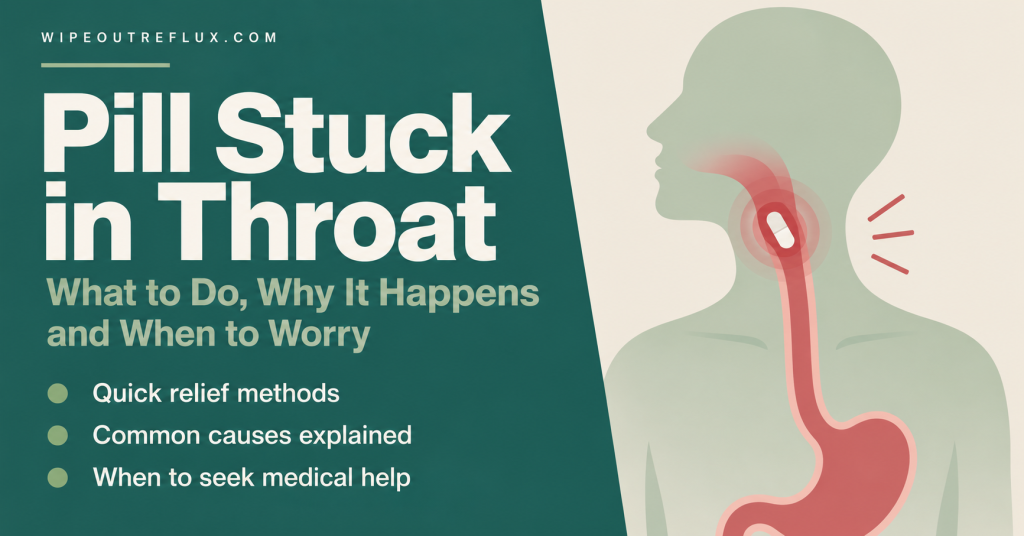
If a pill feels stuck in your throat and you can still breathe, talk and swallow your own saliva, the pill is almost certainly not in your airway. It’s either sitting in your esophagus — the food pipe running behind your windpipe — or, far more often, it has already gone down and left behind an irritated patch that your throat keeps reporting as “something’s still there.”
That distinction matters, because the two situations need completely different responses. A pill genuinely lodged in the esophagus usually shifts with water and time. A sensation that outlasts the pill is a healing problem, not a blockage problem, and no amount of swallowing, coughing or throat clearing will dislodge something that isn’t there any more.
I’ve spent years writing about throat symptoms that don’t behave the way people expect, and this is one of the most misread of the lot. Below I’ll walk through how to tell which situation you’re in, what actually helps, why the feeling can hang around for days after the pill is long gone, and the handful of signs that mean you should stop reading and get seen.
Key Takeaways
- If you can breathe, speak and swallow saliva, the pill is not blocking your airway — you are not choking, and you have time to deal with this calmly.
- Drooling, being unable to swallow your own spit, severe chest pain, vomiting blood or breathing difficulty are emergencies — go to the emergency department.
- Most “stuck pill” feelings that last more than an hour or two are not a lodged pill at all: they’re pill esophagitis (a small chemical burn where the tablet sat) or globus sensation.
- Pill esophagitis usually settles within one to two weeks once the culprit medication stops, and most people feel much better inside a week.
- Antibiotics — doxycycline above all — account for more than half of cases, along with NSAIDs, bisphosphonates, potassium chloride, iron and vitamin C tablets.
- Taking pills with less than 100 ml of water, or lying down afterwards, is the single biggest avoidable risk factor.
- Two simple techniques are proven to help: the pop-bottle method for tablets and the lean-forward technique for capsules.
- Reflux makes all of this more likely and more persistent — a sensitized, pepsin-exposed throat holds on to the “something’s stuck” signal long after the tissue has healed.
First, Rule Out the Emergency
The airway and the food pipe are two separate tubes. A pill that went down “the wrong way” into your airway would cause violent coughing, wheezing, and real difficulty getting air in — you would not be calmly searching the internet about it. The overwhelming majority of people who feel a pill stuck have it in the esophagus, or have nothing physically there at all.
That said, there are situations where you need help now rather than later. Go to an emergency department if you have any of the following:
- You cannot swallow your own saliva, or you’re drooling because it won’t go down.
- You have severe, unrelenting chest pain, or pain that’s getting worse rather than easing.
- You’re short of breath, wheezing or your voice has changed suddenly.
- You’re vomiting blood, or bringing up material that looks like coffee grounds.
- You swallowed something that isn’t a normal pill — a button battery, a blister pack fragment, a sharp object.
Complete blockage of the esophagus is the one situation where waiting it out is the wrong call, and the tell is simple: saliva has nowhere to go. If you can swallow water, you do not have a complete blockage.
What’s Actually Going On — Three Different Problems
People describe all three of these as “a pill stuck in my throat,” which is exactly why the internet advice on this topic is so contradictory. They’re not the same thing.
1. The pill really is lodged
Pills don’t fall down the esophagus under gravity. They’re carried by a muscular wave, and they need liquid to move. Swallowed dry, or swallowed while lying flat, a tablet can simply park — usually at one of the natural narrow points, where the aortic arch crosses the esophagus or just above the lower valve. This is the phase that lasts minutes to hours, not days, and it’s the only phase where “dislodging” is a meaningful idea.
2. Pill esophagitis — a chemical burn where it sat
If a pill sits still against the esophageal lining long enough, it starts to dissolve in place. Instead of a diluted dose reaching your stomach, you get a concentrated one burning a small patch of tissue that has no protective mucus layer worth speaking of. That’s pill-induced esophagitis, and it’s the reason the discomfort can start hours after the pill has already moved on.
It’s more common than most people realize — around 3.9 cases per 100,000 people a year are documented, which is certainly an undercount since most never get scoped [Saleem and Sharma, StatPearls, 2023]. The classic picture is pain behind the breastbone (about 72% of cases), pain on swallowing (around 39%) and difficulty swallowing (around 30%), coming on anywhere from a few hours to ten days after the dose.
3. Globus — the sensation that outlives the injury
The third scenario is the one that frustrates people most: the pill went down fine, any irritation has healed, and yet the feeling of something lodged in the throat persists. That’s globus sensation, and it’s remarkably common — up to 46% of otherwise healthy people report it at some point, and it accounts for roughly 4% of all ENT referrals [Lee and Kim, World Journal of Gastroenterology, 2012]. I’ve written about this in detail in my guide to the lump in throat feeling from reflux, and the pill version follows exactly the same pattern.
How to Dislodge a Pill That’s Genuinely Stuck
If it’s been minutes rather than days, and you can still swallow liquid, here’s the order I’d work through:
- Drink a full glass of water, standing or sitting upright. Not sips — a proper 200–250 ml, taken steadily. Volume is what generates the pressure to move a tablet along.
- Stay upright for at least 30 minutes. Lying down removes the one bit of help gravity gives you and is a known risk factor for the pill staying put.
- Try a soft, moist bolus. A few mouthfuls of yogurt, a small piece of soft bread, or a banana can carry a stubborn tablet down ahead of it. Chew properly — the point is a soft mass, not a second thing to get stuck.
- Warm liquid can help. Warm water or weak, non-acidic tea relaxes the esophagus slightly and helps some formulations dissolve. Skip anything fizzy, acidic or very hot.
- Don’t take a replacement dose. If the pill is still in there dissolving, a second one risks doubling the dose and the irritation. Call your pharmacist before repeating anything.
Two things to avoid: don’t put your fingers down your throat, and don’t try to force the pill down with repeated hard swallows against resistance. If liquid won’t go down at all, that’s the emergency scenario above, not a technique problem.
Why the Feeling Won’t Go Away — Day 2, Day 3 and Beyond
This is the search I see most, and the honest answer is reassuring: a sensation lasting three days almost never means the pill is still sitting there. Tablets dissolve. What’s left behind is a sore patch of lining and a throat that has become very good at noticing it.
Drug-induced esophagitis is usually self-limiting, improving within one to two weeks of stopping the culprit medication, and most people are symptom-free inside a week once the drug is stopped and simple treatment started [Saleem and Sharma, StatPearls, 2023]. The mucosa heals on roughly the same timeline as any other superficial ulcer — a comparison I go into in more depth in how long a reflux sore throat takes to heal.
What keeps the sensation going past that point is usually sensitization. The nerves in the throat and upper esophagus turn their gain up after an injury, and the upper esophageal sphincter — the muscular ring at the top of the food pipe — tightens in response to irritation from below. In laryngopharyngeal reflux specifically, those sphincter reflexes are measurably altered, which both worsens clearance of refluxed material and drives the globus sensation [Koutroumpakis and Richards, Otolaryngologic Clinics of North America, 2025]. In other words: the pill started it, but reflux physiology is often what keeps it running.
In the meantime, what helps is protecting the healing surface rather than chasing the sensation. Soft, bland, non-acidic food for a few days. Plenty of water. No alcohol, no smoking, nothing scalding hot. A barrier agent such as sucralfate coats ulcerated tissue directly and is one of the standard treatments, and an alginate after meals stops stomach contents adding insult to injury while the patch heals. If reflux is part of your picture anyway, keeping it off the healing tissue is the fastest route through — which is where the Wipeout Diet Plan earns its place, because reducing the number of reflux events is what gives an irritated esophagus a quiet week to repair.
The Pills Most Likely to Do This
Some medications are far worse offenders than others, and antibiotics lead the field — they’re implicated in more than half of all drug-induced esophageal injuries [Guttman and Zachos, Paediatrics and Child Health, 2011]. The usual suspects:
- Doxycycline and other tetracyclines. The single most common cause. They’re strongly acidic when dissolved, and they’re often prescribed for acne or infections to people who take them at bedtime with a mouthful of water — the worst possible combination.
- NSAIDs including aspirin, which damage the lining chemically as well as by direct contact.
- Bisphosphonates such as alendronate for osteoporosis. Their dosing instructions — a full glass of water, stay upright for 30 minutes — exist precisely because of this problem.
- Potassium chloride tablets, which can cause deep ulceration.
- Iron (ferrous sulfate) and vitamin C (ascorbic acid). Both are highly acidic in solution, and both are common supplements — I cover the reflux side of iron in do iron supplements cause heartburn.
- Large capsules and sustained-release formulations of almost anything. Gelatin capsules are sticky when damp, which is exactly the property you don’t want.
There’s a particular irony worth naming: several drugs taken for reflux-related problems get taken last thing at night with minimal water, which is the classic setup for this injury. If you take anything at bedtime, that’s the dose to change first.
The Reflux Connection
If you already have reflux, you’re stacked against on three fronts, and it’s worth understanding each.
First, transit. Reflux disease is associated with weaker, less co-ordinated esophageal contractions, and pills lodge more readily where the esophagus is narrowed — including at an esophageal stricture formed by years of acid exposure. A tablet that would clear a healthy esophagus in seconds can hang up at that point.
Second, tissue. An esophagus that’s already dealing with erosive esophagitis has less margin to absorb a chemical insult, so a lodged pill does more damage than it would on healthy lining.
Third, and most relevant for silent reflux, sensation. Pepsin deposited in the throat keeps the tissue in a low-grade irritated state, and reflux is thought to account for somewhere between 23% and 68% of globus cases [Lee and Kim, World Journal of Gastroenterology, 2012]. On an already-primed throat, one bad pill experience can start a sensation that then feeds itself for weeks. That’s also why people with LPR report this symptom out of all proportion to how often they actually get pills stuck — a theme I explore in can acid reflux make it hard to swallow and in the broader food stuck in throat feeling guide.
How to Take Pills So This Doesn’t Happen Again
This is genuinely preventable, and the fixes are unglamorous:
- Use 200–250 ml of water, every time. Taking medication with less than 100 ml measurably raises the risk of it lodging.
- Stay upright for 30 minutes afterwards. Sitting counts; slumping on the sofa at a shallow angle doesn’t really.
- Never take pills as the last thing before bed. Move the dose earlier in the evening, or take it with food if the label allows.
- Use the pop-bottle method for tablets. Put the tablet on your tongue, seal your lips around the opening of a flexible plastic water bottle, and swallow with a sucking motion. In a study of 151 adults it substantially improved tablet swallowing in around 60% of attempts [Schiele et al., Annals of Family Medicine, 2014].
- Use the lean-forward technique for capsules. Put the capsule on your tongue, take a medium sip of water, tilt your chin down towards your chest, then swallow. Capsules float, so tipping forward moves them to the back of the throat — this improved capsule swallowing in nearly 90% of attempts in the same study.
- Ask about the format. Liquids, dispersible tablets, smaller-dose versions and patches all exist. A pharmacist can usually tell you in a minute whether a tablet can be split, crushed or swapped — and whether it absolutely can’t, which matters for sustained-release drugs.
When to See a Doctor
Book an appointment rather than waiting it out if the sensation persists beyond about two weeks, if swallowing is getting harder rather than easier, if you’re losing weight or avoiding food, if there’s persistent pain on swallowing, or if you’re bringing up blood. Those are the signs that warrant a look with a camera — usually to confirm a simple ulcer that’s healing, occasionally to find a stricture or something else that needs treating. Persistent one-sided symptoms, hoarseness that doesn’t settle and unexplained weight loss are the classic alarm features that shouldn’t be left.
None of that is a reason to panic on day two. It’s a reason to have a timeline in your head so you know when watchful waiting turns into something else.
Conclusion
A pill stuck in your throat is frightening in the moment and almost always benign in the outcome. If you can breathe and swallow saliva, you’re not choking. If the feeling has lasted days, the pill is long gone — what you’re feeling is a healing patch of esophagus, a sensitized throat, or both. Water, upright posture, soft food and a little patience cover most of it, and changing how you take that medication covers the rest.
The part worth thinking about beyond this week is why your throat was primed to react in the first place. If you already get globus, throat clearing, hoarseness or that lump sensation between pill incidents, the underlying reflux is doing most of the work and the tablet was just the trigger. The Wipeout Diet Plan is the complete framework I built for exactly that problem — it was designed first and foremost around LPR, the stubborn throat-based form of reflux, but because it works on the same underlying mechanisms it does just as much for classic GERD and heartburn. Fewer reflux events means a throat that isn’t constantly sensitized, which is what stops a one-off pill scare turning into three weeks of symptoms. If you’d rather start smaller, the Wipeout Food Reference Guide is the essential companion — it sets out which foods and drinks are safe for reflux and LPR along with their pH values, so you can take the acid load off a healing esophagus straight away.
Frequently Asked Questions
I feel like a pill is stuck in my throat but I can breathe — is that dangerous?
No. If you can breathe, speak and swallow your own saliva, the pill is not in your airway and you are not choking. It’s either in your esophagus, which is a separate tube, or it has already passed and left an irritated patch behind. The one situation that needs emergency care is being unable to swallow saliva or drooling, which suggests a complete blockage.
How do you dislodge a pill stuck in your throat?
Stay upright and drink a full glass of water — 200 to 250 ml, steadily, not in sips. If that doesn’t do it, try a soft moist bolus such as yogurt, banana or a small piece of soft bread to carry it down. Don’t lie down, don’t put fingers down your throat, and don’t take a replacement dose without checking with a pharmacist first.
Why does the feeling of a pill stuck in my throat not go away?
Because the pill usually isn’t there any more. Tablets dissolve within minutes to hours, so a sensation lasting into day two or three is coming from a small irritated or ulcerated patch where the pill sat, or from globus — a sensation generated by a sensitized throat with nothing physically lodged. Both settle with time rather than with more swallowing.
I’ve had a pill stuck feeling for 3 days — should I worry?
Three days is common and not alarming on its own, especially if it’s slowly improving and you can eat and drink normally. Pill-induced esophagitis typically improves within one to two weeks. Get it checked if it’s getting worse rather than better, if swallowing food is becoming difficult, if there’s significant pain on swallowing, or if it’s still there after about two weeks.
What’s the best remedy for a pill stuck in the throat?
For the first hour: water and upright posture. After that, the goal switches from moving the pill to protecting the healing tissue — soft bland food, no alcohol or smoking, nothing acidic or scalding, and a barrier agent such as sucralfate or an alginate to keep stomach contents off the sore patch. Your doctor may also add a short course of acid suppression while it heals.
Which medications most often get stuck and cause damage?
Antibiotics account for more than half of cases, with doxycycline the worst offender. NSAIDs and aspirin, bisphosphonates such as alendronate, potassium chloride, iron tablets and vitamin C are the other regular culprits, along with large capsules and sustained-release formulations of any drug.
Can acid reflux make pills more likely to get stuck?
Yes, on several fronts. Reflux is associated with weaker esophageal contractions, and long-term acid exposure can cause narrowing or strictures where a tablet can hang up. An already-inflamed lining is also more easily damaged by a pill sitting against it, and pepsin-driven throat sensitivity means the resulting sensation lasts longer than it would otherwise.
Research & References
- [Saleem and Sharma, StatPearls, 2023] — Review of drug-induced esophagitis reporting an incidence of 3.9 cases per 100,000 per year, presenting symptoms of retrosternal pain (71.8%), odynophagia (38.5%) and dysphagia (29.5%), and resolution within 1 to 2 weeks of stopping the culprit drug. Also documents taking medication with under 100 ml of water and recumbent posture as key risk factors, and 200–250 ml of water plus 30 minutes upright as prevention.
- [Schiele et al., Annals of Family Medicine, 2014] — Study of 151 adults finding the pop-bottle method substantially improved tablet swallowing in 59.7% of interventions, and the lean-forward technique improved capsule swallowing in 88.6% of interventions.
- [Lee and Kim, World Journal of Gastroenterology, 2012] — Review of globus pharyngeus reporting it in up to 46% of apparently healthy individuals and about 4% of new ENT referrals, with reflux disease accounting for an estimated 23% to 68% of cases.
- [Koutroumpakis and Richards, Otolaryngologic Clinics of North America, 2025] — Review describing laryngopharyngeal reflux as a subset of GERD with altered upper esophageal sphincter reflexes that impair clearance of refluxate and contribute to globus and dysphagia symptoms.
- [Guttman and Zachos, Paediatrics and Child Health, 2011] — Case report and review noting that drug-induced esophageal injury is under-recognized, is associated with antibiotic use in more than 50% of cases, and occurs more readily at points where the esophagus is naturally or abnormally narrowed.

David Gray
12 years living with LPR · Consultant & researcher
I've lived with LPR for twelve years — the misdiagnoses, the PPI courses that did nothing, the slow work of figuring out what actually helps. Wipeout Reflux is where I translate the research into plain terms for people stuck in the same place. Every claim here is sourced to peer-reviewed work, and I consult one-to-one with LPR sufferers.