
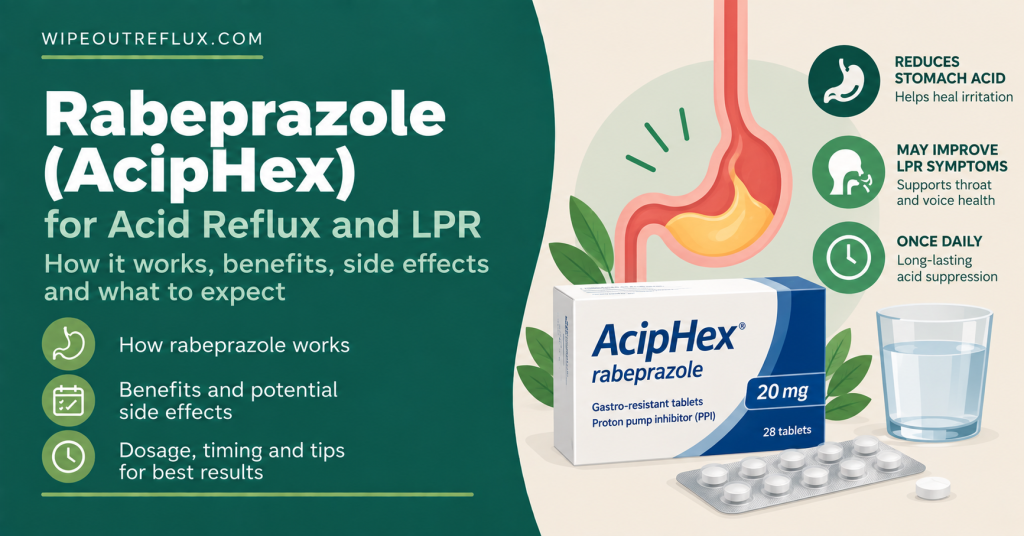
Rabeprazole — sold as AcipHex in the US and Pariet in the UK, Europe and much of Asia — is a proton pump inhibitor, the same class as omeprazole, esomeprazole, lansoprazole and pantoprazole. It shuts down the acid pumps in your stomach lining, and for acid reflux and GERD it’s used at 20 mg once daily.
What makes it genuinely different from the others isn’t marketing. It’s two pieces of chemistry. Rabeprazole activates faster than any other PPI, so it produces more acid suppression on the first day. And it’s broken down mostly by a non-enzymatic route rather than by the liver enzyme CYP2C19, which makes its effect far more consistent from person to person and gives it a cleaner drug interaction profile.
Whether any of that helps you depends entirely on what your symptoms are. For heartburn and erosive esophagitis it’s a strong, predictable option. For silent reflux, it has the same ceiling every PPI has — and I’ll be straight with you about that further down. I’ve had LPR for 12 years and been round this particular block more than once.
Key Takeaways
- Rabeprazole is a proton pump inhibitor; AcipHex is the US brand name and Pariet the name used in the UK and Europe.
- It has the highest pKa of the common PPIs, so it activates fastest and delivers the most acid suppression on day one.
- It’s cleared largely by a non-enzymatic pathway, so CYP2C19 genotype affects it far less than it affects omeprazole — meaning more consistent results between individuals.
- The standard adult dose for reflux is 20 mg once daily; 10 mg exists in the UK and Europe for maintenance and milder symptomatic GERD, but not as a US tablet strength.
- Twice-daily 20 mg is used off-label for LPR, though the trial evidence for twice-daily over once-daily dosing in throat symptoms is weak.
- Side effects are mild and class-typical: headache, diarrhea, nausea, abdominal pain, flatulence, constipation.
- It is prescription-only — there is no over-the-counter rabeprazole in the US or UK — but generic rabeprazole sodium is cheap and widely available.
- Faster and more consistent acid suppression still doesn’t address pepsin, which is what drives most laryngeal symptoms.
What rabeprazole is and how it differs from other PPIs
To answer the question directly: yes, AcipHex is a proton pump inhibitor. Its classification is a substituted benzimidazole PPI — the same pharmacological family as omeprazole (Prilosec), esomeprazole (Nexium), lansoprazole (Prevacid) and pantoprazole (Protonix). The generic name is rabeprazole sodium.
Every drug in that class works the same way at the business end. Each is a prodrug that circulates inactive, concentrates inside the acid-secreting channels of the stomach’s parietal cells, converts to an active form in that acidic environment, and then permanently disables the proton pumps it finds switched on. Your stomach has to build new pumps to recover, which takes a day or two.
The differences between PPIs are therefore not about the target. They’re about how quickly each one converts to its active form, and how your liver clears it. Rabeprazole is unusual on both counts.
It activates faster. Conversion to the active form depends on the molecule’s pKa — effectively, how readily it becomes active as pH drops. Rabeprazole has the highest pKa of the group, around 4.9 against roughly 4.1 for omeprazole and lansoprazole, and it reaches maximal pump inhibition in about 8 minutes compared with around 20 minutes for those two [Kusano et al., Clinical Medicine Insights: Gastroenterology, 2011]. That shows up clinically: in a double-blind crossover comparison of four PPIs in healthy volunteers, rabeprazole produced significantly greater acid suppression than lansoprazole, pantoprazole and omeprazole on the first day of dosing [Pantoflickova et al., Alimentary Pharmacology & Therapeutics, 2003].
It’s cleared differently. Most PPIs lean heavily on the liver enzyme CYP2C19, whose activity varies genetically — which is why the same dose of omeprazole can do very different things in two people. Rabeprazole is metabolized predominantly by non-enzymatic reduction to a thioether, with only a minor contribution from CYP2C19 and CYP3A4, making it the PPI least affected by CYP2C19 genotype [Horn, Alimentary Pharmacology & Therapeutics, 2004]. In head-to-head volunteer work, acid suppression from omeprazole varied significantly by genotype while rabeprazole’s did not [Shirai et al., Alimentary Pharmacology & Therapeutics, 2001].
That’s the real selling point: predictability. Not that it’s stronger, but that you’re less likely to be the person for whom it quietly does very little.
Rabeprazole vs omeprazole, pantoprazole and Nexium
All four heal erosive esophagitis at broadly similar rates, and the differences between them are smaller than the branding implies. Where they diverge:
Rabeprazole vs omeprazole. The clearest gap. Omeprazole’s effect swings with CYP2C19 genotype; rabeprazole’s largely doesn’t. Rabeprazole also works faster from the first dose. In pooled 24-hour pH comparisons, median gastric pH was 3.4 on rabeprazole against 1.9 on omeprazole [Kusano et al., Clinical Medicine Insights: Gastroenterology, 2011]. If omeprazole has underperformed for you, rabeprazole is a rational next thing to try rather than a lateral move.
Rabeprazole vs pantoprazole. Pantoprazole is the slowest to activate of the group and is the standard choice when drug interactions are the priority — it’s the usual PPI for anyone on clopidogrel. Rabeprazole also has a relatively clean interaction profile, but pantoprazole has the longer track record in that role. More on it in pantoprazole for acid reflux.
Rabeprazole vs esomeprazole (Nexium). Nexium’s edge comes from higher systemic exposure per milligram; rabeprazole’s comes from faster activation and genotype independence. Esomeprazole has the larger body of erosive esophagitis trial data, much of it generated at 40 mg. For everyday reflux there’s little to choose between them, and in practice cost and individual response decide it. See Prilosec vs Nexium if you’re weighing those two specifically.
Rabeprazole vs lansoprazole and dexlansoprazole. Lansoprazole sits between omeprazole and rabeprazole on speed and genotype dependence. Dexlansoprazole (Dexilant) is the outlier — a dual delayed-release formulation that releases in two waves, which is the only PPI designed specifically to extend coverage rather than deepen it. Background on the former in lansoprazole for acid reflux.
The honest summary: switching between PPIs produces meaningful change in a minority of people, and when it does, it’s usually because the first one was a poor metabolic match. Rabeprazole is a sensible switch precisely because it takes metabolism out of the equation.
Dose: 10 mg, 20 mg, and twice daily for LPR
The US label is straightforward. For healing erosive or ulcerative GERD, 20 mg once daily for four to eight weeks, with maintenance at 20 mg once daily studied out to 12 months; for symptomatic GERD without esophagitis, 20 mg daily for up to four weeks. AcipHex is supplied only as a 20 mg delayed-release tablet, and tablets must be swallowed whole, never crushed or split [AcipHex Prescribing Information, U.S. Food and Drug Administration, 2018].
The 10 mg question comes up constantly, and the answer is geographical. In the UK and Europe, rabeprazole is licensed at 10 mg as well as 20 mg: maintenance of healed reflux esophagitis can be 20 mg or 10 mg once daily depending on response, and moderate to very severe symptomatic GERD without esophagitis is treated with 10 mg once daily [Pariet 10 mg Summary of Product Characteristics, electronic Medicines Compendium]. In the US there’s no 10 mg tablet — the low-dose sprinkle capsules are a pediatric formulation, not an adult step-down.
Timing. Rabeprazole is more forgiving than most PPIs here. The US label allows it to be taken with or without food for reflux indications, and the UK product information states that neither time of day nor food intake showed any effect on rabeprazole’s activity — while still recommending morning dosing before eating for once-daily treatment. I’d take the recommendation over the permission: the pump-activation mechanism is the same as every other PPI, so a dose that lands ahead of a meal is still working with the drug rather than around it. Same logic as the timing rules for omeprazole.
Twice daily for LPR. Off-label twice-daily dosing — 20 mg before breakfast and 20 mg before the evening meal — is common practice for silent reflux, on the theory that laryngeal tissue is far more sensitive than esophageal tissue and needs deeper suppression. It’s a reasonable theory with thin evidence. A randomized trial comparing twice-daily against once-daily PPI dosing in laryngopharyngeal reflux found no better symptom response from the twice-daily regimen at either 8 or 16 weeks [Ji et al., Journal of Neurogastroenterology and Motility, 2024]. If you’re on twice daily and it isn’t helping after a proper trial, the answer probably isn’t a third dose.
Side effects
Rabeprazole is well tolerated, and the common side effects are mild and class-typical. In the controlled trials behind the US label, reactions occurring in at least 2% of adults and more often than placebo were pain (3% vs 1%), pharyngitis (3% vs 2%), flatulence (3% vs 1%), infection (2% vs 1%) and constipation (2% vs 1%) [AcipHex Prescribing Information, U.S. Food and Drug Administration, 2018]. The UK product information lists headache, dizziness, diarrhea, nausea, vomiting, abdominal pain, constipation, flatulence, cough, pharyngitis, rhinitis and asthenia as common — affecting between 1 in 100 and 1 in 10 people [Pariet 10 mg Summary of Product Characteristics, electronic Medicines Compendium].
Most of those settle within the first week or two. Headache and looser stools are the two that most often prompt people to stop.
The longer-term concerns are class effects rather than rabeprazole-specific ones, and the label carries the same set as every other PPI: acute interstitial nephritis, Clostridioides difficile-associated diarrhea, bone fracture with long-term use, cutaneous and systemic lupus erythematosus, vitamin B12 deficiency with use beyond three years, low magnesium, and fundic gland polyps with use beyond a year. None of these are reasons to avoid a short course; all of them are reasons not to drift into indefinite use without a plan. I’ve covered the evidence on each in PPIs and bone density, PPIs and kidney disease, low magnesium on PPIs and what nutrients PPIs deplete.
One thing worth knowing before you start: stopping a PPI abruptly after several weeks can cause rebound acid hypersecretion, where symptoms come back worse than baseline for a week or two. That’s a withdrawal effect, not proof you need the drug. The structured way down is in the PPI taper schedule, with the mechanism in getting off PPIs and acid rebound.
Generic name, cost and over-the-counter availability
The generic name is rabeprazole sodium. AcipHex is the US brand; Pariet is the name it carries in the UK, Europe, Japan and much of the rest of the world. Generic rabeprazole sodium delayed-release tablets are widely available and inexpensive — in most markets the brand has been largely displaced by generics, and there’s no clinical reason to pay for the brand.
On availability: rabeprazole is prescription-only. There is no over-the-counter rabeprazole in the US or the UK. That’s a real practical difference from omeprazole and esomeprazole, both of which you can buy off the shelf at 20 mg. If you want a PPI without seeing a doctor, rabeprazole isn’t an option — see the best over-the-counter medicine for acid reflux for what is.
Cost-wise, generic rabeprazole sits in the same broad territory as generic pantoprazole and esomeprazole, though exact pricing varies a lot by country, insurance and pharmacy. It’s not a premium drug.
Does rabeprazole work for LPR and silent reflux?
This is the part I care most about getting right, because it’s where most people reading this actually are.
There is trial evidence. A randomized placebo-controlled study found rabeprazole effective in treating laryngopharyngeal reflux [Lam et al., Clinical Gastroenterology and Hepatology, 2010] — which puts it ahead of much of the LPR literature, where placebo-controlled PPI trials have repeatedly failed to separate. Rabeprazole’s faster onset and consistency across metabolizer types are plausible reasons it performed better than some.
But I’d temper that in two ways. First, LPR trials are notoriously noisy: symptom scores improve substantially on placebo, follow-up is short, and populations are diagnosed inconsistently. Second, and more fundamentally, no PPI addresses what actually damages the larynx.
The agent doing the harm in silent reflux isn’t only acid. It’s pepsin — the stomach’s protein-digesting enzyme — which travels up with the refluxate, binds to laryngeal tissue and stays there. It sits dormant at throat pH and is reactivated every time something acidic passes over it: a coffee, a glass of orange juice, a vinegar dressing. A PPI reduces how acidic your refluxate is. It does not stop reflux events happening, it does not remove deposited pepsin, and it does nothing about the acidic things you swallow.
That’s the ceiling, and it’s why so many people with throat symptoms work through omeprazole, then esomeprazole, then rabeprazole, then twice-daily rabeprazole, without ever feeling properly well. I’ve written the full argument in why PPIs don’t work for LPR, and the broader options in proton pump inhibitors for LPR and the best medication for LPR.
If you’ve reached rabeprazole because nothing else worked, it’s worth a proper trial — eight weeks, taken correctly, judged honestly. But run it alongside the dietary work rather than instead of it. That’s the combination that moves LPR, and it’s exactly what the Wipeout Diet Plan is built around.
Conclusion
Rabeprazole is one of the better-designed PPIs. It activates faster than anything else in the class, it works more consistently across different metabolisms because it largely bypasses CYP2C19, and it carries a cleaner interaction profile as a result. For heartburn, GERD and erosive esophagitis at 20 mg once daily, it’s a strong, dependable choice — and if omeprazole has underwhelmed you, it’s a genuinely rational switch rather than a shuffle between near-identical drugs.
What it can’t do is change what a PPI fundamentally is. It suppresses acid. It doesn’t reduce how often you reflux, it doesn’t repair the barrier letting it happen, and in silent reflux it doesn’t touch the pepsin already bound to your throat tissue. Faster and more consistent suppression of the wrong variable is still the wrong variable. That’s why the answer to a PPI that isn’t working is so rarely another PPI.
The Wipeout Diet Plan is what I’d point you to for the part medication leaves untouched. It’s the complete, structured approach — what to eat and in what order, how to sequence meals and sleep so they stop working against you, how to bring pepsin reactivation down week by week, and how to taper acid suppression safely once your throat and esophagus have had a real chance to heal. I designed it first around LPR, the throat-based form that responds worst to drugs, but because it works on the same underlying reflux mechanisms it does just as much for classic GERD and everyday heartburn.
If you want a lighter starting point, the Wipeout Food Reference Guide is the essential companion — every food and drink worth knowing about for acid reflux and LPR, with its pH, so you can stop guessing while you work out your own triggers.
Frequently Asked Questions
Is AcipHex a proton pump inhibitor?
Yes. AcipHex is the US brand name for rabeprazole sodium, a proton pump inhibitor in the same class as omeprazole, esomeprazole, lansoprazole and pantoprazole. Its classification is a substituted benzimidazole PPI.
What is the generic name for AcipHex?
Rabeprazole sodium. Generic rabeprazole sodium delayed-release tablets are widely available and considerably cheaper than the brand, with no clinical difference.
Is rabeprazole stronger than omeprazole?
It acts faster and more consistently rather than being straightforwardly stronger. It reaches full pump inhibition in minutes rather than tens of minutes, and its effect doesn’t swing with CYP2C19 genotype the way omeprazole’s does — so it’s less likely to underperform in any given individual.
Can you buy rabeprazole over the counter?
No. Rabeprazole is prescription-only in both the US and the UK. Omeprazole and esomeprazole are the PPIs available over the counter at 20 mg.
Should rabeprazole be taken before or after food?
The US label permits it with or without food for reflux, and the UK product information says food doesn’t meaningfully affect it — but it still recommends taking it in the morning before eating. Taking it about an hour before breakfast works with the mechanism, so that’s what I’d do.
What is the difference between rabeprazole 10 mg and 20 mg?
20 mg is the standard treatment dose for reflux esophagitis and symptomatic GERD. 10 mg is a lower-strength option licensed in the UK and Europe for maintenance after healing and for symptomatic GERD without esophagitis — it isn’t available as an adult tablet strength in the US.
How long can you stay on rabeprazole?
Short courses run four to eight weeks, and maintenance at 20 mg has been studied for up to 12 months. Longer than that should be a deliberate decision with your doctor, weighed against the class risks, and paired with a plan for eventually coming off — not something that happens by repeat prescription.
Research & References
- [Kusano et al., Clinical Medicine Insights: Gastroenterology, 2011] — Review reporting rabeprazole’s pKa of 4.9 against 4.1 for omeprazole and lansoprazole, maximal inhibition within about 8 minutes versus 20, predominantly non-enzymatic metabolism, and median 24-hour gastric pH of 3.4 on rabeprazole versus 1.9 on omeprazole.
- [Pantoflickova et al., Alimentary Pharmacology & Therapeutics, 2003] — Double-blind crossover study in 18 healthy volunteers; rabeprazole produced significantly greater acid inhibition on the first day of dosing than lansoprazole, pantoprazole or omeprazole.
- [Horn, Alimentary Pharmacology & Therapeutics, 2004] — Review concluding rabeprazole’s clearance is largely non-enzymatic, making it less dependent on CYP2C19 than other PPIs, with more consistent pharmacokinetics across genotypes and fewer clinically significant drug interactions than omeprazole.
- [Shirai et al., Alimentary Pharmacology & Therapeutics, 2001] — Eight-day dosing study showing acid suppression from omeprazole varied significantly with CYP2C19 genotype, while rabeprazole showed no significant differences in acid suppression between genotype groups.
- [Lam et al., Clinical Gastroenterology and Hepatology, 2010] — Randomized placebo-controlled trial finding rabeprazole effective in treating laryngopharyngeal reflux.
- [Ji et al., Journal of Neurogastroenterology and Motility, 2024] — Randomized controlled trial in laryngopharyngeal reflux finding no higher symptom-index response rate for twice-daily versus once-daily PPI dosing at 8 or 16 weeks.
- [AcipHex Prescribing Information, U.S. Food and Drug Administration, 2018] — US dosing for erosive GERD, maintenance and symptomatic GERD; 20 mg delayed-release tablet only; adverse reaction rates versus placebo; class warnings and metabolism data.
- [Pariet 10 mg Summary of Product Characteristics, electronic Medicines Compendium] — UK licensing of 10 mg and 20 mg strengths, maintenance and symptomatic GERD dosing, morning-before-eating recommendation, and common side effect frequencies.

David Gray
12 years living with LPR · Consultant & researcher
I've lived with LPR for twelve years — the misdiagnoses, the PPI courses that did nothing, the slow work of figuring out what actually helps. Wipeout Reflux is where I translate the research into plain terms for people stuck in the same place. Every claim here is sourced to peer-reviewed work, and I consult one-to-one with LPR sufferers.