
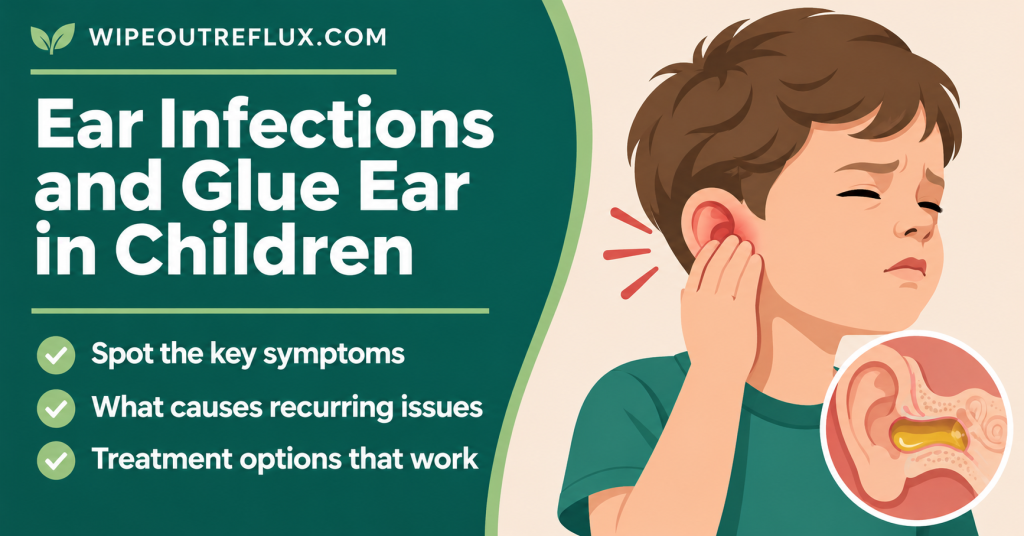
Reflux may play a real part in ear infections and glue ear in some children. Researchers have repeatedly found pepsin, a digestive enzyme that’s only made in the stomach, in the fluid trapped behind children’s eardrums. In the landmark study, 83% of glue ear fluid samples contained pepsin, at levels up to 1,000 times higher than in the blood. The only realistic way for it to get there is stomach contents traveling up the esophagus, into the back of the nose and through the Eustachian tube.
That doesn’t mean reflux causes every ear infection, or that every child with glue ear needs reflux medication. Colds, enlarged adenoids, allergies and simple anatomy are still the main drivers. But for children who keep getting ear infections, or whose glue ear just won’t clear, reflux is a factor that’s worth knowing about and that often gets overlooked.
Here’s what the research actually shows, why young children are especially vulnerable, and what you can do about it.
Key Takeaways
- Glue ear (otitis media with effusion) is a build-up of thick fluid behind the eardrum and is the most common cause of hearing loss in children.
- Pepsin, a stomach enzyme, has been found in the middle ear fluid of most children with glue ear in several studies, with an average of around 85% across studies in one systematic review.
- Pepsin can only reach the middle ear by reflux traveling up through the back of the nose and the Eustachian tube.
- Young children’s Eustachian tubes are shorter, floppier and more horizontal than adults’, and they spend more time lying down, which makes this route easier.
- Lab research suggests pepsin drives inflammation and mucus production in the middle ear, and higher pepsin levels are linked to thicker, “gluier” fluid.
- Many children with reflux-related ear problems don’t vomit or seem to have obvious reflux symptoms.
- Evidence that reflux medication clears glue ear is still weak, so it isn’t a routine treatment. Any medication should be guided by your child’s doctor.
- Feeding habits, mealtime timing and a smoke-free home can reduce reflux and ear problems without medication.
What Is Glue Ear?
Behind your child’s eardrum is a small, air-filled space called the middle ear. It contains the tiny bones that pass sound vibrations to the inner ear. To stay healthy, that space needs to be ventilated and drained, and that’s the job of the Eustachian tube, a narrow channel running from the middle ear to the back of the nose.
Glue ear, known medically as otitis media with effusion (OME), is when the middle ear fills up with fluid that can’t drain. Over time that fluid can become thick and sticky, like glue, which is where the name comes from. It muffles sound, so the main sign is reduced hearing rather than pain.
Glue ear is different from an acute ear infection (acute otitis media), which comes on suddenly with ear pain, fever and a generally unwell child. The two are closely linked though. Glue ear often follows an ear infection, and fluid that sits in the middle ear makes further infections more likely.
Signs of glue ear in children
- Not responding when called, or mishearing words
- Turning the TV or tablet up louder than usual
- Speaking more loudly, or delayed or unclear speech in younger children
- Seeming inattentive, tired or frustrated, especially at school
- Mild earache or a feeling of fullness, or tugging at the ears
- Balance problems or clumsiness in some children
The Pepsin-in-the-Middle-Ear Research
This is the part I find fascinating, because it’s such a clear example of what I talk about across this site: pepsin turning up in places it has no business being.
Pepsin is made only in the stomach. It isn’t produced in the ear, the nose or the throat. So if you find it somewhere else in the body, it got there by reflux. That makes it an excellent marker for tracking where refluxed stomach contents have traveled. I explain pepsin in more detail in what is pepsin.
The 2002 Lancet study that started it
Researchers in Newcastle and Nottingham in the UK tested fluid taken from the middle ears of children having surgery for glue ear. They found pepsin or its precursor, pepsinogen, in 45 of 54 samples (83%), at concentrations up to 1,000 times higher than in the children’s blood. They concluded that reflux of gastric juice could be a major cause of glue ear in children [Tasker et al., The Lancet, 2002].
The same team followed up with a larger analysis of 65 samples. This time 59 (91%) tested positive for pepsin or pepsinogen, and in 19 samples the enzyme was still active and able to break down proteins [Tasker et al., The Laryngoscope, 2002].
Studies with control groups
A fair question is whether pepsin just turns up in everyone’s middle ear. A large US study answered that. It tested middle ear samples from 509 children having ear tubes placed for recurrent infections or glue ear and compared them with children having ear surgery (cochlear implants) who had no history of ear infections. Pepsin was found in 20% of the children with ear disease, compared with just 1.4% of the controls [O’Reilly et al., The Laryngoscope, 2008].
The rates vary a lot between studies, mostly because of differences in the tests used. A systematic review pulling the studies together found pepsin in an average of 85.3% of middle ear samples from children with otitis media, with active enzyme in around a third. The same review found that roughly half of children with chronic glue ear had reflux disease, a higher rate than you’d expect in the general population [Miura et al., Otolaryngology–Head and Neck Surgery, 2012].
Pepsin and “gluey” fluid
More recent work has started to explain how pepsin might cause trouble once it’s there. In a study of 30 children having ear tubes placed, pepsin was found in the middle ear fluid of 77%. Higher pepsin levels were linked to thicker, more viscous fluid, higher levels of inflammatory signals (interleukins 6 and 8), more neutrophil activity and more of the mucin that makes fluid sticky. When the researchers exposed middle ear cells to pepsin in the lab, even at near-neutral pH, the cells switched on inflammatory genes [Samuels et al., The Laryngoscope, 2022].
That last point matters. The middle ear isn’t acidic, so you might expect pepsin to be harmless there. But this study suggests pepsin can still drive inflammation without strong acid around it. Nikki Johnston, one of the authors, is the pepsin researcher I interviewed for this site, and our conversation on pepsin and why acid-suppressing drugs often fall short covers exactly this.
How Reflux Reaches a Child’s Middle Ear
It sounds like a long way from the stomach to the ear, but the route is surprisingly direct:
- Stomach contents reflux up the esophagus, past the upper esophageal sphincter and into the throat.
- From the throat, they can travel up into the nasopharynx, the space at the back of the nose.
- The Eustachian tube opens into the nasopharynx. When the tube opens, during swallowing, yawning, crying or feeding, refluxed material can be drawn up into the middle ear.
Once there, acid and pepsin can irritate the lining of the Eustachian tube and middle ear. Inflamed tissue swells, the tube struggles to open and drain, and fluid starts to build. That’s the perfect setting for bacteria from a cold to settle in and cause infection. Adults can get a version of this too, which I cover in acid reflux and Eustachian tube dysfunction.
Why Young Children Are So Vulnerable
Several things stack the odds against babies and toddlers:
- Their Eustachian tubes are shorter and flatter. In young children the tube is shorter, softer and closer to horizontal than in adults. Fluid drains out less easily, and material in the back of the nose has a shorter, flatter path in.
- Reflux is common in infancy. Most babies reflux to some degree in the first months of life, because the valve at the bottom of the esophagus is still maturing and their diet is entirely liquid. I explain this in silent reflux in newborns.
- They spend a lot of time lying down. Babies feed, sleep and play lying flat far more than older children, which makes it easier for refluxed material to pool at the back of the nose.
- They’re constantly getting colds. Viral infections inflame the Eustachian tube too, and reflux on top of that can tip a child from a cold into an ear infection or glue ear.
As children grow, their Eustachian tubes lengthen and become more angled, which is one reason most children outgrow both glue ear and frequent ear infections by school age.
Signs Reflux Might Be Involved in Your Child’s Ear Problems
Many children with reflux reaching their ears don’t have dramatic symptoms. That’s the “silent” part of silent reflux. But it’s worth raising reflux with your child’s doctor if repeated ear infections or glue ear come alongside any of these:
- Frequent spitting up or vomiting beyond the first few months
- Arching, crying or fussing during or after feeds
- A chronic cough, especially at night or after eating
- Noisy breathing, hoarseness or a croaky voice
- Constant nasal congestion or recurring sinus problems
- Bad breath or frequent throat clearing in older children
- Complaints of tummy ache, a sour taste or burning in older children
My guide to silent reflux in children covers these symptoms in more detail, and if you’ve got a baby, colic vs reflux in babies can help you tell the two apart.
Does Treating Reflux Clear Glue Ear?
This is where I have to be honest with you, because it’s the question every parent asks: if reflux is involved, will reflux medication fix the ears?
The short answer is that we don’t know yet, and the evidence so far is thin.
- The 2012 systematic review concluded that the existing research couldn’t support recommending antireflux therapy for otitis media [Miura et al., Otolaryngology–Head and Neck Surgery, 2012].
- One study of children with persistent glue ear found 58% had reflux disease, and 52% of those treated with a PPI improved, with better hearing levels after treatment. But there was no placebo group, and glue ear often clears on its own, so it’s hard to know how much was the medication [Elbeltagy & Abdelhafeez, International Archives of Otorhinolaryngology, 2022].
- A placebo-controlled US trial of lansoprazole in children with chronic glue ear struggled to recruit, enrolled only 16 children, and couldn’t show a benefit either way [Dewan & Lieu, The Journal of International Advanced Otology, 2018].
There’s also a mechanistic reason PPIs may not be the answer. They reduce acid, but they don’t stop reflux happening, and they don’t remove pepsin. The 2022 study suggests pepsin can cause inflammation in the middle ear even without much acid. That’s the same reason PPIs often disappoint in adults with throat reflux, which I explain in why PPIs don’t work for LPR.
Pediatric guidelines have also moved toward using acid suppression less in children, recommending short trials only where reflux disease is clearly present, and moving away from blaming airway symptoms on reflux without good evidence [Rosen et al., Journal of Pediatric Gastroenterology and Nutrition, 2018]. PPIs have side effects in children too, so please don’t give reflux medication to a child without speaking to their doctor first.
The research I’m most interested in is in pepsin-targeting treatments. Fosamprenavir, an existing drug that blocks pepsin, is being studied in adults with throat reflux. I’ve covered it in fosamprenavir for LPR. It’s not something that’s being used for children’s ears, but it shows where the thinking is heading.
Practical Ways to Reduce Reflux and Protect Your Child’s Ears
While the medication evidence is uncertain, there’s a lot you can do day to day that reduces reflux, lowers ear infection risk, or both. Always check with your child’s doctor or health visitor before making changes to a baby’s feeding.
For babies
- Never feed lying flat or prop a bottle. Feeding with your baby semi-upright, rather than lying back, helps keep milk out of the back of the nose and away from the Eustachian tubes.
- Offer smaller, more frequent feeds if your doctor agrees. An overfull stomach refluxes more.
- Hold your baby upright for 20 to 30 minutes after feeds, and wind them gently.
- Breastfeed if you can. Breastfeeding is well known to lower the risk of ear infections.
- Keep sleep safe. This one is important: babies should always sleep flat on their back on a firm mattress, with no wedges, pillows or sleep positioners, even if they have reflux. Raising the head of the bed is an adult strategy, not one for infants.
For toddlers and older children
- Finish the evening meal two to three hours before bed, so the stomach isn’t full when they lie down.
- Cut back on fizzy drinks, juice and very acidic foods, especially in the evening. Acidic drinks can reactivate pepsin sitting in the throat and nose.
- Watch for trigger foods. Chocolate, fatty and fried foods, tomato-based sauces and spicy foods are common culprits in older children.
- Help them stay a healthy weight and avoid tight waistbands, which push on the stomach.
- Treat congestion. Saline rinses or sprays for older children can help keep the back of the nose and Eustachian tubes clearer.
For everyone in the house
- Keep your home smoke-free. Second-hand smoke is a well-established risk factor for ear infections in children, and it worsens reflux too.
- Look at the family diet. Children eat what the household eats. If you or your partner deal with reflux too, a lower-acid way of eating at home can help everyone. That’s exactly what the Wipeout Diet Plan is built around, though for children any significant dietary change should be run past their doctor first.
Standard Treatment for Glue Ear
It’s worth knowing what usually happens with glue ear, so reflux is seen as one piece of the picture rather than a replacement for normal care:
- Watchful waiting. Glue ear often clears on its own within about three months, so doctors usually monitor first.
- Hearing tests to check how much the fluid is affecting your child’s hearing.
- Autoinflation, where older children blow up a special balloon through their nose to help open the Eustachian tubes.
- Hearing aids as a temporary measure for some children.
- Ear tubes (grommets) if glue ear is persistent and affecting hearing, speech or learning. These tiny tubes let air into the middle ear and allow fluid to drain.
- Adenoid removal is sometimes considered, especially if fluid keeps coming back after tubes.
If your child has persistent glue ear, recurrent infections and signs of reflux, it’s reasonable to ask their pediatrician or ENT whether reflux should be looked at as part of the overall plan.
When to See a Doctor
See your child’s doctor if they have:
- Hearing problems or speech delays
- Repeated ear infections
- Ear pain with a high fever, or fluid or pus coming from the ear
- Swelling, redness or tenderness behind the ear (seek urgent care)
- Vomiting that is forceful, green, bloody, or happening with poor weight gain
- Breathing difficulties, or feeding refusal in a baby
Conclusion
The link between reflux and children’s ear problems is one of the clearest examples of how far stomach contents can travel. Pepsin is only made in the stomach, yet study after study has found it in the fluid behind children’s eardrums, much more often in children with ear disease than without. Newer research suggests it doesn’t just sit there either. It appears to drive the inflammation and thick mucus that make glue ear so stubborn.
That doesn’t make reflux the cause of every ear infection, and it doesn’t mean reflux medication is the fix. The trials so far are small and inconclusive, PPIs don’t remove pepsin, and pediatric guidelines rightly urge caution with acid suppression in children. What it does mean is that for a child with recurring ear infections or glue ear plus signs of reflux, it’s worth putting reflux on the table with your doctor and tackling it through feeding, meal timing and household habits.
If reflux is something you’re dealing with yourself, or it runs through the family, the Wipeout Diet Plan is the most complete guide I’ve put together. I designed it first and foremost around silent reflux, the pepsin-driven, throat-and-airway type behind problems like this, but because it tackles the same root causes it works just as well for GERD and ordinary heartburn. It shows you which foods keep pepsin quiet, how to time meals, and how to build a lower-acid way of eating that can work for the whole household.
Frequently Asked Questions
Can acid reflux cause ear infections in children?
Reflux may contribute in some children. Pepsin from the stomach has been found in the middle ear fluid of many children with ear infections and glue ear, and much less often in children without ear disease. Reflux can inflame the Eustachian tube, which makes fluid build-up and infection more likely, but it’s one factor among several, alongside colds, adenoids and anatomy.
How does reflux get into the ear?
Refluxed stomach contents can travel up past the throat into the back of the nose, where the Eustachian tube opens. When the tube opens during swallowing, feeding or crying, that material can be drawn into the middle ear. Young children’s short, horizontal Eustachian tubes make this easier.
What is pepsin and why was it found in children’s ears?
Pepsin is a digestive enzyme made only in the stomach. Because the body doesn’t produce it anywhere else, finding it in the middle ear is strong evidence that stomach contents have refluxed there. Studies have found it in most samples of glue ear fluid tested.
Will reflux medicine cure glue ear?
There isn’t good evidence that it will. Small studies have shown mixed results, and a systematic review concluded antireflux therapy can’t be endorsed for otitis media yet. Reflux medication should only be given to children under a doctor’s guidance.
Can reflux in babies cause glue ear?
It may contribute. Babies reflux frequently, spend a lot of time lying down, and have Eustachian tubes that make it easy for material at the back of the nose to reach the middle ear. Feeding semi-upright, avoiding bottle propping and holding your baby upright after feeds can all help.
Should my baby sleep raised up to help reflux and ear problems?
No. Babies should always sleep flat on their back on a firm surface, without wedges, pillows or positioners, even if they have reflux. Raising the head of the bed is advice for adults and older children, not infants.
Will my child grow out of glue ear?
Most children do. Glue ear often clears within a few months, and as children grow their Eustachian tubes lengthen and drain better. Infant reflux also usually settles by the end of the first year. Persistent cases may need ear tubes, so keep up with hearing checks.
Research & References
- [Tasker et al., The Lancet, 2002] — Found pepsin/pepsinogen in 45 of 54 (83%) middle ear effusions from children with glue ear, at up to 1,000 times serum levels, suggesting gastric reflux could be a major cause.
- [Tasker et al., The Laryngoscope, 2002] — In 65 middle ear effusions from children, 59 (91%) contained pepsin/pepsinogen and 19 had active acidic protease activity; the authors concluded the pepsin was almost certainly due to reflux.
- [O’Reilly et al., The Laryngoscope, 2008] — Pepsin was found in the middle ear of 20% of 509 children having ear tubes for otitis media, compared with 1.4% of control children with no history of ear infections.
- [Miura et al., Otolaryngology–Head and Neck Surgery, 2012] — Systematic review finding pepsin/pepsinogen in a mean 85.3% of middle ear samples in otitis media and reflux disease in around half of children with chronic glue ear; antireflux therapy could not be endorsed on current evidence.
- [Samuels et al., The Laryngoscope, 2022] — Pepsin was present in 77% of children’s middle ear fluid and correlated with fluid viscosity, inflammatory interleukins, neutrophil elastase and mucin; pepsin triggered inflammatory gene expression in middle ear cells in the lab.
- [Elbeltagy & Abdelhafeez, International Archives of Otorhinolaryngology, 2022] — In children with persistent glue ear, 58% had reflux disease, and 52% of those improved after PPI treatment, though the study had no placebo group.
- [Dewan & Lieu, The Journal of International Advanced Otology, 2018] — Placebo-controlled trial of lansoprazole for chronic glue ear that enrolled only 16 children and could not demonstrate a benefit; the authors called for a larger study.
- [Rosen et al., Journal of Pediatric Gastroenterology and Nutrition, 2018] — NASPGHAN/ESPGHAN pediatric reflux guidelines, which focus on reducing acid suppression where possible and shift away from attributing airway symptoms to reflux without evidence.

David Gray
12 years living with LPR · Consultant & researcher
I've lived with LPR for twelve years — the misdiagnoses, the PPI courses that did nothing, the slow work of figuring out what actually helps. Wipeout Reflux is where I translate the research into plain terms for people stuck in the same place. Every claim here is sourced to peer-reviewed work, and I consult one-to-one with LPR sufferers.