
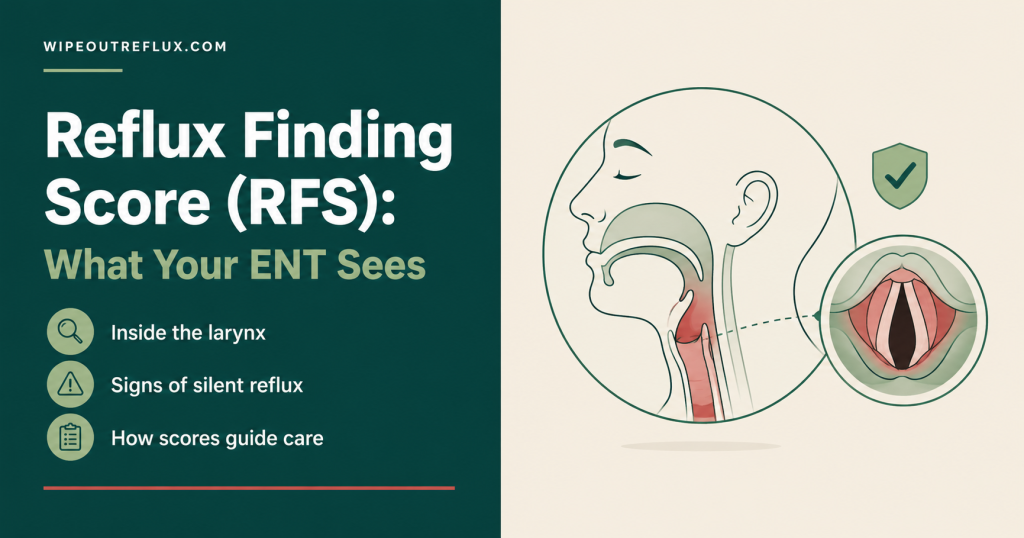
The Reflux Finding Score (RFS) is the checklist your ENT fills in when they look at your voice box with a camera and are trying to work out whether reflux is behind your throat symptoms. It rates eight specific signs of irritation in the larynx — things like swelling, redness and thick mucus — and adds them up into a single number from 0 to 26.
The number that matters is 7. A total above 7 is taken to suggest laryngopharyngeal reflux (LPR, or silent reflux), because in the original research patients scoring higher than 7 had roughly a 94% chance of having reflux confirmed on acid testing. The higher the score, the more inflamed your larynx looks.
It’s the visual half of the LPR picture, and it’s designed to sit alongside the symptom half — the Reflux Symptom Index, which scores what you feel. Here’s exactly what your ENT is looking at, what each finding means, and how much weight to put on the result.
Key Takeaways
- The Reflux Finding Score (RFS) is an eight-item scale your ENT scores from a laryngoscopy to gauge how much your voice box looks irritated by reflux.
- It runs from 0 (no abnormal findings) to 26 (maximum), and a score above 7 suggests laryngopharyngeal reflux.
- In the original study, patients scoring over 7 had about a 94% probability of having LPR confirmed on acid testing.
- The eight findings include swelling, redness, thick mucus and tissue changes in and around the vocal folds.
- The RFS measures physical findings; the Reflux Symptom Index (RSI) measures your symptoms — the two are meant to work together.
- It’s also used to track progress: a falling RFS over months suggests treatment is working.
- The score is somewhat subjective — different doctors can rate the same larynx differently — so it’s a guide, not a verdict.
- A high RFS points to reflux as the driver, but confirming and treating the cause still matters more than the number itself.
What the RFS is and why it exists
Silent reflux is genuinely hard to pin down. Unlike classic heartburn, its symptoms — hoarseness, throat clearing, a lump sensation, chronic cough — are vague and shared with many other conditions. Before the RFS, doctors described what they saw in the larynx in loose, inconsistent language, and there was no standard way to say how much reflux irritation was present.
The Reflux Finding Score was created to fix that. Introduced and validated by a team of laryngologists, it turns the physical signs of reflux in the voice box into a structured, numbered scale — so findings can be recorded consistently, compared between visits, and communicated clearly between clinicians Belafsky et al., The Laryngoscope, 2001. In their study of patients with reflux confirmed by acid monitoring, the scale proved reliable and reproducible, and a total above 7 flagged LPR with about 94% probability. That threshold is why the RFS caught on as a practical bedside tool.
The eight things your ENT is scoring
During a laryngoscopy, a thin flexible camera is passed through your nose to view the larynx. As they look, your ENT is rating these eight findings. Understanding them demystifies what can feel like a very opaque exam.
- Subglottic edema (pseudosulcus). Swelling just below the vocal folds that creates a false groove running along them. Scored 0 or 2.
- Ventricular obliteration. The small space between the true and false vocal folds becomes swollen and harder to see. Scored 2 (partial) or 4 (complete) — and it’s a common finding in LPR.
- Erythema / hyperemia. Redness of the larynx from irritation. Scored 2 if limited to the arytenoids, 4 if more diffuse.
- Vocal fold edema. Swelling of the vocal folds themselves, ranging from mild to severe (polypoid). Scored 1 to 4.
- Diffuse laryngeal edema. More widespread swelling across the larynx, graded by how much it narrows the airway. Scored 1 to 4.
- Posterior commissure hypertrophy. Thickening of the tissue at the back of the larynx, where refluxed material tends to pool. Scored 1 to 4 — one of the more telling reflux signs.
- Granuloma / granulation tissue. Small lumps of reactive tissue from ongoing irritation. Scored 0 or 2.
- Thick endolaryngeal mucus. Excess sticky mucus coating the larynx. Scored 0 or 2.
Add them up and you get a total out of 26. Notice the pattern: most of these are variations on swelling, because that’s what chronic exposure to refluxed acid and pepsin does to delicate laryngeal tissue. If you want the underlying culprit, it’s largely pepsin reaching the throat and reactivating there — the same enzyme that makes silent reflux so damaging in the first place.
What your score means
Here’s how to read the number your ENT lands on:
- 0–7: Within the range considered normal or borderline. Reflux is less likely to be the main driver of your symptoms, though it doesn’t rule it out entirely.
- Above 7: Suggestive of laryngopharyngeal reflux. This is the threshold from the original validation, where scores over 7 carried roughly a 94% probability of LPR.
- 11 and above: Often treated as a firmer indication, reflecting clearly visible laryngeal irritation.
Just as useful as the one-off number is the trend. Because the RFS is reproducible, your ENT can score it again after a few months of treatment. A total that falls from, say, 14 to 6 is objective evidence that the inflammation is settling — a reassuring counterpart to how you feel, and a common way to judge whether a silent reflux treatment plan is working.
RFS and RSI: two halves of the same picture
This is the part worth really understanding, because the RFS was never meant to stand alone.
The two validated LPR tools measure different things. The Reflux Finding Score is what the doctor sees — objective physical findings in the larynx. The Reflux Symptom Index (RSI) is what the patient feels — a questionnaire scoring the severity of your symptoms, where a total above 13 is considered abnormal. One captures the signs, the other the symptoms.
Used together they’re far more convincing than either alone: a high RSI (you feel bad) plus a high RFS (your larynx looks inflamed) builds a strong case for LPR and is a common way ENTs approach the diagnosis. They don’t always move in lockstep — you can feel dreadful with modest findings, or show clear findings with mild symptoms — which is exactly why doctors look at both rather than trusting one number. If you want the wider diagnostic context, I lay it out in how acid reflux is diagnosed, and the distinction between the throat-based and classic forms in GERD vs LPR.
The honest limitation: it’s subjective
I’d be doing you a disservice not to flag this, because it’s important for how much weight you put on your score.
The RFS depends on one clinician’s visual judgement of swelling and redness — and those judgements vary. When researchers had multiple general otolaryngologists score the same laryngoscopy videos, inter-rater reliability was only fair, and, tellingly, knowing the patient’s symptoms actually influenced how they scored the findings Chang et al., Journal of Voice, 2015. In other words, two competent doctors can look at the same larynx and land on different numbers.
There’s a second catch: many of these findings — mild redness, a little swelling — also appear in people without reflux, from voice overuse, allergies, smoke, or simply normal variation. That overlap is part of why silent reflux is so easily over-diagnosed, a theme I dig into in silent reflux myths. None of this makes the RFS useless — it’s a genuinely helpful, structured tool — but it means your score is a well-informed clue, not a lab-certain verdict. Treat a borderline result as a reason to look at the whole picture, not a final answer.
Conclusion
The Reflux Finding Score is your ENT’s structured way of turning “your voice box looks irritated” into a number they can track. Eight findings, a scale of 0 to 26, and a meaningful line at 7 — above which reflux becomes the likely explanation for your throat symptoms. Read alongside the symptom-based Reflux Symptom Index, and watched over time as treatment progresses, it’s one of the most useful tools ENTs have for pinning down silent reflux. Just hold it with appropriate humility: it’s a skilled visual judgement, it varies between doctors, and its findings overlap with harmless causes, so it guides the diagnosis rather than settling it.
What the number can’t tell you is the thing that matters most — what to actually do about it. A high RFS confirms your larynx is being irritated by reflux; it doesn’t reduce that irritation. Bringing the score down means bringing the reflux down, and the biggest lever there is what reaches your throat in the first place. Because LPR is driven by pepsin activated by acid, the priority is removing the acidic and reflux-provoking triggers feeding the problem.
That’s where the Wipeout Food Reference Guide earns its place — the essential reference for which foods and drinks are safe with acid reflux and LPR, and their pH values, so you’re removing what’s inflaming your larynx rather than guessing. And for the full, structured method, the Wipeout Diet Plan goes far deeper. It was built first and foremost around LPR — the exact throat-based reflux the RFS is designed to detect — and because it targets the same underlying mechanisms, it works just as well for classic GERD and heartburn too. Let your ENT track the score; use the diet to give it something better to measure.
Frequently Asked Questions
What is a normal Reflux Finding Score?
A score of 7 or below is generally considered normal or borderline. A total above 7 suggests laryngopharyngeal reflux — in the original validation study, scores over 7 carried about a 94% probability of confirmed LPR. Scores of 11 and above indicate clearly visible laryngeal irritation.
What does a high Reflux Finding Score mean?
It means your ENT sees significant physical signs of reflux irritation in your larynx — swelling, redness, thick mucus or tissue changes. The higher the score toward the maximum of 26, the more inflamed the voice box appears, and the stronger the case that reflux is driving your throat symptoms.
How is the RFS different from the RSI?
The Reflux Finding Score measures what the doctor sees on laryngoscopy — objective physical findings. The Reflux Symptom Index measures what you feel — a symptom questionnaire where above 13 is abnormal. They assess LPR from different angles and are most reliable used together.
Can the Reflux Finding Score be wrong?
It can be imprecise. The score relies on one clinician’s visual judgement, and studies show different doctors can rate the same larynx differently. Many findings also overlap with non-reflux causes like voice overuse or allergies. It’s a helpful guide rather than a definitive test, which is why it’s combined with symptoms and, sometimes, acid or pepsin testing.
Is the RFS used to track treatment?
Yes, and this is one of its most valuable uses. Because it’s reproducible, your ENT can re-score it after months of treatment. A falling total is objective evidence that laryngeal inflammation is settling, complementing how you feel and helping judge whether your plan is working.
Do I need acid testing if my RFS is high?
Not always — a high RFS combined with matching symptoms often guides treatment directly. But because the score is subjective and findings overlap with other conditions, doctors may add pH or pepsin testing when the picture is unclear, symptoms don’t respond, or before considering more significant interventions.
Research & References
- Validation study introducing the Reflux Finding Score, an eight-item laryngoscopic scale (range 0–26) shown to be reliable and reproducible, with scores above 7 carrying approximately a 94% probability of laryngopharyngeal reflux confirmed on double-probe pH monitoring Belafsky et al., The Laryngoscope, 2001.
- Reliability study in which general otolaryngologists scored laryngoscopy videos, finding inter-rater reliability of the RFS to be only fair and showing that knowledge of patient symptoms influenced the scores — underlining the score’s subjectivity Chang et al., Journal of Voice, 2015.

David Gray
12 years living with LPR · Consultant & researcher
I've lived with LPR for twelve years — the misdiagnoses, the PPI courses that did nothing, the slow work of figuring out what actually helps. Wipeout Reflux is where I translate the research into plain terms for people stuck in the same place. Every claim here is sourced to peer-reviewed work, and I consult one-to-one with LPR sufferers.