
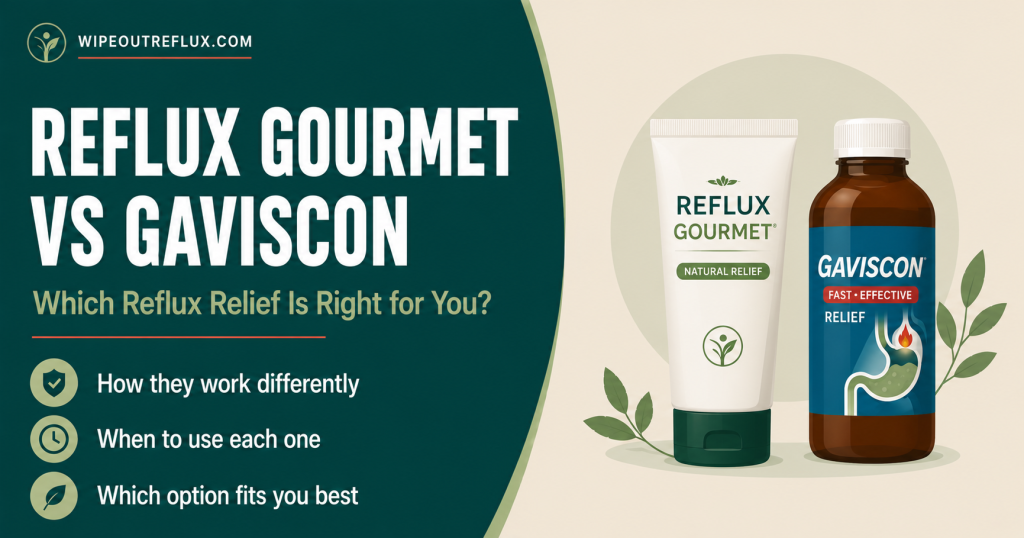
Both products work on the same principle — an alginate raft that floats on top of your stomach contents and physically blocks reflux. But which one wins depends almost entirely on one thing most comparisons get wrong: which Gaviscon you’re actually comparing.
If you mean the Gaviscon sold on American shelves, that’s an antacid with alginic acid as an inactive ingredient. Reflux Gourmet beats it comfortably for raft strength. If you mean Gaviscon Advance — the UK formulation with 1,000 mg of sodium alginate per 10 ml — that’s a different conversation, and it’s the one with actual clinical trial evidence behind it in LPR.
So the honest answer is: Reflux Gourmet beats US Gaviscon, Gaviscon Advance beats both on evidence and cost, and Reflux Gourmet wins on taste, convenience and ingredient quality. Here’s how to decide which fits you.
Key Takeaways
- Both products form an alginate raft — a physical barrier, not an acid reducer.
- US Gaviscon lists aluminium hydroxide and magnesium carbonate as its actives, with alginic acid as an inactive ingredient — it’s primarily an antacid.
- Gaviscon Advance (UK) contains 1,000 mg sodium alginate per 10 ml, roughly ten times the alginate of the US version.
- Reflux Gourmet uses a sodium alginate and sodium bicarbonate complex with no aluminium, and comes as a pleasant-tasting paste.
- Alginate therapy beat placebo and antacids for GERD symptom resolution with an odds ratio of 4.42 in a meta-analysis of 14 randomised trials.
- Gaviscon Advance specifically has published trial evidence in laryngopharyngeal reflux.
- Alginate rafts have been shown by scintigraphy to sit on the acid pocket and push it below the diaphragm.
- For LPR and night-time symptoms, raft strength matters most; for taste and daytime convenience, Reflux Gourmet has the edge.
How alginate rafts work
Alginate comes from brown seaweed. When it meets stomach acid it precipitates into a gel, and the bicarbonate in the formula releases carbon dioxide that makes the gel buoyant. The result is a low-density raft floating on top of your stomach contents.
That raft matters because of something called the acid pocket — a layer of unbuffered acid that sits at the top of the stomach after meals, right at the junction with the oesophagus. It’s the acid that reflux events draw from.
This has been directly imaged. Using scintigraphy in patients with GERD and hiatal hernia, an alginate-antacid raft co-localised with the postprandial acid pocket and displaced it below the diaphragm in 71% of patients, versus 21% on antacid alone, and significantly reduced acid reflux episodes Rohof et al., Clinical Gastroenterology and Hepatology, 2013.
That’s the crucial distinction from PPIs. Acid suppression makes reflux less acidic; an alginate raft reduces whether reflux happens at all, and how much material comes up. For anyone whose main problem is volume, regurgitation or throat symptoms, that difference is the whole point — and it’s a big part of why PPIs underperform in LPR.
The evidence for the class is solid. A systematic review and meta-analysis of 14 randomised controlled trials covering 2,095 subjects found alginate-based therapies increased the odds of GERD symptom resolution compared with placebo or antacids, with an odds ratio of 4.42 Leiman et al., Diseases of the Esophagus, 2017.
The Gaviscon problem: which one do you mean?
This trips up almost everyone, and it’s the single most important thing in this article.
US Gaviscon
The Gaviscon you’ll find in an American pharmacy is formulated as an antacid. The Extra Strength chewable tablets list aluminium hydroxide 160 mg and magnesium carbonate 105 mg as active ingredients, with alginic acid appearing among the inactive ingredients alongside sodium bicarbonate DailyMed, Gaviscon Extra Strength product label.
It does form some raft, and it does neutralise acid. But the alginate dose is far lower than the UK product, and the aluminium content is something plenty of people would rather avoid long term.
Available as Gaviscon Extra Strength chewable tablets or Gaviscon Extra Strength liquid.
Gaviscon Advance (UK)
This is a genuinely different product: 1,000 mg of sodium alginate per 10 ml, with potassium bicarbonate, and no aluminium. The alginate concentration is roughly ten times that of the US formulation.
It’s the version with the strongest published evidence in throat-based reflux. In a randomised controlled trial, a liquid alginate suspension (Gaviscon Advance) produced significant improvement in laryngopharyngeal reflux symptoms and findings compared with control McGlashan et al., European Archives of Oto-Rhino-Laryngology, 2009.
It isn’t sold in US pharmacies, but it’s widely available as an import — Gaviscon Advance Aniseed 500 ml is the standard bottle. I’ve written more about it in my full Gaviscon Advance guide.
Fair warning on the taste: the aniseed is divisive, and the peppermint version is worth avoiding since peppermint relaxes the lower oesophageal sphincter.
What Reflux Gourmet is
Reflux Gourmet is a US product built specifically as alginate therapy rather than as an antacid. Its proprietary alginate complex combines sodium alginate, sodium bicarbonate and calcium pantothenate, in a thick caramel-textured paste rather than a chalky suspension.
What it gets right:
- No aluminium. Nothing in it is there to neutralise acid via metal salts.
- Genuinely palatable. Vanilla caramel and mint chocolate, and it tastes like a dessert topping rather than medicine. That sounds trivial until you consider that the main reason alginate fails is people stop taking it.
- Clean formulation. Non-GMO, gluten-free, no parabens, and generally considered suitable in pregnancy — though check with your doctor, as with anything during pregnancy-related reflux.
- Format options. The 8 oz jar for home, single-serve sachets for travel and eating out, and an alginate gum that also stimulates saliva.
That gum format is quietly clever, incidentally. Saliva is your oesophagus’s own bicarbonate buffer, which is why chewing gum after meals helps reflux on its own.
What it doesn’t have is Reflux Gourmet’s own published clinical trial. The alginate class has strong evidence and Gaviscon Advance has product-specific LPR evidence; Reflux Gourmet is relying on the class effect. That’s reasonable science, but it’s not the same thing, and I’d rather say so plainly.
Head to head
Raft strength
Gaviscon Advance wins. 1,000 mg of sodium alginate per 10 ml is the highest readily available dose, and raft strength is the mechanism doing the work. Reflux Gourmet comes second; US Gaviscon is a distant third on this measure.
Evidence
Gaviscon Advance wins. It’s the formulation used in the LPR trial and in much of the alginate literature. The others benefit from class-level evidence rather than product-specific trials.
Ingredients
Reflux Gourmet wins. No aluminium, no artificial sweeteners, and a shorter ingredient list. If you’re taking something several times a day indefinitely, that matters.
Taste and adherence
Reflux Gourmet wins comfortably. This is its real advantage. A treatment you’ll actually take four times a day beats a better treatment you abandon after three weeks because it tastes of aniseed.
Convenience
Reflux Gourmet wins. Single-serve sachets are far easier to carry than a 500 ml bottle, which matters if your symptoms flare when eating out or travelling.
Cost
Gaviscon Advance wins by a wide margin. A 500 ml bottle delivers around 100 doses. Reflux Gourmet is a premium-priced product, and if you’re dosing after every meal and at bedtime the difference adds up quickly over months.
Availability
Reflux Gourmet wins for US buyers. Gaviscon Advance requires importing, which means variable stock and occasional long shipping.
Which should you actually buy?
Choose Gaviscon Advance if your symptoms are throat-based — throat clearing, hoarseness, globus — or you’re dealing with significant night-time reflux, and you want the strongest raft with the best trial evidence at the lowest cost per dose. Taste is the price of admission.
Choose Reflux Gourmet if you’ve tried Gaviscon Advance and couldn’t stomach it, you want to avoid aluminium, you need something portable for meals out, or you’re managing reflux in pregnancy and want a cleaner ingredient list. Adherence beats theoretical potency.
Choose US Gaviscon if you want something cheap from a local pharmacy for occasional heartburn. For daily LPR management it’s the weakest of the three.
Worth considering as well: RefluxRaft is another US alginate product that sits between the two on price, and I’ve compared it directly in Gaviscon vs Reflux Raft. There’s also a broader overview in alginates for acid reflux if you want the full landscape.
Getting the timing right — this matters more than the brand
Alginate is one of the few reflux treatments where when you take it changes whether it works at all.
- Always after food, never before. The raft needs to float on top of a meal. Taken on an empty stomach it has nothing to sit on.
- 30 minutes after eating is the sweet spot for most people.
- Always at bedtime, after your last food or drink. Overnight is when reflux travels furthest, and a raft lasting up to four hours covers the most vulnerable window.
- Don’t drink for 20–30 minutes afterwards. Washing it down defeats the purpose.
- Four times a day — after each meal and at bedtime — is the standard therapeutic pattern, not once when symptoms flare.
- Space it from other medication by about two hours, since alginates can affect absorption.
Combining it with raising the head of your bed and leaving three hours between your last meal and lying down does considerably more than switching brands will.
Conclusion
Reflux Gourmet versus Gaviscon isn’t really one comparison — it’s two. Against the Gaviscon sold in US pharmacies, which is fundamentally an aluminium-based antacid with a little alginic acid in it, Reflux Gourmet is the stronger alginate therapy and the cleaner product. Against Gaviscon Advance, with its 1,000 mg of sodium alginate per dose and a randomised trial behind it in laryngopharyngeal reflux, Reflux Gourmet trades some raft strength and a lot of cost for a product you’ll actually enjoy taking.
My honest view: if you can tolerate the taste, Gaviscon Advance is the better first choice on evidence and price, particularly for throat symptoms and night-time reflux. If you can’t — and plenty of people genuinely can’t — Reflux Gourmet is a legitimate alternative rather than a compromise, because the treatment you take consistently beats the one you gave up on.
What neither product does is fix the underlying problem. An alginate raft is a barrier you reapply several times a day; it doesn’t reduce how much reflux your body generates in the first place. That comes down to what and how you eat, which is where the Wipeout Food Reference Guide earns its place — the essential reference for which foods and drinks are safe with acid reflux and LPR, with their pH values, so you’re removing triggers rather than just capping them. And if you want the full structured approach rather than a food list, the Wipeout Diet Plan goes considerably deeper. It was designed first around LPR — the stubborn throat-based form, where alginates matter most — but because it works on the same underlying mechanisms it’s just as effective for GERD and everyday heartburn. Use alginate as the barrier while the diet does the structural work, and you need the barrier a lot less.
Frequently Asked Questions
Is Reflux Gourmet better than Gaviscon?
Better than US Gaviscon, yes — it’s a purpose-built alginate rather than an antacid with alginic acid added. Compared with Gaviscon Advance from the UK, Reflux Gourmet has less alginate per dose and no product-specific trial, but wins clearly on taste, portability and ingredient quality.
Why is US Gaviscon different from UK Gaviscon?
They’re different formulations sold under the same brand. The US product is regulated as an antacid, with aluminium hydroxide and magnesium carbonate as actives and alginic acid as an inactive ingredient. Gaviscon Advance in the UK contains 1,000 mg of sodium alginate per 10 ml, roughly ten times the alginate.
Can I take alginate and a PPI together?
Yes, and they work on different mechanisms — the PPI reduces acidity, the alginate reduces reflux volume physically. Space them apart by a couple of hours, and take the PPI before food while alginate goes after food.
How long does an alginate raft last?
Around three to four hours, which is why the standard pattern is after each meal plus bedtime rather than once daily. It’s a barrier you reapply, not a treatment that builds up.
Does Reflux Gourmet work for LPR and silent reflux?
Alginate therapy as a class is well suited to LPR because it reduces the volume and reach of reflux rather than just its acidity, which matters when pepsin is the problem. The specific trial evidence in LPR used Gaviscon Advance, so that’s the better-evidenced choice if throat symptoms are your main issue.
Is it safe to use alginate every day long term?
Alginates have a good safety profile and are among the few reflux treatments considered suitable in pregnancy. The main considerations are sodium content in some formulations and spacing from other medications. Check with your doctor if you’re on a sodium-restricted diet or take medication that needs consistent absorption.
Why did Gaviscon stop working for me?
Usually timing. Taken before food, or washed down with a drink, or used only when symptoms appear rather than after every meal, an alginate raft can’t do its job. Before switching products, try four doses a day taken 30 minutes after eating and at bedtime, with nothing to drink afterwards for half an hour.
Research & References
- Systematic review and meta-analysis of 14 randomised controlled trials in 2,095 subjects finding alginate-based therapies increased the odds of gastroesophageal reflux symptom resolution compared with placebo or antacids (odds ratio 4.42, 95% CI 2.45–7.97) Leiman et al., Diseases of the Esophagus, 2017.
- Randomised controlled trial of a liquid alginate suspension (Gaviscon Advance) in the management of laryngopharyngeal reflux, showing significant symptomatic and clinical improvement compared with control McGlashan et al., European Archives of Oto-Rhino-Laryngology, 2009.
- Scintigraphy study in patients with GERD and hiatal hernia showing an alginate-antacid raft co-localised with the postprandial acid pocket and displaced it below the diaphragm in 71% of patients versus 21% on antacid alone, significantly reducing acid reflux episodes Rohof et al., Clinical Gastroenterology and Hepatology, 2013.
- Official US product label for Gaviscon Extra Strength chewable tablets, listing aluminium hydroxide 160 mg and magnesium carbonate 105 mg as active ingredients, with alginic acid and sodium bicarbonate among the inactive ingredients DailyMed, US National Library of Medicine.

David Gray
12 years living with LPR · Consultant & researcher
I've lived with LPR for twelve years — the misdiagnoses, the PPI courses that did nothing, the slow work of figuring out what actually helps. Wipeout Reflux is where I translate the research into plain terms for people stuck in the same place. Every claim here is sourced to peer-reviewed work, and I consult one-to-one with LPR sufferers.
Helpful and clear facts and insight re these remedies.
Thanks – and for your helpful reply to my email!!
b.t.w. I’m sending this (& possibly other of your info) to UCLA health / my support team members whom I think will greatly appreciate your meticulous research!
Best to you in getting this and much of your info out to patients AND docs!
Thanks so much for the kind words — really glad you found it helpful! And I appreciate you passing it along to your team at UCLA Health. Getting this kind of information in front of both patients and doctors is exactly what I’m aiming for, so that genuinely means a lot. Wishing you all the best.