
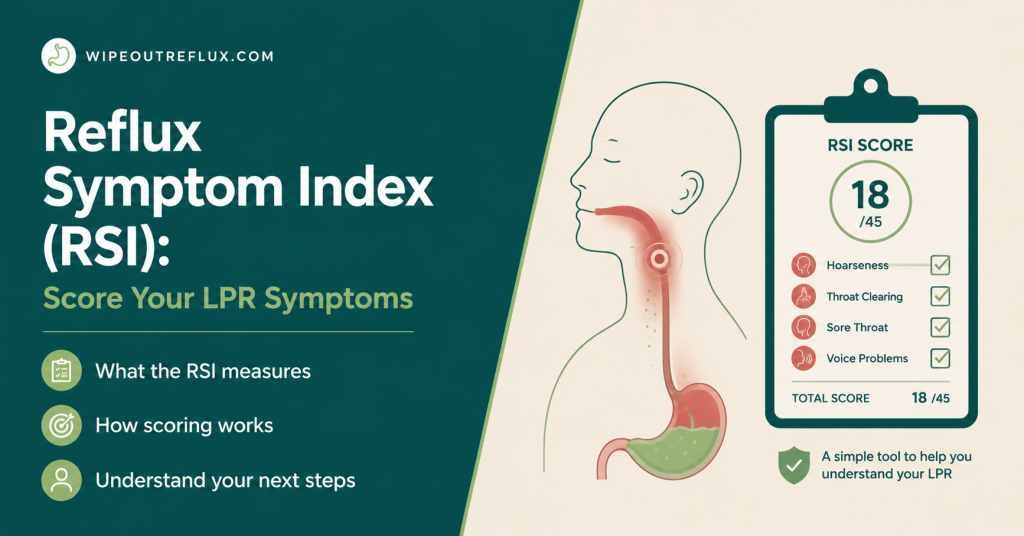
The Reflux Symptom Index (RSI) is a quick, nine-question self-test that helps you gauge whether your symptoms fit the pattern of silent reflux — laryngopharyngeal reflux, or LPR. You rate nine common throat and voice symptoms from 0 (no problem) to 5 (severe problem) based on the past month, then add them up. The total runs from 0 to 45, and a score above 13 is considered abnormal and suggestive of LPR.
It was developed and validated by a team of reflux specialists as a simple, reliable way to capture the symptoms that classic heartburn questionnaires miss Belafsky et al., Journal of Voice, 2002. It takes under a minute, and below you can score yourself right now — or use our interactive RSI quiz to get your result instantly — but the most important thing to understand up front is what the number does and doesn’t mean.
Key Takeaways
- The RSI is a nine-item self-questionnaire for silent reflux (LPR), each item scored 0 to 5 for a total out of 45.
- A score above 13 is considered abnormal and suggests your symptoms are consistent with LPR.
- It focuses on throat and voice symptoms — hoarseness, throat clearing, mucus, cough, a lump sensation — not just heartburn.
- It’s a screening and tracking tool, not a diagnosis: other conditions like allergies and postnasal drip can push the score up too.
- A high score is a reason to look more closely and, ideally, see a doctor or ENT — not a reason to panic.
- Because it was designed to measure change, it’s genuinely useful for tracking whether your symptoms improve as you treat the reflux — you can score yourself below or with our interactive RSI quiz.
What the Reflux Symptom Index Is
Standard reflux is easy to describe: heartburn, a sour taste, regurgitation. But silent reflux (LPR) is different — it shows up in the throat and voice box rather than the chest, so people often have hoarseness, a nagging cough, constant throat clearing, or a lump-in-the-throat feeling with little or no heartburn at all. That makes it easy to miss, and easy to mistake for something else.
The RSI was created to put numbers on exactly these symptoms. The original study developed it as a self-administered instrument and showed it was both valid and reliable — patients’ scores improved significantly after reflux treatment, and repeat testing gave consistent results Belafsky et al., Journal of Voice, 2002. Today it’s one of the most widely used tools for spotting and monitoring LPR, often alongside a throat examination.
The RSI Questionnaire — Score Yourself
For each of the nine symptoms below, think about how much it has bothered you over the past month, and give it a score from 0 to 5:
- 0 = no problem
- 5 = severe problem
Rate each of these:
- Hoarseness or a problem with your voice
- Clearing your throat
- Excess throat mucus or postnasal drip
- Difficulty swallowing food, liquids, or pills
- Coughing after you eat or after lying down
- Breathing difficulties or choking episodes
- Troublesome or annoying cough
- A sensation of something sticking in your throat, or a lump in your throat
- Heartburn, chest pain, indigestion, or stomach acid coming up
Now add up all nine numbers. Your total will be somewhere between 0 and 45. If you’d rather not tally it by hand, our interactive RSI quiz asks the same nine questions and calculates and interprets your score for you automatically.
What Your Score Means
The interpretation is refreshingly simple:
- 13 or below: Within the normal range. Your symptoms are less likely to be driven by reflux, though a score in the low teens with bothersome symptoms is still worth discussing with a doctor.
- Above 13: Considered abnormal and consistent with laryngopharyngeal reflux. The higher the number, the more your symptom burden points toward reflux as a likely contributor.
That cutoff of 13 comes from the original validation work, where it separated people with LPR from healthy individuals Belafsky et al., Journal of Voice, 2002. In practice, clinics use the RSI together with a throat exam and other findings, and studies confirm it’s a useful part of diagnosing LPR when combined with those assessments Muddaiah et al., Indian Journal of Otolaryngology and Head & Neck Surgery, 2023.
Important: It’s a Screening Tool, Not a Diagnosis
This is the part that matters most, so don’t skip it. A high RSI score tells you your symptoms look like LPR — it does not, by itself, prove you have it. The nine symptoms it measures aren’t unique to reflux, and several other conditions can push your score above 13 without any reflux being involved.
The biggest overlap is with allergies and postnasal drip, which cause many of the same throat-clearing, mucus, and cough symptoms. Chronic rhinitis, asthma, viral infections, voice overuse, and even anxiety can all raise your score too. That’s exactly why the RSI is designed as a screening and tracking tool rather than a standalone test — a high number is a signpost pointing toward “look into this properly,” not a final answer. If your symptoms feel more nasal or seasonal, it’s worth understanding how acid reflux and allergies can be told apart before assuming it’s reflux.
What to Do With a High Score
If you scored above 13, here’s a sensible way to act on it without overreacting.
See a doctor or ENT
A persistent high score, especially with hoarseness or swallowing trouble, deserves a professional look. An ENT can examine your throat and voice box directly and help sort reflux from allergies or other causes. Any hoarseness lasting more than a few weeks should always be checked.
Consider objective testing if it’s unclear
Because symptoms alone can’t confirm LPR, your doctor may suggest a test that actually measures reflux reaching the throat — such as Restech pharyngeal pH monitoring or a saliva pepsin test like Peptest. These look higher up than a standard esophageal probe, where silent reflux actually does its damage.
Start reducing the reflux itself
Whether or not you pursue testing, the foundation of managing LPR is lowering how much acid and pepsin reach your throat — and that’s driven mostly by diet and habits. Cutting acidic and trigger foods, not eating late, and breaking the throat-clearing habit (which keeps the tissue inflamed) all help. There’s a fuller roadmap in this guide to silent reflux treatment.
Using the RSI to Track Your Progress
Here’s an underused benefit: because the RSI was built as an outcomes measure, it’s excellent for tracking change over time. Take the RSI quiz today, then again after four to eight weeks of consistent diet and lifestyle changes. A falling number is real, motivating evidence that your throat is settling — and if the score isn’t budging despite genuine effort, that’s a useful signal to revisit the plan or push for further evaluation. Treating the RSI as a repeatable check-in, rather than a one-time verdict, is where it earns its keep.
The Bottom Line
The Reflux Symptom Index is a fast, well-validated way to put a number on the throat and voice symptoms of silent reflux, and a score above 13 is a meaningful nudge that LPR could be behind what you’re feeling. But its real value is as a starting point and a progress tracker — not a diagnosis. Plenty of other things, allergies chief among them, can raise the score, so a high number is a reason to look closer and ideally get a professional opinion, not a reason to worry. Used well, it turns a vague, frustrating cluster of throat symptoms into something you can actually measure and watch improve.
And improving it comes back to the same place every time: reducing how much acid and pepsin reach your throat, which is largely about what and when you eat. A great starting point is the Wipeout Food Reference Guide, the essential reference to which foods and drinks are safe for acid reflux and LPR along with their pH values, so you can build a throat-friendly diet with confidence. And if you want the complete, step-by-step system for calming silent reflux at its source and watching that RSI score fall, the Wipeout Diet Plan goes much deeper — it’s the ultimate guide to healing the underlying reflux for good.
Frequently Asked Questions
What is a normal RSI score?
A total of 13 or below is considered within the normal range. Scores above 13 are considered abnormal and suggest your symptoms are consistent with laryngopharyngeal reflux (silent reflux). The scale runs from 0 to 45, so higher numbers reflect a heavier symptom burden.
Does a high RSI score mean I definitely have silent reflux?
No. A high score means your symptoms fit the LPR pattern, but it isn’t a diagnosis on its own. Allergies, postnasal drip, asthma, infections, and voice strain can all raise the score without reflux being the cause. It’s a screening and tracking tool best used alongside a doctor’s assessment.
How often should I take the RSI?
It’s very useful to repeat. Because it was designed to measure change, scoring yourself before you start treatment and then every few weeks afterward lets you track whether your symptoms are actually improving. A steadily falling score is good evidence that your approach is working — retaking our RSI quiz each time makes this effortless to keep an eye on.
Can allergies raise my RSI score?
Yes, and this is one of the most common confounders. Allergies and postnasal drip cause throat clearing, excess mucus, and cough — several of the exact symptoms the RSI measures. If your symptoms are seasonal or strongly nasal, it’s worth exploring whether allergies, reflux, or both are responsible.
What should I do if I score above 13?
Treat it as a prompt to look closer, not a diagnosis. Consider seeing a doctor or ENT, especially if you have hoarseness or swallowing difficulty, and ask about tests that measure throat reflux directly if the picture is unclear. Meanwhile, start reducing reflux through diet and lifestyle changes, which is the foundation of managing LPR.
Is the RSI the same as an actual reflux test?
No. The RSI measures your symptoms; it doesn’t measure acid or pepsin. Objective tests like pharyngeal pH monitoring or a saliva pepsin test measure reflux reaching your throat directly. The RSI is best thought of as the first, symptom-based step that helps decide whether those tests are worth pursuing.
Research & References
- Belafsky et al., Journal of Voice, 2002 — The original study developing and validating the nine-item Reflux Symptom Index, establishing the 0–45 scale and the threshold above 13 as indicative of laryngopharyngeal reflux.
- Muddaiah et al., Indian Journal of Otolaryngology and Head & Neck Surgery, 2023 — Prospective study confirming the value of the Reflux Symptom Index, used together with the Reflux Finding Score, in diagnosing laryngopharyngeal reflux in clinical practice.

David Gray
Content Researcher & Author
David Gray founded Wipeout Reflux to address a critical gap in reflux management. His research synthesizes over 100 peer-reviewed studies on laryngopharyngeal reflux (LPR), pepsin biology, and GERD pathophysiology. For LPR specifically—a condition most physicians misdiagnose—his work focuses on pepsin reactivation and why standard PPI therapy fails most patients. He develops evidence-based protocols targeting root causes of both LPR and GERD, integrating emerging research on sphincter dysfunction, dietary interventions, and newer clinical approaches. Wipeout Reflux represents practical application of clinical science for patients seeking real solutions.