
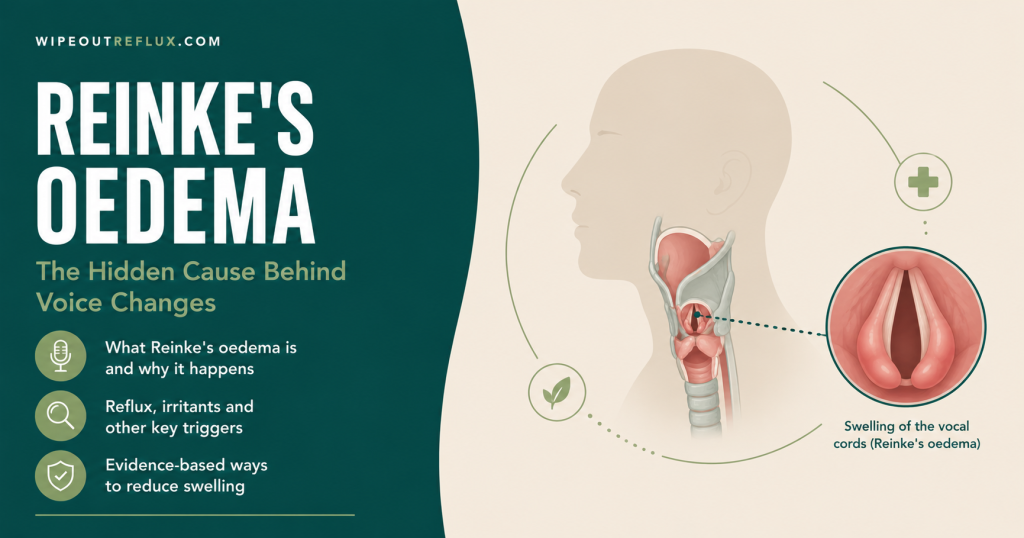
Reinke’s oedema (also spelled Reinke’s edema) is a swelling of the vocal cords that gradually deepens the voice into a low, gravelly, almost masculine rasp. It’s the classic “smoker’s voice” — and that’s the biggest clue to its cause. The fluid collects in a loose layer of the vocal fold called Reinke’s space, which is why the condition carries his name.
The single most important thing to know is that Reinke’s oedema is overwhelmingly a smoking disease. Long-term tobacco exposure is the main driver, with acid reflux and heavy voice use adding to the irritation. The voice deepens because the swollen cords gain mass, and heavier cords vibrate more slowly — which literally lowers your pitch. It’s most often noticed in women, precisely because that drop in pitch is more striking in a female voice.
Here’s what Reinke’s oedema is, why the voice changes the way it does, the smoking and reflux link behind it, and what actually reverses it.
Key Takeaways
- Reinke’s oedema is fluid swelling in the soft layer of the vocal folds (Reinke’s space), producing a deep, hoarse, gravelly voice.
- Smoking is by far the main cause — severity tracks with how much and how long you’ve smoked — and stopping is the single most important treatment.
- The voice deepens because the swollen cords carry more mass and vibrate more slowly, measurably lowering vocal pitch.
- It’s diagnosed more often in women because the drop to a low, masculine pitch is more noticeable in a female voice.
- Acid reflux (especially silent reflux/LPR) is a common contributing irritant, along with vocal overuse and, in some people, an underactive thyroid.
- Quitting smoking halts progression and can partly improve the voice; established swelling usually needs surgery to remove it.
- Controlling reflux and resting the voice support recovery and help prevent it coming back.
What Reinke’s oedema actually is
Your vocal folds aren’t solid flaps — they’re layered. Just beneath the surface lining sits a soft, jelly-like layer known as Reinke’s space, which lets the cords ripple and vibrate freely to make sound. In Reinke’s oedema, that space fills with fluid and swells, sometimes so much that the cords take on a floppy, polypoid, water-balloon appearance (which is why doctors also call it polypoid corditis). The swelling is usually on both cords and builds slowly over years of ongoing irritation. It isn’t cancer and it isn’t contagious — it’s a chronic response of that delicate layer to being irritated day after day.
Why the voice deepens
This is the part that puzzles people: why does the voice drop rather than just get hoarse? It comes down to simple physics. Pitch depends partly on how fast your vocal cords vibrate, and vibration speed depends on their mass — heavier cords swing more slowly, producing a lower note, exactly like a thicker, heavier guitar string. When Reinke’s space fills with fluid, the cords become bulkier and heavier, so their vibration frequency falls and the voice deepens.
This isn’t just theory — it’s measurable. In one analysis, most people with Reinke’s oedema had a fundamental frequency (the acoustic measure of voice pitch) below 160 Hz, compared with only a small fraction of healthy controls, reflecting a distinctly deeper voice Cardoso López et al., Journal of Personalized Medicine, 2026. That’s why women are diagnosed more often: a female voice dropping into a low, masculine range is far more conspicuous than the same change in a man, so women are more likely to notice it and seek help Dewan et al., Laryngoscope Investigative Otolaryngology, 2022. Alongside the low pitch, people often notice roughness, reduced vocal range, breathiness, and a voice that tires easily — and it can look and sound a lot like ordinary reflux-related hoarseness at first.
The smoking link: the number one cause
If there’s one message to take away, it’s this: Reinke’s oedema is a smoking disease. Tobacco smoke is the main risk factor for developing it and for it coming back after treatment, and the severity of the swelling tracks with how many cigarettes you smoke a day and for how long Dewan et al., Laryngoscope Investigative Otolaryngology, 2022. The chronic chemical and thermal irritation of smoke inflames the vocal fold lining and drives fluid into Reinke’s space over years.
That’s also the good news, because it means the most powerful treatment is free and in your hands: stopping smoking halts the process and is essential before any other measure can work. Worth knowing too — smoking doesn’t only harm the cords directly; it also worsens acid reflux, which piles a second irritant onto the same tissue.
The reflux link
Reflux is the important co-conspirator. When stomach contents travel up to the throat — the pattern seen in silent reflux, or LPR — the acid and the enzyme pepsin irritate the vocal folds directly, adding to the inflammation that smoking starts. Laryngopharyngeal reflux turns up frequently in people with Reinke’s oedema; in one series it was found in 16 of 18 patients Dewan et al., Laryngoscope Investigative Otolaryngology, 2022. That doesn’t mean reflux alone causes the condition — smoking is the heavyweight — but it’s a genuine contributor and, importantly, one you can control. It’s the same reflux mechanism behind chronic reflux laryngitis and the broader picture of LPR symptoms. Calming reflux won’t melt away established swelling, but it removes a constant source of irritation that keeps the cords inflamed and makes recurrence more likely.
Other contributors
Two more factors round out the picture. Heavy or abusive voice use — a lot of loud talking, shouting or professional voice demands — adds mechanical stress to already irritated cords, which is why professional voice users need to take vocal strain seriously. And an underactive thyroid (hypothyroidism) is associated with vocal fold swelling in some people, so it’s often checked when Reinke’s oedema is diagnosed — part of why thyroid problems come up in reflux and voice clinics. Reinke’s oedema is usually the result of several of these irritants stacking up over years rather than any single one.
How it’s diagnosed
Reinke’s oedema is diagnosed by an ear, nose and throat specialist looking directly at the vocal cords with a laryngoscope, usually with a stroboscope that shows how the cords vibrate. The swollen, floppy, fluid-filled folds have a characteristic appearance. Because a persistently hoarse or deepening voice can occasionally signal something more serious, any voice change lasting more than a few weeks — especially in a smoker — should be examined rather than ignored. Our guide on when to see a doctor for LPR covers the warning signs worth acting on.
Treatment: what actually reverses it
Management follows a clear order of priority:
- Stop smoking — first and non-negotiable. Nothing else works reliably while smoking continues, and quitting can halt progression and partly improve the voice on its own. It’s the foundation of treatment Dewan et al., Laryngoscope Investigative Otolaryngology, 2022.
- Control the reflux. Reducing the acid and pepsin reaching your voice box removes a key ongoing irritant — the heart of any silent reflux treatment, and the piece a diet-based approach like the Wipeout Diet Plan is built to handle.
- Rest and retrain the voice. Voice therapy reduces the mechanical strain that feeds the swelling and helps you use your voice more efficiently.
- Surgery for established swelling. When the oedema is significant, it usually needs a delicate operation (phonosurgery, often a microflap technique) to remove the excess fluid and tissue and restore the cords — best done after you’ve stopped smoking to protect the result and prevent recurrence Dewan et al., Laryngoscope Investigative Otolaryngology, 2022.
Reflux control and voice care don’t replace surgery for advanced cases, but they make surgery more successful and protect your voice for the long run — and for milder swelling, tackling the irritants can be enough to stabilise things. You can also support healing by learning how to heal vocal cords irritated by reflux.
Conclusion
Reinke’s oedema deepens the voice for a very physical reason: fluid swells the soft layer of the vocal cords, the cords gain mass, and heavier cords vibrate more slowly into a low, gravelly tone. Above everything else, it’s a smoking condition — so stopping smoking is the one step that changes the trajectory. But reflux is a real and controllable co-driver, and heavy voice use and thyroid problems can pile on too. Established swelling often needs surgery, yet removing the irritants behind it is what protects your voice afterward and keeps the oedema from returning.
Reflux is the part of that picture you have the most direct control over, and it comes down to what you eat and drink. The Wipeout Diet Plan is the complete, step-by-step way to bring reflux down at its source, so the acid and pepsin stop reaching and re-irritating your vocal cords — a meaningful support alongside quitting smoking, voice care and any surgery you may need. It was designed first and foremost around LPR and silent reflux, the throat-based form that irritates the voice box, but because it targets the same underlying mechanisms it works just as well for classic GERD and heartburn. The Wipeout Food Reference Guide is the essential companion, showing at a glance which foods and drinks are safe with acid reflux and LPR and their pH values, so you can strip out the triggers that keep your throat inflamed. Stop the smoke, calm the reflux, and give your voice the best chance to recover.
Frequently Asked Questions
Is Reinke’s oedema reversible?
Partly. Stopping smoking halts progression and can improve the voice, and for mild swelling that may be enough to stabilise it. But established, significant oedema usually doesn’t fully resolve on its own and needs surgery to remove the excess fluid and tissue. Controlling reflux and resting the voice support recovery and reduce the chance of it returning.
Why does Reinke’s oedema make your voice deeper?
Because the swelling adds mass to your vocal cords. Pitch depends on how fast the cords vibrate, and heavier cords vibrate more slowly — producing a lower note, just like a thicker guitar string. As fluid fills Reinke’s space, the cords bulk up and their vibration frequency drops, deepening the voice into a low, gravelly tone.
Can acid reflux cause Reinke’s oedema?
Reflux is a contributing irritant rather than the main cause. Smoking is by far the biggest driver, but acid and pepsin reaching the voice box — as in silent reflux/LPR — add to the inflammation and are found frequently in people with the condition. Reflux alone rarely causes it, but controlling reflux removes an ongoing irritant and helps prevent recurrence.
Will quitting smoking cure Reinke’s oedema?
Quitting is the single most important step and can halt progression and partly improve the voice, but it may not fully reverse swelling that’s already established — that often still needs surgery. Crucially, surgery works best and lasts longest only after you’ve stopped smoking, so quitting is the foundation everything else builds on.
Is Reinke’s oedema dangerous or a sign of cancer?
Reinke’s oedema itself is benign, not cancer. However, because it’s strongly linked to smoking — which also raises the risk of other throat and voice-box problems — and because a persistently hoarse or deepening voice can occasionally signal something more serious, any lasting voice change in a smoker should be examined by an ENT specialist to confirm the diagnosis.
Research & References
- Review of Reinke’s edema management and voice outcomes, identifying tobacco use as the main risk factor for the condition and its recurrence (with severity related to amount and duration of smoking), noting frequent laryngopharyngeal reflux (found in 16 of 18 patients in one series), explaining that the voice lowers due to excessive vocal fold mass, and outlining treatment beginning with smoking cessation followed by surgical excision, voice therapy and reflux management Dewan et al., Laryngoscope Investigative Otolaryngology, 2022.
- Voice-analysis study finding that most patients with Reinke’s edema had a fundamental frequency below 160 Hz — reflecting a markedly lower, deeper voice pitch — compared with only a small fraction of healthy controls Cardoso López et al., Journal of Personalized Medicine, 2026.

David Gray
12 years living with LPR · Consultant & researcher
I've lived with LPR for twelve years — the misdiagnoses, the PPI courses that did nothing, the slow work of figuring out what actually helps. Wipeout Reflux is where I translate the research into plain terms for people stuck in the same place. Every claim here is sourced to peer-reviewed work, and I consult one-to-one with LPR sufferers.