
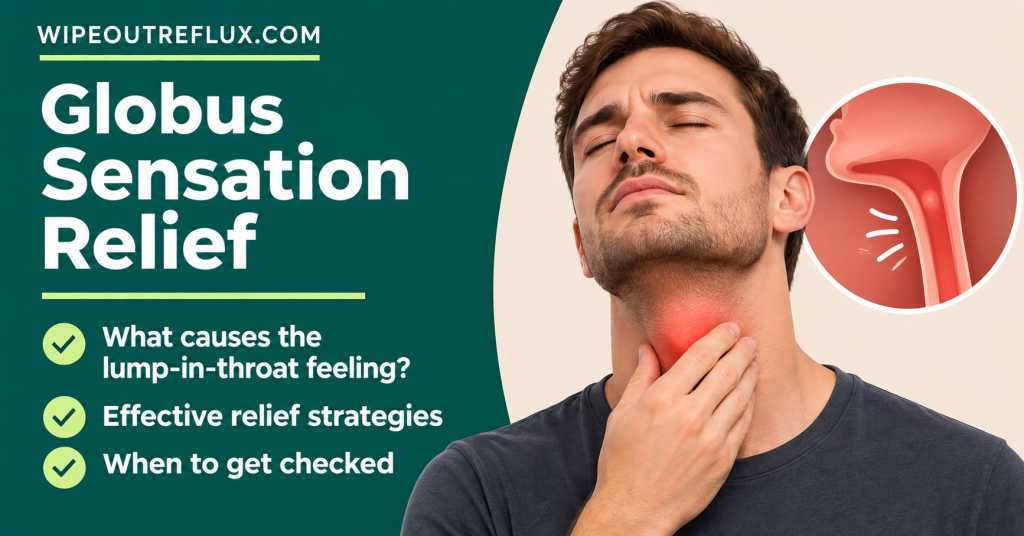
The best relaxation techniques for globus sensation are slow belly breathing, swapping throat clearing for a sip of water, the yawn-sigh, jaw and tongue release, neck and shoulder stretches, and gentle massage around the voice box. These target the muscle tension around the throat that keeps the “lump” feeling going. Ten minutes a day, plus catching yourself before you clear your throat or “test” a swallow, is often enough to make a noticeable difference within a few weeks.
These techniques come from the speech and language therapy approach to globus, which has been shown to reduce symptoms in a randomized trial. If reflux is driving your globus, you’ll get the best results by treating the reflux at the same time. And if the feeling comes with pain, real trouble swallowing, weight loss or a lasting hoarse voice, get checked before you rely on exercises alone.
Key Takeaways
- Globus is the feeling of a lump in the throat when nothing is actually there. It’s common and harmless, but it can be very persistent.
- Muscle tension around the throat, reflux irritation and stress all feed the sensation, and they often work together.
- Speech therapy using relaxation and throat-care techniques improved globus symptoms in a randomized controlled trial.
- Slow belly breathing, the yawn-sigh, jaw release, neck stretches and gentle laryngeal massage are the core self-help exercises.
- Constant throat clearing and repeated dry swallows to “check” the lump make globus worse. Sip water or do a single wet swallow instead.
- Hypnotherapy, cognitive behavioral therapy and low-dose amitriptyline have also helped in studies when exercises aren’t enough.
- Treat reflux alongside the exercises if you have reflux symptoms. Acid suppression alone doesn’t seem to help globus without reflux.
Why Relaxation Helps Globus
Globus isn’t a physical lump. It’s a sensation, and it tends to come from a combination of three things:
- Muscle tension. The muscles around the voice box and the upper esophageal sphincter (the muscle ring at the top of your food pipe) can stay tighter than they should. In one study, raised pressure in this sphincter was found in 28% of people with globus, compared with 3% of people without it [Jones and Prowse, British Journal of General Practice, 2015].
- Irritation. Reflux, post-nasal drip and constant throat clearing all irritate the throat lining and make it more sensitive. Reflux has been suggested as a cause in somewhere between 23% and 68% of globus cases [Lee and Kim, World Journal of Gastroenterology, 2012].
- Attention and stress. Once you notice the lump, you check it. You swallow to test it, you clear your throat, and you tense up. That focus makes the sensation louder, and stress tightens the throat muscles further.
Relaxation techniques work on the first and third parts of that loop. They release the muscles directly, and they give your nervous system something calmer to do than checking. If reflux is part of your picture, treating it handles the second part. I explain the reflux connection in detail in my main guide to globus sensation from reflux.
What the Research Says About Relaxation Therapy for Globus
The best evidence comes from speech and language therapy, which teaches many of the techniques below. In a randomized controlled trial of 36 people with globus, those given speech therapy had significantly better symptom scores after three months than those given reassurance from a nurse [Khalil et al., Revue de Laryngologie Otologie Rhinologie, 2003]. The therapy focused on relaxation and reducing tension in the throat and larynx.
It’s a small trial, and some experts point out that part of the benefit may come from the reassurance and attention that comes with therapy [Jones and Prowse, British Journal of General Practice, 2015]. I don’t see that as a weakness. If understanding the sensation and learning to stop fighting it helps, that’s part of how it works.
Hypnotically assisted relaxation has also been tested. In a small case series of people whose globus hadn’t responded to reflux treatment, 9 out of 10 who completed a seven-session program reported a reduction in their symptoms [Kiebles et al., Diseases of the Esophagus, 2010].
9 Relaxation Techniques and Exercises for Globus Relief
You don’t need to do all of these. Try them, keep the two or three that give you the most relief, and do them every day. Consistency matters far more than doing them perfectly.
1. Slow belly breathing
When you’re tense or anxious, you tend to breathe high in your chest and use your neck and shoulder muscles to do it. That adds to the tension around your throat. Belly breathing (diaphragmatic breathing) moves the work down to the diaphragm.
- Sit or lie down. Put one hand on your chest and one on your stomach.
- Breathe in slowly through your nose for about 4 seconds. Let your stomach rise. Your chest hand should barely move.
- Breathe out gently through slightly parted lips for about 6 seconds. Let your stomach fall.
- Keep going for 5 minutes. Aim for around 6 breaths a minute.
There’s a bonus if you have reflux. Your diaphragm wraps around the lower esophageal sphincter and helps keep it closed. In a randomized trial, people with reflux who trained with abdominal breathing exercises had less acid exposure, better quality of life and used less reflux medication [Eherer et al., American Journal of Gastroenterology, 2012]. I go through more routines in breathing exercises for acid reflux.
2. Replace throat clearing with a sip of water
This is the single most useful habit change. Every forceful throat clear slams your vocal cords together, irritates the lining and tightens the muscles around it. The relief lasts a few seconds, and then the urge comes back stronger.
When you feel the urge, try one of these instead:
- Take a small sip of water and swallow.
- Do one firm, deliberate swallow.
- Hum gently for a couple of seconds, then swallow.
It feels unnatural at first. Most people find the urge fades noticeably after a week or two. My guide to stopping constant throat clearing has more on breaking the habit.
3. Stop “testing” the lump with dry swallows
Globus tends to be most noticeable when you swallow saliva on an empty throat, and it frequently improves when you eat [You et al., World Journal of Gastroenterology, 2013]. So repeatedly dry-swallowing to see if the lump is still there is the worst possible test. It makes the sensation more obvious and tires the muscles.
If you catch yourself checking, sip some water instead, then shift your attention to something else. The less you check, the quieter the sensation tends to get.
4. The yawn-sigh
Voice therapists use this to open and relax the throat. A yawn naturally lowers your voice box and stretches the muscles around it.
- Start a yawn with your mouth closed or slightly open. Feel the back of your throat open up.
- At the top of the yawn, let the air out on a gentle, relaxed “ahh” sigh, sliding from a higher pitch to a lower one.
- Repeat 5 to 10 times.
5. Jaw and tongue release
Your jaw and tongue muscles connect to the hyoid bone, which sits just above your voice box. A clenched jaw or a tongue pressed hard against the roof of your mouth pulls on that whole area.
- Jaw drop: Let your jaw hang loose with your lips gently closed and your teeth apart. Hold for 30 seconds. Check in on this throughout the day.
- Jaw massage: Use your fingertips to make slow circles on the muscles just in front of your ears, where your jaw hinges. Keep going for 30 to 60 seconds.
- Tongue stretch: Stick your tongue out and down toward your chin. Hold for 5 seconds, then relax. Repeat 5 times.
6. Neck and shoulder stretches
Tight neck and shoulder muscles add to the tension in the throat. Do these slowly, without forcing anything:
- Shoulder rolls: Roll your shoulders up, back and down 10 times.
- Side neck stretch: Tip your right ear toward your right shoulder until you feel a stretch on the left side. Hold for 20 seconds, then switch sides.
- Chin tuck: Gently draw your chin straight back, as if making a double chin. Hold for 5 seconds. Repeat 5 times. This counters the forward-head posture many of us have from screens.
7. Gentle laryngeal massage
This is a simple version of the manual therapy used by voice therapists. It can be surprisingly effective, but be gentle.
- Find the U-shaped hyoid bone just above your Adam’s apple, under your jaw.
- Place your thumb and index finger on either side of it. Make small, slow circles for about 30 seconds.
- Move your fingers down slightly into the soft space between the hyoid bone and the top of your voice box. Make small circles again.
- Gently ease your voice box slightly downward with light pressure, then release. Repeat a few times.
Never press hard. Stay off the sides of your neck where you can feel a pulse. Stop if it hurts or makes you dizzy. If you can, have a speech and language therapist show you this in person.
8. Humming and straw breathing
Gentle humming and breathing out through a straw create a slight back-pressure that helps the voice box relax and work efficiently. Voice therapists call these semi-occluded vocal tract exercises.
- Humming: Hum gently on “mmm” at a comfortable, easy pitch. You should feel a light buzz on your lips. Do this for 1 to 2 minutes.
- Straw phonation: Put a drinking straw in your mouth and hum through it, gliding slowly up and down in pitch. Do this for 1 to 2 minutes.
9. Progressive muscle relaxation
Stress tightens the throat, and many people with globus notice it’s worse during stressful times. Progressive muscle relaxation helps you spot and release tension around your body.
Work through each muscle group, from your feet to your face. Tense each one for 5 seconds, then release it for 10 to 15 seconds and notice how it feels to let go. Finish with your shoulders, jaw and face. This takes 10 to 15 minutes, and it works well before bed.
A Simple 10-Minute Daily Routine
If you want a starting point, try this once or twice a day:
- Belly breathing: 3 minutes
- Shoulder rolls and side neck stretches: 2 minutes
- Jaw drop, jaw massage and tongue stretch: 2 minutes
- Yawn-sighs: 5 repetitions
- Humming or straw phonation: 1 to 2 minutes
- Gentle laryngeal massage: 1 minute
All day long, swap throat clearing and dry-swallow checks for a sip of water. Give it at least 3 to 4 weeks. Muscle tension and habits that have built up over months don’t usually release in a few days.
Don’t Forget the Reflux Side
If you have any reflux symptoms, such as heartburn, hoarseness, throat clearing, sticky mucus or a sour taste, relaxation alone may not be enough. Refluxed acid and pepsin keep irritating the throat, and an irritated throat is a tense, sensitive throat.
Interestingly, acid-blocking medication doesn’t seem to help globus in people with no reflux symptoms. A meta-analysis found PPIs were no better than placebo for that group [Jones and Prowse, British Journal of General Practice, 2015]. But if reflux is part of the picture, cutting down what reaches your throat matters. That means not eating late, eating smaller meals and cutting back on the most common triggers. The Wipeout Diet Plan takes you through this step by step.
Reflux and globus can also feed each other through a tight upper esophageal sphincter. I explain how in the upper esophageal sphincter and acid reflux and in cricopharyngeal spasm vs globus.
When Self-Help Isn’t Enough
If you’ve been consistent for a month or two and the lump is still bothering you, there are good next steps:
- Speech and language therapy. Ask your doctor or ENT for a referral to a therapist who treats voice and throat problems. They can check your technique and do hands-on muscle work. See my guide to voice therapy for silent reflux for what to expect.
- Hypnotherapy or CBT. Both target the attention and anxiety loop. Gut- and esophagus-directed hypnotherapy is increasingly available, including through apps. I cover it in gut-directed hypnotherapy for reflux.
- Low-dose amitriptyline. In a small randomized trial, 75% of people with globus responded to 25 mg of amitriptyline at bedtime for four weeks, compared with 36% on a PPI [You et al., World Journal of Gastroenterology, 2013]. At low doses it acts on nerve sensitivity rather than mood. It’s a prescription medicine, so discuss it with your doctor.
If anxiety is a big part of your symptoms, my article on whether silent reflux causes anxiety looks at how the two feed each other.
When to See a Doctor First
Globus is benign, but these symptoms are not typical of globus and need to be checked before you rely on exercises:
- Pain in your throat, especially on one side or spreading to your ear
- Food actually getting stuck, or real difficulty swallowing
- Pain when swallowing
- A hoarse voice lasting more than three weeks
- A lump you can see or feel in your neck
- Unexplained weight loss
- Coughing up blood
- Symptoms that are steadily getting worse, especially if you smoke or drink heavily
My article on whether difficulty swallowing is a sign of cancer explains the difference between globus and true swallowing problems.
Conclusion
Globus is frustrating, but it’s one of the throat symptoms you can do the most about yourself. Slow belly breathing, the yawn-sigh, jaw release, neck stretches, humming and gentle laryngeal massage all help release the muscle tension that keeps the lump feeling going. Just as important is what you stop doing: forceful throat clearing and dry swallows to check whether the lump is still there. Give a daily routine at least a few weeks. If you’re still struggling after that, speech therapy, hypnotherapy or a low-dose medication from your doctor are well worth exploring.
For many people, though, globus and reflux go hand in hand. Relaxing the throat is only half the job if refluxed acid and pepsin keep irritating it every day. The Wipeout Diet Plan is my complete, in-depth guide to calming reflux through what and when you eat. I designed it first for LPR, the throat-based reflux most closely tied to globus, but it targets the same root causes as GERD and heartburn, so it works just as well for those. Pair it with the exercises above and you’re tackling both sides of the problem at once.
Frequently Asked Questions
What is the fastest way to relieve globus sensation?
For quick relief, take a sip of water, then do a few minutes of slow belly breathing and some yawn-sighs. Gentle massage around the hyoid bone can also ease tension quickly. Longer-term relief comes from doing the exercises daily and cutting out throat clearing.
How long does globus take to go away?
It varies. Some people improve within weeks once they understand the sensation and start relaxation work. For others it lasts months or comes and goes, often flaring with stress or reflux. Consistent exercises and treating any reflux give you the best chance of shortening it.
Can anxiety cause globus sensation?
Anxiety doesn’t cause globus on its own in most people, but it’s a strong amplifier. Stress tightens the throat muscles, and anxiety makes you focus on and check the sensation, which makes it more noticeable.
Does drinking water help globus?
Yes, in two ways. Sipping water is a good replacement for throat clearing, and globus often feels better when you swallow food or liquid than when you dry-swallow saliva. Staying hydrated also keeps mucus thinner.
Can a speech therapist help with globus?
Yes. Speech and language therapists teach relaxation, throat-care and swallowing techniques, and can do manual therapy on the throat muscles. A randomized trial found speech therapy improved globus symptoms more than reassurance alone.
Is globus sensation dangerous?
No. Globus is a harmless sensation. But pain, real difficulty swallowing, weight loss, a lump in your neck or a lasting hoarse voice aren’t typical of globus and should be checked by a doctor.
Can reflux cause globus?
Yes. Reflux, especially silent reflux (LPR), is one of the most common causes linked to globus. Acid and pepsin irritate the throat and can make the muscles around it tighten. If you have other reflux symptoms, treat the reflux alongside the relaxation exercises.
Research & References
- [Lee and Kim, World Journal of Gastroenterology, 2012] — Review of globus causes and treatment. Reflux may account for 23% to 68% of cases; speech therapy, antidepressants and CBT can help when symptoms persist after negative tests.
- [Jones and Prowse, British Journal of General Practice, 2015] — Update for GPs noting raised upper esophageal sphincter pressure in 28% of globus patients vs 3% of controls, and that PPIs were no better than placebo for globus without reflux symptoms.
- [Khalil et al., Revue de Laryngologie Otologie Rhinologie, 2003] — Randomized controlled trial of 36 people with globus; speech therapy improved symptom scores significantly more than reassurance from a nurse practitioner.
- [Kiebles et al., Diseases of the Esophagus, 2010] — Case series of hypnotically assisted relaxation for globus unresponsive to reflux therapy; 9 of 10 people who completed treatment reported reduced symptoms.
- [Eherer et al., American Journal of Gastroenterology, 2012] — Randomized controlled trial showing abdominal breathing training improved reflux on pH monitoring, quality of life scores and PPI use.
- [You et al., World Journal of Gastroenterology, 2013] — Randomized trial of 34 people with globus; 75% responded to low-dose amitriptyline vs 35.7% to pantoprazole after four weeks.

David Gray
12 years living with LPR · Consultant & researcher
I've lived with LPR for twelve years — the misdiagnoses, the PPI courses that did nothing, the slow work of figuring out what actually helps. Wipeout Reflux is where I translate the research into plain terms for people stuck in the same place. Every claim here is sourced to peer-reviewed work, and I consult one-to-one with LPR sufferers.