
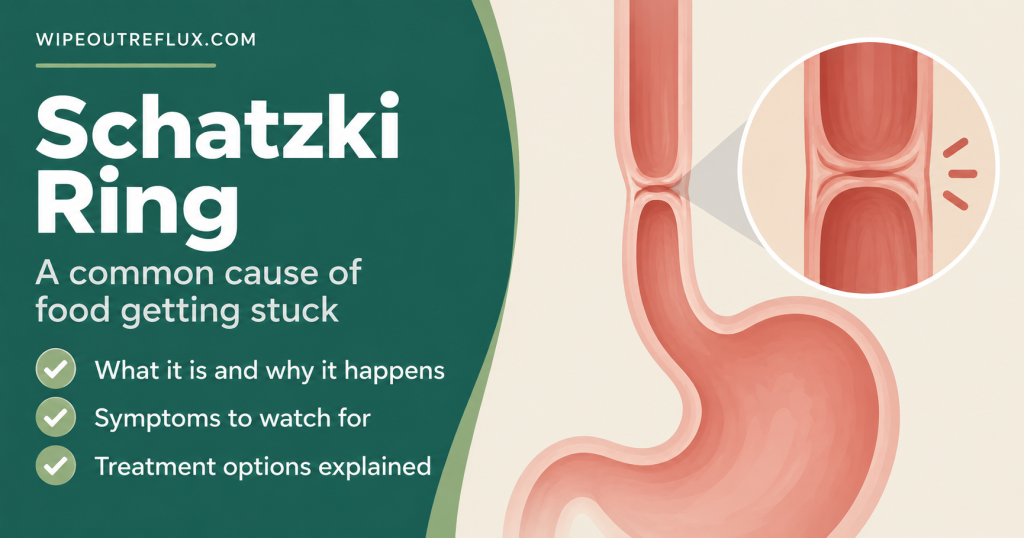
A Schatzki ring is a thin band of tissue at the bottom of the esophagus, right where it meets the stomach, that narrows the opening food has to pass through. Most people who have one never know it — the ring is wide enough that food slips through fine. But when the opening narrows past a certain point, you get the classic symptom: a piece of food, very often a mouthful of steak, sticks fast in the lower chest and won’t go down.
That sudden, dramatic food-sticking episode has a nickname among doctors: “steakhouse syndrome,” because it so often happens mid-meal at a restaurant. It’s alarming, but a Schatzki ring itself is benign — it isn’t cancer and doesn’t become cancer. What it is, quite often, is connected to acid reflux, which is the part most explanations gloss over and the part that matters for keeping it from coming back.
Here’s what causes a Schatzki ring, how it’s treated, what your endoscopy or barium report is actually telling you, and where reflux fits in.
Key Takeaways
- A Schatzki ring is a thin mucosal ring at the junction of the esophagus and stomach that can narrow the passage for food.
- The hallmark symptom is intermittent trouble swallowing solids — especially meat and bread — sometimes with food getting stuck (“steakhouse syndrome”).
- Whether it causes symptoms depends on the opening: rings narrower than about 13 mm almost always cause trouble, while those wider than about 20 mm rarely do.
- It’s strongly linked to hiatal hernia and acid reflux — rings don’t protect against reflux and may actually slow acid clearance.
- The main treatment is a quick endoscopic dilation (stretching or rupturing the ring), which gives immediate relief.
- Rings often come back, and long-term acid suppression after dilation reduces the chance of recurrence.
- A Schatzki ring is benign — not cancer — though a fully stuck piece of food can be a medical emergency.
What Is a Schatzki Ring?
A Schatzki ring (sometimes written “Schatzki’s ring,” and also called a lower esophageal ring or “B ring”) is a thin, circular ridge of tissue that sits at the squamocolumnar junction — the line where the pale lining of the esophagus meets the pinker lining of the stomach. It’s usually only 2–4 mm thick, made of mucosa rather than muscle, and it forms a shelf that food has to pass over on the way down.
Almost all Schatzki rings sit at the top of a hiatal hernia, which is one of the clues to why they’re so tied up with reflux. The ring itself is common — it turns up on a lot of barium studies and endoscopies — but only becomes a problem when the central opening gets tight enough to catch food.
Symptoms: Steakhouse Syndrome
The tell-tale sign is intermittent dysphagia — difficulty swallowing — that affects solid food far more than liquids. It’s typically episodic rather than constant: you can go weeks or months with no trouble, then a poorly chewed lump of meat, bread or dry chicken lodges in the lower chest and simply stops.
Classically this happens at a meal, often with meat, which is where “steakhouse syndrome” comes from. When it’s mild, the food eventually goes down with a drink of water or comes back up and you carry on. When it’s severe, the bolus is fully impacted — stuck, with saliva backing up behind it — and that needs urgent endoscopic removal. If you’ve had episodes of food catching or of difficulty swallowing, a Schatzki ring is one of the first things a gastroenterologist will look for.
The reason it comes and goes is the geometry. Whether a ring causes symptoms is largely down to the diameter of its opening: rings with a lumen narrower than about 13 mm almost always cause dysphagia, those between 13 and 20 mm cause it variably, and rings wider than about 20 mm are usually silent. A large, dry mouthful can catch on a borderline ring one day and pass fine the next.
What Causes a Schatzki Ring?
The honest answer is that it’s still debated, and there are two main theories — congenital and acquired — that probably both contribute in different people.
The theory with the most practical weight is that many Schatzki rings are acquired through acid reflux. The ring sits exactly where refluxed acid would repeatedly wash over the lining, and chronic low-grade injury and scarring at that junction is a plausible way to build a fibrous ridge over time. The strong association with hiatal hernia — itself a driver of reflux — fits this picture.
Importantly, having a ring doesn’t shield you from reflux. One study measuring acid exposure found that Schatzki’s rings do not protect against acid reflux and may actually decrease the esophagus’s ability to clear acid back down into the stomach [Winters et al., Digestive Diseases and Sciences, 2003]. In other words, reflux and the ring tend to travel together, which is exactly why treatment isn’t only about the ring itself.
Schatzki Ring and Reflux: Why the Link Matters
If a ring is at least partly a product of reflux, then dilating it without addressing the reflux is treating the symptom and ignoring the cause. That’s not just theory — it shows up in how often rings recur, and in what prevents recurrence (covered under treatment below).
It also means a Schatzki ring is worth treating as a signal. If you have one, it’s reasonable to assume acid has been reaching the lower esophagus more than it should, and to take that seriously even between swallowing episodes. Understanding your reflux — whether it’s classic GERD or the silent, throat-based kind — is part of managing the ring, not a separate issue.
What Your Report Means: “Non-Obstructing,” “Widely Patent” and Other Phrases
A lot of people find a Schatzki ring mentioned on an endoscopy or barium-swallow report and go straight to searching the exact wording. Here’s what the common phrases mean:
- “Lower esophageal ring” / “B ring” / “Schatzki ring” — all describe the same thing: the thin mucosal ring at the esophago-gastric junction.
- “Non-obstructing Schatzki ring” — the ring is present but isn’t currently blocking the passage of food. It was seen, but it’s not tight enough to be causing an obstruction. This is common and generally reassuring.
- “Widely patent” — “patent” means open, so “widely patent” means the opening is wide (typically 20 mm or more). A widely patent ring is very unlikely to cause symptoms.
- A measurement in mm — if a diameter is given, compare it to the thresholds above: under ~13 mm is likely to cause trouble, over ~20 mm usually won’t.
So if your report says “non-obstructing” or “widely patent,” the ring is unlikely to be your problem right now — but its presence still points to reflux being part of your picture. If it says the ring is tight or you’re having food catch, that’s the situation dilation is designed for. A ring is often first spotted on a barium swallow (a barium tablet or marshmallow is sometimes used to provoke a subtle ring) and confirmed at endoscopy.
Schatzki Ring Treatment and Dilation
The mainstay of treatment for a symptomatic ring is esophageal dilation — stretching or rupturing the ring to widen the opening. It’s done during an endoscopy, usually with a single pass of a large dilator (a bougie), which fractures the thin ring and immediately restores a normal-sized passage. Balloon dilation is an alternative. For most people it’s quick, effective, and brings prompt relief from the food-sticking episodes.
The catch is recurrence. Schatzki rings have a well-documented tendency to come back, and a substantial proportion of people need more than one dilation over the years. That’s where the reflux link becomes practical.
Because reflux appears to feed ring formation, acid suppression after dilation can keep it from returning. A prospective, randomized, placebo-controlled trial found that long-term acid-suppressive therapy after dilation reduced the relapse of Schatzki’s rings — patients kept on acid suppression were significantly less likely to have their dysphagia return than those on placebo [Sgouros et al., American Journal of Gastroenterology, 2005]. This is why a gastroenterologist will often pair dilation with ongoing reflux treatment rather than dilation alone.
Schatzki Ring Diet: What Actually Helps
Diet won’t make a ring disappear — only dilation opens a tight ring — but sensible eating habits genuinely reduce the risk of food getting stuck, and matter most if you’re waiting for a procedure or managing a borderline ring:
- Chew thoroughly and take small bites. The single biggest protection against impaction. Most stuck-food episodes involve a large, under-chewed lump.
- Be careful with the classic culprits: steak and other tough meats, dry chicken, fresh bread and doughy foods, and anything you tend to bolt.
- Sip fluids with meals and stay sitting upright while eating and for a while afterwards.
- Slow down. Eating quickly, especially while talking or distracted, is how a borderline ring turns into an emergency.
Alongside this, because reflux is so often part of the story, reducing acid exposure is worth doing in its own right — both the medical acid suppression above and a dietary approach that cuts reflux at the source.
Is a Schatzki Ring Serious?
Reassuringly, no — a Schatzki ring is benign. It is not cancer, and unlike Barrett’s esophagus it does not carry a risk of turning into cancer. Many are found incidentally and never cause a moment’s trouble.
The one genuine risk is acute food impaction — a piece of food fully stuck, unable to go down or come up, often with saliva pooling. That’s a medical emergency needing prompt endoscopic removal, both for comfort and to avoid damage from a prolonged impaction. If food is truly stuck and you can’t swallow your own saliva, that’s an emergency-room situation, not a wait-and-see one.
How a Schatzki Ring Differs From Similar Findings
Several esophageal problems cause overlapping symptoms, and reports can be confusing. In brief:
- Esophageal web — also a thin membrane, but usually in the upper esophagus rather than the lower, and sometimes linked to iron deficiency. A Schatzki ring is specifically at the esophago-gastric junction.
- Peptic stricture — a longer, tapered narrowing caused by chronic acid damage, rather than a thin discrete ring. Strictures are a more extensive scarring problem; the esophageal stricture picture is different from a simple ring, though both can stem from reflux and both are treated with dilation.
- Achalasia — a muscle/nerve disorder where the lower valve fails to relax, causing trouble with both solids and liquids and a very different mechanism. My comparison of achalasia versus acid reflux covers how to tell them apart.
The distinguishing features of a Schatzki ring are its location (right at the junction), its thinness, and the pattern of intermittent solid-food dysphagia.
Conclusion
A Schatzki ring is a thin, benign ring at the bottom of the esophagus that can narrow the path for food and cause the classic “steakhouse syndrome” of solid food sticking. It’s not dangerous in itself and never turns cancerous, but it’s worth taking seriously — both because a fully impacted mouthful is an emergency, and because the ring is so closely tied to acid reflux. When your report says “non-obstructing” or “widely patent,” the ring probably isn’t your immediate problem; when it’s tight, a quick endoscopic dilation usually fixes the swallowing straight away.
The part that too often gets missed is the reflux underneath. Rings recur, and the evidence shows that controlling acid after dilation makes recurrence less likely — so treating the ring without treating the reflux is only half the job. That’s where a mechanism-first approach earns its place. The Wipeout Diet Plan is built to reduce how often and how forcefully you reflux in the first place — through meal size, timing, fat load and trigger foods — which is exactly the acid exposure that appears to feed ring formation. I designed it first around LPR and silent reflux, the throat-based form, but because it works on the same underlying reflux mechanisms it helps classic GERD and everyday heartburn just as well. And if you want a concrete starting point, the Wipeout Food Reference Guide is the essential companion — every food and drink that’s safe for acid reflux and LPR with its actual pH value, so you’re working from numbers instead of guesswork.
Get the ring dilated if it needs it. Then quiet down the reflux that helped create it.
Frequently Asked Questions
Is a Schatzki ring serious or dangerous?
No — it’s a benign finding that isn’t cancer and doesn’t become cancer. The only real danger is acute food impaction, where a piece of food gets fully stuck and needs urgent endoscopic removal. Between those episodes, a Schatzki ring is not a threat to your health.
What does a “non-obstructing” Schatzki ring mean?
It means the ring was seen on your endoscopy or barium study but isn’t currently blocking the passage of food — the opening is wide enough that food passes normally. It’s a common and generally reassuring finding, though it still suggests reflux is part of your picture.
Does a Schatzki ring need to be treated?
Only if it’s causing symptoms. A wide, “widely patent” ring found incidentally usually needs no treatment. A ring tight enough to catch food is treated with endoscopic dilation, which is quick and effective, often paired with reflux treatment to reduce recurrence.
Can a Schatzki ring go away on its own?
No — diet and reflux control can reduce food-sticking episodes and help stop a ring worsening or coming back, but they won’t open a ring that’s already tight. That requires dilation. What you can influence is recurrence, by keeping acid reflux under control after treatment.
What foods should I avoid with a Schatzki ring?
Be cautious with tough or dry foods that form large boluses — steak and other meats, dry chicken, fresh bread and doughy foods. The bigger fix is habit: chew thoroughly, take small bites, sip fluids, sit upright and don’t rush your meals.
Is a Schatzki ring caused by acid reflux?
It’s strongly linked. Many rings are thought to be acquired through chronic acid reflux at the esophago-gastric junction, they almost always sit atop a hiatal hernia, and rings don’t protect against reflux. That connection is why acid suppression after dilation helps prevent them coming back.
Research & References
- Study measuring esophageal acid exposure in patients with Schatzki’s rings, finding the rings do not protect against acid reflux and may decrease the esophagus’s ability to clear acid [Winters et al., Digestive Diseases and Sciences, 2003].
- Prospective, randomized, placebo-controlled trial finding that long-term acid-suppressive therapy after dilation reduced the relapse of lower esophageal (Schatzki’s) rings [Sgouros et al., American Journal of Gastroenterology, 2005].

David Gray
12 years living with LPR · Consultant & researcher
I've lived with LPR for twelve years — the misdiagnoses, the PPI courses that did nothing, the slow work of figuring out what actually helps. Wipeout Reflux is where I translate the research into plain terms for people stuck in the same place. Every claim here is sourced to peer-reviewed work, and I consult one-to-one with LPR sufferers.