
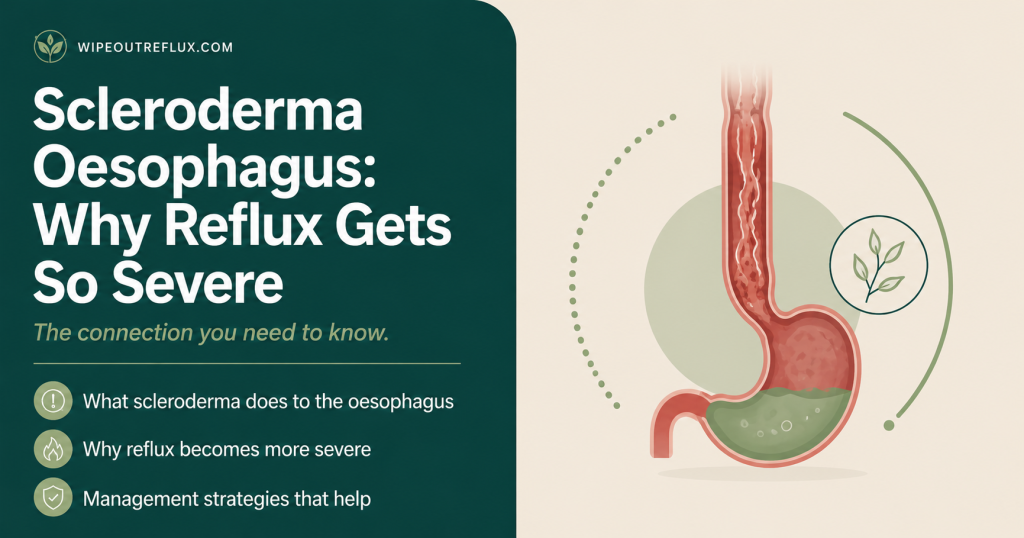
Scleroderma causes some of the most severe, stubborn reflux in all of medicine, and the reason comes down to one thing: the oesophagus loses its ability to move. In systemic sclerosis (scleroderma), the smooth muscle of the lower oesophagus is gradually replaced by scar tissue. The muscle that should squeeze food downward stops contracting, and the valve at the bottom that should hold stomach contents down goes slack. The result is a wide-open, motionless lower oesophagus — a near-perfect setup for acid to pour up and sit there.
This pattern is so characteristic that doctors have a name for it: the “scleroderma esophagus.” It explains why reflux in this condition tends to be relentless, why it so often resists standard doses of medication, and why complications like severe inflammation, narrowing and Barrett’s oesophagus are far more common than in ordinary GERD. It also explains why the usual advice needs adapting — because the underlying problem isn’t too much acid, it’s an oesophagus that can’t clear what refluxes.
Here’s what’s actually happening in the scleroderma oesophagus, why the reflux gets so severe, how it’s treated, and the practical measures that genuinely help alongside medical care.
Key Takeaways
- In scleroderma, oesophageal smooth muscle is replaced by fibrosis, producing weak or absent peristalsis in the lower oesophagus and a slack lower oesophageal sphincter.
- This creates severe reflux for two reasons: the valve can’t hold acid down, and the oesophagus can’t clear acid back once it refluxes — so acid contact time is very long.
- Oesophageal involvement is extremely common in systemic sclerosis, and motility testing often shows the classic “scleroderma esophagus” pattern even in people without obvious symptoms.
- Complications are more frequent and more serious: erosive oesophagitis, peptic strictures, and Barrett’s oesophagus with a notably higher risk of progression.
- PPIs are the mainstay and often needed at higher or twice-daily doses — but they treat the acid, not the dysmotility, so prokinetics, alginates and positioning matter too.
- This is a condition to manage with a specialist; diet and lifestyle reduce the reflux burden and symptoms but work alongside medical treatment, not instead of it.
What goes wrong in the scleroderma oesophagus
To understand the reflux, you have to understand the mechanics, because this isn’t an acid-overproduction problem — it’s a movement problem. Normally, when you swallow, a coordinated wave of muscle contraction (peristalsis) sweeps food down the oesophagus, and the lower oesophageal sphincter opens to let it through, then closes to keep stomach contents from coming back up. Both of those depend on healthy smooth muscle.
In systemic sclerosis, that smooth muscle in the lower two-thirds of the oesophagus is progressively damaged and replaced by fibrous scar tissue. On a motility test, this shows up as weak or completely absent contractions in the lower oesophagus combined with a low-pressure, incompetent sphincter — the signature the literature describes as absent peristalsis with a hypotensive lower oesophageal sphincter [Ghani et al., PAMJ Clinical Medicine, 2020]. This is exactly the kind of oesophageal motility problem that turns ordinary reflux into something much harder to control.
Why the reflux gets so severe
Here’s the part that makes scleroderma reflux uniquely punishing, and it’s a double failure. First, the slack sphincter can’t hold acid down, so reflux happens easily and often. Second — and this is the bit people miss — the paralysed oesophagus can’t clear the acid back into the stomach once it has refluxed. In a healthy oesophagus, a reflux episode is quickly swept back down by peristalsis and neutralised by saliva. In the scleroderma oesophagus, that clearance mechanism is gone, so acid simply pools against the oesophageal lining for far longer.
It’s the acid contact time that does the damage, and in this condition it’s dramatically prolonged. That’s why symptoms tend to be severe and constant rather than occasional, and why they often don’t respond to the standard measures that work for everyday heartburn. It’s a more extreme version of the same reason acid suppression alone often disappoints when the underlying mechanics are the real problem — you can lower the acidity of what refluxes, but if it still sits there for an hour at a time, tissue damage continues.
The complications to watch for
Because acid sits against the lining for so long, the scleroderma oesophagus is prone to the more serious end of reflux disease, and this is the main reason it needs proper monitoring:
- Erosive oesophagitis. Prolonged acid exposure inflames and ulcerates the lining, causing erosive oesophagitis far more readily than in typical GERD.
- Peptic strictures. Repeated injury and healing can lay down scar tissue that narrows the oesophagus, producing an oesophageal stricture and difficulty swallowing — which compounds the existing motility problem.
- Barrett’s oesophagus. Chronic reflux can transform the lining into Barrett’s oesophagus, and in scleroderma this carries a meaningfully higher risk of progressing toward dysplasia and cancer than Barrett’s in the general population — one reason surveillance endoscopy matters here [Anilkumar et al., Gastroenterology Report, 2021].
None of this is meant to frighten you — it’s to explain why scleroderma reflux is taken seriously and monitored more closely than ordinary heartburn, and why staying on top of it genuinely matters.
How scleroderma reflux is treated
Treatment has to work on both halves of the problem: the acid and the movement. Acid suppression is the foundation. Proton pump inhibitors are the mainstay, and in scleroderma they’re frequently needed at higher or twice-daily doses because standard dosing often isn’t enough to protect a lining that’s exposed for so long. But a reappraisal of PPI use in systemic sclerosis makes the crucial point plainly: PPIs treat the acid, not the underlying dysmotility — so they’re necessary but rarely sufficient on their own [Hughes et al., The Lancet Rheumatology, 2022].
That’s why the fuller approach layers on additional tools. Prokinetic medications aim to encourage what movement the oesophagus and stomach still have, helping clear acid and empty the stomach faster. Alginates form a physical raft on top of the stomach contents, which is particularly useful when the sphincter can’t do its job. And because clearance is so impaired, keeping acid out of the oesophagus by gravity becomes disproportionately valuable. All of this should be coordinated by a gastroenterologist and rheumatologist together — this is not a condition to self-manage, and if medication doesn’t seem to be working, that’s a conversation to have with your specialist rather than a reason to give up on it.
What genuinely helps day to day
Alongside medical treatment, the practical measures matter more here than in ordinary reflux, precisely because your oesophagus can’t clear acid on its own. Gravity has to do the work your muscles no longer can.
- Raise the head of your bed. This is one of the highest-value steps in scleroderma reflux. Elevating the head of the bed on blocks (not just piling up pillows) uses gravity to keep acid down through the night, when clearance is at its worst.
- Mind your sleeping position. Staying more upright and favouring the left side can reduce overnight acid exposure.
- Leave a long gap before lying down. Because your oesophagus empties slowly, stopping eating well before bed — longer than the usual advice — gives food and acid more time to clear.
- Eat smaller, softer, more frequent meals. Large or dry meals are harder for a weak oesophagus to move; smaller, moist meals pass more easily and reflux less.
- Stay upright after eating. Sit or walk rather than reclining, so gravity keeps things heading the right way.
Conclusion
The scleroderma oesophagus is a genuinely difficult problem, but understanding it makes it far more manageable. The reflux is severe not because of excess acid but because a fibrosed oesophagus can neither keep acid down nor clear it away, so acid lingers and damages the lining. That’s why treatment has to combine strong acid suppression with prokinetics, alginates and relentless attention to gravity — and why regular specialist follow-up and monitoring for complications are non-negotiable. This is very much a condition to manage hand-in-hand with your gastroenterologist and rheumatologist.
Within that medical framework, what you eat and how you time it does real work to lower the reflux burden your oesophagus has to cope with, and that’s where a structured approach helps. The Wipeout Diet Plan is the complete, step-by-step method I built for calming reflux at its source through what you eat and drink — it was designed first and foremost around LPR, the throat-based form, but because it works on the same reflux mechanisms it helps reduce the acid load in classic GERD and severe reflux too. Used as a companion to your medical treatment — never a replacement for it — it can meaningfully cut how much acid is there to reflux in the first place. The Wipeout Food Reference Guide is the essential quick companion, showing which foods and drinks are gentlest for reflux and their pH values, so you can build meals that are easier on a fragile oesophagus. Pair diligent medical care with a reflux-smart diet and gravity on your side, and you give a difficult condition the best possible chance of staying controlled.
Frequently Asked Questions
What is scleroderma esophagus?
“Scleroderma esophagus” is the term for the characteristic oesophageal damage in systemic sclerosis, where smooth muscle in the lower oesophagus is replaced by scar tissue. This produces weak or absent peristalsis and a slack lower oesophageal sphincter, so the oesophagus can neither hold acid down nor clear it away — leading to severe, persistent reflux.
Why is reflux so bad in scleroderma?
Because two mechanisms fail at once. The lower oesophageal sphincter becomes too weak to keep stomach contents down, so reflux happens easily, and the paralysed oesophagus can’t sweep the acid back into the stomach afterwards. Acid therefore sits against the lining for a very long time, causing more damage and more stubborn symptoms than in ordinary GERD.
Do PPIs work for scleroderma reflux?
They’re the mainstay and are genuinely important, but often need to be used at higher or twice-daily doses, and they’re rarely enough on their own. PPIs reduce the acid but don’t fix the underlying motility problem, so treatment usually adds prokinetics, alginates and strong positioning measures. Always adjust doses with your specialist rather than on your own.
Is scleroderma reflux dangerous?
It needs to be taken seriously because prolonged acid exposure makes complications like erosive oesophagitis, strictures and Barrett’s oesophagus more likely, and Barrett’s in scleroderma carries a higher progression risk than usual. That’s why regular monitoring, often including surveillance endoscopy, is part of good care. With proper treatment and follow-up, though, it can be managed well.
What lifestyle changes help scleroderma esophagus most?
Gravity-based measures matter most because your oesophagus can’t clear acid on its own. Raising the head of the bed on blocks, staying upright after meals, leaving a long gap before lying down, and eating smaller, softer, more frequent meals all reduce how long acid sits against the lining. These work best alongside medication, not instead of it.
Research & References
- Study of oesophageal motility in systemic sclerosis using high-resolution manometry, documenting absent peristalsis with a hypotensive lower oesophageal sphincter as the characteristic pattern and finding motility disorders in most patients — recommending manometry even without digestive symptoms [Ghani et al., PAMJ Clinical Medicine, 2020].
- Reappraisal of proton pump inhibitor use in systemic sclerosis, emphasising that PPIs are the mainstay for reflux but often require maximised dosing and that they treat the acid rather than the underlying dysmotility, supporting the addition of prokinetics and alginates [Hughes et al., The Lancet Rheumatology, 2022].
- Study of Barrett’s oesophagus in systemic sclerosis reporting a substantially higher rate of neoplastic progression (to dysplasia or adenocarcinoma) than in the general Barrett’s population, underscoring the need for closer surveillance [Anilkumar et al., Gastroenterology Report, 2021].

David Gray
12 years living with LPR · Consultant & researcher
I've lived with LPR for twelve years — the misdiagnoses, the PPI courses that did nothing, the slow work of figuring out what actually helps. Wipeout Reflux is where I translate the research into plain terms for people stuck in the same place. Every claim here is sourced to peer-reviewed work, and I consult one-to-one with LPR sufferers.