
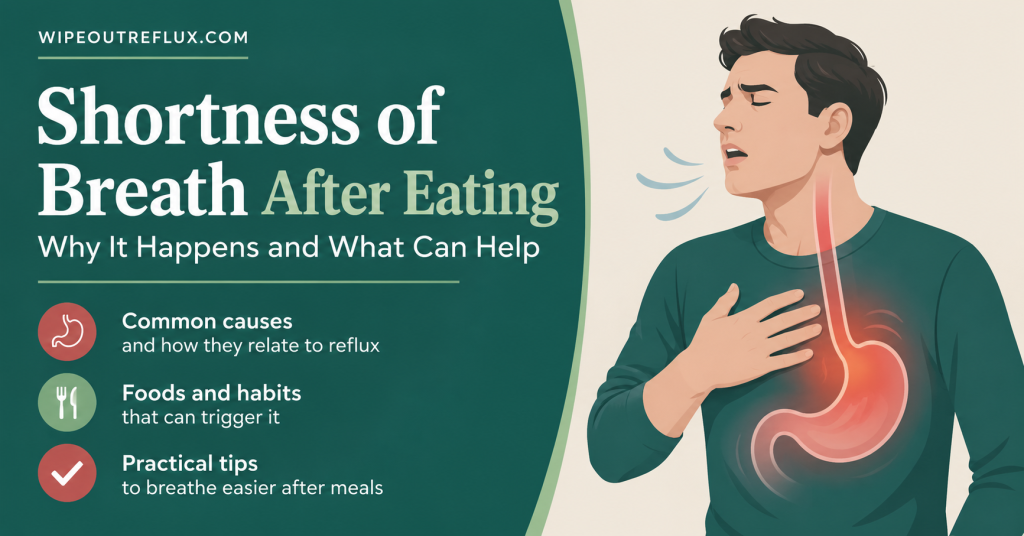
Shortness of breath after eating usually comes from what a meal does to the space inside your chest and abdomen. A full stomach pushes up against the diaphragm, your main breathing muscle, so it has less room to move down when you breathe in. The same stretch of the stomach also sets off reflux, and acid in the esophagus can tighten the airways through a nerve reflex. That’s why you can feel breathless, or feel like you can’t take a full breath, without any heartburn.
Big meals, fizzy drinks, eating fast, bloating and lying down soon after eating all make it worse. A hiatal hernia, especially a large one, is a common hidden cause, and so are asthma and COPD, because people with these conditions have less breathing reserve to spare.
Breathlessness after a meal can sometimes be a sign of a heart problem. If it comes with chest pain or pressure, pain spreading to your arm, jaw or back, sweating, nausea or dizziness, call emergency services. Don’t wait to see if it passes.
Key Takeaways
- A full stomach limits how far your diaphragm can move down, so each breath feels shallower and less satisfying.
- Stretching the stomach is the main trigger for the valve openings that cause reflux, which is why after-meal breathlessness and reflux often go together.
- Acid in the esophagus can tighten the airways through the vagus nerve, even when it never reaches your throat.
- Getting breathless after a small meal points to a hiatal hernia, slow stomach emptying or a sensitive stomach rather than just overeating.
- Lying down after eating makes it worse, because the stomach presses on the diaphragm and reflux travels more easily.
- Anxiety can turn mild after-meal pressure into a cycle of air hunger and over-breathing.
- Smaller meals, fewer fizzy drinks, eating slowly and staying upright for 2 to 3 hours help most people.
- Breathlessness with chest pain, sweating, arm or jaw pain, or swelling of the lips or throat is an emergency.
Why Do I Get Short of Breath After Eating?
People usually describe it to me in one of a few ways. “I can’t get a full breath after dinner.” “It feels like my stomach is pushing on my lungs.” “I have to sit up straight or I feel like I’m suffocating.” Those descriptions are surprisingly accurate, because the problem is mostly mechanical.
Your stomach sits directly under the left side of your diaphragm. When you breathe in, the diaphragm contracts and moves down, which pulls air into your lungs. Anything that takes up room underneath it, like a full stomach, trapped gas or a bloated gut, makes that downward movement harder. The lungs can’t expand as fully, so your brain registers it as breathlessness.
On top of that, a meal triggers reflux. That adds a second route to breathlessness that has nothing to do with physical space. Here are the main causes:
- Stomach distension pressing on the diaphragm: the most common reason, and the one most other guides skip over.
- Reflux after meals: acid in the esophagus can tighten the airways or irritate the throat.
- A hiatal hernia: part of the stomach sits above the diaphragm, inside the chest.
- Bloating and swallowed air: fizzy drinks, eating fast and gas-producing foods.
- Existing lung conditions: asthma and COPD leave less spare breathing capacity.
- Anxiety and over-breathing: the sensation itself can start a cycle of air hunger.
- Less common causes: food allergy, heart problems and anemia.
The Diaphragm Problem: How a Full Stomach Squeezes Your Breathing
What normally happens when you eat
Your abdomen is designed to make room for a meal. In healthy people, eating causes the diaphragm to relax and lift slightly while the upper abdominal wall tightens, so the abdomen can expand without bulging outward. Researchers using muscle recordings and CT scans showed exactly this pattern after a test meal [Burri et al., Gut, 2014].
The same study found that people who get uncomfortable and bloated after eating do the opposite. Their diaphragm contracts and pushes down while the front of the abdomen relaxes. They also hit their limit at a much smaller meal size, around 600 ml compared with around 900 ml in healthy people. It’s a faulty reflex between the gut and the breathing muscles, and it helps explain why some people feel full, bloated and short of breath after a meal that wouldn’t bother anyone else.
Why it feels like you can’t take a deep breath
This kind of breathlessness has a particular feel. You’re not wheezing and you’re not gasping. You just can’t get that satisfying, full breath at the top of an inhale, so you keep trying to yawn or sigh. That’s the feeling of a diaphragm that can’t move down as far as it wants to.
It’s also why the symptom is worse when you’re slumped on the sofa after dinner. Slouching folds your abdomen, which pushes the stomach up even further. Sitting upright or standing gives the diaphragm back some room, which is why many people instinctively stand up when it happens.
Reflux: The Second Reason You Feel Breathless After Meals
Why meals set off reflux
Your lower esophageal sphincter, the valve at the top of your stomach, doesn’t just stay shut and occasionally leak. It opens for several seconds at a time in episodes called transient lower esophageal sphincter relaxations. The main trigger for those openings is stretch in the upper part of the stomach. Fill the stomach and you get more of them [Holloway et al., Gastroenterology, 1985].
So the same meal that crowds your diaphragm also opens the door to reflux. That’s why after-meal breathlessness and reflux so often turn up together, and why big meals are worse than small ones. I go into this in more detail in does overeating cause acid reflux.
How reflux tightens your airways
Your esophagus and your airways share the same nerve supply, the vagus nerve. When acid touches the lower esophagus, it can trigger a reflex that narrows the airways, even if nothing reaches your throat or lungs.
In a controlled study of people with asthma, dripping dilute acid into the lower esophagus reduced lung function compared with salt water. Breathing tests such as FEV1 and peak flow dropped, and markers of vagus nerve activity rose. This happened whether or not the participants had diagnosed reflux [Amarasiri et al., BMC Pulmonary Medicine, 2013]. An earlier study found the same reflex could trigger coughing, and numbing the esophagus blocked it [Ing et al., American Journal of Respiratory and Critical Care Medicine, 1994].
This is the part that confuses a lot of people. You can feel tight-chested and breathless after a meal with no burning at all, because the reflux is doing its work through a nerve rather than through pain. I explain the nerve link in the vagus nerve and acid reflux, and the tight-chest version in acid reflux chest tightness.
When reflux reaches the throat
If reflux travels all the way up to your voice box (silent reflux, or LPR), it can irritate the throat and vocal cords. That can cause a tight, restricted feeling in the throat, a need to clear it, or in some people brief spasms of the vocal cords. This is a different feeling from a squashed diaphragm. It’s more “my throat is closing” than “my lungs can’t fill.” If that sounds like you, my guide to silent reflux and shortness of breath covers the throat side of this in depth, and laryngospasm and silent reflux covers the sudden, frightening episodes.
In my own years of dealing with LPR, a heavy dinner was the surest way to get a tight throat, a sense of not breathing freely, and a night of throat clearing. The meal itself, more than any single food, was usually the trigger.
Hiatal Hernia: A Common Hidden Cause
With a hiatal hernia, part of your stomach pushes up through the opening in the diaphragm and sits inside the chest. Small sliding hernias are very common and mainly make reflux easier. Larger ones, and especially paraesophageal hernias where the stomach rolls up alongside the esophagus, can take up real space in the chest.
When that part of the stomach fills with food, it presses on the lungs and heart from inside the chest. Typical signs are feeling full very quickly, chest pressure or breathlessness after eating, and needing to sit up straight to feel comfortable.
A systematic review of six studies looked at what happens to breathing after these hernias are repaired. Lung volumes (FEV1, FVC and vital capacity) improved after surgery, mainly in people with large hernias where more than half of the stomach sat inside the chest, and patients reported less breathlessness. The authors concluded the improvement came from removing the physical compression on the lungs, not from reducing reflux [Myers et al., Frontiers in Surgery, 2021].
If you get breathless even after small meals, feel full after a few bites, or have a known hernia, ask your doctor whether imaging is worthwhile. More in hiatal hernia and reflux.
Shortness of Breath After a Small Meal
If a sandwich or a bowl of soup is enough to make you breathless, overeating isn’t the explanation. The usual suspects are:
- A hiatal hernia that fills quickly, as above.
- Slow stomach emptying (gastroparesis). Food sits in the stomach for hours, so even a small meal keeps it stretched for a long time. Nausea, early fullness and bloating are common alongside. See gastroparesis and acid reflux.
- Functional dyspepsia. The stomach is overly sensitive to stretch and doesn’t relax properly to accept food, so a normal amount feels like too much. This is the group in the Burri study whose diaphragm pushed down after eating. More in functional dyspepsia.
- Swallowed air. Eating fast, talking while eating, drinking through a straw and chewing gum all fill the stomach with air before the food even arrives.
- Pregnancy and abdominal weight. Anything that already takes up room in the abdomen leaves the diaphragm less space to spare.
Bloating, Gas and Fizzy Drinks
Gas takes up far more room than food. A can of soda releases a surprising volume of carbon dioxide into the stomach, and that gas stretches the stomach in exactly the way that triggers reflux and pushes on the diaphragm. Beer and sparkling water do the same. See is sparkling water bad for acid reflux.
Gas from fermentation lower down in the gut can also push up on the diaphragm, especially with IBS or after a meal heavy in beans, onions, wheat or certain sweeteners. If you’re breathless along with a tight, swollen belly and lots of burping, gas is probably a big part of it. More in acid reflux and gas and acid reflux and burping.
Shortness of Breath After Eating and Lying Down
Lying down after a meal makes both problems worse at once. When you’re flat, your abdominal contents slide up toward your chest and press on the diaphragm. Gravity also stops helping to keep stomach contents down, so reflux travels further and stays in the esophagus longer.
Timing matters a lot here. In a case-control study, people who went to bed within 3 hours of dinner had much higher odds of reflux than those who waited 4 hours or more [Fujiwara et al., American Journal of Gastroenterology, 2005]. If you notice breathlessness mainly when you lie down after eating, that’s a strong clue that reflux and stomach pressure are behind it. See how long before bed you should stop eating.
One exception: breathlessness when lying flat that happens whether or not you’ve eaten, especially if you need extra pillows to breathe or wake up gasping, can be a sign of heart failure. That needs a doctor’s assessment.
Asthma, COPD and After-Meal Breathlessness
If you already have a lung condition, a meal hits harder. With COPD, the lungs are often over-inflated and the diaphragm is already flattened, so it has less room to work with. A full stomach can take away the little reserve that’s left. Many people with COPD do better with small, frequent meals for exactly this reason. See acid reflux and COPD.
With asthma, the esophagus-to-airway reflex described above can be enough to tip already twitchy airways into tightening. If your asthma flares after meals or at night, reflux is worth looking into. More in acid reflux misdiagnosed as asthma.
Anxiety and Shortness of Breath After Eating
Anxiety plays a bigger role in this symptom than most people expect, and it usually works by amplifying something real. You eat, your stomach presses on your diaphragm, and you notice you can’t get a full breath. That’s alarming, so you start breathing faster and deeper from the upper chest. Over-breathing then causes its own symptoms: air hunger, tingling, lightheadedness, chest tightness and a racing heart. Now it feels much worse, and the cycle feeds itself.
The sign that anxiety is in the mix is frequent sighing or yawning to try to “get a breath in,” with the feeling settling when you’re distracted. Slow breathing out through pursed lips, with a longer out-breath than in-breath, often breaks the cycle within a few minutes. I talk about the reflux and anxiety overlap in does silent reflux cause anxiety and breathing exercises for acid reflux.
Anxiety should be the last explanation you settle on, though, not the first. Rule out the physical causes before putting it down to nerves.
Food Allergy and Other Less Common Causes
- Food allergy: breathlessness within minutes of a specific food, with itching, hives, flushing, swelling of the lips or tongue, or a hoarse voice, can be an allergic reaction. If breathing is affected, treat it as an emergency.
- Histamine-rich meals: aged cheese, wine, cured meats and leftovers can cause flushing, a stuffy nose and chest tightness in some people. See histamine intolerance and acid reflux.
- Anemia: low iron reduces how much oxygen your blood carries, so any extra demand, including digestion, can leave you breathless.
- Heart problems: digestion diverts extra blood to the gut, which increases the workload on the heart. In people with narrowed coronary arteries, that can bring on chest pain and breathlessness after meals. This is covered in the next section.
When Shortness of Breath After Eating Could Be Your Heart
Most after-meal breathlessness is digestive. But a heavy meal increases the heart’s workload, and in someone with coronary artery disease, that extra demand can trigger angina, sometimes felt more as breathlessness than pain. Reflux and heart symptoms can feel remarkably similar, so don’t try to tell them apart on your own.
Call emergency services if breathlessness after eating comes with:
- Chest pain, pressure, squeezing or heaviness
- Pain spreading to your arm, shoulder, neck, jaw or back
- Sweating, nausea or vomiting, or feeling faint
- Breathlessness that keeps getting worse, or that comes on with mild exertion after meals
- Swelling of the lips, tongue or throat, or difficulty swallowing your own saliva
See a doctor soon if you have:
- Breathlessness after eating that’s new, frequent or getting worse
- Breathlessness when lying flat, needing extra pillows, or ankle swelling
- Difficulty swallowing, food sticking, or feeling full after a few bites
- Unexplained weight loss, vomiting, or black stools
- Risk factors for heart disease, such as smoking, diabetes, high blood pressure or a family history
I’ve written a full comparison in heartburn or heart attack. If you’re ever unsure, get checked. A clear ECG is reassuring, and it lets you treat the reflux with confidence.
How to Stop Shortness of Breath After Eating
Because the main drivers are stomach stretch and reflux, the most effective fixes target both. Most people notice a difference within a week or two.
- Eat smaller meals, more often. This is the single biggest change. Less stretch means less pressure on the diaphragm and fewer valve openings. Four or five modest meals beat two or three large ones.
- Slow down. Eating fast means swallowing more air and overfilling the stomach before fullness signals catch up. Put your fork down between bites and aim for at least 20 minutes per meal.
- Cut back on fizzy drinks and beer. Carbonation adds gas volume that stretches the stomach. Still water, sipped rather than gulped, is the easiest swap.
- Don’t drink large amounts with meals. A big glass of liquid on top of a full plate adds volume fast. Small sips are fine.
- Sit upright while eating and afterward. Avoid slumping on the sofa. A short, gentle walk after eating helps your stomach empty and keeps you upright. See does walking after meals help acid reflux.
- Leave 3 hours between your last meal and bed. If night-time symptoms are a problem, raise the head of your bed as well. See how to raise the head of your bed.
- Loosen your waistband. Tight belts and waistbands squeeze the abdomen and push the stomach up. More in tight clothing and acid reflux.
- Lower the fat and acid in your meals. Fatty meals stay in the stomach longer and relax the valve. Acidic foods and drinks add fuel for pepsin if reflux reaches your throat. Cutting both is the core idea behind the Wipeout Diet Plan. See also LPR foods to avoid.
- Consider an alginate after meals. Alginates like Gaviscon Advance form a raft on top of the stomach contents that helps block reflux in the hours after eating. See alginates for acid reflux.
- Practice belly breathing. Slow breathing with your hand on your upper abdomen trains the diaphragm and helps break the anxious over-breathing cycle. The diaphragm also forms part of your anti-reflux barrier, so it’s worth doing daily.
Quick relief when it happens
- Stand up or sit up straight. Don’t lie down.
- Loosen anything tight around your waist.
- Breathe in gently through your nose, then out slowly through pursed lips, making the out-breath longer.
- Take a slow walk around the room.
- If you burp easily, let it happen. Releasing trapped air often eases the pressure quickly.
Conclusion
Shortness of breath after eating usually comes down to space and reflux. A full or bloated stomach crowds your diaphragm so each breath feels shallow, and the same stretch opens the valve that lets reflux through. Acid in the esophagus can then tighten your airways through the vagus nerve, often with no heartburn to warn you. A hiatal hernia, gas, lying down too soon and an existing lung condition all add to it. And because a heavy meal also works the heart harder, breathlessness with chest pain, sweating or pain spreading to your arm or jaw always needs urgent attention.
For most people, though, the solution starts with the size and makeup of their meals. If you want a clear plan to follow instead of trial and error, the Wipeout Diet Plan is where I’d point you first. It walks you step by step through the meal patterns, portion habits and low-acid, lower-fat foods that keep reflux down, so your stomach and airways get a break. I built it originally around silent reflux, the throat-based kind, but it targets the same root mechanisms, so it works equally well if your reflux is classic heartburn or GERD.
If you’d prefer something lighter to start with, the Wipeout Food Reference Guide is the essential companion. It lists the foods and drinks that are safe for acid reflux and LPR, along with their pH values, so you can build smaller, gentler meals without second-guessing every ingredient.
Frequently Asked Questions
Why do I feel like I can’t breathe after eating?
Most often because a full stomach presses up on your diaphragm and stops it moving down fully, so each breath feels shallow. Meals also trigger reflux, and acid in the esophagus can tighten the airways through a nerve reflex. Bloating, fizzy drinks and lying down after eating make it worse.
Can acid reflux cause shortness of breath after eating?
Yes. Stomach stretch after a meal triggers the valve openings that cause reflux. Acid in the lower esophagus can narrow the airways through the vagus nerve, and reflux that reaches the throat can make it feel tight. Both can happen without heartburn.
Why do I get short of breath after eating a small meal?
Breathlessness after small meals suggests something other than overeating, such as a hiatal hernia, slow stomach emptying (gastroparesis), an overly sensitive stomach (functional dyspepsia) or swallowed air. If it happens regularly, it’s worth seeing a doctor.
Is shortness of breath after eating a sign of a heart problem?
It can be. A large meal increases the heart’s workload, and in people with coronary artery disease, that can trigger angina. Breathlessness with chest pain or pressure, sweating, nausea, or pain in the arm, jaw or back needs emergency care.
Why is it worse when I lie down after eating?
Lying flat lets your abdominal contents press up on the diaphragm, and gravity no longer helps keep stomach contents down, so reflux travels more easily. Waiting 3 hours after your last meal before lying down helps a lot.
Can anxiety cause shortness of breath after eating?
It can make it much worse. Noticing pressure under your ribs can trigger fast, shallow over-breathing, which causes air hunger, tingling and chest tightness. Slow breathing with a long out-breath usually settles it. Rule out physical causes first, though.
What are the best remedies for shortness of breath after eating?
Smaller meals, eating slowly, cutting back on fizzy drinks, staying upright for 2 to 3 hours after eating, loosening tight waistbands and lowering fat and acid in your meals. An alginate after meals can help block reflux, and slow belly breathing helps in the moment.
Research & References
- [Burri et al., Gut, 2014] — In healthy people, eating made the diaphragm relax and the upper abdominal wall tighten. In people with bloating, the diaphragm contracted and pushed down instead, and they reached their limit at a smaller meal size.
- [Holloway et al., Gastroenterology, 1985] — Showed that stretching the stomach provokes transient lower esophageal sphincter relaxations, the main way reflux happens after meals.
- [Amarasiri et al., BMC Pulmonary Medicine, 2013] — Acid in the esophagus reduced lung function (FEV1 and peak flow) in people with asthma and increased vagal activity, whether or not they had diagnosed reflux.
- [Ing et al., American Journal of Respiratory and Critical Care Medicine, 1994] — Acid in the lower esophagus triggered coughing in people with reflux-related cough, and numbing the esophagus blocked it, supporting an esophagus-to-airway nerve reflex.
- [Myers et al., Frontiers in Surgery, 2021] — Systematic review finding that lung volumes and breathlessness improved after paraesophageal hernia repair, mainly in larger hernias, due to relief of physical compression on the lungs.
- [Fujiwara et al., American Journal of Gastroenterology, 2005] — Going to bed within 3 hours of dinner was associated with markedly higher odds of reflux than waiting 4 hours or more.

David Gray
12 years living with LPR · Consultant & researcher
I've lived with LPR for twelve years — the misdiagnoses, the PPI courses that did nothing, the slow work of figuring out what actually helps. Wipeout Reflux is where I translate the research into plain terms for people stuck in the same place. Every claim here is sourced to peer-reviewed work, and I consult one-to-one with LPR sufferers.