
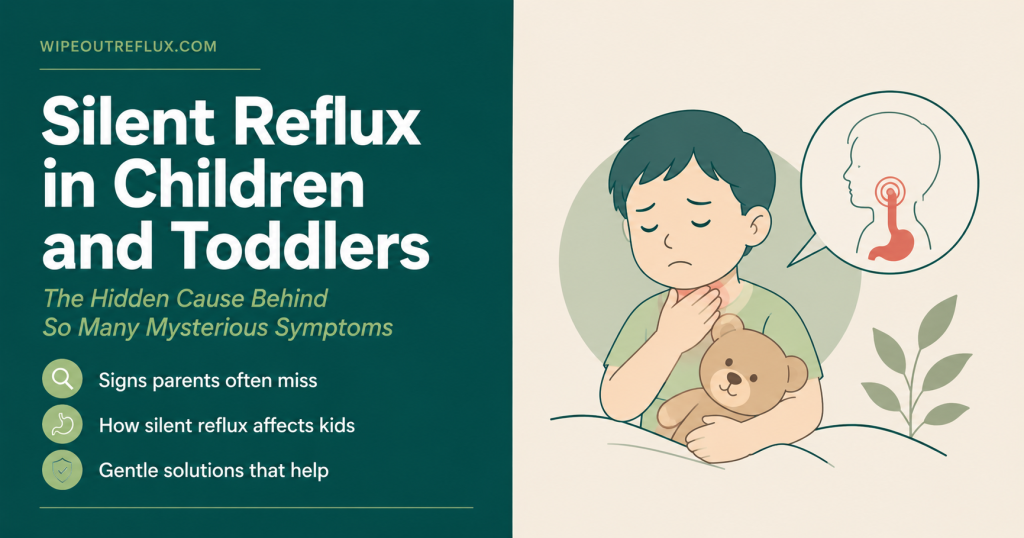
Silent reflux in children — laryngopharyngeal reflux, or LPR — happens when stomach contents travel up and reach the throat, voice box and airway rather than causing the obvious spitting up or heartburn most parents expect. Because there’s often no visible vomiting, it’s easy to miss, which is exactly why it’s called “silent.”
The tell-tale signs in babies and toddlers tend to be a chronic cough, a hoarse or raspy cry, frequent throat clearing, congestion or noisy breathing, difficulty feeding, and disrupted sleep. Unlike classic reflux, these symptoms point upward — to the throat and airway — instead of the chest and tummy.
Here’s the most important thing I can tell you up front: I write about reflux from years of managing my own LPR as an adult, but a child is not a small adult. Reflux in children needs to be assessed by a paediatrician or GP, not self-diagnosed or self-treated. This article will help you recognise the signs and understand what’s happening, so you can have a more informed conversation with your child’s doctor — it is not a substitute for that visit.
Key Takeaways
- Silent reflux (LPR) in children means stomach contents reach the throat and airway without the obvious spitting up or heartburn of typical reflux — so the signs are easy to overlook.
- Common signs include chronic cough, hoarse cry or voice, frequent throat clearing, noisy or congested breathing, feeding refusal or arching, and poor sleep.
- Some reflux is completely normal in babies. Most infants “spit up,” and the majority outgrow it — around 90% by their first birthday [Rosen et al., JPGN, 2018].
- Reflux only becomes reflux disease (GERD) when it causes troublesome symptoms or complications — poor weight gain, feeding difficulty, breathing problems, or distress.
- Certain “red flag” symptoms need urgent medical attention: I’ve listed them below, and they always mean a doctor, not a home remedy.
- A child with suspected silent reflux should always be assessed by a GP or paediatrician. Do not start any medication, supplement, or elimination diet without medical guidance.
What Is Silent Reflux in Children?
To understand silent reflux, it helps to separate a few terms that often get muddled.
Gastroesophageal reflux (GER) is simply the backward flow of stomach contents into the oesophagus. In babies this is extremely common and usually harmless — it’s why they spit up. GER disease (GERD) is when that reflux starts causing troublesome symptoms or complications. And laryngopharyngeal reflux (LPR) — silent reflux — is when the refluxed material travels higher, past the upper oesophagus, and reaches the larynx (voice box) and throat.
The reason LPR is “silent” is that it often bypasses the classic signs. There may be no heartburn a child can describe, and no dramatic vomiting a parent can see. Instead, the damage shows up in the throat and airway as coughing, hoarseness, congestion and irritation. The throat and larynx are far more sensitive to stomach contents than the oesophagus is, so even small amounts of reflux — and even weakly acidic reflux — can cause noticeable symptoms.
In fact, studies using specialised probes in children have found that a large proportion of reflux reaching the throat is only weakly acidic rather than strongly acidic, which is one reason acid-suppressing medicines don’t always help and why diagnosis is genuinely difficult in this age group [Lechien et al., Journal of Clinical Medicine, 2023].
If you’d like the fuller adult picture of how LPR differs from ordinary reflux, my guides on GERD vs LPR and LPR symptoms explain the mechanism in more depth — just keep in mind those are written for adults.
Signs and Symptoms of Silent Reflux in Babies and Toddlers
Because babies and young toddlers can’t tell you what they feel, you’re reading behaviour and physical signs. The symptoms differ a little by age.
In babies (0–12 months)
- Chronic cough or a persistent “wet” sound in the throat
- Hoarse or raspy cry
- Frequent congestion or noisy, rattly breathing not explained by a cold
- Gagging, choking, or frequent swallowing
- Feeding difficulties — pulling off the breast or bottle, arching the back, crying during or after feeds
- Frequent hiccups
- Difficulty settling and disrupted, restless sleep
- Recurrent ear infections
In toddlers
- Ongoing cough or throat clearing, especially at night or first thing in the morning
- Hoarse voice
- Complaints of a sore throat or a “lump” feeling, or refusing certain foods
- Bad breath
- Difficulty swallowing or a sensation of food sticking
- Recurrent respiratory symptoms — wheezing, or repeated chest and throat infections
- Disrupted sleep or reluctance to lie flat
None of these signs is unique to reflux on its own — a cough can be a cold, hoarseness can be from crying, congestion can be allergies. What raises the suspicion of silent reflux is a cluster of these symptoms that persists and doesn’t fit an obvious cause. That’s the pattern to bring to your doctor.
Is Some Reflux Normal? Yes — and This Matters
It’s genuinely important not to over-worry. Reflux is a normal part of infancy. The valve between the stomach and oesophagus is still developing, babies spend a lot of time lying down, and their diet is entirely liquid — all of which make some reflux almost inevitable. Around half of all babies regurgitate regularly in the early months.
The reassuring part is that the vast majority grow out of it. As the muscles mature, babies sit up, and solids are introduced, symptoms typically fade — with roughly 90% of infants resolving their visible reflux by around 12 months of age [Rosen et al., JPGN, 2018]. A large birth-cohort study that followed children for nine years found that most infant “spilling” was self-limiting and didn’t predict lasting problems [Martin et al., Pediatrics, 2002].
So the question is not really “does my child have any reflux?” — many do. It’s “is the reflux troubling my child?” That distinction is what separates normal physiology from something that needs treatment, and it’s a judgement a clinician is best placed to make.
Red Flags: When to Seek Medical Help Urgently
Some symptoms are not consistent with simple reflux and can signal a more serious problem. If your child shows any of the following, contact a doctor promptly — and for the breathing-related ones, seek emergency care:
- Poor weight gain, weight loss, or failure to thrive
- Forceful or projectile vomiting
- Vomit that is green or yellow (bile), or that contains blood
- Blood in the stool
- Difficulty breathing, pauses in breathing, or turning blue
- Choking, gagging, or apparent pain that stops your child feeding
- Persistent, forceful refusal to feed leading to dehydration
- Fever alongside the reflux symptoms
- Onset of vomiting after 6 months of age, or symptoms that begin or worsen suddenly
- Extreme irritability, back-arching in obvious distress, or a bulging soft spot
These are the kinds of “warning” symptoms that paediatric guidelines flag as needing further investigation rather than watchful waiting, because they can point to conditions other than reflux [Rosen et al., JPGN, 2018]. When in doubt, get your child seen — it is always the right call.
How Silent Reflux Is Diagnosed in Children
There’s no simple at-home test for silent reflux, and honestly, diagnosis in children is difficult even for specialists — the symptoms are non-specific and overlap with many other conditions. A doctor will usually start with a careful history and physical examination, and often that’s enough to make a working diagnosis and begin conservative management.
If symptoms are severe, persistent, or there are red flags, a paediatrician or paediatric gastroenterologist may consider further tests, which can include:
- Laryngoscopy — an ENT specialist looking at the voice box and throat for signs of irritation.
- pH-impedance monitoring — a probe that measures both acidic and non-acidic reflux over 24 hours; considered the most informative test, though not always well tolerated by young children.
- Upper endoscopy — to look at the oesophagus directly and rule out other causes.
Notably, paediatric guidelines specifically advise against diagnosing reflux using salivary pepsin tests or other biomarkers in children, because they’re not reliable enough in this population — a contrast with some adult approaches [Rosen et al., JPGN, 2018]. It’s another reason this is firmly a job for a clinician rather than home assessment.
How Silent Reflux in Children Is Managed
The overwhelming first-line approach for children is non-medication measures, and reputable guidelines are deliberately cautious about acid-suppressing drugs in this age group — particularly for airway and throat symptoms, where the evidence that medication helps is weak and the drugs carry their own risks [Rosen et al., JPGN, 2018].
I want to be clear that everything below should be done with your doctor’s input, not instead of seeing them. But these are the kinds of conservative steps a clinician commonly recommends:
For babies
- Smaller, more frequent feeds. Overfilling the stomach makes reflux more likely; smaller volumes more often can help.
- Frequent burping during and after feeds.
- Keeping baby upright for 20–30 minutes after feeding.
- Thickened feeds or a feed change, if your doctor advises — a trial of a cow’s-milk-protein-free diet (for the breastfeeding mother, or via a hydrolysed formula) is sometimes recommended, because cow’s-milk allergy can mimic reflux.
- Safe sleep always comes first. Do not use wedges, elevated sleepers, or positioners for babies. Current safe-sleep guidance is that infants sleep flat on their back, and inclined sleep products have been linked to serious safety risks. This is a crucial difference from adults, where a wedge pillow is a standard reflux measure.
For toddlers
- Avoid meals close to bedtime — leaving a gap between the last meal and lying down.
- Smaller portions and a calm, unhurried pace at meals.
- Identifying trigger foods with your doctor’s guidance — but never impose a restrictive elimination diet on a growing child without professional supervision, as nutrition and growth take priority.
- For older toddlers in a bed, gentle head-of-bed elevation may be discussed with your doctor — but this is not something to improvise for a child still in a cot.
If conservative measures aren’t enough and symptoms are significant, a doctor may consider a time-limited trial of medication and monitor the response closely. That decision belongs with the prescriber.
A Note for Parents Who Have Reflux Themselves
Reflux does tend to run in families, and many parents who find this site are managing their own LPR while noticing similar signs in their child. If that’s you, your personal experience is genuinely useful — you know what the symptoms feel like and you’ll spot patterns early. But please resist the temptation to apply your own regime to your child. The low-acid diet, alginates, and other tools I write about for adults are calibrated for adult bodies and adult diagnoses. Children’s nutrition, growth and safety change the equation completely. Use your experience to advocate for your child with their doctor, not to treat them at home.
Conclusion
Silent reflux in children is easy to miss precisely because it doesn’t announce itself the way ordinary reflux does. When stomach contents reach the throat and airway rather than causing spit-up or heartburn, the result is a puzzling cluster of coughing, hoarseness, congestion, feeding trouble and broken sleep — symptoms that are easy to attribute to colds or teething. If you’re seeing several of these together and they aren’t going away, silent reflux is worth raising with your child’s doctor.
At the same time, it’s worth holding onto the reassuring reality: some reflux is completely normal in babies, and most children grow out of it without any lasting problems. The goal isn’t to eliminate every trace of reflux — it’s to make sure your child is comfortable, feeding well, growing well, and sleeping. When those things are on track, watchful waiting with simple conservative measures is often all that’s needed.
The single most important step is to have your child properly assessed. A GP or paediatrician can distinguish normal infant reflux from something that needs treatment, rule out the more serious conditions that can mimic reflux, and guide any changes safely. Please treat everything here as background to inform that conversation, not a replacement for it — and never start medication, supplements, or restrictive diets for a child without medical guidance.
If you’re managing your own reflux alongside caring for your child and want to understand the condition better for yourself, the Wipeout Diet Plan is the complete system I built from my own recovery — it’s designed for adults, and it explains the mechanisms behind LPR in a way that may help you make sense of what you’re seeing. The Wipeout Food Reference Guide is an essential companion for your own diet too, covering the foods and drinks allowed for acid reflux and LPR along with their pH values. For your child, though, your child’s doctor is the guide to follow.
Frequently Asked Questions
How do I know if my baby has silent reflux and not just a cold?
A cold usually comes with a fever, resolves within a week or two, and often affects others in the household. Silent reflux symptoms — chronic cough, hoarseness, congestion, feeding fuss — tend to persist for weeks, recur, or cluster together without an obvious infection. If congestion and cough drag on with no clear cause, or feeding is consistently distressed, ask your doctor to consider reflux.
Can silent reflux in children go away on its own?
Often, yes. Reflux is very common in infancy and the large majority of babies outgrow it as the muscles mature and they start sitting up and eating solids — around 90% by their first birthday. That’s a key reason doctors favour conservative measures and watchful waiting before medication for most children.
Is it safe to raise the head of my baby’s cot for reflux?
No. This is one of the most important differences between children and adults. Current safe-sleep guidance is that babies sleep flat on their backs, and inclined sleepers, wedges and positioners have been linked to serious safety risks. Never elevate a baby’s sleep surface or use a positioning device without explicit medical instruction. For adults, a wedge pillow is standard; for infants, it isn’t.
What foods should I cut out for a toddler with silent reflux?
Don’t put a young child on a restrictive diet without professional guidance — growth and nutrition come first. Some children are sensitive to cow’s-milk protein, which can mimic reflux, and your doctor may suggest a supervised trial. Beyond that, a clinician or paediatric dietitian can help you identify genuine triggers safely rather than cutting out food groups on guesswork.
Does my child need medication for silent reflux?
Usually not as a first step. Paediatric guidelines are cautious about acid-suppressing medicines in children, especially for throat and airway symptoms where the evidence of benefit is limited. Medication may be considered for a time-limited trial if conservative measures fail and symptoms are significant — but that’s a decision for the prescribing doctor, who will monitor the response.
My other child had reflux — is it likely this one does too?
Reflux does have a familial tendency, so it’s reasonable to be alert to it. That said, each child is different, and the presence of reflux in a sibling isn’t a diagnosis. Bring your family history to your doctor — it’s useful context — but let the assessment be based on this child’s own symptoms.
When should I take my child to A&E rather than wait for the GP?
Seek emergency care for any breathing difficulty, pauses in breathing or blue colour, choking, green or bloody vomit, blood in the stool, signs of dehydration, or a child who seems seriously unwell. These aren’t features of simple reflux and need urgent assessment. When you’re unsure, err on the side of being seen.
Research Sources
- [Rosen et al., JPGN, 2018] — The joint NASPGHAN-ESPGHAN pediatric reflux clinical practice guideline; establishes that most infant reflux resolves by 12 months, defines red-flag warning symptoms, prioritises non-pharmacological management, and advises against salivary pepsin testing for diagnosis in children.
- [Martin et al., Pediatrics, 2002] — A prospective birth-cohort study following children to nine years of age, finding that infant “spilling” is largely self-limiting and that early regurgitation is common and usually resolves.
- [Lechien et al., Journal of Clinical Medicine, 2023] — An evidence-based review of pediatric laryngopharyngeal reflux covering its non-specific symptoms, the predominance of weakly acidic reflux, and the diagnostic challenge in infants and children.

David Gray
12 years living with LPR · Consultant & researcher
I've lived with LPR for twelve years — the misdiagnoses, the PPI courses that did nothing, the slow work of figuring out what actually helps. Wipeout Reflux is where I translate the research into plain terms for people stuck in the same place. Every claim here is sourced to peer-reviewed work, and I consult one-to-one with LPR sufferers.