
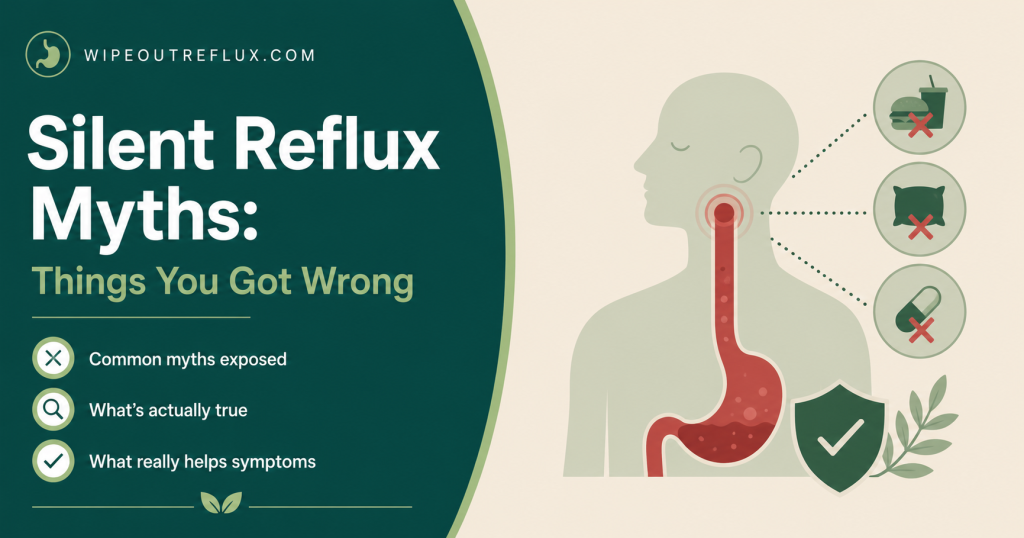
Silent reflux is probably the most misunderstood condition I write about. It gets confused with GERD, dismissed as allergies, treated with drugs that often don’t touch it, and explained with a model of “too much acid” that the research moved past years ago.
That matters, because most of the myths below don’t just cause confusion — they cause months of wasted time. People stay on medication that isn’t working, ignore the one intervention that has the strongest evidence behind it, or conclude they don’t have reflux at all because a test came back clean.
Here are the thirteen things people most often get wrong about silent reflux, and what the evidence actually says. Some of these will be familiar. A few will probably surprise you — number 8 in particular contradicts advice you’ve almost certainly been given.
Key Takeaways
- “Silent” means silent of heartburn — not silent of symptoms. LPR is loud, just in the throat rather than the chest.
- In pH-documented LPR patients, 60% had no heartburn at all and 81% had a completely normal esophageal lining.
- Pepsin, not acid alone, does most of the damage — and it can injure throat tissue even when the reflux isn’t acidic.
- PPI evidence in LPR is genuinely mixed, and even favourable meta-analyses show no improvement in objective laryngeal findings versus placebo.
- Most hypopharyngeal reflux events happen during the day while upright, not overnight — which undercuts a lot of standard advice.
- Diet isn’t a minor add-on: a plant-based Mediterranean approach matched or beat PPIs in a direct comparison.
- Food acidity matters in LPR in a way it doesn’t in GERD, because acid reactivates pepsin already sitting in your throat tissue.
- Alkaline water isn’t marketing nonsense — pH 8.8 water irreversibly denatures pepsin in the lab — but it’s an adjunct, not a treatment.
- Recovery is measured in months, not weeks. Expecting results in a fortnight is the most common reason people give up too early.
Myth 1: “Silent reflux means you don’t really have symptoms”
The truth: “Silent” refers to the absence of heartburn, not the absence of symptoms. People with LPR often have a long and miserable list: chronic throat clearing, hoarseness, a persistent lump sensation, postnasal drip, excess mucus, a chronic cough, sore throat, difficulty swallowing, and a voice that tires quickly.
The condition is silent only in the sense that the reflux passes through the esophagus without announcing itself in the chest. It’s anything but silent once it reaches the larynx. If you want the full list, I’ve covered it in detail in LPR symptoms.
Part of what makes it confusing is that you generally can’t feel the reflux events themselves. Hypopharyngeal reflux events are frequently gaseous and weakly acidic rather than the liquid, burning kind, so there’s often nothing to notice in the moment — only the accumulating irritation afterwards.
Myth 2: “If you don’t get heartburn, you don’t have reflux”
The truth: This is the single most common reason silent reflux goes undiagnosed for years, and the data on it is unambiguous. In a study of patients with pH-documented laryngopharyngeal reflux, 60% reported no heartburn whatsoever Koufman et al., The Laryngoscope, 2002.
Stomach contents can travel the full length of the esophagus and reach the larynx without causing symptoms — or injury — in transit. The esophagus is built to handle occasional acid exposure. The larynx isn’t. So the tissue that gets damaged is the one at the far end, and the tissue in the middle that would normally produce heartburn stays comfortable.
Waiting for heartburn before considering reflux means most people with LPR would never be considered at all.
Myth 3: “A normal endoscopy rules it out”
The truth: A clear endoscopy is expected in LPR, not reassuring against it. In the same study, 81% of patients with pH-documented LPR had entirely normal esophageal epithelium — no esophagitis, no Barrett’s, nothing Koufman et al., The Laryngoscope, 2002.
An endoscopy looks at the esophagus and stomach. LPR damages the larynx. It’s the wrong instrument pointed at the wrong place. Being told “your scope was clean, so it isn’t reflux” is one of the most common dead ends people hit, and it’s simply not what a clean scope means.
The tests that are actually informative are laryngoscopy, a salivary pepsin test like the Peptest, or oropharyngeal pH monitoring such as Restech.
Myth 4: “Silent reflux is just GERD that’s reached the throat”
The truth: They overlap, but they behave differently enough that treating LPR as “GERD, but higher up” is why so many people get nowhere. The patterns, mechanisms and manifestations genuinely differ, which was the central conclusion of the research above.
The practical differences: GERD is mostly a nighttime, supine, acidic problem; LPR events are more often daytime, upright, gaseous and weakly acidic. GERD damage needs sustained acid exposure; laryngeal tissue is far more fragile and lacks the clearance mechanisms and mucosal defences the esophagus has, so it takes much less exposure to cause trouble. And the drugs that reliably heal esophagitis frequently do very little for a hoarse voice.
I’ve broken the comparison down properly in GERD vs LPR, and the full picture is in the complete guide to LPR.
Myth 5: “It’s caused by too much stomach acid”
The truth: Acid is involved, but it’s largely the delivery vehicle. The agent doing the damage is pepsin — the digestive enzyme that comes up with the refluxate, lands on laryngeal tissue, and stays there.
This is the finding that reframes the whole condition. Human pepsin remains enzymatically active at a pH as high as 6.5, is stable at neutral pH, and isn’t irreversibly inactivated until around pH 8 Johnston et al., The Laryngoscope, 2007. Since the larynx sits at roughly pH 6.8, pepsin deposited there doesn’t wash away or break down. It sits dormant, waiting for the next drop in pH to switch it back on.
That’s why the “too much acid” model fails to explain LPR, and why suppressing acid production alone doesn’t remove the problem. More on the practical implications in how to neutralize pepsin in the throat.
Myth 6: “If the reflux isn’t acidic, it can’t do any damage”
The truth: Non-acid reflux is not harmless reflux. Pepsin in a non-acidic refluxate can still damage hypopharyngeal epithelial cells — researchers demonstrated that pepsin is taken up into laryngeal cells by receptor-mediated endocytosis, causing mitochondrial and Golgi damage even at neutral pH Johnston et al., Annals of Otology, Rhinology & Laryngology, 2009.
This matters practically. It explains why people on maximum acid suppression can still have active symptoms — the medication changes the pH of the refluxate but doesn’t stop the refluxate, and the pepsin is still arriving. Reducing the number of reflux events matters as much as reducing their acidity.
Myth 7: “PPIs are the treatment — and if they don’t work, it wasn’t reflux”
The truth: Both halves of this are wrong, and the second half causes real harm.
On the first: the evidence for PPIs in LPR is genuinely mixed, which is unusual for a first-line treatment. Meta-analyses of randomised controlled trials have found PPIs improve reflux symptom scores compared with placebo — but crucially show no advantage over placebo in the reflux finding score, the objective measure of what the larynx actually looks like Guo et al., Journal of Clinical Gastroenterology, 2016. Other meta-analyses have reached similarly equivocal conclusions Wei, European Archives of Oto-Rhino-Laryngology, 2016. Given the mechanism — pepsin doing damage regardless of pH — that’s not surprising.
On the second: PPI failure is so common in LPR that it has its own label in the literature, “recalcitrant” LPR, and dedicated research into what to do about it. Not responding to acid suppression is characteristic of the condition, not evidence against it. If that’s where you are, when acid reflux medication isn’t working is the place to start, and if you’re planning to come off them, do it carefully — see getting off PPIs and acid rebound.
Myth 8: “Silent reflux is mainly a nighttime problem”
The truth: This is the one that surprises most people, because it contradicts standard reflux advice. When researchers reviewed hypopharyngeal-esophageal impedance-pH monitoring in LPR patients, they found that reflux events reaching the throat occurred predominantly during the daytime and in the upright position — a pattern the authors noted does not support the routine use of double-dose PPIs or bedtime alginate Lechien et al., Journal of Clinical Medicine, 2022.
That’s close to the opposite of the GERD pattern, where lying down is the main risk period. It doesn’t mean nighttime measures are pointless — raising the head of the bed and leaving a long gap before lying down are still worth doing, and plenty of people do have overnight symptoms (see acid reflux at night). But if you’ve been focusing entirely on bedtime while eating and drinking whatever you like during the day, you’ve likely been aiming at the wrong window.
Myth 9: “Diet is a minor add-on to the real treatment”
The truth: Diet has arguably the strongest evidence of anything in LPR management. In a direct comparison, patients treated with a 90–95% whole-food, plant-based, Mediterranean-style diet plus alkaline water did at least as well as those on PPI therapy — 62.6% achieved a six-point reduction in their Reflux Symptom Index, versus 54.1% on medication Zalvan et al., JAMA Otolaryngology–Head & Neck Surgery, 2017.
A dietary approach outperforming the standard drug isn’t a small finding, and it’s the reason I put so much weight on food here rather than treating it as supportive advice around a prescription. If you want the practical version, start with the LPR diet or the Koufman diet.
Myth 10: “Only fatty and spicy foods matter”
The truth: That’s GERD advice applied to a condition it doesn’t fit. Fat and spice do matter, but in LPR the acidity of what you eat and drink is a separate and arguably bigger lever — because dietary acid reactivates the pepsin already sitting in your throat tissue.
This is exactly what a strict low-acid diet tests, and it works: avoiding anything below roughly pH 5 produced meaningful improvement in patients whose LPR had failed to respond to twice-daily PPIs plus a bedtime H2 blocker Koufman, Annals of Otology, Rhinology & Laryngology, 2011.
Which is why “healthy” foods trip so many people up. Lemon water, citrus, most berries, tomato, vinegar dressings, kombucha, sparkling water, wine, and a huge range of packaged foods containing citric acid are all well below that threshold. This is the single hardest part of LPR to navigate by instinct, because acidity isn’t something you can reliably taste. It’s the reason I put together the Wipeout Food Reference Guide — the essential reference for which foods and drinks are safe for acid reflux and LPR along with their actual pH values, so you’re working from numbers rather than guesswork. The foods to eat and foods to avoid lists cover the basics.
Myth 11: “Alkaline water is just marketing”
The truth: Alkaline water attracts a lot of deserved scepticism, most of which is aimed at wild claims about “alkalising the body.” Those claims are nonsense. But there’s a specific, narrow, well-evidenced reason it’s relevant to LPR that has nothing to do with body pH.
Water at pH 8.8 instantly and irreversibly denatures human pepsin in vitro, rendering it permanently inactive — and has substantially better acid-buffering capacity than ordinary water Koufman & Johnston, Annals of Otology, Rhinology & Laryngology, 2012. Given that pepsin sitting in throat tissue is the core problem in LPR, something that deactivates it on contact is worth knowing about.
Two honest caveats: that was a laboratory study, not a clinical trial, and the pH matters — ordinary bottled “alkaline” water at pH 8 doesn’t do the same thing. It’s a useful adjunct, not a treatment. I’ve covered where it does and doesn’t help in alkaline water for LPR.
Myth 12: “It’s really just allergies, post-nasal drip, or a virus that hung around”
The truth: These conditions look almost identical from the outside, which is why LPR is so often misdiagnosed as one of them — frequently for years. Chronic throat clearing, mucus, a cough and a scratchy throat are the shared final pathway of several different problems.
The tell is usually the pattern rather than the symptom. Reflux-driven symptoms tend to be worse after meals, worse with acidic foods and drinks, worse on waking, and don’t respond to antihistamines or nasal steroids. Allergy symptoms tend to be seasonal, come with itching and sneezing, and do respond to antihistamines. And plenty of people have both at once, which muddies things further.
It’s the same story with the respiratory overlaps — reflux is regularly misdiagnosed as asthma, and mistaken for post-nasal drip and sinus congestion. If treatment for the supposed condition hasn’t worked, that’s a strong hint the diagnosis is wrong.
Myth 13: “A couple of weeks of eating well should sort it out”
The truth: This is the expectation that causes most people to quit just before things start working. Laryngeal tissue heals slowly, and it’s being re-exposed constantly. Meaningful improvement typically takes two to three months of consistency, and full resolution can take six.
Two weeks of a clean diet often produces almost nothing measurable, which feels like proof it isn’t working. It isn’t — it’s just too early. Worse, the intermittent approach that follows (“I was good for a week, then had a bad weekend”) never gives the tissue an uninterrupted stretch to recover, so people can spend a year in a cycle that never quite works.
The practical answer is to track it properly. Score your main symptoms out of five each day and look at the monthly trend rather than the daily noise. I’ve written about realistic timelines in how long an acid reflux sore throat takes to heal, and about what a full recovery actually looked like in how I cured my silent reflux.
The Bottom Line
Almost every myth on this list traces back to the same root error: treating silent reflux as a variant of heartburn. It isn’t. The damage is done by pepsin rather than acid alone, it happens in tissue that has none of the esophagus’s defences, it shows up mostly during the day rather than at night, and it doesn’t reliably respond to the drugs that fix esophagitis. Once you understand that, the pieces that seemed contradictory — a clean endoscopy, no heartburn, PPIs that don’t help, symptoms that flare after a “healthy” lemon water — all start making sense at once.
The other consistent thread is that food does more of the work here than most people expect, and that acidity specifically is the variable people get wrong. That’s the gap the Wipeout Food Reference Guide exists to fill — the essential list of which foods and drinks are safe for acid reflux and LPR along with their pH values, so you can stop guessing at labels and start making decisions from actual numbers.
And if you’d rather have the whole system than a myth-by-myth correction, the Wipeout Diet Plan is the deeper, step-by-step version — what to eat, in what order, over what timeframe, and how to rebuild tolerance instead of avoiding everything forever. It’s built above all for LPR and silent reflux, since that’s the form that most often defeats standard treatment, but it works on the same underlying mechanisms that drive GERD and ordinary heartburn, so it does just as much for those. Either way, the first step is the same: stop treating silent reflux as heartburn that took a wrong turn.
Frequently Asked Questions
Can you have silent reflux without any symptoms at all?
Not really — “silent” means without heartburn, not without symptoms. Almost everyone with LPR has something: throat clearing, hoarseness, a lump sensation, mucus, a cough, or a sore throat. What’s genuinely silent is the reflux event itself, which you usually can’t feel because it’s often gaseous and weakly acidic rather than burning.
Why did my doctor say my endoscopy was normal if I have silent reflux?
Because a normal endoscopy is the expected finding in LPR. In pH-documented LPR patients, 81% had entirely normal esophageal tissue. The endoscopy examines your esophagus and stomach, but LPR damages the larynx — so a clean scope doesn’t rule it out. Laryngoscopy, salivary pepsin testing, or oropharyngeal pH monitoring are the relevant investigations.
Do PPIs work for silent reflux?
Sometimes, but far less reliably than for GERD. Meta-analyses show symptom scores improving versus placebo, while objective laryngeal findings do not. Failure to respond is common enough to have its own term in the literature. If PPIs haven’t helped, that’s characteristic of LPR rather than evidence you don’t have it.
Is silent reflux caused by too much stomach acid?
Not primarily. Pepsin is the main damaging agent — it lands on laryngeal tissue, stays active at pH levels well above what acid-suppressing drugs target, and can be reactivated by later acid exposure. This is why reducing acid production alone often doesn’t resolve symptoms, and why reducing dietary acid matters so much.
Is silent reflux worse at night?
Not usually, which surprises people. Impedance-pH studies show that reflux events reaching the throat happen predominantly during the day while upright — close to the opposite of the GERD pattern. Nighttime precautions still help many people, but daytime food and drink choices deserve at least as much attention.
Can silent reflux be cured with diet alone?
For a lot of people, yes — or close enough to it. In a head-to-head comparison, a plant-based Mediterranean-style diet with alkaline water performed at least as well as PPI therapy. Diet is not a supporting act in LPR; it’s the intervention with the strongest evidence behind it.
Does alkaline water actually help silent reflux?
It has a specific, evidence-backed role: water at pH 8.8 irreversibly denatures pepsin in laboratory testing and buffers acid better than ordinary water. That’s relevant because pepsin is the core problem. But it was an in vitro study, the pH threshold matters, and it’s an adjunct rather than a treatment on its own.
How long does silent reflux take to heal?
Longer than most people expect. Meaningful improvement usually takes two to three months of consistent changes, and full resolution can take around six. Two weeks rarely shows much, which is why so many people abandon an approach that was actually working. Track symptoms monthly rather than daily.
Can silent reflux be mistaken for allergies?
Very often, and for years at a time. The symptoms overlap almost completely. The distinguishing pattern is that reflux symptoms worsen after meals and with acidic food and drink and don’t respond to antihistamines, while allergy symptoms tend to be seasonal and involve itching and sneezing. Many people have both simultaneously.
Research & References
- Koufman et al., The Laryngoscope, 2002 — In patients with pH-documented laryngopharyngeal reflux, 60% had no heartburn and 81% had normal esophageal epithelium, establishing that LPR differs from classic GERD in its patterns, mechanisms and manifestations.
- Johnston et al., The Laryngoscope, 2007 — Human pepsin remains enzymatically active at a pH as high as 6.5, is stable at neutral pH, and is not irreversibly inactivated until around pH 8, meaning pepsin in laryngeal tissue can be reactivated by later acid exposure.
- Johnston et al., Annals of Otology, Rhinology & Laryngology, 2009 — Pepsin in non-acidic refluxate damaged hypopharyngeal epithelial cells via receptor-mediated endocytosis, producing mitochondrial and Golgi damage at neutral pH.
- Guo et al., Journal of Clinical Gastroenterology, 2016 — Meta-analysis of randomised controlled trials finding PPI therapy improved reflux symptom scores versus placebo in LPR, but showed no advantage over placebo in the objective reflux finding score.
- Wei, European Archives of Oto-Rhino-Laryngology, 2016 — Further meta-analysis of PPI therapy in laryngopharyngeal reflux, reporting improvement in symptom response but continuing uncertainty about clinical benefit given heterogeneity between trials.
- Lechien et al., Journal of Clinical Medicine, 2022 — Review of hypopharyngeal-esophageal impedance-pH monitoring in LPR, finding that reflux events reaching the throat are predominantly daytime, upright, gaseous and weakly or non-acidic, which does not support routine double-dose PPIs or bedtime alginate.
- Zalvan et al., JAMA Otolaryngology–Head & Neck Surgery, 2017 — A plant-based, Mediterranean-style diet with alkaline water performed at least as well as PPI therapy for LPR, with 62.6% of the diet group achieving a six-point Reflux Symptom Index reduction versus 54.1% on medication.
- Koufman, Annals of Otology, Rhinology & Laryngology, 2011 — A strict low-acid diet avoiding foods and drinks below roughly pH 5 produced meaningful improvement in patients with laryngopharyngeal reflux that had not responded to acid-suppressing medication.
- Koufman & Johnston, Annals of Otology, Rhinology & Laryngology, 2012 — Water at pH 8.8 instantly and irreversibly denatured human pepsin in vitro and showed acid-buffering capacity far exceeding conventional-pH waters, suggesting a possible adjunctive role in reflux treatment.
- Koufman, The Laryngoscope, 1991 — Landmark investigation of 225 patients using ambulatory 24-hour pH monitoring alongside experimental work establishing the combined role of acid and pepsin in laryngeal injury.

David Gray
12 years living with LPR · Consultant & researcher
I've lived with LPR for twelve years — the misdiagnoses, the PPI courses that did nothing, the slow work of figuring out what actually helps. Wipeout Reflux is where I translate the research into plain terms for people stuck in the same place. Every claim here is sourced to peer-reviewed work, and I consult one-to-one with LPR sufferers.