
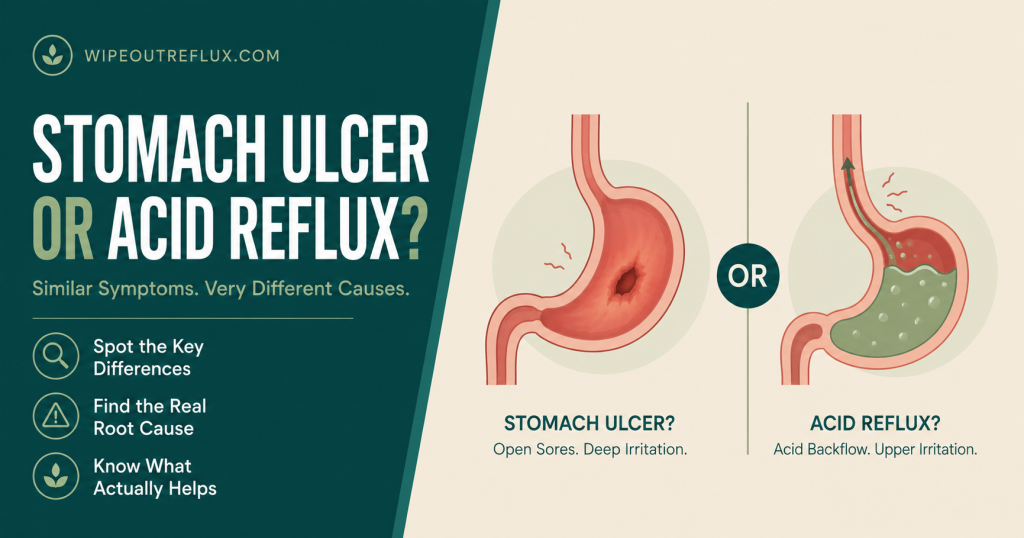
The short answer: a stomach ulcer is an open sore in the stomach or duodenal lining, so the pain sits in the upper abdomen and often has a relationship with food — classically worse when the stomach is empty, briefly eased by eating, and prone to waking you in the early hours. Acid reflux is stomach contents travelling upward, so the burn sits behind the breastbone, rises towards the throat, and gets worse when you lie down or bend forward.
Two features belong to reflux and never to an ulcer: position-dependence and throat involvement. If lying flat reliably makes it worse, or you have hoarseness, a lump sensation, constant throat clearing or a cough that won’t settle, you’re dealing with reflux.
But I want to be honest with you up front, because most articles on this aren’t. Symptom patterns point you in a direction; they do not give you an answer. When researchers tested whether clinical history could separate organic disease like ulcers from functional problems, neither experienced clinicians nor computer models managed it reliably. If an ulcer is genuinely on the table, that question gets settled by a test, not by a symptom checklist.
Key Takeaways
- An ulcer is a discrete break through the lining of the stomach or duodenum; reflux is a mechanical failure that lets stomach contents travel upward.
- Ulcer pain is upper-abdominal and food-related. Duodenal ulcers classically hurt on an empty stomach and ease with eating; gastric ulcers often hurt more after eating.
- Reflux burns behind the breastbone, rises, worsens lying flat, and brings a sour taste or regurgitation.
- Throat symptoms — hoarseness, throat clearing, lump sensation, chronic cough — are reflux, never ulcer.
- Clinical history alone cannot reliably separate organic from functional upper-gut disease; the positive likelihood ratio in one landmark analysis was only 1.6.
- Around 95% of duodenal ulcers and 70% of gastric ulcers are associated with Helicobacter pylori, and eradication drops the relapse rate from roughly 80% to about 5%.
- Feeling better on a PPI proves nothing about which condition you have — acid suppression heals ulcers and relieves reflux.
- Black tarry stools, vomiting blood or coffee-ground material, sudden severe abdominal pain, unexplained weight loss or difficulty swallowing need urgent medical assessment, not a diet plan.
What a stomach ulcer actually is
A peptic ulcer is a crater. Not inflammation, not irritation — an actual break that extends through the mucosa into the deeper layers of the wall. That’s what separates it from gastritis, which is diffuse inflammation of the lining, and it’s why ulcers can bleed and, rarely, perforate while gastritis generally doesn’t.
They occur in two places, and the location changes the symptom pattern:
- Gastric ulcer — in the stomach itself. Pain often comes on during or shortly after eating, because food stimulates acid production directly onto the ulcer. People with gastric ulcers sometimes start avoiding food and lose weight.
- Duodenal ulcer — in the first part of the small intestine, just past the stomach outlet. Pain classically arrives two to five hours after a meal, when the stomach has emptied acid into the duodenum with nothing to buffer it, and is eased for a while by eating or by an antacid. Night-time pain that wakes you between midnight and 3am is a strong duodenal pattern.
Two causes dominate. The first is Helicobacter pylori, a bacterium that colonises the stomach lining. Around 95% of duodenal ulcers and 70% of gastric ulcers are associated with it Ford et al., Cochrane Database of Systematic Reviews, 2016. It’s extraordinarily widespread — a meta-analysis of over 400,000 people across 73 countries put global prevalence at 44.3% Zamani et al., Alimentary Pharmacology & Therapeutics, 2018 — though the overwhelming majority of carriers never develop an ulcer.
The second is NSAIDs: ibuprofen, naproxen, diclofenac, aspirin. They block the prostaglandins that maintain the stomach’s mucus layer and blood supply. Alongside H. pylori, they account for the bulk of peptic ulceration, and as H. pylori rates fall worldwide, anti-inflammatory and anti-thrombotic drugs are taking over as the dominant cause Lanas and Chan, The Lancet, 2017. If you take anything from that list regularly, it belongs at the top of your list of suspects — and it’s worth reviewing the wider set of medications that make reflux and stomach symptoms worse.
What does not cause ulcers: stress and spicy food. Both can aggravate an ulcer that already exists, but the old story that worry burns a hole in your stomach was overturned decades ago. I’ve covered the fuller picture of what stress genuinely does to reflux and where spicy food actually fits elsewhere.
What acid reflux actually is
Reflux isn’t a wound — it’s a plumbing problem. The lower oesophageal sphincter should stay closed between swallows. When it relaxes at the wrong time, or stomach pressure overcomes it, contents travel back up into the oesophagus and sometimes as far as the throat.
What comes up isn’t only acid. It carries pepsin, the stomach’s protein-digesting enzyme, which is the main troublemaker when refluxate reaches the larynx. That’s the split between classic GERD, where damage shows up in the oesophagus, and LPR or silent reflux, where the throat takes the hit and there may be no heartburn whatsoever.
So the mechanisms are entirely different. An ulcer is local tissue damage in one spot. Reflux is a repeated transport failure. That difference is what generates the distinguishing symptoms.
The classic symptom patterns
Ulcer pattern
- Location: upper abdomen, in the midline between the breastbone and the navel — you can usually point to it with one finger
- Character: gnawing, burning, aching, sometimes described as hunger pain or a hollow rawness
- Timing: duodenal — two to five hours after eating, and often at night; gastric — during or soon after eating
- Food relationship: eating or an antacid may give thirty minutes to a couple of hours of genuine relief (duodenal), or reliably make it worse (gastric)
- Position: unchanged by lying down or standing up
- Company: nausea, bloating, early fullness, loss of appetite, sometimes weight loss
- Course: often comes in bouts — a few weeks of pain, then quiet for months
Reflux pattern
- Location: behind the breastbone, moving upward towards the throat
- Character: burning, hot, rising — heartburn in the literal sense
- Timing: 30–60 minutes after eating, in the evening, at night once you’re horizontal
- Food relationship: worse after large, fatty or late meals; eating does not relieve it
- Position: clearly worse lying flat or bending forward; better upright
- Company: sour or bitter taste, regurgitation, hoarseness, throat clearing, chronic cough, lump-in-throat sensation
- Course: tends to be a steady daily or near-daily pattern tied to meals and posture
Why those lists aren’t enough on their own
Here’s the part I think you deserve to hear, and the part most articles on this topic quietly leave out.
Researchers have specifically tested whether the clinical history can separate organic disease — ulcers, erosions, cancer — from functional problems in people with upper-gut symptoms. The answer was no. A clinician’s impression, or a computer model built from demographics, risk factors, history and symptoms, produced a positive likelihood ratio of just 1.6 for organic dyspepsia, and a negative result only pulled the likelihood down to 0.46. The conclusion was blunt: neither approach adequately distinguished organic from functional disease in patients referred for endoscopy Moayyedi et al., JAMA, 2006.
A likelihood ratio of 1.6 is close to useless. It means the classic ulcer story shifts the odds barely at all. Plenty of people with textbook night-waking hunger pain have a perfectly normal endoscopy, and plenty of people with an ulcer have vague, unimpressive symptoms or none at all.
It gets muddier still, because upper-abdominal symptoms and reflux symptoms travel together. In a meta-analysis of community populations, dyspepsia was present in 43.9% of people with weekly reflux symptoms, the two overlapped in 25.9% of individuals overall, and the odds of dyspepsia were almost sevenfold higher in people with reflux symptoms Eusebi et al., Clinical Gastroenterology and Hepatology, 2018. Having one doesn’t protect you from the other.
So use the symptom patterns to decide what to investigate and how urgently — not to close the case.
The clues that genuinely do point one way
With that caveat in place, a handful of features carry real weight, because they’re mechanistically impossible for the other condition to produce.
Position-dependence points to reflux. If your symptoms reliably worsen within minutes of lying flat and improve when you sit up, that’s gravity acting on a sphincter. An ulcer crater doesn’t care which way up you are. Raising the head of your bed is close to a free diagnostic test in this respect: if it helps, you have reflux.
Throat symptoms point to reflux. Hoarseness, a persistent need to clear your throat, a lump sensation, a dry nagging cough, post-nasal drip that shrugs off allergy treatment — these are LPR symptoms, caused by refluxate reaching the larynx. A stomach ulcer cannot reach your voice box.
Regurgitation points to reflux. Actual liquid or food arriving in your mouth or the back of your throat, especially when you bend or lie down, is a transport failure. Ulcers don’t do that.
Relief from eating points to an ulcer. This is the strongest ulcer-specific clue. If a glass of milk or a slice of bread reliably switches the pain off for an hour or two, that’s food buffering acid against a raw surface. Reflux does the opposite — eating usually starts a reflux episode. That said, if you’re getting burning when you haven’t eaten, it’s worth understanding why heartburn happens on an empty stomach, because reflux can do that too for different reasons.
Difficulty swallowing points away from both — or rather, it points to a complication. It can occur with severe reflux and stricture, but it always needs investigating rather than managing at home. I’ve written more on reflux and difficulty swallowing.
Why “it got better on omeprazole” proves nothing
This is the trap I see people fall into most often, and it deserves its own section.
Proton pump inhibitors suppress acid production. That heals ulcers, and it relieves reflux. So a good response to a PPI tells you that acid is involved in your symptoms — which was never in doubt — and nothing at all about which condition you have. Nor does it treat the cause of an ulcer, if that cause is H. pylori or an anti-inflammatory you’re still taking. It just holds the damage back while the underlying driver continues.
The other half of the trap is what happens when you stop. Acid rebound after PPI withdrawal produces symptoms in people who never had reflux to begin with, which can look convincingly like a relapse of whatever you thought you had. If you’re planning to come off, how to get off PPIs without acid rebound is worth reading first.
And if a proper trial of acid suppression doesn’t help, that’s genuinely informative — it’s a signal to investigate rather than to keep escalating the dose. That’s the situation I’ve written about in what to do when reflux medication isn’t working.
Red flags: do not sit on these
The reason it matters to take the ulcer possibility seriously is that ulcers have complications reflux does not. Seek urgent medical care for:
- Black, tarry, sticky stools — digested blood from an upper GI bleed
- Vomiting blood, or material that looks like coffee grounds
- Sudden, severe, unrelenting abdominal pain, especially with a rigid abdomen — possible perforation
- Feeling faint, dizzy or breathless alongside abdominal symptoms — possible blood loss
And book a non-urgent but prompt appointment for unintentional weight loss, persistent vomiting, difficulty swallowing or food sticking, unexplained anaemia, or new upper-abdominal symptoms starting later in life.
Separately: if chest pain arrives with sweating, breathlessness, or pain spreading to the jaw or arm, treat it as cardiac until proven otherwise. Telling heartburn from a heart attack is not a puzzle to solve at home.
How this actually gets sorted out
The pathway is more straightforward than most people expect, and it’s largely determined by your age and whether you have alarm features.
Current guidance recommends that people under 60 with dyspepsia have a non-invasive H. pylori test — a breath test or stool antigen test — and be treated if positive, rather than going straight to endoscopy. People 60 and over are advised to have an upper endoscopy to exclude organic pathology, and alarm features are considered case by case rather than automatically triggering a camera in younger patients Moayyedi et al., The American Journal of Gastroenterology, 2017.
For reflux, the approach is different again. For typical heartburn and regurgitation without alarm features, an eight-week trial of acid suppression is the reasonable first step, with endoscopy held back for alarm features or non-response Katz et al., The American Journal of Gastroenterology, 2022. And a normal endoscopy doesn’t exclude reflux — most people with reflux disease have a normal-looking oesophagus, which is why endoscopy for acid reflux so often comes back clear while symptoms continue. The full range of options is laid out in how acid reflux is diagnosed.
The practical takeaway: if there’s any real chance of an ulcer, get an H. pylori test. It’s cheap, non-invasive, and it’s the single test most likely to change your treatment.
Treatment diverges completely
This is where the distinction stops being academic.
An H. pylori-positive ulcer needs antibiotics, not acid suppression. The numbers here are dramatic. In the Cochrane review, people whose H. pylori was successfully eradicated had an ulcer relapse rate of around 5%, compared with roughly 80% in those healed on acid-suppressing H2 blockers alone Ford et al., Cochrane Database of Systematic Reviews, 2016. That is the difference between curing something and managing it indefinitely. If you’ve had recurring ulcer-type pain for years on a PPI and nobody has ever tested you, that’s the gap to close. The relationship between H. pylori and acid reflux is worth understanding too, since eradication can shift reflux symptoms in either direction.
An NSAID ulcer needs the NSAID stopped or changed. No amount of acid suppression outruns a drug that’s still stripping the stomach’s defences every day.
Reflux needs mechanics and timing. Suppressing acid alters what the refluxate contains; it doesn’t stop reflux happening. That’s precisely why PPIs so often fail for LPR — pepsin is still travelling up and still causing damage at higher pH. Meal size, meal timing, the gap before bed, bed elevation, waistband pressure and food choices are what actually move the needle.
That food side is where most people get stuck, because the advice online contradicts itself constantly. The Wipeout Food Reference Guide is the essential reference for it — which foods and drinks are genuinely safe with acid reflux and LPR, and their pH values, so you’re not guessing meal by meal.
What to do while you’re finding out
- Stop NSAIDs if you can. Speak to your doctor if you’re taking them for a reason, but this is the highest-yield single change for a suspected ulcer.
- Ask for an H. pylori test. Note that PPIs and antibiotics can cause false negatives, so it’s usually done after a gap off acid suppression — ask how long.
- Eat smaller, earlier meals. Smaller volumes reduce gastric pressure, which helps reflux, and avoid overloading an inflamed or ulcerated lining. Leave a proper gap before bed — see how long before bed you should stop eating.
- Cut alcohol and stop smoking. Smoking impairs ulcer healing and weakens the sphincter, and the link between smoking and reflux is one of the clearest in the literature. Alcohol irritates the lining directly.
- Raise the head of your bed. Useless for an ulcer, transformative for night reflux — which makes it quietly diagnostic.
- Be careful with supplements. Soothing options like DGL and zinc carnosine have a reasonable rationale for mucosal healing, but they are not a substitute for finding out whether you have H. pylori.
Conclusion
An ulcer is a sore in the stomach or duodenum, so it hurts in your upper abdomen and has a conversation with food — eased by it, or triggered by it, depending on where the ulcer sits. Reflux is contents escaping upward, so it burns behind the breastbone, rises, and gets worse the moment you lie flat. Position-dependence, regurgitation and throat symptoms are reflux. Genuine relief from eating is the strongest pointer to an ulcer.
But hold your conclusion loosely. The evidence is clear that symptom patterns alone don’t reliably separate organic disease from functional problems, and reflux and upper-abdominal symptoms overlap in around a quarter of people. If an ulcer is plausible — regular anti-inflammatories, night-waking pain, nausea, weight loss, or symptoms that keep coming back — the answer is an H. pylori test and a conversation with your doctor, not a longer prescription for the same PPI. Eradication takes the relapse rate from about 80% to about 5%, and no amount of acid suppression comes close to that.
Once the ulcer question is settled and reflux is what you’re left managing, the day-to-day work is food, timing and posture. The Wipeout Food Reference Guide is the essential place to start — the allowed foods and drinks for acid reflux and LPR with their pH values, so you can stop second-guessing every meal. If you’d rather follow a full system, the Wipeout Diet Plan goes a great deal deeper. It was designed first around LPR, the stubborn throat-based form, but since it works on the same underlying mechanisms it does the job just as well for GERD and everyday heartburn — and a calmer, lower-pressure stomach is exactly what a healing lining wants anyway.
Frequently Asked Questions
How do I know if I have a stomach ulcer or acid reflux?
Location and food relationship are the best starting points. Ulcer pain sits in the upper abdomen and often responds to eating — relieved by it with a duodenal ulcer, worsened by it with a gastric ulcer. Reflux burns behind the breastbone, rises towards the throat and worsens lying down. But symptoms alone aren’t conclusive, so if an ulcer is plausible, get tested for H. pylori.
Can a stomach ulcer cause heartburn?
Ulcer pain is sometimes described as burning, which people naturally call heartburn, and the two conditions frequently coexist. What an ulcer cannot do is produce a rising burn behind the breastbone, regurgitation, or throat symptoms. If those are present, reflux is part of your picture regardless of whether an ulcer is too.
Does eating make an ulcer better or worse?
It depends where the ulcer is. Duodenal ulcers typically feel better for thirty minutes to a couple of hours after eating, because food buffers acid. Gastric ulcers often feel worse during or shortly after a meal. Reflux, by contrast, is usually triggered by eating rather than relieved by it.
Can acid reflux cause a stomach ulcer?
No. Reflux damages the oesophagus and throat, not the stomach lining. Peptic ulcers are overwhelmingly caused by Helicobacter pylori and NSAIDs. Reflux can cause oesophageal ulceration in severe cases, but that’s a different lesion in a different place from a stomach ulcer.
Do I need an endoscopy to diagnose a stomach ulcer?
Endoscopy is the definitive test, but it isn’t always the first step. Guidance suggests that people under 60 with dyspepsia have a non-invasive H. pylori test and treatment if positive, with endoscopy recommended from age 60 or where alarm features warrant it. Alarm features at any age should prompt a medical review.
Will omeprazole heal a stomach ulcer?
It helps ulcers heal by removing acid from the equation, but it doesn’t address the cause. If H. pylori is present, eradication with antibiotics is what prevents recurrence — relapse rates are around 5% after successful eradication compared with roughly 80% with acid suppression alone. If NSAIDs are the cause, the drug has to change.
Can stress or spicy food cause an ulcer?
No. This is one of the most persistent myths in gut health. H. pylori and NSAIDs cause the overwhelming majority of peptic ulcers. Stress and spicy food can aggravate symptoms from an ulcer that already exists, but they don’t create one.
What are the warning signs of a bleeding ulcer?
Black tarry stools, vomiting blood or material resembling coffee grounds, sudden severe abdominal pain, or feeling faint, dizzy and breathless. These need emergency assessment, not a wait-and-see approach. Ulcers can bleed with little prior warning, particularly in people taking anti-inflammatories or blood thinners.
Research & References
- Rational Clinical Examination analysis concluding that neither clinician impression nor computer models incorporating demographics, risk factors, history and symptoms adequately distinguished organic from functional dyspepsia, with a positive likelihood ratio of 1.6 (95% CI 1.4–1.8) and a negative likelihood ratio of 0.46 (95% CI 0.38–0.55) Moayyedi et al., JAMA, 2006.
- Cochrane systematic review of eradication therapy in Helicobacter pylori-positive peptic ulcer disease, noting that around 95% of duodenal and 70% of gastric ulcers are associated with the infection, and that successful eradication reduced ulcer relapse to approximately 5% compared with about 80% in those healed on histamine-2 receptor antagonists Ford et al., Cochrane Database of Systematic Reviews, 2016.
- Review of peptic ulcer disease describing Helicobacter pylori and non-steroidal anti-inflammatory drugs as the dominant causes, with declining H. pylori prevalence and widespread anti-thrombotic use shifting the drivers of ulceration in ageing populations Lanas and Chan, The Lancet, 2017.
- Meta-analysis of 410,879 participants across 73 countries reporting a worldwide Helicobacter pylori prevalence of 44.3%, with 50.8% in developing countries and 34.7% in developed countries Zamani et al., Alimentary Pharmacology & Therapeutics, 2018.
- Systematic review and meta-analysis of community populations finding dyspepsia in 43.9% of individuals with weekly reflux symptoms, a pooled overlap of 25.9%, and almost sevenfold higher odds of dyspepsia in those with weekly reflux symptoms Eusebi et al., Clinical Gastroenterology and Hepatology, 2018.
- American College of Gastroenterology and Canadian Association of Gastroenterology guideline recommending non-invasive Helicobacter pylori testing and treatment for dyspeptic patients under 60, and upper gastrointestinal endoscopy from age 60 to exclude organic pathology Moayyedi et al., The American Journal of Gastroenterology, 2017.
- American College of Gastroenterology clinical guideline recommending an eight-week trial of acid suppression for typical reflux symptoms without alarm features, with endoscopy reserved for alarm features or non-response Katz et al., The American Journal of Gastroenterology, 2022.

David Gray
12 years living with LPR · Consultant & researcher
I've lived with LPR for twelve years — the misdiagnoses, the PPI courses that did nothing, the slow work of figuring out what actually helps. Wipeout Reflux is where I translate the research into plain terms for people stuck in the same place. Every claim here is sourced to peer-reviewed work, and I consult one-to-one with LPR sufferers.