
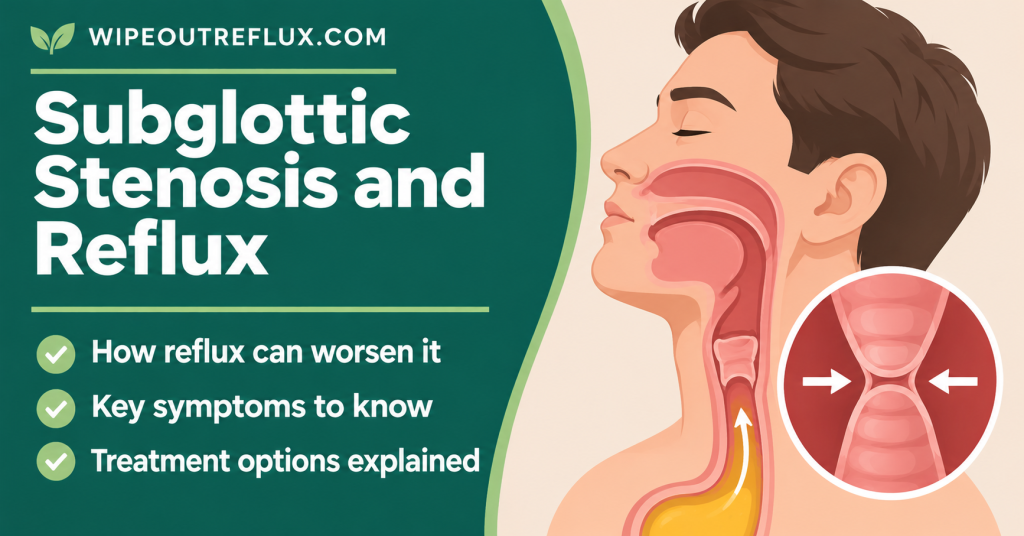
Subglottic stenosis is a narrowing of the airway just below the vocal cords, caused by scar tissue building up in the ring of cartilage there. The most common symptom is shortness of breath that gradually gets worse over months, often with noisy breathing, and it’s frequently mistaken for asthma at first.
Reflux is one of the leading suspects in subglottic stenosis, especially the “idiopathic” type that has no obvious cause and affects mostly women. Animal studies show stomach acid on an injured airway produces stenosis, pH monitoring finds reflux in a large share of patients, and pepsin, the stomach enzyme, has been found inside the scar tissue of women with idiopathic subglottic stenosis but not in normal airways.
Reflux isn’t proven to be the cause, and it’s probably one factor among several. But it’s one of the few factors you can actually do something about, which is why it’s worth understanding properly.
Key Takeaways
- Subglottic stenosis is scarring and narrowing of the airway just below the vocal cords.
- Common causes include previous breathing tubes or tracheostomy, injury, and inflammatory conditions, but many adult cases are idiopathic, meaning no clear cause is found.
- Idiopathic subglottic stenosis affects almost exclusively women, usually in middle age.
- In animal experiments, stomach acid applied to an injured airway caused stenosis, while the same injury healed normally without it.
- Around half or more of people with subglottic stenosis have abnormal reflux on testing in several studies.
- Pepsin was found in the airway scar tissue of 59% of women with idiopathic subglottic stenosis, and in none of the controls.
- Standard acid testing didn’t predict which patients had pepsin in their tissue, suggesting non-acid reflux may matter.
- Treating reflux may help reduce irritation and slow recurrence, but it’s an add-on to specialist airway care, not a replacement for it.
What Is Subglottic Stenosis?
Your voice box (larynx) sits at the top of your windpipe. The vocal cords are inside it, and the area just below them is called the subglottis. It’s surrounded by the cricoid cartilage, the only complete ring of cartilage in your airway. Because it’s a full, rigid ring, any swelling or scarring on the inside can only narrow the airway inward.
Subglottic stenosis is when scar tissue builds up in this area and narrows the opening. Since airflow depends heavily on the width of the airway, even a modest narrowing can make a big difference to how easily you can breathe.
Symptoms
- Shortness of breath that slowly gets worse over months or years, first with exercise and later with everyday activity
- Noisy breathing (stridor), especially when breathing in or exerting yourself
- A cough, or difficulty clearing mucus
- Feeling like you can’t get a full breath, or air hunger
- Breathing problems that don’t respond properly to asthma inhalers
- Sometimes voice changes, though the voice is often normal because the vocal cords themselves aren’t affected
Many people are treated for asthma for years before the real diagnosis is made. If your “asthma” isn’t responding to treatment, my article on acid reflux misdiagnosed as asthma is worth a read too.
Causes
- Breathing tubes and tracheostomy. The most common cause overall. A tube pressing on the subglottis can damage the lining and lead to scarring, especially after long intubations.
- Inflammatory and autoimmune conditions such as granulomatosis with polyangiitis (formerly Wegener’s), sarcoidosis and relapsing polychondritis.
- Injury from trauma or surgery.
- Congenital, where a baby is born with a narrow subglottis.
- Idiopathic subglottic stenosis (iSGS), where no cause is found. This is the type most linked to reflux in research.
Idiopathic Subglottic Stenosis: The Mystery Type
Idiopathic subglottic stenosis is unusual. It affects almost exclusively women, typically in their 30s to 50s, with no history of breathing tubes or autoimmune disease. In a large Mayo Clinic group of patients who had reflux testing, 97.6% were women, with an average age of about 55 [Fang et al., Gastroenterology Research and Practice, 2018].
Researchers have looked at hormones, the immune system, the local bacteria in the airway, and repeated low-grade injury from things like coughing. Reflux has been in the frame for decades, and the evidence for it is more interesting than most people realize.
The Evidence Linking Reflux to Subglottic Stenosis
1. Stomach acid turned a healing wound into a stenosis
The story starts with a patient whose subglottic stenosis kept coming back despite every treatment. When doctors found she was silently aspirating stomach acid into her larynx and treated the reflux with antacids and an H2 blocker, the stenosis resolved and she no longer needed her tracheostomy.
That case led the same team to run an animal experiment. They made small injuries in the subglottis of dogs. In the control animals, the injuries healed normally without narrowing. In the animals whose injuries were painted with gastric acid, subglottic stenosis developed, and when the cartilage was also damaged, the stenosis was even worse and came on faster [Little et al., Annals of Otology, Rhinology & Laryngology, 1985].
The takeaway is important. Acid didn’t create the injury, but it turned a wound that would have healed into one that scarred down and narrowed. That fits with the idea that reflux makes the airway much worse at healing from minor damage.
2. Reflux shows up on testing in a large share of patients
In Jamie Koufman’s landmark study of 225 ENT patients using 24-hour pH monitoring, 78% of the patients with laryngeal and tracheal stenosis had abnormal results [Koufman, The Laryngoscope, 1991].
More recently, the Mayo Clinic review of patients with idiopathic subglottic stenosis who had combined pH-impedance testing found close to half had reflux disease [Fang et al., Gastroenterology Research and Practice, 2018]. If you want to know more about that test, I explain it in pH-impedance testing.
3. Pepsin inside the scar tissue
This is the finding I think matters most. Researchers took biopsies from the subglottic scar in 22 women with idiopathic subglottic stenosis and tested them for pepsin. Pepsin was present in 13 of them (59%). In control patients having throat surgery for unrelated reasons, no pepsin was detected at all [Blumin & Johnston, The Laryngoscope, 2011].
Just as interesting, 24-hour pH testing didn’t predict who had pepsin in their tissue. The authors concluded that non-acidic reflux was present in the affected tissue and could be causing the disease, and that standard acid testing would miss it.
If you’ve read much on this site, that will sound familiar. Pepsin is only made in the stomach. It can latch onto the cells lining the throat and airway, get taken up inside them, and sit there. Every time something acidic comes along, even a mildly acidic drink, it can reactivate. I cover this in what is pepsin and how pepsin reactivates in the throat.
The honest caveats
None of this proves reflux causes subglottic stenosis. Pepsin in the tissue tells us reflux reached it, not that reflux started the scarring. And when the same research group exposed laryngeal cells to pepsin in the lab, it didn’t switch on most of the key genes involved in turning normal tissue into scar tissue [McCann et al., The Laryngoscope, 2020]. So the mechanism is still unclear.
The most likely picture is that reflux is an accelerant rather than the sole cause. Something injures or inflames the subglottis, and reflux, especially pepsin, keeps that area irritated and stops it from healing cleanly.
Why Reflux Can Reach Below the Vocal Cords
It might seem strange that reflux could reach below the vocal cords, since they’re supposed to keep things out of the airway. There are a few ways it happens:
- Microaspiration. Tiny amounts of refluxed material can slip past the vocal cords, especially during sleep when your reflexes are dulled.
- Mist and droplets. Reflux that reaches the throat can be breathed in as a fine aerosol rather than a liquid.
- A weak upper esophageal sphincter. If the valve at the top of your esophagus doesn’t close properly, reflux reaches the throat more easily. More in my article on the upper esophageal sphincter.
Because the throat and airway have far fewer defenses than the esophagus, even small amounts that wouldn’t bother the esophagus can do damage there. That’s the core difference between GERD and LPR, which I explain in GERD vs LPR.
Reflux and Children With Subglottic Stenosis
Subglottic stenosis in children usually follows time on a breathing tube, often in premature babies. Reflux has long been considered a factor in how these children heal. In one pediatric series, 25 children were treated aggressively for reflux before their airway surgery. Nine improved enough on reflux treatment alone that they no longer had symptoms, and endoscopic surgery failed in only one of the 16 who went on to have it. Four of the children had never been intubated at all, suggesting reflux alone was behind their stenosis [Halstead, Otolaryngology–Head and Neck Surgery, 1999].
That study had no control group, so it can’t prove the reflux treatment caused the improvement. But reflux control around airway surgery in children has been widely practised for this reason.
How Subglottic Stenosis Is Diagnosed and Treated
Diagnosis is usually made by an ENT or airway specialist looking below the vocal cords with a flexible or rigid scope. A CT scan and breathing tests (a flow-volume loop, which shows a characteristic flattened pattern) can help measure how narrow the airway is.
Treatment depends on how severe the narrowing is, and it’s always surgical or procedural rather than reflux treatment alone. The largest study to date followed 810 people with idiopathic subglottic stenosis for three years after one of the three main procedures:
- Endoscopic dilation, where the narrowed area is stretched with a balloon. It’s the least invasive and most common option, but 28% of patients needed another procedure within the study period.
- Endoscopic resection with medical therapy, where scar tissue is removed through the mouth and followed with medication. Around 12% needed a repeat procedure.
- Cricotracheal resection, open surgery to remove the narrowed section. Just 1% needed further surgery, but it carries the highest surgical risk and the biggest effect on the voice.
[Gelbard et al., JAMA Otolaryngology–Head & Neck Surgery, 2020]
The fact that the endoscopic approach combined with ongoing medical therapy did better than dilation alone fits with the idea that subglottic stenosis is an ongoing inflammatory process, not just a “blocked pipe.” Reducing anything that keeps irritating the area, including reflux, makes sense as part of that.
What You Can Do About the Reflux Side
If you have subglottic stenosis, the most important thing is to be under the care of an airway specialist. Reflux control is something you can add alongside that care, and it’s worth discussing with your team. If you need help finding the right specialist, see how to find an LPR specialist.
Ask about proper reflux testing
Because the Blumin study found acid testing didn’t predict pepsin in the tissue, it’s worth asking whether pH-impedance testing, which detects non-acid reflux too, is appropriate for you.
Don’t rely on acid suppression alone
PPIs are often prescribed to people with subglottic stenosis, and they may help by making refluxate less acidic. But they don’t stop reflux happening, and they don’t remove pepsin. If non-acid reflux and pepsin are part of the problem, a PPI alone won’t address it. I explain why in why PPIs don’t work for LPR and non-acid reflux.
Physically block reflux, especially at night
- Use an alginate after meals and at bedtime. Alginates form a raft on top of your stomach contents that physically blocks reflux, acidic or not. See alginates for acid reflux.
- Stop eating three hours before bed. Microaspiration is most likely during sleep, so going to bed with an empty stomach matters.
- Raise the head of your bed by six to eight inches.
Keep pepsin quiet with a low-acid diet
Even with reflux reduced, pepsin that’s already sitting in your throat and airway lining can be reactivated by acidic foods and drinks. Cutting back on things like soda, citrus, vinegar, wine and tomato-based foods for a sustained period lowers that reactivation. This is the core idea behind the Wipeout Diet Plan, which walks you through exactly what to swap and how to rebuild your meals around it.
Reduce other airway irritants
Avoid smoking and vaping, manage any chronic cough, and treat post-nasal drip. Repeated coughing and throat clearing are a form of mechanical trauma to an area that’s already struggling to heal.
When to See a Doctor
See a doctor if you have breathlessness that’s gradually getting worse, noisy breathing, or “asthma” that isn’t responding to inhalers, particularly if you’ve ever had a breathing tube. Seek urgent help if you’re struggling to breathe at rest, have noisy breathing that’s getting rapidly worse, or your lips turn blue.
If you’re already diagnosed and have reflux symptoms like throat clearing, a lump-in-the-throat sensation or a chronic cough, my guide to LPR symptoms can help you work out whether reflux could be playing a part.
Conclusion
Subglottic stenosis is a narrowing of the airway just below the vocal cords, and in many adults, particularly women, no clear cause is ever found. Reflux has been one of the main suspects for decades, and the evidence has stacked up in its favor. Stomach acid turned healing airway injuries into stenosis in animal experiments, abnormal reflux turns up in a large proportion of patients, and pepsin has been found inside the scar tissue itself, but not in normal airways.
Reflux isn’t proven to be the cause, and it isn’t a replacement for proper airway treatment. But it’s one of the few contributing factors that’s within your control. Because standard acid testing can miss non-acid reflux, and PPIs don’t stop pepsin, the most complete approach combines specialist care with measures that physically reduce reflux and keep pepsin quiet.
That’s where the Wipeout Diet Plan comes in. It was designed first and foremost for LPR, the throat-and-airway type of reflux that’s relevant to subglottic stenosis, though because it targets the same root causes it works just as well for classic GERD and heartburn. It’s the in-depth, step-by-step version of everything in this article: which foods and drinks to cut, what to replace them with, how to time meals around bedtime, and how to reintroduce foods without undoing your progress.
Frequently Asked Questions
Can acid reflux cause subglottic stenosis?
Reflux is strongly linked to subglottic stenosis, but it isn’t proven to be the sole cause. Animal studies show stomach acid prevents airway injuries from healing normally and causes narrowing, and pepsin has been found in the scar tissue of many patients with idiopathic subglottic stenosis. It’s most likely one contributing factor among several.
What is idiopathic subglottic stenosis?
It’s subglottic stenosis with no identifiable cause, such as a previous breathing tube, injury or autoimmune disease. It affects almost exclusively women, usually between their 30s and 50s.
Why was pepsin found in subglottic stenosis tissue?
Pepsin is only made in the stomach, so finding it in the airway means refluxed stomach contents reached that tissue. In one study, 59% of women with idiopathic subglottic stenosis had pepsin in their scar tissue, while control patients had none.
Will a PPI help subglottic stenosis?
PPIs are often used and may help by making reflux less acidic, but there’s no strong evidence that they reverse stenosis. They don’t stop reflux or remove pepsin, so non-acid reflux may still reach the airway. Physical measures like alginates and bedtime changes can add to them.
What are the first symptoms of subglottic stenosis?
The most common early symptom is shortness of breath with exercise that gradually gets worse. Noisy breathing, a cough, and breathing problems that don’t improve with asthma inhalers are also common.
Can subglottic stenosis be cured?
Open surgery to remove the narrowed section has the lowest recurrence rate, but carries more risk. Endoscopic treatments are less invasive but more likely to need repeating. Many people manage the condition long-term with periodic procedures.
Is subglottic stenosis the same as LPR?
No. LPR is reflux reaching the throat and voice box, while subglottic stenosis is a structural narrowing of the airway. However, LPR may contribute to subglottic stenosis by irritating the airway and interfering with healing.
Research & References
- [Little et al., Annals of Otology, Rhinology & Laryngology, 1985] — A patient’s recalcitrant subglottic stenosis resolved after reflux treatment; in a canine model, gastric acid applied to subglottic injuries caused stenosis, while control injuries healed normally.
- [Koufman, The Laryngoscope, 1991] — Study of 225 ENT patients using 24-hour pH monitoring, in which 78% of patients with laryngeal and tracheal stenosis had abnormal results.
- [Blumin & Johnston, The Laryngoscope, 2011] — Pepsin was found in subglottic scar biopsies from 13 of 22 (59%) women with idiopathic subglottic stenosis and in none of the controls; pH testing did not predict pepsin presence.
- [Fang et al., Gastroenterology Research and Practice, 2018] — Mayo Clinic review of patients with idiopathic subglottic stenosis who underwent pH-impedance testing; nearly all were women and close to half had reflux disease.
- [McCann et al., The Laryngoscope, 2020] — Laboratory study in which pepsin exposure did not alter most key markers of scar-tissue transition in laryngeal cells, leaving the mechanism of pepsin in idiopathic subglottic stenosis unresolved.
- [Halstead, Otolaryngology–Head and Neck Surgery, 1999] — In children with subglottic stenosis treated aggressively for reflux, 9 of 25 became symptom-free on reflux treatment alone and endoscopic repair failed in only 1 of 16.
- [Gelbard et al., JAMA Otolaryngology–Head & Neck Surgery, 2020] — Prospective study of 810 patients with idiopathic subglottic stenosis; repeat procedures were needed in 28% after endoscopic dilation, 12% after endoscopic resection with medical therapy and 1% after cricotracheal resection.

David Gray
12 years living with LPR · Consultant & researcher
I've lived with LPR for twelve years — the misdiagnoses, the PPI courses that did nothing, the slow work of figuring out what actually helps. Wipeout Reflux is where I translate the research into plain terms for people stuck in the same place. Every claim here is sourced to peer-reviewed work, and I consult one-to-one with LPR sufferers.