
If you’ve just looked in the mirror, spotted your uvula — the little fleshy tab hanging at the back of your throat — and thought “that looks swollen, long, or bumpy,” take a breath. A swollen uvula is common, usually harmless, and very often temporary. Most people simply never look back there, so the first time they do, a perfectly ordinary uvula can look alarming.
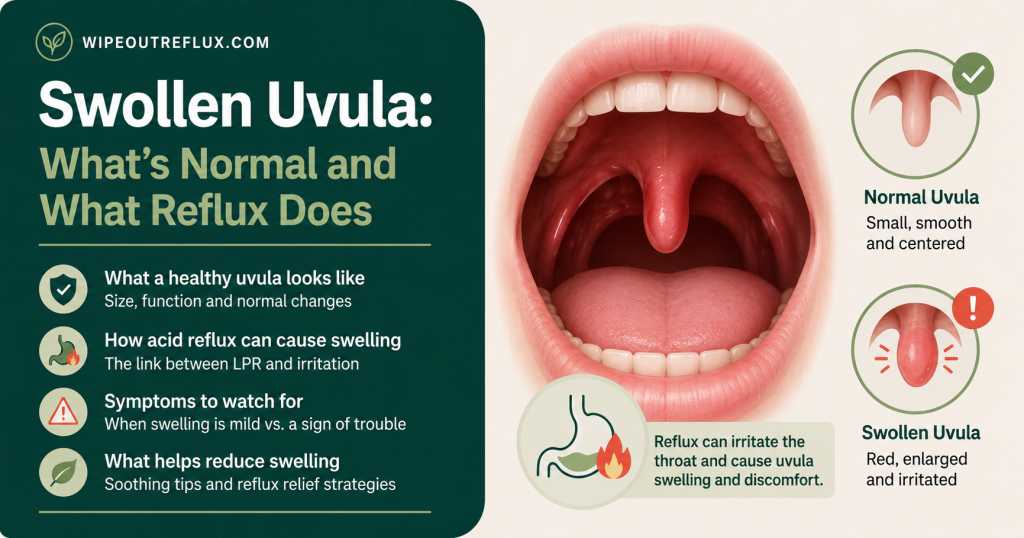
So let’s settle the main question straight away: a normal uvula is a small, soft, teardrop-shaped tag of tissue, pink like the rest of your mouth, that dangles from the back of your soft palate and moves when you talk or swallow. A swollen uvula, by contrast, looks noticeably red, enlarged and often elongated — sometimes long enough to touch your tongue and make you gag. Knowing the difference between a normal uvula size versus a swollen one is usually enough to calm the initial fright.
And here’s the part that matters on a reflux site: acid reflux — especially the silent, throat-based kind — is one of the most overlooked reasons a uvula becomes irritated, swollen and long. Let me show you what’s normal, what counts as swollen, what those “uvula bumps” actually are, what causes it, how reflux fits in, and when a swollen uvula is a genuine emergency.
Key Takeaways
- A normal uvula is small, soft, pink and teardrop-shaped — a swollen uvula looks red, enlarged and often longer than normal.
- Most swollen uvulas are harmless and temporary, so a first look in the mirror is often scarier than the reality.
- “Uvula bumps” are usually normal surface tissue or mild irritation, not a sign of anything serious.
- Common causes include infection, allergy, dehydration, snoring, smoking or vaping — and acid reflux.
- Silent reflux (LPR) bathes the throat in acid and pepsin, causing low-grade inflammation that can leave the uvula swollen and elongated.
- A uvula that swells rapidly with any difficulty breathing or swallowing is a medical emergency — seek urgent care.
- If your uvula is repeatedly swollen alongside throat clearing, hoarseness or a lump sensation, reflux is a likely driver.
What a normal uvula looks like (normal vs swollen uvula)
Let’s start with the reassuring baseline, because “is my uvula normal or swollen?” is the question almost everyone arrives with. A normal uvula is a small, fleshy, teardrop- or finger-shaped tag that hangs from the middle of your soft palate at the back of the mouth. It’s usually around 1 to 1.5 cm long, the same healthy pink as the surrounding tissue, soft and mobile — it lifts when you say “ahh” and helps with speech and swallowing.
Crucially, uvulas vary a lot from person to person. Some are naturally longer, some shorter, some a little curved or slightly split at the tip — all completely normal. So if yours simply looks bigger or longer than you expected, but it’s the normal pink colour, isn’t sore, and isn’t causing gagging or trouble swallowing, there’s a good chance you’re looking at your normal uvula size rather than a swollen one.
Signs your uvula is actually swollen
Here’s how to tell a genuinely swollen uvula from a normal one. When a uvula is inflamed, it tends to show several of these together:
- Redness — it looks angrier and more red than the surrounding tissue.
- Enlargement — visibly fatter or more bulbous than usual.
- Elongation — a common complaint is “my uvula is swollen and long,” or that it’s suddenly longer than normal, sometimes resting on or near the tongue.
- A foreign-body feeling — the sense of something stuck at the back of the throat, triggering gagging or a tickly cough.
- Soreness, difficulty swallowing, a dry or scratchy throat, or new snoring.
A normal uvula size versus a swollen one really comes down to this cluster of changes. One or two on their own may be nothing; several together point to true swelling — what doctors call uvulitis.
What about “uvula bumps”?
A huge number of people search for “uvula bumps” after noticing the surface of their uvula isn’t perfectly smooth — and the reassuring news is that this is usually normal. The lining at the back of your throat naturally contains small clusters of lymphoid tissue, and the uvula’s surface can be a little uneven, so faint bumps or a slightly textured tip are often just your normal anatomy that you’ve never examined this closely before.
Bumps can also appear when the uvula is mildly irritated — from a dry throat, a cold, or acid reflux — and these tend to settle as the irritation calms. Bumps only warrant a closer look from a doctor if they’re growing, one-sided, white or ulcerated, bleeding, or hanging around for more than a couple of weeks. Short of that, the odd bump on the uvula is rarely a cause for worry.
What causes a swollen uvula?
A swollen uvula (uvulitis) has a fairly short list of usual suspects:
- Infection — viral or bacterial, often spreading from a nearby sore throat, tonsillitis, cold or flu.
- Allergic reaction (angioedema) — an allergic swelling of the uvula, sometimes called Quincke’s disease, which can come on fast and is the type to take seriously.
- Dehydration and dryness — not drinking enough, mouth-breathing, snoring or sleeping with your mouth open can leave the uvula dried out and swollen by morning.
- Irritants — smoking, vaping, heavy alcohol, or inhaled chemicals.
- Trauma — from a recent throat infection, medical procedure, or repeated vomiting.
- Acid reflux — particularly the silent, throat-based kind, which is the one people least expect.
If your swollen uvula keeps coming back rather than appearing once with an obvious cold, that recurring pattern is a strong hint that something ongoing — like reflux — is behind it.
How acid reflux swells the uvula
This is where reflux earns its place on the list. Most people think of reflux as heartburn in the chest, but in silent reflux (LPR), stomach contents travel all the way up to the throat — and they carry more than just acid. They bring pepsin, a digestive enzyme that lodges in the delicate throat tissues and reactivates every time it meets acid, keeping the whole area in a state of low-grade inflammation.
The uvula and soft palate sit right in the firing line. Repeated acid and pepsin exposure can leave them chronically irritated, swollen and elongated — which is exactly why so many people with LPR notice a uvula that’s puffy, long, or brushing against the tongue, along with a persistent lump-in-the-throat sensation. This isn’t guesswork: doctors can score the visible throat inflammation that reflux produces using a validated tool, the Reflux Finding Score, which reliably documents these physical changes Belafsky et al., The Laryngoscope, 2001. It’s the same throat irritation behind reflux-related hoarseness and constant throat clearing, and I cover the uvula angle in clinical depth in uvula enlargement and acid reflux. A dry mouth from reflux can make it worse, too, as I explain in acid reflux and dry mouth.
When a swollen uvula is an emergency
The vast majority of swollen uvulas are harmless — but a few situations need urgent care, so it’s worth knowing them. Seek emergency help right away if a swollen uvula comes with any of these:
- Difficulty breathing, noisy breathing, or a feeling that your airway is closing.
- Trouble swallowing your own saliva, or drooling because you can’t swallow.
- Rapid, severe swelling, especially with swelling of the lips, tongue or face — this suggests an allergic angioedema.
- High fever, pus, or severe throat pain that’s quickly getting worse.
Any of these — particularly breathing trouble — means call emergency services, not wait it out. Short of these red flags, a swollen uvula that lingers beyond about a week, or keeps returning, is worth a non-urgent visit to your doctor to find the cause, as I outline in when to see a doctor.
How to soothe a swollen uvula at home
For the everyday, non-emergency swollen uvula, simple measures usually help while it settles:
- Hydrate well. Sip water through the day; dryness is a big driver of uvula swelling.
- Humidify the air. A bedroom humidifier helps if you wake with a swollen, dry throat from mouth-breathing or snoring.
- Gargle warm salt water. A gentle, time-tested way to calm throat inflammation.
- Drop the irritants. Ease off smoking, vaping and alcohol while it heals.
- Suck a soothing lozenge to keep the throat moist and comfortable.
- Address the cause. If it’s reflux-driven, the lasting fix is calming the reflux — not just soothing the uvula.
Is it reflux? How to tell
If your swollen uvula is a one-off arriving with an obvious cold, it’s probably just that. But if it’s recurrent or chronic and comes with the classic silent reflux symptoms — frequent throat clearing, hoarseness, a lump sensation, post-nasal drip, or a throat that feels worse first thing in the morning — then reflux is a strong candidate. You might also notice other throat changes from reflux, and even visible changes on the tongue. When reflux is the root cause, no amount of gargling fixes it for good — you have to calm the acid at the source, which is exactly what my Wipeout Diet Plan is built to do.
Conclusion
So, if a mirror check has you worried about a swollen uvula, the odds are firmly in your favour: a normal uvula just varies more than people realise, “uvula bumps” are usually harmless anatomy, and even a genuinely swollen, elongated uvula is most often temporary and treatable. Learn the difference between a normal uvula size and a swollen one, rule out the emergency signs, and soothe the rest with hydration and gentle care. If it keeps coming back, though, that recurrence is telling you something — and reflux is one of the most common somethings.
When silent reflux is quietly inflaming your throat and uvula, the answer isn’t another lozenge — it’s calming the reflux at its source so the tissue can finally heal. That’s exactly what my Wipeout Diet Plan is built to do: the complete, in-depth system for getting reflux under control for good. I designed it first and foremost around LPR, the stubborn throat-based kind that’s hardest to treat — and the kind most likely to be irritating your uvula — but because it works on the same underlying reflux mechanisms, it’s just as effective for GERD, heartburn and everyday acid reflux.
And to make it easy day to day, the Wipeout Food Reference Guide is the essential companion — it lays out the real pH values of foods and drinks for acid reflux and LPR, so you can quickly cut the acid that’s keeping your throat inflamed. Calm the reflux, and a chronically swollen, irritated uvula often settles right down with it.
Frequently Asked Questions
Is my uvula normal or swollen?
A normal uvula is small, soft, pink and teardrop-shaped, and doesn’t cause discomfort. A swollen uvula looks red and enlarged, often longer than normal, and may trigger gagging, soreness or trouble swallowing. If yours is simply bigger than you expected but the normal pink colour and pain-free, it’s likely just your natural uvula size — uvulas vary a lot between people.
Why is my uvula longer than normal or touching my tongue?
An elongated uvula that feels swollen and long is usually inflamed. Common reasons include dehydration, snoring or mouth-breathing overnight, infection, allergy, irritants like smoking, and acid reflux. If it’s a recurring problem rather than a one-off, ongoing irritation such as silent reflux is a likely cause.
Are uvula bumps normal?
Usually, yes. The back of the throat naturally has small clusters of lymphoid tissue, and the uvula’s surface can be slightly uneven, so faint bumps are often just normal anatomy. Bumps from mild irritation settle on their own. See a doctor only if a bump is growing, one-sided, white, ulcerated, bleeding, or lasts more than a couple of weeks.
Can acid reflux cause a swollen uvula?
Yes. Silent reflux (LPR) sends acid and the enzyme pepsin up into the throat, where they cause ongoing low-grade inflammation of the soft palate and uvula. This can leave the uvula swollen, elongated and irritated, often alongside throat clearing, hoarseness and a lump sensation. Calming the reflux is what allows the tissue to heal.
When should I worry about a swollen uvula?
Seek emergency care if a swollen uvula comes with difficulty breathing, trouble swallowing your saliva, drooling, or rapid severe swelling of the lips, tongue or face — these suggest a dangerous allergic reaction. Also see a doctor if there’s high fever and pus, or if the swelling lasts more than about a week or keeps returning.
Research & References
- The Reflux Finding Score, a validated and reliable clinical tool, documents the visible inflammation that laryngopharyngeal reflux produces in the throat — confirming that reflux causes objective, measurable irritation of the pharyngeal tissues, including structures like the soft palate and uvula Belafsky et al., The Laryngoscope, 2001.
- A strict low-acid diet produced dramatic symptom improvement in patients with stubborn laryngopharyngeal reflux, supporting a dietary approach when reflux is the cause of ongoing throat and uvula irritation Koufman, Annals of Otology, Rhinology & Laryngology, 2011.

David Gray
12 years living with LPR · Consultant & researcher
I've lived with LPR for twelve years — the misdiagnoses, the PPI courses that did nothing, the slow work of figuring out what actually helps. Wipeout Reflux is where I translate the research into plain terms for people stuck in the same place. Every claim here is sourced to peer-reviewed work, and I consult one-to-one with LPR sufferers.