
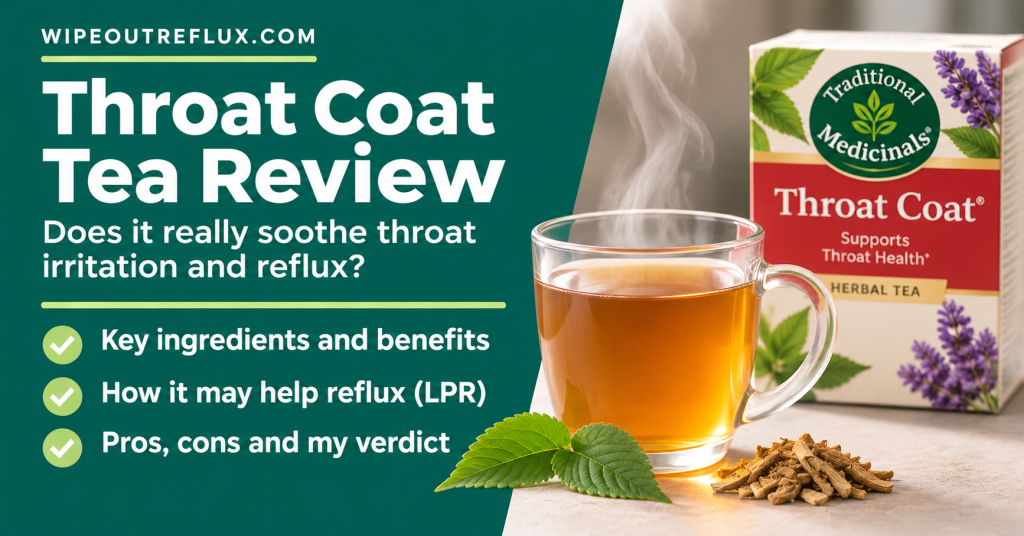
Throat Coat tea from Traditional Medicinals does work for what it’s designed for: temporary relief of a sore, scratchy throat. A small placebo-controlled trial found it reduced throat pain on swallowing within minutes. It contains licorice root, slippery elm, marshmallow root and wild cherry bark, which coat and soothe irritated tissue. For reflux and silent reflux (LPR), it’s a reasonable occasional comfort drink, but it isn’t a treatment, and the licorice means it isn’t ideal for drinking several cups a day for months, during pregnancy, or if you have high blood pressure.
Throat Coat is a popular choice among people with LPR, and it’s easy to see why: the throat feels raw, the tea feels soothing, and the ingredients overlap with supplements often recommended for reflux. Below I go through what’s actually in it, what the evidence shows, how it fits with reflux, who should be careful, and the alternatives I’d consider for daily use.
Key Takeaways
- Throat Coat is a caffeine-free herbal tea made with licorice root, slippery elm bark, marshmallow root, wild cherry bark, fennel, cinnamon and orange peel.
- In a randomized, double-blind trial of 60 adults with acute sore throat, Throat Coat relieved pain on swallowing significantly more than placebo tea, within 5 to 30 minutes.
- Slippery elm and marshmallow root are demulcents: they form a slick, mucilaginous layer that coats irritated throat tissue.
- Licorice is the main active ingredient. It isn’t deglycyrrhizinated (it’s not DGL), so it contains glycyrrhizin, which can raise blood pressure and lower potassium with regular use.
- The relief is temporary. Throat Coat doesn’t reduce reflux, neutralize pepsin or heal reflux damage.
- Avoid it, or check with your doctor first, if you’re pregnant or breastfeeding, have high blood pressure, heart or kidney disease or low potassium, or take diuretics.
- For daily, long-term LPR support, DGL licorice, slippery elm or marshmallow root on their own are usually better choices.
- Used occasionally on bad throat days, it’s a pleasant, low-risk comfort drink.
What’s in Throat Coat Tea?
The original Traditional Medicinals Organic Throat Coat contains:
| Ingredient | What it’s there for |
|---|---|
| Licorice root (plus licorice extract) | Sweet taste and a soothing, coating effect. It’s the largest ingredient by weight. |
| Slippery elm bark | A demulcent rich in mucilage, which coats the throat |
| Marshmallow root | Another mucilage-rich demulcent |
| Wild cherry bark | Used traditionally for coughs |
| Fennel fruit | Flavor, and used traditionally for digestion |
| Cinnamon bark and orange peel | Flavor |
The Canadian version of the label lists amounts per 2 g tea bag: 420 mg licorice root, 340 mg wild cherry bark, 300 mg fennel, 120 mg marshmallow root and 100 mg slippery elm. In other words, licorice is the dominant herb, and slippery elm and marshmallow, the ingredients most people associate with “throat coating”, are present in much smaller amounts. The US formulation may differ slightly, so check your box.
It’s caffeine-free, and there’s also a Lemon Echinacea version. For reflux I’d stick with the original, because citrus flavors can irritate a sensitive throat.
Does Throat Coat Tea Work?
For sore throats, there’s genuine, if limited, evidence. In a multicenter, randomized, double-blind trial, 60 adults with acute pharyngitis drank either Throat Coat or a placebo tea 4 to 6 times a day. Throat Coat reduced pain on swallowing significantly more than placebo at 5, 10, 15, 20 and 30 minutes after the first cup, and overall pain relief was greater [Brinckmann et al., Journal of Alternative and Complementary Medicine, 2003].
That’s a small, short study of infection-related sore throats, and it measured rapid, temporary relief, not healing. Still, it’s more evidence than most herbal teas have.
Throat Coat Tea for Acid Reflux and LPR
This is where I want to be honest, because the tea is marketed for throat health and many people with silent reflux use it daily.
What it can do
- Temporarily soothe a raw, scratchy throat through the coating effect of the mucilage and the warmth of the drink
- Replace more irritating drinks. If it replaces coffee, black tea, citrus juice or a fizzy drink, that alone may help. See best teas for acid reflux.
- Calm the urge to clear your throat for a while. See how to stop constant throat clearing.
What it can’t do
- Reduce reflux. It doesn’t strengthen the sphincters or stop stomach contents reaching your throat.
- Neutralize pepsin. With LPR, the main driver of throat damage is pepsin lodged in the tissue. A coating tea doesn’t inactivate it. See how to neutralize pepsin in the throat.
- Heal the throat on its own. Healing depends on reducing how much reflux reaches it.
Is Throat Coat good for silent reflux?
As an occasional comfort drink, yes. It’s warm, caffeine-free, non-carbonated and not obviously acidic. As a daily treatment, it’s not ideal, mainly because of the licorice.
The Licorice Problem
Throat Coat uses whole licorice root, not DGL (deglycyrrhizinated licorice). That matters.
Whole licorice contains glycyrrhizin, which blocks an enzyme that normally stops cortisol from acting like aldosterone in the kidneys. With regular intake, this can cause sodium and water retention, higher blood pressure and low potassium. A meta-analysis of 18 studies found that consistently taking at least 100 mg of glycyrrhizic acid a day raised systolic blood pressure by about 5.5 mmHg and lowered potassium [Penninkilampi et al., Journal of Human Hypertension, 2017].
The amount of glycyrrhizin in one cup of Throat Coat isn’t published and varies with the root. One or two cups during a cold is very unlikely to cause problems in a healthy adult. Several cups a day for weeks or months, which is how people with chronic LPR often use it, is a different situation, especially if you already have high blood pressure.
Pregnancy is a particular concern. In a Finnish study, children whose mothers ate large amounts of licorice in pregnancy (at least 500 mg of glycyrrhizin a week) showed differences in pubertal timing and cognitive and behavioral outcomes [Räikkönen et al., American Journal of Epidemiology, 2017]. The Canadian label for Throat Coat says not to use it if you’re pregnant or breastfeeding.
Who should avoid Throat Coat or check first
- Pregnant or breastfeeding women
- People with high blood pressure, heart disease, kidney or liver disease, or low potassium
- People taking diuretics, steroids, digoxin, other potassium-lowering drugs, or blood pressure medication
- Anyone planning to drink it daily for more than a few weeks
Better Options for Daily LPR Throat Support
If you like the idea of Throat Coat but want something you can take every day, these deliver the useful parts without the glycyrrhizin:
- DGL licorice: licorice with the glycyrrhizin removed, usually as chewable tablets before meals
- Slippery elm: as a powder mixed into warm water, giving far more mucilage than one tea bag
- Marshmallow root: a cold infusion is especially mucilaginous
- Chamomile tea: a gentle, licorice-free daily tea
- An alginate at bedtime, such as Gaviscon Advance, which actually reduces reflux overnight rather than just soothing afterward. See alginates for acid reflux.
For a broader overview, see supplements for LPR.
How to Drink Throat Coat
- Pour about 8 oz of freshly boiled water over one bag, cover, and steep for 10 to 15 minutes. The long steep releases more mucilage. Squeeze the bag gently at the end.
- Let it cool to warm, not scalding, before sipping slowly.
- Skip the lemon. A little honey is fine.
- For reflux, avoid drinking it right before lying down. Large amounts of fluid close to bed can add to night-time reflux. See acid reflux at night.
- Keep it to occasional use, no more than a cup or two a day for short periods, unless your doctor says otherwise.
My Verdict
For a sore throat from a cold: a good choice, with real, if small-scale, evidence for quick, temporary relief.
For reflux and LPR: fine as an occasional comfort drink on bad days, and better than coffee, citrus or fizzy drinks. But it doesn’t treat reflux, and because it uses whole licorice, it isn’t what I’d drink several times a day long term. For daily throat support, DGL, slippery elm or marshmallow root on their own, plus an alginate at night and a low-acid diet, will do more.
If you want to try it, the original Traditional Medicinals Organic Throat Coat is widely available in boxes of 16 bags.
Conclusion
Throat Coat tea does what it says: it coats and soothes a sore throat, and a placebo-controlled trial showed rapid, temporary pain relief. For silent reflux, that soothing is real but short-lived, because the tea doesn’t stop reflux or deal with pepsin in the throat. Its whole licorice content also makes it a poor fit for heavy daily use, pregnancy or high blood pressure.
Use it as a comfort drink, not a cure. What actually lets a reflux throat heal is reducing how much reflux reaches it, and that’s mostly about what and when you eat. The Wipeout Diet Plan is the step-by-step, low-acid plan I built to heal my own LPR throat. It works just as well for GERD and everyday heartburn.
Frequently Asked Questions
Is Throat Coat tea good for acid reflux?
It can soothe a reflux-irritated throat temporarily and is a gentler choice than coffee or citrus drinks. But it doesn’t reduce reflux or heal the throat, and its licorice makes it unsuitable for heavy daily use.
Does Throat Coat tea have caffeine?
No. It’s a caffeine-free herbal tea.
Can I drink Throat Coat tea every day?
A cup a day for a short period is unlikely to cause problems in healthy adults. Because it contains whole licorice, regular daily use over weeks can raise blood pressure and lower potassium in some people. Check with your doctor if you plan to drink it long term.
Is Throat Coat tea safe during pregnancy?
It’s generally not recommended. The licorice content is the concern, and the label advises against use in pregnancy and breastfeeding.
What’s the difference between Throat Coat and DGL?
Throat Coat contains whole licorice root, including glycyrrhizin. DGL is licorice with the glycyrrhizin removed, so it doesn’t carry the same blood pressure and potassium risks. That makes it the better option for regular reflux use.
How long should Throat Coat steep?
10 to 15 minutes, covered. The long steep releases more of the mucilage from the slippery elm and marshmallow root.
Does Throat Coat help hoarseness?
It may make your throat feel more comfortable, but it won’t fix hoarseness caused by reflux, overuse or other vocal cord problems. Hoarseness lasting more than three weeks should be checked by a doctor. See can reflux cause hoarseness?
Research & References
- A multicenter, randomized, double-blind, placebo-controlled trial of 60 adults with acute pharyngitis, finding that Throat Coat significantly reduced pain on swallowing compared with placebo from 5 to 30 minutes after the first dose [Brinckmann et al., Journal of Alternative and Complementary Medicine, 2003].
- A systematic review and meta-analysis of 18 studies finding that consistent intake of at least 100 mg a day of glycyrrhizic acid raised systolic blood pressure by 5.45 mmHg and diastolic by 3.19 mmHg, and lowered plasma potassium [Penninkilampi et al., Journal of Human Hypertension, 2017].
- A Finnish cohort study linking high maternal glycyrrhizin intake in pregnancy (at least 500 mg a week) with earlier pubertal development in girls and with cognitive and psychiatric differences in children [Räikkönen et al., American Journal of Epidemiology, 2017].

David Gray
12 years living with LPR · Consultant & researcher
I've lived with LPR for twelve years — the misdiagnoses, the PPI courses that did nothing, the slow work of figuring out what actually helps. Wipeout Reflux is where I translate the research into plain terms for people stuck in the same place. Every claim here is sourced to peer-reviewed work, and I consult one-to-one with LPR sufferers.