
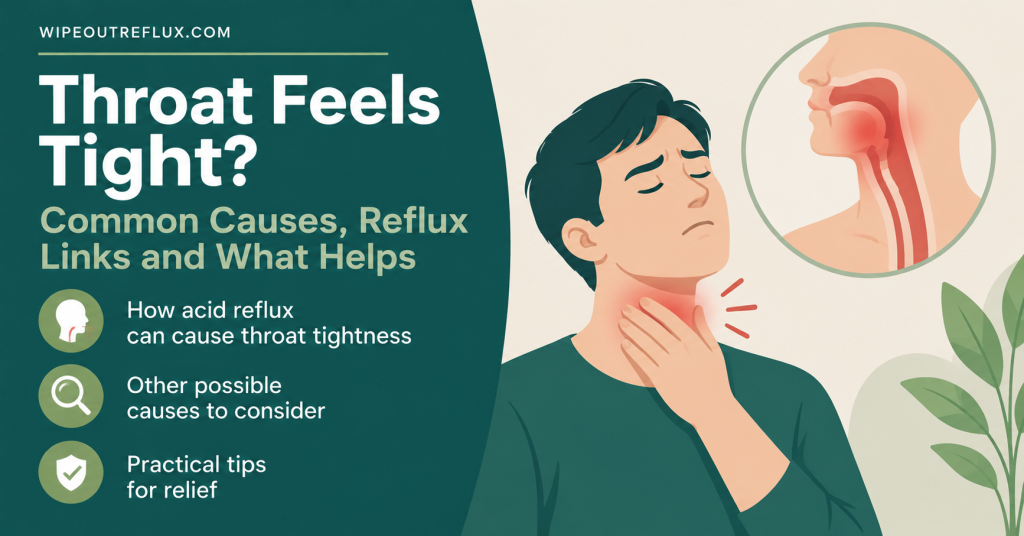
If your throat feels tight — squeezed, closed, banded, like something is pressing in from the sides — the most common explanation in an otherwise healthy adult is not swelling at all. It’s your upper esophageal sphincter, the ring of muscle at the top of your food pipe, clamping down harder than it should.
And the most common reason it does that is reflux. Not necessarily the heartburn kind. In laryngopharyngeal reflux (LPR, or silent reflux), stomach contents reach the throat, the sphincter tightens defensively, and you feel the tension rather than the acid. That’s why so many people with a tight throat have no heartburn whatsoever and get told their throat looks fine.
Before anything else, though: if the tightness came on suddenly and comes with swelling of the lips, tongue or face, hives, drooling, a change in your voice, or any difficulty breathing, that is anaphylaxis until a doctor proves otherwise. Call emergency services now. Do not read the rest of this page first.
Key Takeaways
- Sudden throat tightness with swelling, hives, drooling or breathing difficulty is a medical emergency — treat it as anaphylaxis and get help immediately.
- Gradual, persistent tightness with no swelling and no trouble breathing is usually muscular, not obstructive: the upper esophageal sphincter contracting in response to reflux.
- Acid in the lower esophagus alone is enough to raise upper sphincter pressure and produce the sensation — the refluxate never has to reach your throat for you to feel it.
- Pepsin, the stomach enzyme that travels up with reflux, keeps irritating throat tissue even when acid levels are low, which is why the feeling persists between episodes.
- Tightness that isn’t sore, comes and goes, eases when you eat and returns when you swallow saliva is the classic globus pattern — and globus is reflux-linked far more often than it is psychological.
- Anxiety genuinely worsens it, but usually by amplifying a real physical signal rather than inventing one.
- Tightness after eating, when lying down, at night or after alcohol all point the same way: these are the conditions under which reflux happens most.
- Allergies, thyroid enlargement, muscle tension dysphonia and eosinophilic esophagitis are the main non-reflux causes worth ruling out.
First: When a Tight Throat Is an Emergency
I’m putting this at the top because nothing else on this page matters if this is what’s happening to you.
Throat tightness that appears over minutes, rather than days or weeks, and arrives alongside any of the following needs emergency care immediately:
- Swelling of the lips, tongue, face or throat
- Hives, a widespread rash, or flushing
- Difficulty breathing, wheezing, or noisy breathing
- Difficulty swallowing your own saliva, or drooling
- A hoarse or muffled voice that came on suddenly
- Feeling faint, a racing heart, or a sense of impending doom
- Vomiting or cramping abdominal pain alongside the throat symptoms
Anaphylaxis is defined by the sudden involvement of more than one body system — skin, airway, gut, circulation — after exposure to a likely trigger, and upper airway symptoms such as throat tightness are among its recognized features Cardona et al., World Allergy Organization Journal, 2020. It can progress from mild to life-threatening within minutes. If you carry an adrenaline auto-injector, use it and then call for help — waiting to see whether it gets worse is the error that causes harm.
Two other patterns need same-day medical assessment rather than an article: tightness with a fever and severe pain on swallowing (which can mean a deep throat infection), and tightness with progressive difficulty swallowing solid food, unexplained weight loss, coughing up blood, or a persistent lump you can feel in your neck.
Still with me? Then what follows is almost certainly the relevant part.
What Does It Mean When Your Throat Feels Tight?
The sensation people describe as tightness is remarkably consistent. It sits in the front or the middle of the neck, often right around the Adam’s apple. It feels like a band, a collar, a hand resting on the windpipe. It is not usually painful. It doesn’t stop you breathing, and it doesn’t stop food going down — in fact food often makes it better for a while.
That pattern points to muscle, not blockage. The upper esophageal sphincter is a ring of muscle that sits at the top of the esophagus, and unlike most of your digestive tract it is under constant tension by default — it’s closed until a swallow opens it. When that resting tension rises, you become aware of it. The awareness is the tightness.
High-resolution manometry studies bear this out. In one study, measurable residual pressure at the upper sphincter was found in 66.7% of patients with globus symptoms compared with 9.5% of controls, and the presence of that pressure independently predicted the symptom with an odds ratio of 6.33 Peng et al., Journal of Clinical Gastroenterology, 2015. A comprehensive review of globus pharyngeus reached the same conclusion — that the condition is multifactorial, with reflux and a hyperdynamic upper esophageal sphincter among the principal mechanisms, rather than the purely psychological cause it was labeled with for most of the twentieth century Järvenpää et al., European Archives of Oto-Rhino-Laryngology, 2018.
So the honest answer to “what does it mean when your throat feels tight” is: it usually means a muscle in your throat is working harder than it needs to. The next question — the useful one — is what’s telling it to do that.
The Reflux Explanation Most People Never Hear
Here’s the finding that changed how I think about this symptom, and it’s one almost nobody is told.
In a controlled experiment, researchers dripped acid into the lower esophagus of healthy volunteers and measured what happened at the top. Upper esophageal sphincter pressure rose in 13 of 20 subjects — and all 13 reported the globus sensation at roughly the moment the pressure went up. The control group, who received water, reported nothing. The authors concluded that globus results from elevated upper sphincter pressure caused by reflux, and does not require the throat itself to be exposed to acid at all Tokashiki et al., European Archives of Oto-Rhino-Laryngology, 2010.
Read that again, because it resolves the most frustrating conversation in this whole area. You can have a throat that feels tight, a laryngoscopy that shows nothing dramatic, no heartburn, and no acid reaching your larynx — and reflux can still be the cause. The esophagus detects acid, the upper esophageal sphincter tightens as a protective reflex, and you feel the reflex, not the reflux.
That protective system is supposed to be a good thing. The problem is what happens when it’s triggered repeatedly. Patients with supraesophageal reflux show impaired sphincter and esophageal responses to simulated reflux, with fewer protective contractile reflexes than either controls or standard GERD patients Babaei et al., Gastroenterology, 2015, and experimental acid exposure reduces the sensitivity of the reflex over time Lang et al., American Journal of Physiology: Gastrointestinal and Liver Physiology, 2019. A recent clinical review frames laryngopharyngeal reflux as a subset of GERD with altered upper sphincter reflexes that impair clearance of refluxate and drive exactly these globus and swallowing symptoms Koutroumpakis and Richards, Otolaryngologic Clinics of North America, 2025.
Why the Feeling Doesn’t Switch Off Between Episodes
If reflux were only acid, the tightness would come and go with each episode. It usually doesn’t — people describe a throat that feels tight all the time, with worse spells on top. The explanation is pepsin, the digestive enzyme that comes up with the refluxate.
Pepsin stays active up to about pH 6.5, and — crucially — remains recoverable rather than destroyed after it’s been neutralized, up to about pH 7.5, only becoming irreversibly inactive at pH 8.0 Johnston et al., The Laryngoscope, 2007. Worse, throat cells take pepsin inside by receptor-mediated endocytosis, where it can cause damage even at neutral pH by reactivating within the cell Johnston et al., Annals of Otology, Rhinology & Laryngology, 2010. So the enzyme sits in your throat tissue between reflux events, and anything acidic you eat or drink can wake it back up.
That is the mechanism behind “my throat feels tight all the time, and certain foods make it much worse for hours.” It isn’t in your head, and it isn’t a new reflux episode each time. It’s residual enzyme being reactivated.
Throat Feels Tight but Not Sore
This combination confuses people and it shouldn’t, because it’s the most typical presentation there is. Tight but not sore, uncomfortable but not painful, present at rest and absent when you’re eating — that is textbook globus.
The pattern to recognize: it’s worse when you swallow saliva (a “dry” swallow, which makes the sphincter work against nothing), better when you swallow food or drink, often worse in the evening, and rarely wakes you from sleep. It’s typically felt in the midline — people locate it either at the front of the throat around the voice box, or slightly deeper at the back of the throat, and both descriptions fit the same underlying mechanism.
When tightness is accompanied by soreness — a sore throat that also feels tight — that usually means the tissue itself is inflamed as well as the muscle being tense. In reflux terms, that’s the difference between the sphincter reacting and the mucosa actually being irritated. It shifts the picture toward direct laryngeal exposure, and it’s worth reading how a reflux-irritated throat behaves and how long it typically takes to settle.
If you want to put a number on your own symptom picture, the Reflux Symptom Index is the nine-item questionnaire clinicians use for exactly this; scores above roughly 13 are considered abnormal Belafsky et al., Journal of Voice, 2002. You can work through the Reflux Symptom Index in a couple of minutes.
Throat Feels Tight When Swallowing
There’s an important distinction here that determines how urgently you need to be seen.
Tightness on swallowing saliva, which improves with food or drink, is the globus pattern described above. The sphincter has raised resting tone; a dry swallow makes you notice it; a bolus of food forces it open properly and the sensation briefly clears.
Food physically sticking, taking two swallows to clear, or needing water to wash it down is dysphagia, and that is a different symptom requiring assessment. Reflux can cause it through a peptic esophageal stricture, but so can eosinophilic esophagitis — an allergic condition of the esophagus that often shows up in younger adults as food getting stuck — and so can achalasia and other motility problems.
The rule I give readers: a tight throat that lets food through easily can usually be worked on at home first. A throat that stops food needs a camera or a barium swallow. If you’re unsure which you have, read through how reflux affects swallowing and take it to your doctor rather than guessing.
Throat Feels Tight and Dry
Tightness plus dryness is a specific and quite telling combination, because saliva is one of the main things protecting your throat.
Acid clearance from the esophagus depends on two things: peristalsis to sweep the volume back down, and swallowed saliva to neutralize what’s left behind. Anything that reduces either one prolongs every reflux episode Helm et al., New England Journal of Medicine, 1984. Less saliva means each episode lasts longer, which means more sphincter reactivity, which means more tightness.
Common drivers of the dry-and-tight combination:
- Mouth breathing, especially overnight or with a blocked nose
- Dehydration and, indirectly, caffeine and alcohol
- Medications — antihistamines, some antidepressants, diuretics, and bladder medications are the usual suspects
- Constant throat clearing, which strips the mucus layer and dries the surface further
- Air conditioning, central heating and dry air
There’s a vicious circle worth breaking here: dryness makes the throat feel tight, tightness makes you clear your throat, throat clearing dries and irritates the tissue further. Breaking the clearing habit is one of the highest-value things you can do — I’ve written a full method for stopping constant throat clearing, and it’s worth also reading about reflux and dry mouth if that’s your main pattern.
Throat Feels Tight After Eating
If the tightness reliably shows up twenty minutes to two hours after a meal, you have a very strong clue. That is the reflux window — the period when the stomach is full, pressure is highest, and the lower sphincter relaxes most often.
What makes it worse, and why:
- Meal size. Volume is the single biggest lever. A large meal distends the stomach and multiplies transient sphincter relaxations.
- Fat content. Fat slows gastric emptying, so the stomach stays full and pressurized for longer.
- Acidic foods and drinks. These matter less for the stomach — which is already acidic — and more for reactivating pepsin already sitting in your throat tissue.
- Lying down or bending afterwards. Gravity is doing more work for you than you realize.
- Eating late. A meal within three hours of bed is the most common single cause of overnight symptoms.
A strict low-acid diet produced dramatic symptom improvement in patients with stubborn laryngopharyngeal reflux in Koufman’s series Koufman, Annals of Otology, Rhinology & Laryngology, 2011, and a later comparison found a plant-based Mediterranean-style diet with alkaline water performed at least as well as proton pump inhibition for LPR symptoms Zalvan et al., JAMA Otolaryngology–Head and Neck Surgery, 2017. That’s the evidence base behind the dietary approach in the Wipeout Diet Plan, and it’s why I put meal composition ahead of medication for throat symptoms.
Throat Feels Tight When You Lie Down
Lying flat removes gravity from the equation, and gravity is doing a lot of quiet work. Recumbent reflux episodes also last longer, because you swallow far less saliva while asleep — so the clearance mechanism described above largely switches off overnight.
This is why so many people report the throat feels tight at night, or notice it most on waking. Practical changes that help, in order of effect:
- Stop eating three hours before bed. Non-negotiable if night symptoms are your main problem.
- Raise the head of the bed by 6–8 inches using risers or a bed wedge — not extra pillows, which bend you at the waist and raise abdominal pressure.
- Sleep on your left side. The anatomy of the stomach means the junction sits above the pool of gastric contents in that position.
- Consider an alginate at bedtime. A randomized trial of Gaviscon Advance in 49 LPR patients found significantly better Reflux Symptom Index and Reflux Finding Scores than in untreated controls McGlashan et al., European Archives of Oto-Rhino-Laryngology, 2009.
I’ve written more on nighttime reflux, the best sleeping position for silent reflux, and how alginates differ from antacids.
One caveat worth knowing: a tight throat that wakes you suddenly, gasping, unable to breathe in for ten to thirty seconds before it passes, is probably reflux laryngospasm rather than ordinary tightness. It’s frightening but self-limiting — and it’s a strong signal to take nighttime reflux control seriously.
Throat Feels Tight and Anxiety
Let me be careful here, because this is where most people get dismissed.
Anxiety absolutely can produce throat tightness on its own. The muscles of the neck and larynx are among the first to tense under stress, and the sensation is real. But two things are true at once, and the useful truth is the second one.
First, globus was labeled “globus hystericus” for a century and that label was wrong. The evidence now points to a physical mechanism with a psychological amplifier, not the reverse Lee and Kim, World Journal of Gastroenterology, 2012.
Second, the amplifier is genuinely powerful. Esophageal hypervigilance and symptom-specific anxiety are prevalent across the whole spectrum of reflux presentations — erosive, non-erosive and functional — independent of how much acid exposure is actually measured Guadagnoli et al., Neurogastroenterology & Motility, 2021. In plain terms: once you’re monitoring your throat, you detect sensations you’d otherwise filter out, and the monitoring itself raises muscle tone.
The practical implication isn’t “it’s anxiety, ignore it.” It’s that you treat both ends. Fix the reflux so there’s less signal to detect, and deliberately reduce the checking behavior — the repeated swallowing, the throat clearing, the neck palpating — so the amplifier turns down. Worth reading alongside: whether silent reflux causes anxiety, whether anxiety can cause LPR, and breathing exercises that lower laryngeal tension directly.
What Else Causes a Tight Throat?
Reflux is the most common cause, not the only one. These are the alternatives I’d want ruled out.
Allergies and Post-Nasal Drip
A throat that feels tight with allergies usually has a distinct signature: it’s seasonal or exposure-linked, comes with itching (eyes, nose, palate), sneezing, and a runny or blocked nose, and improves on an antihistamine. Post-nasal drip contributes mechanically too — mucus pooling at the top of the throat provokes repeated swallowing and clearing, which raises sphincter tone.
The trap is that LPR and allergies produce overlapping symptoms, and plenty of people are treated for one when they have the other — or have both. If antihistamines haven’t touched it after a fair trial, allergy is probably not the main driver. See also reflux and post-nasal drip.
Thyroid Enlargement
A goiter or thyroid nodule sits directly in front of the trachea and can produce exactly this pressure sensation, often worse when lying flat or turning the head. It’s easy to check with an examination and an ultrasound, and worth doing if the tightness is genuinely constant rather than fluctuating. Thyroid problems and reflux also interact in both directions.
Muscle Tension Dysphonia and Laryngeal Overuse
If you talk, teach, sing or present for a living, chronically over-recruited laryngeal muscles can produce tightness with or without voice change. In a review of 150 muscle tension dysphonia patients, contributing factors included reflux in 49%, excessive voice use in 63% and high stress in 18% Altman et al., Journal of Voice, 2005 — the causes overlap rather than compete. Notably, in 18 patients with dysphonia that hadn’t responded to proton pump inhibitors, voice therapy alone cut median Reflux Symptom Index from 18.5 to 10.5 Schneider et al., The Laryngoscope, 2019. Speech and language therapy also outperformed reassurance alone in a randomized trial of 36 globus patients Khalil et al., Revue de Laryngologie — Otologie — Rhinologie, 2003. If your tightness is worse after a day of heavy talking, voice therapy may do more than any diet change.
Alcohol
Tightness after drinking alcohol has three overlapping explanations: alcohol relaxes the lower esophageal sphincter and promotes reflux, it’s dehydrating and reduces saliva, and many drinks are acidic in their own right. Wine, beer and most mixers sit well below the pH threshold at which pepsin becomes active — see the acidity of alcoholic drinks and what tends to happen when people stop drinking.
Laryngeal Sensory Neuropathy
Occasionally a throat that feels tight out of nowhere, with no reflux pattern, no allergy pattern and a normal scope, turns out to be a sensitized laryngeal nerve — often after a viral illness. It behaves like nerve pain elsewhere: disproportionate, persistent, unresponsive to acid suppression. Laryngeal sensory neuropathy is worth knowing about if you’ve exhausted everything else.
How to Work Out Which One You Have
You can get surprisingly far with a two-week symptom diary. Note the time of day, what you’d eaten in the previous three hours, your position, and how much you’d been talking. Then look for the pattern:
- Worse after meals, in the evening, and on lying down → reflux
- Worse with dry swallows, better with food → globus, most often reflux-driven
- Worse in spring or around pets, with itch and sneezing → allergy
- Worse after heavy voice use, better on a quiet weekend → muscular/voice
- Constant, unvarying, day after day with a visible or palpable neck change → structural; get it examined
- Food sticking, weight loss, one-sided pain, coughing blood → urgent assessment, not a diary
If you’ve had it more than a few weeks, get a laryngoscopy. Not because it will always find something — often it won’t — but because a normal scope legitimately takes the frightening possibilities off the table, and that alone reduces the hypervigilance that keeps the muscle tight.
What Actually Helps
Assuming the emergency causes are excluded and reflux is the likely driver, this is the order I’d work in:
- Cut the reflux events, don’t just neutralize them. Smaller meals, less fat, nothing within three hours of bed. This does more than any single product.
- Stop reactivating pepsin. Reduce acidic drinks, especially between meals when there’s no food to buffer them. This is the step people skip and the one that most often explains “why does my throat feel tight even on medication.”
- Protect overnight. Bed elevation, left side, and an alginate at bedtime.
- Break the clearing and checking loop. Sip water instead of clearing; a silent swallow instead of a forceful one.
- Add hydration deliberately. More saliva, faster clearance, less irritation.
- Address voice load if it applies. Volume, duration and vocal rest.
Proton pump inhibitors are worth mentioning for balance: they reduce acid but do nothing to pepsin, which is why they perform far better for heartburn than for throat symptoms. If you’ve taken one for eight weeks with no change in the tightness, that isn’t a treatment failure so much as a clue about the mechanism. Worth reading: how to deal with pepsin in the throat and the broader silent reflux treatment options.
Conclusion
A throat that feels tight is, in the overwhelming majority of cases, a muscle doing its job too enthusiastically — and the thing most often telling it to do that is reflux you may not be able to feel anywhere else. The experimental evidence is unusually clean on this point: put acid in the lower esophagus and the upper sphincter tightens and the sensation appears, without a drop of acid ever reaching the throat. Add pepsin sitting in the tissue between episodes, and you have a symptom that persists, fluctuates with what you eat and drink, and stubbornly ignores acid-suppressing medication.
Which means the lever that works is upstream. Fewer reflux events, less pepsin reactivation, better overnight protection. That’s exactly what the Wipeout Diet Plan is built around — the full protocol I developed over twelve years of managing this myself, aimed at reducing how often reflux happens rather than chasing the symptom after it arrives. It was designed first for LPR, the throat-based form that responds least well to standard acid suppression, but because it works on the same underlying mechanisms it does the same job for GERD and everyday heartburn.
If you’d rather start smaller, the Wipeout Food Reference Guide is the essential companion — the foods and drinks that matter for acid reflux and LPR with their pH values, so you can stop unknowingly reactivating pepsin several times a day.
And keep the first section of this article in mind. Tightness that builds slowly is a mechanism problem worth working on patiently. Tightness that arrives in minutes, with swelling or breathing difficulty, is an emergency — and no amount of reading is a substitute for making that call.
This article is general information, not medical advice. Persistent throat symptoms should be assessed by a doctor.
Frequently Asked Questions
Why does my throat feel tight but not sore?
Because the sensation is coming from muscle tension rather than inflamed tissue. The upper esophageal sphincter raises its resting tone in response to reflux, and you feel that tension as a band or squeeze. Soreness means the lining itself is irritated, which is a separate — though often coexisting — problem.
Can anxiety alone make your throat feel tight?
Yes, but it’s less common than people assume, and it’s usually amplifying something physical rather than creating it from nothing. The modern evidence treats globus as a physical mechanism with a psychological amplifier. If your tightness also tracks with meals, position or time of day, anxiety is unlikely to be the whole story.
Why does my throat feel tight after eating?
The twenty-minute to two-hour window after a meal is when the stomach is fullest, pressure is highest, and the lower sphincter relaxes most often. Larger and fattier meals extend that window. If your tightness is reliably post-meal, reflux is the leading explanation regardless of whether you get heartburn.
Why is my throat tight when I lie down?
Gravity stops helping, and you swallow far less saliva when lying down or asleep, so each reflux episode lasts longer. That’s a double hit to the clearance system. Raising the head of the bed and leaving three hours between your last meal and bedtime addresses both.
Should I worry about a tight throat that comes out of nowhere?
If it appears over minutes with swelling, hives, drooling or breathing difficulty, treat it as anaphylaxis and get emergency help. If it appears over days or weeks with none of those, it’s very unlikely to be dangerous — but anything persisting beyond three to four weeks deserves a laryngoscopy, mainly to rule things out.
Can allergies make your throat feel tight?
They can, usually alongside itching, sneezing and nasal symptoms, and usually with a seasonal or exposure-linked pattern. Post-nasal drip adds a mechanical element by provoking repeated swallowing. If a proper trial of antihistamines hasn’t helped, allergy is probably not the main cause.
Why does my throat feel tight after drinking alcohol?
Three reasons stack up. Alcohol relaxes the lower esophageal sphincter, making reflux more likely; it’s dehydrating, so there’s less saliva to clear acid; and most alcoholic drinks are acidic enough to reactivate pepsin already present in throat tissue. Spirits diluted with a non-acidic mixer tend to cause the least trouble, but reducing the total is what actually moves the needle.
Research & References
- [Tokashiki et al., European Archives of Oto-Rhino-Laryngology, 2010] — Acid perfused into the distal esophagus raised upper esophageal sphincter pressure in 13 of 20 healthy volunteers, and all 13 reported globus at about the moment the pressure rose; the control group given water reported neither. The authors concluded globus results from elevated UES pressure caused by reflux and does not require direct hypopharyngeal acid exposure.
- [Peng et al., Journal of Clinical Gastroenterology, 2015] — High-resolution manometry found recordable upper esophageal sphincter residual pressure in 66.7% of globus patients versus 9.5% of controls, with measurable residual pressure independently predicting globus symptoms at an odds ratio of 6.33.
- [Järvenpää et al., European Archives of Oto-Rhino-Laryngology, 2018] — Review of globus pharyngeus concluding the condition is multifactorial, with reflux and hyperdynamic upper esophageal sphincter pressure among the principal mechanisms rather than a purely psychological cause.
- [Babaei et al., Gastroenterology, 2015] — Patients with supraesophageal reflux disease showed impaired upper esophageal sphincter and esophageal responses to simulated reflux events, with fewer UES contractile reflexes to slow acid infusion than controls or GERD patients.
- [Lang et al., American Journal of Physiology: Gastrointestinal and Liver Physiology, 2019] — Esophageal acid exposure reduced sensitivity to activation of the esophago-UES contractile reflex, suggesting chronic reflux degrades rather than sharpens the sphincter’s protective response.
- [Koutroumpakis and Richards, Otolaryngologic Clinics of North America, 2025] — Review describing laryngopharyngeal reflux as a subset of GERD with altered upper esophageal sphincter reflexes that impair clearance of refluxate and contribute to globus and dysphagia symptoms.
- [Johnston et al., The Laryngoscope, 2007] — Characterized human pepsin’s pH behavior: active up to about pH 6.5, inactive but recoverable after neutralization up to pH 7.5, and irreversibly inactivated at pH 8.0.
- [Johnston et al., Annals of Otology, Rhinology & Laryngology, 2010] — Showed pepsin is taken into hypopharyngeal cells by receptor-mediated endocytosis and causes damage even at neutral pH by reactivating inside the cell.
- [Cardona et al., World Allergy Organization Journal, 2020] — World Allergy Organization anaphylaxis guidance describing diagnostic criteria, the multi-system presentation including upper airway symptoms, and intramuscular adrenaline as first-line treatment.
- [Helm et al., New England Journal of Medicine, 1984] — Showed that clearing acid from the esophagus requires both peristaltic emptying of the refluxed volume and neutralization by swallowed saliva, so anything that weakens peristalsis or reduces saliva prolongs each episode.
- [Guadagnoli et al., Neurogastroenterology & Motility, 2021] — Found esophageal hypervigilance and symptom-specific anxiety prevalent across the full spectrum of GERD presentations — erosive, non-erosive and functional — independent of measured acid exposure.
- [Lee and Kim, World Journal of Gastroenterology, 2012] — Review of globus pharyngeus etiology, diagnosis and treatment, covering reflux, upper esophageal sphincter dysfunction and psychological contributors, and the diagnostic work-up used to exclude structural causes.
- [Belafsky et al., Journal of Voice, 2002] — Developed and validated the Reflux Symptom Index, a nine-item self-administered questionnaire (each item 0–5, maximum 45) for laryngopharyngeal reflux, with scores above about 13 considered abnormal.
- [Altman et al., Journal of Voice, 2005] — Review of 150 patients diagnosed with muscle tension dysphonia found contributing factors of gastroesophageal reflux in 49%, excessive voice use in 63%, excessive loudness demands in 23% and high stress in 18%.
- [Schneider et al., The Laryngoscope, 2019] — In 18 patients with dysphonia unresponsive to proton pump inhibitors and treated with voice therapy alone, median Reflux Symptom Index fell from 18.5 to 10.5 and median Voice Handicap Index-10 from 25.5 to 13.5.
- [Khalil et al., Revue de Laryngologie — Otologie — Rhinologie, 2003] — Randomized controlled trial of 36 globus patients found significant improvement in symptom scores with speech therapy compared with both baseline and a reassurance-only control group.
- [McGlashan et al., European Archives of Oto-Rhino-Laryngology, 2009] — Randomized trial of Gaviscon Advance in 49 patients with laryngopharyngeal reflux; the treated group had significantly better Reflux Symptom Index and Reflux Finding Scores than untreated controls.
- [Koufman, Annals of Otology, Rhinology & Laryngology, 2011] — Reported dramatic symptom improvement in patients with recalcitrant laryngopharyngeal reflux following a strict low-acid diet.
- [Zalvan et al., JAMA Otolaryngology–Head and Neck Surgery, 2017] — Comparison of alkaline water plus a plant-based Mediterranean-style diet and reflux precautions against proton pump inhibition found the dietary approach was not significantly worse than medication for LPR symptoms.

David Gray
12 years living with LPR · Consultant & researcher
I've lived with LPR for twelve years — the misdiagnoses, the PPI courses that did nothing, the slow work of figuring out what actually helps. Wipeout Reflux is where I translate the research into plain terms for people stuck in the same place. Every claim here is sourced to peer-reviewed work, and I consult one-to-one with LPR sufferers.