
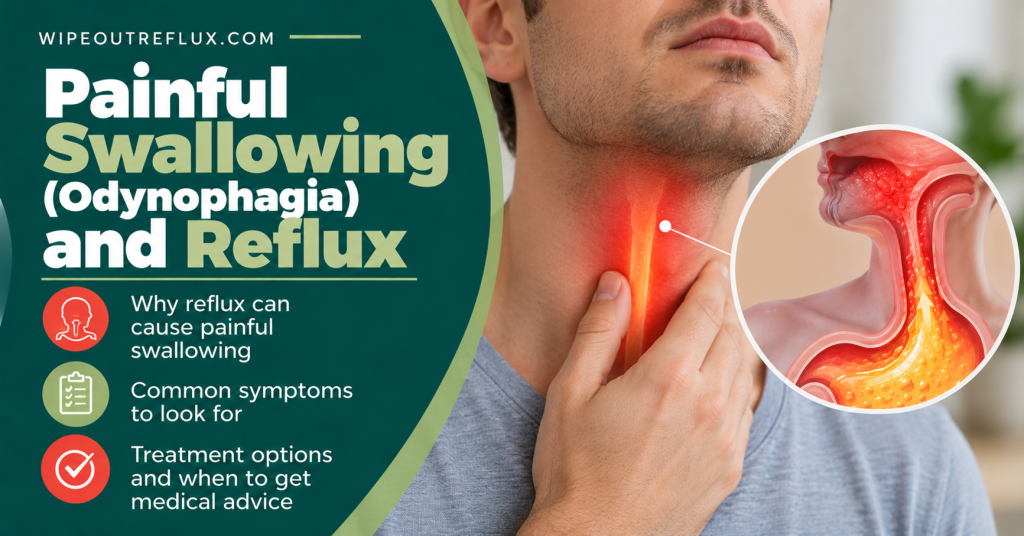
Painful swallowing, known medically as odynophagia, means it hurts when food, drink or even saliva goes down. Most of the time the cause is in the throat: a cold or other viral infection, tonsillitis or strep throat. These usually come on suddenly, often with a fever or runny nose, and settle within a week or so.
When the pain is lower down, behind the breastbone, or it keeps going for weeks without any sign of infection, the cause is more often in the esophagus. Acid reflux is one of the most common culprits, either by inflaming the esophagus (esophagitis) or by irritating the throat in silent reflux (LPR). A pill that lodged on the way down and infections such as thrush are other causes worth knowing about.
Painful swallowing that lasts more than a week or two, gets worse, or comes with food sticking, weight loss or a high fever should be checked by a doctor. Most causes are very treatable once they’re identified.
Key Takeaways
- Odynophagia means pain on swallowing. Dysphagia means difficulty swallowing. They can happen together but aren’t the same thing.
- Throat infections (viral sore throats, tonsillitis, strep) are the most common cause of sudden throat pain when swallowing.
- Pain behind the breastbone when you swallow usually points to the esophagus, most often reflux esophagitis.
- Silent reflux can cause a raw, burning throat that hurts on swallowing for weeks, usually without heartburn.
- Some tablets, especially certain antibiotics, painkillers and supplements, can burn the esophagus if they stick on the way down.
- Thrush (candida) can infect the esophagus, particularly after antibiotics, steroid inhalers or with weakened immunity.
- Pain on one side when swallowing usually comes from one tonsil or the tissue around it.
- See a doctor if it lasts more than one to two weeks, keeps getting worse, or comes with food sticking, weight loss, drooling or trouble breathing.
Odynophagia vs Dysphagia: What’s the Difference?
These two words get mixed up a lot, including by doctors in a hurry, so it’s worth separating them.
- Odynophagia is pain when swallowing. Food goes down, but it hurts as it does.
- Dysphagia is difficulty swallowing: food or liquid feels like it sticks, goes down slowly or won’t go down at all.
You can have one without the other, or both together. Painful swallowing without any sticking usually points to inflammation, infection or irritation of the lining. Sticking without pain points more toward a narrowing or a muscle problem. If food is actually getting stuck, my guide to dysphagia is the better place to start, and doctors generally evaluate it differently, often with endoscopy first [Wilkinson et al., American Family Physician, 2021].
Where Does It Hurt? Throat vs Chest
The single most useful clue is where you feel the pain.
- Pain in the throat, at or above the Adam’s apple, usually comes from the throat itself: the tonsils, the back of the throat or the voice box. Infections and silent reflux are the main causes.
- Pain behind the breastbone, felt a second or two after you swallow as food travels down, usually comes from the esophagus. Reflux esophagitis, pill injury and esophageal infections are the main causes.
Timing matters too. Pain that started suddenly with a fever or cold is almost always infection. Pain that has crept up gradually and lingered for weeks, especially if it’s worse after meals or in the morning, is more likely reflux or another non-infectious cause.
Common Causes of Throat Pain When Swallowing
1. Viral sore throat
Colds, flu and other viruses are by far the most common cause. The throat feels raw and scratchy, swallowing hurts, and there’s usually a runny nose, cough or hoarse voice alongside it. When a sore throat comes with these cold-type symptoms, a virus is much more likely than strep, and guidelines advise that strep testing usually isn’t needed [Shulman et al., Clinical Infectious Diseases, 2012]. It usually settles in 5 to 10 days.
2. Tonsillitis and strep throat
Tonsillitis makes swallowing very painful, often with fever, swollen tender glands under the jaw and red, swollen tonsils, sometimes with white patches. Strep throat, the bacterial form, is more likely when there’s fever and pus on the tonsils but no cough or runny nose. Strep needs a quick test and, if positive, antibiotics.
3. Silent reflux (LPR)
If your throat has hurt on swallowing for weeks with no fever, no cold and no improvement after antibiotics, silent reflux is one of the most likely explanations. It’s covered in detail below.
4. Post-nasal drip and dry air
Mucus constantly draining down the back of the throat, or a night of mouth breathing in dry air, can leave the throat raw and painful to swallow, especially first thing in the morning. This usually eases as the day goes on.
5. Peritonsillar abscess (quinsy)
A collection of pus next to one tonsil, usually after tonsillitis. The pain is severe and one-sided, often spreads to the ear, and comes with a muffled “hot potato” voice and difficulty opening the mouth. It’s most common in adults aged 20 to 40 and needs prompt drainage and antibiotics [Galioto, American Family Physician, 2017].
6. A scratch from food
A sharp crisp, fish bone or crusty bread can scratch the throat and cause pinpoint pain on swallowing. This usually heals within a few days. If you feel something is still stuck, or the pain is getting worse, get it looked at.
Common Causes of Chest Pain When Swallowing
1. Reflux esophagitis
When acid reflux happens often enough, it can inflame and erode the lining of the esophagus. Swallowing then hurts because food and drink pass over raw tissue, a bit like eating with a mouth ulcer. Hot drinks, spicy food, citrus and alcohol often sting most. Doctors grade the severity from A to D on endoscopy using the Los Angeles classification [Lundell et al., Gut, 1999]. More in my guide to erosive esophagitis.
2. Pill esophagitis
This one catches a lot of people out. If a tablet lingers in the esophagus instead of going straight down, it can dissolve against the lining and burn it. It often happens when people take tablets with only a sip of water or lie down straight afterward. The main culprits include the antibiotics doxycycline and tetracycline, anti-inflammatory painkillers, potassium supplements, iron tablets and bisphosphonates for bone health. Chest pain behind the breastbone, painful swallowing and difficulty swallowing are the typical symptoms, and it usually heals within one to two weeks once the culprit is stopped [Saleem and Sharma, StatPearls, 2023]. If you’ve recently started antibiotics, see can antibiotics cause heartburn.
3. Esophageal thrush and other infections
Candida (thrush) is the most common infection of the esophagus, followed by herpes simplex and cytomegalovirus. Risk factors include recent antibiotics, steroid use (including steroid inhalers for asthma), chemotherapy, diabetes and weakened immunity, and the typical symptoms are sudden painful or difficult swallowing [Rosołowski and Kierzkiewicz, Przeglad Gastroenterologiczny, 2013]. Long-term acid-suppressing medication may also raise the risk slightly: in a study of more than 7,700 people having endoscopy, PPI users had higher odds of esophageal thrush [Ogiso et al., Scientific Reports, 2021]. Visible white patches in the mouth (oral thrush) alongside painful swallowing are a strong clue.
4. Eosinophilic esophagitis (EoE)
EoE is an allergic-type inflammation of the esophagus. It more often causes food sticking than pain, but painful swallowing and heartburn-like symptoms are common too. It’s diagnosed by biopsy during an endoscopy [Dellon et al., Gastroenterology, 2018]. See eosinophilic esophagitis vs acid reflux.
Painful Swallowing and Silent Reflux
Silent reflux is the cause I see overlooked most often, because people assume reflux always means heartburn. It doesn’t.
How reflux makes swallowing hurt
In laryngopharyngeal reflux (LPR), stomach contents travel all the way up the esophagus and spill into the throat and voice box. The throat lining has very little natural protection against acid and digestive enzymes, so even small amounts cause irritation. In the original research that defined LPR, most patients came in with throat and voice symptoms, and only a minority had heartburn [Koufman, The Laryngoscope, 1991].
The real driver is pepsin, the stomach’s protein-digesting enzyme. Pepsin can stick to throat tissue and stay there, and it reactivates whenever something acidic arrives, whether that’s another reflux episode or an acidic drink [Johnston et al., The Laryngoscope, 2007]. The result is a throat that stays raw, so every swallow rubs over irritated tissue. That’s why reflux-related throat pain often flares after coffee, wine, juice or a late dinner.
What reflux-related swallowing pain feels like
- A raw, burning or scalded feeling in the throat rather than a sharp pain
- Often worst on the first few swallows of the morning
- Lasting weeks or months, with no fever or swollen glands
- Often with throat clearing, mucus, hoarseness or a lump sensation. See lump in throat from reflux
- Sometimes referred to the ear on one or both sides. See acid reflux ear pain
- Antibiotics didn’t help
If several of these sound familiar, score yourself on the Reflux Symptom Index. A score above 13 suggests reflux is likely to be involved [Belafsky et al., Journal of Voice, 2002]. For the bigger picture of reflux in the throat, see my guide to the acid reflux throat.
Pain When Swallowing on One Side
Pain on just one side when you swallow usually comes from the tonsil or the tissue around it on that side, because swallowing squeezes and stretches that area. Common reasons include:
- Tonsillitis that’s worse on one side
- A tender, swollen lymph node under the jaw
- A small scratch from sharp food
- A tonsil stone
- Reflux irritation, which often feels worse on the side you sleep on
- Glossopharyngeal neuralgia: rare, brief, electric-shock-like pain deep in one side of the throat, triggered by swallowing, talking or yawning [Shah and Padalia, StatPearls, 2023]
One-sided throat pain often travels to the ear on the same side, because the throat and ear share nerves [Earwood et al., American Family Physician, 2018]. Severe one-sided pain with difficulty opening your mouth or a muffled voice needs to be seen the same day, because it can be a peritonsillar abscess.
Throat Hurts When Swallowing but No Sore Throat
Some people say their throat doesn’t hurt at rest, only when they swallow. That pattern usually means the lining is mildly inflamed but not badly enough to ache on its own. Swallowing presses the tissues together and brings out the pain. Common causes include:
- Silent reflux, especially if it’s worse in the morning or after meals
- The early or late stage of a viral sore throat
- Post-nasal drip
- Pill irritation lower down, felt behind the breastbone
- Muscle tension in the neck and throat
If it has gone on for more than two or three weeks, see my guide to a sore throat that won’t go away, which walks through the longer-lasting causes.
What Helps Painful Swallowing
For quick relief
- Eat soft, cool or lukewarm foods. Yogurt, oatmeal, mashed potato, soups and smoothies go down more easily than dry, crunchy or very hot food.
- Sip fluids regularly to keep the throat moist.
- Gargle with warm salt water for throat-level pain: half a teaspoon of salt in a glass of warm water, two or three times a day.
- Use simple pain relief such as acetaminophen if it suits you, taken 20 to 30 minutes before meals so eating is easier. Be cautious with ibuprofen and other anti-inflammatories if reflux or esophagitis is involved, as they can irritate the esophagus. See does ibuprofen cause acid reflux.
- Avoid the stingers: very hot drinks, spicy food, citrus, tomato, alcohol and carbonated drinks.
To prevent pill esophagitis
- Take tablets with a full glass of water
- Stay upright for at least 30 minutes afterward
- Never take tablets right before lying down for the night
- Ask your pharmacist whether a liquid version is available if you struggle with tablets
If reflux is the cause
Throat and esophageal tissue heal slowly, so give reflux changes at least four to six weeks.
- Take an alginate after meals and at bedtime. Alginates form a protective raft on top of your stomach contents that blocks reflux. In a trial of 49 people with LPR, Gaviscon Advance improved both symptoms and throat appearance compared with no treatment [McGlashan et al., European Archives of Oto-Rhino-Laryngology, 2009]. More in alginates for acid reflux.
- Lower the acid in your diet. This stops pepsin from being switched back on in the throat. In people with stubborn LPR, a strict low-acid diet improved symptoms in 95% of patients within two weeks [Koufman, Annals of Otology, Rhinology & Laryngology, 2011]. My Wipeout Diet Plan lays out exactly what to eat and drink while your throat heals, so you’re not guessing. You can also start with LPR foods to avoid.
- Stop eating three hours before bed and raise the head of your bed if your throat is worst in the morning.
- Talk to your doctor about medication if you have chest pain on swallowing. Esophagitis usually heals well with a course of a proton pump inhibitor, and US guidelines recommend an initial 8-week course for erosive esophagitis [Katz et al., American Journal of Gastroenterology, 2022].
Most people notice their throat calming down within a few weeks, but long-standing irritation can take two to three months to settle fully. See how long a reflux sore throat takes to heal.
When to See a Doctor
Book an appointment if:
- Painful swallowing has lasted more than one to two weeks
- It’s getting worse rather than better
- You feel pain behind your breastbone when you swallow
- Food or tablets feel like they’re sticking
- You’ve lost weight without trying
- You’ve been hoarse for more than three weeks
- You have white patches in your mouth, or you use a steroid inhaler, have diabetes or have a weakened immune system
Get seen the same day or call emergency services if:
- You can’t swallow your own saliva or you’re drooling
- You have difficulty breathing or noisy breathing
- You have severe one-sided throat pain with trouble opening your mouth or a muffled voice
- You have a high fever and feel very unwell
- Something is stuck and won’t go down
- You’re vomiting blood or passing black stools
If your doctor wants to look inside the esophagus, an endoscopy is quick and usually done under sedation. I explain what to expect in endoscopy for acid reflux. And if you’re worried that swallowing problems mean something serious, my guide on whether difficulty swallowing is a sign of cancer puts the risk in perspective.
Conclusion
Painful swallowing is usually a short-lived throat infection that clears in a week. When it lingers, the location of the pain is your best clue: throat pain that persists without infection often points to silent reflux, while pain behind the breastbone points to the esophagus, most commonly reflux esophagitis, a lodged tablet or thrush. Each of these is very treatable once you know which one you’re dealing with, and anything lasting more than a couple of weeks deserves a proper look.
If reflux turns out to be behind it, the Wipeout Diet Plan is where I’d point you first. It’s the complete, step-by-step approach I’ve refined over twelve years of managing reflux myself, covering what to eat and drink, when to eat, and how to let irritated tissue heal. I built it originally for silent reflux, the throat-based type behind so much lingering swallowing pain, but since it targets the same underlying causes it works just as well for GERD and esophagitis.
If you’d like a simpler starting point, the Wipeout Food Reference Guide is the essential companion. It lists the foods and drinks that are safe for acid reflux and LPR, with their pH values, so you can quickly choose meals that won’t sting on the way down.
Frequently Asked Questions
Why does my throat hurt when I swallow?
The most common reason is a viral sore throat or tonsillitis, which usually clears within a week. If it lasts for weeks with no fever, silent reflux, post-nasal drip or another ongoing irritant is more likely. Pain behind the breastbone when swallowing suggests the esophagus rather than the throat.
What is odynophagia?
Odynophagia is the medical term for pain when swallowing. It’s different from dysphagia, which means difficulty swallowing or food sticking. Odynophagia usually points to inflammation, infection or injury of the throat or esophagus lining.
Can acid reflux cause painful swallowing?
Yes. Reflux can inflame the esophagus (esophagitis), causing pain behind the breastbone as food goes down. It can also irritate the throat in silent reflux, causing a raw, burning pain on swallowing that’s often worst in the morning, usually without heartburn.
Why does it hurt to swallow on one side?
One-sided pain usually comes from the tonsil or nearby tissue on that side, such as tonsillitis, a swollen gland, a tonsil stone or a small scratch from food. Severe one-sided pain with difficulty opening your mouth or a muffled voice should be seen the same day.
How long should painful swallowing last?
From a viral infection, usually 5 to 10 days. Pill esophagitis usually heals in one to two weeks after stopping the tablet. If it lasts longer than two weeks or keeps getting worse, see a doctor.
What should I eat when it hurts to swallow?
Soft, cool or lukewarm foods are easiest: yogurt, oatmeal, scrambled eggs, mashed potato, soups, bananas and smoothies made without citrus. Avoid very hot drinks, spicy food, citrus, tomato, alcohol and dry, crunchy foods until it settles.
Can a pill burn your throat or esophagus?
Yes. If a tablet sticks on the way down, it can dissolve against the lining and cause a painful burn, called pill esophagitis. Antibiotics such as doxycycline, anti-inflammatory painkillers, iron and potassium tablets are common culprits. Taking tablets with a full glass of water and staying upright for 30 minutes helps prevent it.
Research & References
- [Wilkinson et al., American Family Physician, 2021] — Clinical review of dysphagia evaluation, distinguishing oropharyngeal from esophageal types and recommending endoscopy as the initial test for esophageal dysphagia.
- [Shulman et al., Clinical Infectious Diseases, 2012] — Infectious Diseases Society of America guideline on group A streptococcal pharyngitis, covering which clinical features suggest a viral cause and when strep testing and antibiotics are appropriate.
- [Galioto, American Family Physician, 2017] — Review of peritonsillar abscess, most frequent in adults aged 20 to 40, presenting with a sore throat much worse on one side, muffled voice and limited mouth opening, and usually treated with drainage and antibiotics.
- [Lundell et al., Gut, 1999] — Validation of the Los Angeles classification for grading reflux esophagitis, showing grade correlated with acid exposure, heartburn severity and treatment response.
- [Saleem and Sharma, StatPearls, 2023] — Review of drug-induced esophagitis reporting retrosternal pain (71.8%), odynophagia (38.5%) and dysphagia (29.5%) as the main presenting symptoms, with resolution within one to two weeks of stopping the culprit drug.
- [Rosołowski and Kierzkiewicz, Przeglad Gastroenterologiczny, 2013] — Review of infectious esophagitis identifying Candida as the predominant cause, followed by cytomegalovirus and herpes simplex, with risk factors including antibiotics, steroids, chemotherapy and immunodeficiency, and typical acute dysphagia and odynophagia.
- [Ogiso et al., Scientific Reports, 2021] — Among 7,736 patients undergoing endoscopy, PPI use raised the odds of esophageal candidiasis in immunocompetent people (odds ratio 1.69).
- [Dellon et al., Gastroenterology, 2018] — International AGREE consensus criteria for diagnosing eosinophilic esophagitis, based on symptoms of esophageal dysfunction and at least 15 eosinophils per high-power field on biopsy.
- [Koufman, The Laryngoscope, 1991] — Landmark study of 225 ear, nose and throat patients using 24-hour pH monitoring that established reflux as a common cause of laryngeal and voice disorders, often without heartburn.
- [Johnston et al., The Laryngoscope, 2007] — Showed pepsin stays stable at throat pH and can be reactivated by acid, explaining ongoing throat irritation between reflux episodes.
- [Belafsky et al., Journal of Voice, 2002] — Developed and validated the Reflux Symptom Index, a nine-item questionnaire for laryngopharyngeal reflux, with scores above 13 considered abnormal.
- [Shah and Padalia, StatPearls, 2023] — Overview of glossopharyngeal neuralgia, a rare cause of brief, sharp pain in the tonsil area and below the ear triggered by swallowing, talking or yawning.
- [Earwood et al., American Family Physician, 2018] — Clinical review noting that referred ear pain is more common than primary ear pain in adults, with tonsillitis and pharyngitis referring pain through the glossopharyngeal nerve.
- [McGlashan et al., European Archives of Oto-Rhino-Laryngology, 2009] — Randomized trial of Gaviscon Advance in 49 patients with laryngopharyngeal reflux; the treated group had significantly better symptom and throat examination scores than untreated controls.
- [Koufman, Annals of Otology, Rhinology & Laryngology, 2011] — In 20 patients with PPI-resistant LPR, a strict diet eliminating foods and drinks below pH 5 for at least two weeks improved symptoms in 95%.
- [Katz et al., American Journal of Gastroenterology, 2022] — ACG clinical guideline for GERD, including an 8-week course of PPI therapy for healing erosive esophagitis and guidance on managing persistent symptoms.

David Gray
12 years living with LPR · Consultant & researcher
I've lived with LPR for twelve years — the misdiagnoses, the PPI courses that did nothing, the slow work of figuring out what actually helps. Wipeout Reflux is where I translate the research into plain terms for people stuck in the same place. Every claim here is sourced to peer-reviewed work, and I consult one-to-one with LPR sufferers.