
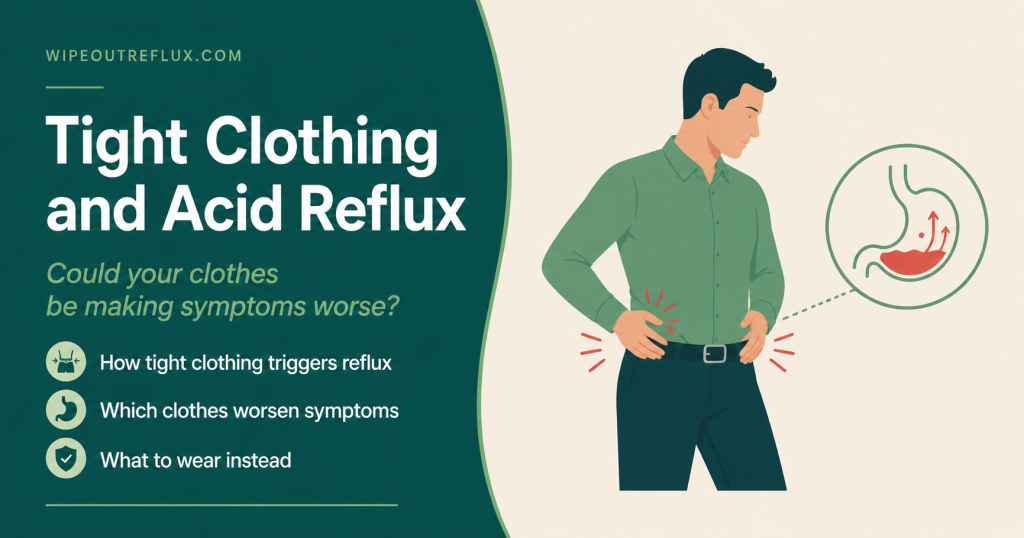
Yes, tight clothing genuinely makes acid reflux worse, and this is one of the few lifestyle factors where the evidence is unusually direct. When researchers put a waist belt on reflux patients and measured what happened inside them, the belt raised pressure inside the stomach by around 7 mmHg while fasting and 9 mmHg after a meal, increased acid reflux at every sensor in the lower oesophagus by roughly eightfold, and — the most striking finding — slowed the clearance of refluxed acid from 23 seconds to 81 seconds.
That last number is the one that matters most. A belt doesn’t just push a bit more acid upwards. It changes how long that acid sits on your oesophageal lining before it’s cleared, and duration of contact is what causes damage and symptoms. Your belt isn’t a minor detail — it’s an intervention.
Below I’ll explain exactly what happens anatomically when you cinch your waist, which garments are the worst offenders, why the timing of the tightness matters far more than most people realise, and what to actually change without rebuilding your wardrobe.
Key Takeaways
- A waist belt raised intragastric pressure by a median of 6.9 mmHg fasting and 9.0 mmHg after a meal in reflux patients.
- Acid reflux into the lower oesophagus increased roughly eightfold with the belt on compared with the belt off.
- The biggest effect was on clearance — refluxed acid took 81 seconds to clear with a belt versus 23 seconds without.
- Waist compression can create a partial hiatus hernia, sliding the junction between stomach and oesophagus upwards and letting acid pool where it shouldn’t.
- Central abdominal fat works through exactly the same mechanism, which is why waist circumference predicts reflux better than weight alone.
- The worst combination is a tight waistband plus a full stomach plus sitting down — all three stack.
- Loosening the belt one notch before a meal is a genuinely effective, free intervention, unlike most reflux “hacks”.
- Shapewear, skinny jeans, waist trainers, corsets and lifting belts all compress the abdomen the same way a belt does.
What a Tight Waistband Actually Does Inside You
Your abdomen is essentially a closed, fluid-filled compartment. Squeeze it anywhere and the pressure rises everywhere inside it, including inside your stomach. That’s the whole mechanism in one sentence, but the consequences are worth spelling out.
The valve keeping stomach contents where they belong isn’t one muscle — it’s two working together. The lower oesophageal sphincter is the intrinsic muscular ring, and the crural diaphragm wraps around it from the outside like a second, external clamp. Together they create a high-pressure zone that has to be stronger than the pressure pushing up from below. A systematic review of what raised intra-abdominal pressure does to this junction concluded that it’s the single major force determining whether the barrier adapts and holds, or gets disrupted and starts leaking — and that the presence of a hiatal hernia tips the balance decisively towards leaking Siboni et al., Journal of Clinical Gastroenterology, 2022.
So a belt does two things at once. It increases the force pushing stomach contents upwards, and by displacing the junction it weakens the barrier holding them down. If you want the full picture of how that valve works, I’ve written about the lower oesophageal sphincter and acid reflux and the role of the hiatal hernia in reflux.
The Belt Study: What the Numbers Actually Showed
This is the study worth knowing about, because it’s a rare case of researchers testing the exact thing people are advised to change.
A team at the University of Glasgow studied 14 patients with reflux disease — eight with oesophagitis and six with Barrett’s oesophagus — using combined pH and pressure measurement around the gastro-oesophageal junction. Each person was studied fasting and after a meal, with a waist belt on and off. The belt raised intragastric pressure by a median of 6.9 mmHg fasting and 9.0 mmHg after eating. Acid reflux measured at every sensor extending 5.5 cm above the peak sphincter pressure point rose roughly eightfold with the belt on Mitchell et al., Gastroenterology, 2017.
But the headline finding was the clearance data. Without the belt, refluxed acid was cleared from the lower oesophagus in a median of 23 seconds. With the belt, it took 81.1 seconds — more than three times as long. And the pattern wasn’t simply slower muscle contractions; it was rapid re-reflux. The oesophagus would sweep the acid down, and the belt pressure would immediately push it straight back up again.
That reframes the whole issue. The problem with a tight waistband isn’t just more reflux events. It’s that each event lasts far longer, because your oesophagus is fighting a constant upward force while trying to clear itself. Oesophageal clearance is a genuinely underrated part of reflux — I’ve covered it in more detail in oesophageal motility and acid reflux.
How a Belt Creates a Mini Hiatus Hernia
The mechanism goes deeper than pressure alone. In a study of healthy volunteers with no reflux symptoms at all, both wearing a waist belt and having a larger waist circumference caused the squamocolumnar junction — the boundary between oesophageal and stomach lining — to be displaced upwards, effectively producing a partial hiatus herniation. Acid exposure just above that junction rose with the belt on, and was worst in the subjects who were both centrally obese and wearing a belt Lee et al., Gut, 2014.
The same Glasgow group summarised the wider implications: raised intra-abdominal pressure from central obesity or a waist belt produces mechanical distortion of the gastro-oesophageal junction, allows acid to creep into the sphincter itself even when there’s no full reflux episode, and enlarges the acid pocket that sits at the top of the stomach after a meal, giving reflux a bigger reservoir to draw on Lee and McColl, Diseases of the Esophagus, 2015.
What I find genuinely striking about that research is that it happened in asymptomatic people. You don’t need to have reflux disease for a belt to be doing this. It’s simply less noticeable.
Why Waist Size Matters More Than Weight
If a belt around your middle raises abdominal pressure, so does fat stored around your middle — through exactly the same physics. This is why waist circumference tends to predict reflux better than BMI does.
A meta-analysis found a clear association between abdominal obesity and reflux oesophagitis, with risk climbing as waist circumference increased and becoming particularly marked above roughly 87 cm Zhan et al., Scandinavian Journal of Gastroenterology, 2022. And high-resolution manometry in 285 patients showed that as BMI rose, so did intragastric pressure and the pressure gradient across the junction — the exact force driving reflux upwards Pandolfino et al., Gastroenterology, 2006.
I mention this not to add another lecture about weight, but because it explains something useful: if your waist has grown and your trouser size hasn’t, you’re now wearing a belt effect on top of an anatomical one. That combination is the worst case in every study that’s looked at it.
Which Clothes Are the Real Offenders
Belts. The most concentrated form of compression, because all the force is applied in a narrow band right at the level of the stomach. This is the one to fix first.
High-waisted trousers, jeans and skirts with a rigid waistband. Non-stretch denim and tailored trousers behave like a permanent belt. And crucially, they get tighter when you sit down — often by a full size worth of compression.
Shapewear, waist trainers and corsets. These are designed to compress the abdomen over a wide area, for hours at a time. There’s no reflux-specific trial on shapewear, but there doesn’t need to be — the mechanism is identical to the belt, applied harder and for longer.
Weightlifting belts. These work by deliberately raising intra-abdominal pressure to stabilise the spine. That’s the point of them. Combined with the pressure spike of a heavy lift, it’s a reliable reflux trigger — see weightlifting and acid reflux.
Tight compression tops and sports bras that sit low. Less of an issue than waist-level compression, but worth noticing if you exercise in them after eating.
Anything you have to undo after a meal. If you’ve ever instinctively loosened your belt after dinner, your body has already told you what it needs. That instinct is correct.
Timing Is Half the Story
Here’s the part most articles miss. The belt effect in the Glasgow study was measurably larger after the meal than during fasting — 9.0 mmHg versus 6.9 mmHg. That’s not a coincidence. A full stomach is already stretched and already generating more pressure; the belt adds to a load that’s higher to begin with.
So the compression matters most in exactly the window when reflux is most likely anyway: the two to three hours after eating. Three things stack in that window:
- A full stomach — more volume, more stretch, more sphincter relaxations. This is why portion size matters so much; see whether overeating causes acid reflux.
- A tight waistband — raising the pressure pushing that volume upwards.
- Sitting down — which folds your abdomen and tightens the waistband further.
If you eat a large restaurant meal in fitted trousers and then sit for two hours, you’ve assembled all three at once. That’s worth remembering for eating out with acid reflux and for holiday heartburn, where big meals and smart clothes tend to arrive together.
What to Actually Change
You don’t need a new wardrobe. You need about five habits.
Loosen one notch before you eat, not after. The pressure is highest right after the meal, so undoing the belt when you already feel uncomfortable means you’ve spent the worst part of the window compressed. Do it as the food arrives.
Wear the belt on your hips, not your waist. Sitting it lower moves the compression below the level of the stomach. It’s a small adjustment that removes most of the effect.
Switch to braces, or a stretch waistband, for big meals. Braces hold trousers up without any circumferential compression at all. For anyone with reflux who has to wear formal clothing regularly, this is the single most effective swap available.
Buy for your sitting size, not your standing size. Try trousers on sitting down. If the waistband digs in when you sit, it will dig in for eight hours a day.
Don’t wear shapewear on days with large or late meals. If you wear it, keep meals smaller and earlier, and take it off before the evening meal rather than after it.
Stay upright afterwards. Compression plus reclining is the worst posture combination there is. A gentle walk or sitting properly upright keeps gravity working — and if evenings are your problem, my guide to acid reflux at night covers the rest.
Situations Where This Matters Most
Long flights. Seated for hours, belted, often after a meal, with cabin pressure already contributing to abdominal bloating. Loosen everything once you’re seated — see acid reflux and flying.
Pregnancy. Abdominal pressure is elevated throughout, which is a major reason reflux is so common in later pregnancy. Anything additional at the waist compounds it — more in acid reflux and pregnancy.
Driving and desk work. Both mean hours seated with the waistband at its tightest. If your reflux is worse on workdays than weekends, clothing is a plausible part of that.
LPR and silent reflux. If your symptoms are throat-based, the clearance finding matters even more — the longer refluxed material lingers, the further up it can travel and the more pepsin gets deposited where it shouldn’t. My complete guide to LPR explains why duration matters more than acidity for throat symptoms.
Conclusion
Of all the lifestyle advice given to people with reflux, “don’t wear tight clothing” is usually delivered as a throwaway line at the end of a list. It deserves better. It’s one of the very few pieces of advice that has been tested directly, with a belt on and a belt off in the same people on the same day, and the effect was large: eightfold more acid reflux, and acid sitting on the oesophageal lining for more than three times as long. It’s also free, instant and requires no willpower.
So loosen the belt before dinner, move it to your hips, try braces, and buy trousers that fit you sitting down. Those changes cost nothing and work immediately. But be clear about what they do: they reduce the mechanical force pushing reflux upwards. They don’t change what’s in your stomach, how much acid it produces, or how irritating the contents are when they arrive in your throat.
That part comes down to what you eat and drink. If you want to know exactly which foods and drinks are safe with acid reflux and LPR, and where each sits on the pH scale, the Wipeout Food Reference Guide is the essential reference to keep on your phone. And if you’d rather follow a complete structured plan than work from a list, the Wipeout Diet Plan goes considerably further — I originally built it around LPR, the stubborn throat-based form that most people find hardest to shift, but because it works on the same underlying mechanisms it’s equally effective for GERD, heartburn and classic acid reflux. Take the pressure off mechanically, and let the diet handle the cause.
Frequently Asked Questions
Can tight clothing really cause acid reflux?
Yes. In a controlled study, simply putting a waist belt on reflux patients raised pressure inside the stomach, increased acid reflux into the lower oesophagus roughly eightfold, and slowed acid clearance from 23 to 81 seconds. It’s one of the most directly demonstrated lifestyle triggers there is.
How tight is too tight?
A useful test: sit down, then check whether the waistband leaves a mark or whether you’d instinctively loosen it after eating. If either is true, it’s tight enough to matter. There’s no exact threshold, but the studies used ordinary belts tightened to a comfortable everyday setting — not extreme compression.
Should I loosen my belt before or after eating?
Before. The pressure effect is largest after the meal, so loosening only once you feel uncomfortable means you’ve already spent the highest-risk period compressed.
Is shapewear bad for acid reflux?
Almost certainly, though it hasn’t been tested specifically. Shapewear compresses the abdomen over a wide area for many hours, which is the same mechanism as a belt applied more firmly and for longer. If you have reflux, avoid wearing it on days with large or late meals.
Are high-waisted jeans worse than low-rise?
Generally yes, because the compression sits at stomach level rather than over the hips. The bigger factor is stretch: a rigid non-stretch waistband at any height compresses far more when you sit than a soft or elasticated one.
Do weightlifting belts cause reflux?
They can, because raising intra-abdominal pressure is precisely how they work. Combined with the pressure surge of a heavy lift and a stomach that isn’t empty, it’s a reliable trigger. Train fasted or well after a meal, and keep the belt for your heaviest sets only.
Will loosening my belt fix my reflux on its own?
No, but it removes a real mechanical force that’s working against you every day, and it costs nothing. Think of it as taking your foot off one pedal — useful, immediate, but not the same as changing what you eat.
Why does my reflux feel worse when I sit down?
Two reasons that compound each other. Sitting folds your abdomen and raises internal pressure, and it makes any waistband noticeably tighter than it was when you were standing. If you’re also slumped rather than upright, you lose some of gravity’s help as well.
Research & References
- Prospective study in 14 patients with oesophagitis or Barrett’s oesophagus using combined pH and pressure measurement around the gastro-oesophageal junction, showing that a waist belt raised intragastric pressure by a median of 6.9 mmHg fasting and 9.0 mmHg postprandially, increased acid reflux at sensors up to 5.5 cm above the sphincter by approximately eightfold, and prolonged acid clearance from a median of 23.0 to 81.1 seconds through rapid re-reflux Mitchell et al., Gastroenterology, 2017.
- Study of 12 asymptomatic volunteers with normal waist circumference and 12 with increased waist circumference, showing that both a waist belt and central obesity displaced the squamocolumnar junction proximally, producing partial hiatus herniation and increased short-segment acid exposure just above the junction, with the greatest effect in obese subjects wearing a belt Lee et al., Gut, 2014.
- Review of how raised intra-abdominal pressure from central obesity and waist belts mechanically distorts the gastro-oesophageal junction, increases acid ingress into the sphincter itself, and enlarges the postprandial acid pocket available to reflux Lee and McColl, Diseases of the Esophagus, 2015.
- Systematic review of the effect of increased intra-abdominal pressure on the oesophagogastric junction, concluding that raised abdominal pressure is the major force determining whether the antireflux barrier adapts or is disrupted, particularly in the presence of a hiatal hernia Siboni et al., Journal of Clinical Gastroenterology, 2022.
- High-resolution manometry study in 285 patients showing that increasing body mass index was strongly correlated with higher intragastric pressure and a greater gastro-oesophageal pressure gradient, along with a higher likelihood of oesophagogastric junction disruption and hiatal hernia Pandolfino et al., Gastroenterology, 2006.
- Systematic review and meta-analysis finding a significant association between abdominal obesity and reflux oesophagitis, with risk rising as waist circumference increased and becoming especially marked above approximately 87 cm Zhan et al., Scandinavian Journal of Gastroenterology, 2022.

David Gray
12 years living with LPR · Consultant & researcher
I've lived with LPR for twelve years — the misdiagnoses, the PPI courses that did nothing, the slow work of figuring out what actually helps. Wipeout Reflux is where I translate the research into plain terms for people stuck in the same place. Every claim here is sourced to peer-reviewed work, and I consult one-to-one with LPR sufferers.