
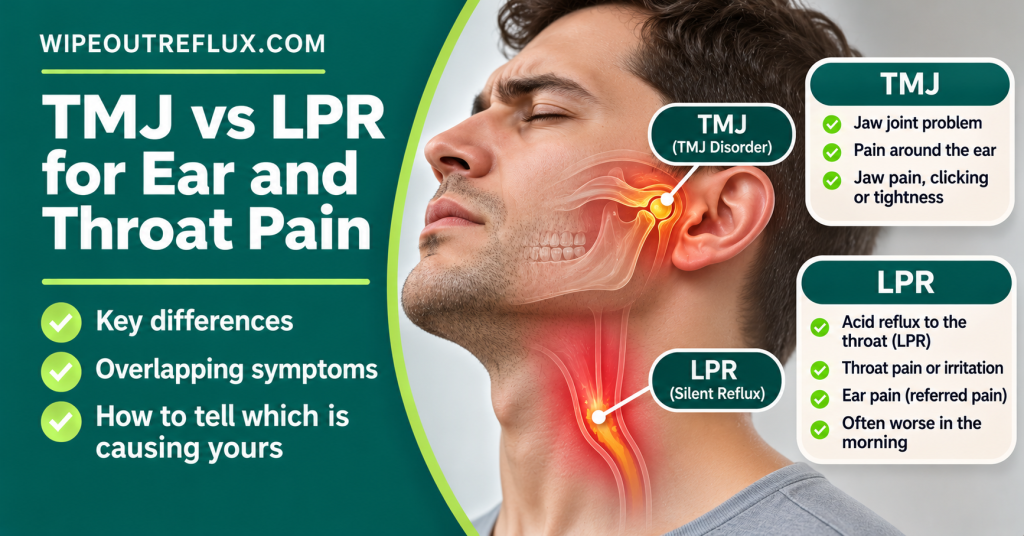
TMJ disorders and LPR can both cause ear pain and throat discomfort, and they’re easy to mix up because the jaw, ear and throat share the same nerves. The quickest way to tell them apart is to notice what sets the pain off. TMJ pain is mechanical: it’s triggered by chewing, yawning, talking or clenching, often comes with jaw clicking or stiffness, and the joint just in front of your ear is tender to press. LPR pain is linked to reflux: it tends to flare after meals or when lying down, and comes with throat clearing, mucus, hoarseness or a lump-in-the-throat feeling.
The two also overlap more than most people realize. Research shows reflux reaching the esophagus at night can trigger teeth grinding, a major driver of jaw pain. So some people have both, and treating one can help the other. If your ear looks normal on examination but keeps hurting, it’s worth working out which one is responsible.
Key Takeaways
- The ear shares nerves with the jaw, teeth, throat and larynx, so pain from any of them can be felt in the ear. This is called referred ear pain.
- The jaw joint is one of the most common sources of ear pain when the ear itself looks normal.
- TMJ pain is mechanical: worse with chewing, yawning or clenching, with jaw clicking, stiffness and tenderness in front of the ear.
- LPR pain is linked to reflux: worse after meals, lying down or at night, with throat clearing, mucus, hoarseness and a lump-in-the-throat feeling.
- Reflux at night can trigger teeth grinding (sleep bruxism), and acid suppression reduced grinding in a small trial. That makes reflux a possible hidden driver of TMJ symptoms.
- Persistent one-sided ear or throat pain with a normal ear exam should always be checked by an ENT, especially if you smoke or drink.
Why Ear and Throat Pain Is So Confusing
Your ear gets its sensation from several different nerves: branches of the trigeminal nerve (which also serves the jaw and teeth), the facial nerve, the glossopharyngeal nerve (which also serves the back of the throat and tonsils), the vagus nerve (which also serves the larynx and esophagus) and upper neck nerves. When something irritates one of those nerves elsewhere, your brain can register the pain as coming from the ear [Chen et al., American Journal of Neuroradiology, 2009].
That’s why a doctor can look in your ear, find nothing wrong, and still not explain the pain. The ear is the messenger, not the source. The trigeminal nerve, which serves the jaw joint and chewing muscles, is the most common pathway for this kind of referred ear pain. The glossopharyngeal and vagus nerves carry it from the throat and larynx, which is how reflux can cause ear pain too.
What Is TMJ Disorder?
Your temporomandibular joints (TMJs) connect your lower jaw to your skull, just in front of each ear. “TMJ” or “TMD” (temporomandibular disorder) covers problems with the joint itself, the cartilage disc inside it, and the chewing muscles around it.
Common causes include clenching or grinding your teeth, stress-related muscle tension, jaw injury, arthritis, and a displaced disc inside the joint.
Why TMJ causes ear pain
The jaw joint sits right next to the ear canal, and they share nerve supply. Ear symptoms are very common in TMJ disorders. In one study of 200 people with TMJ problems, more than three-quarters reported at least one ear-related symptom. Ear pain affected up to around two-thirds of those with muscle-related TMJ pain, compared with only 8% of people without TMJ problems [Tuz et al., American Journal of Orthodontics and Dentofacial Orthopedics, 2003]. Ringing in the ears, a blocked or full feeling, and dizziness are also common.
Can TMJ cause throat pain?
It can. The chewing muscles, particularly the pterygoid muscles deep inside the jaw, and the muscles at the front of the neck are closely connected. Tension or spasm in them can cause a dull ache under the jaw or in the side of the throat, discomfort when swallowing, or a tight feeling in the throat. It usually feels muscular and achy, often on one side, and it gets worse after a lot of chewing or talking, or after a night of clenching.
How LPR Causes Ear and Throat Pain
In LPR, stomach contents, including acid and pepsin, reach the throat and larynx. That irritation can cause:
- Throat pain or burning, often a raw or sore feeling rather than classic heartburn
- Referred ear pain through the vagus and glossopharyngeal nerves, which supply both the throat and the ear
- Ear fullness or popping, because inflammation around the back of the nose can affect the Eustachian tubes
- Throat clearing, mucus, hoarseness, cough and a lump-in-the-throat feeling
I’ve covered the ear side in more detail in acid reflux and ear pain and acid reflux and Eustachian tube dysfunction.
TMJ vs LPR: How to Tell the Difference
Here are the clues I’d look at, side by side.
What triggers the pain
- TMJ: chewing (especially tough foods or gum), yawning, talking a lot, clenching, opening wide.
- LPR: meals (especially large, late, fatty or acidic ones), lying down, bending over, trigger foods and drinks.
Timing
- TMJ: often worst in the morning if you grind or clench at night, with a tired, stiff jaw on waking. It can also build through a day of chewing and talking.
- LPR: often worst in the morning too, but as hoarseness, mucus and a raw throat rather than jaw stiffness. It also flares after meals and in the evening.
Where it hurts
- TMJ: just in front of the ear, at the jaw joint, spreading into the temple, cheek or side of the head. It’s often one-sided.
- LPR: in the throat, the larynx (Adam’s apple area) or behind the breastbone, with ear pain that’s harder to pin down. It’s more often felt centrally or on both sides.
Other symptoms
- TMJ: jaw clicking, popping or grating, a jaw that locks or won’t open fully, headaches, worn or sensitive teeth, ringing in the ear, facial muscle pain.
- LPR: throat clearing, excess mucus or postnasal drip, hoarseness, a chronic cough, a lump-in-the-throat feeling, a sour taste, and sometimes heartburn.
The touch test
Put your fingertips just in front of both ears and slowly open and close your mouth. If you feel clicking, grinding or tenderness, or if pressing on the joint or your cheek muscles reproduces your ear pain, that points toward TMJ. Pressing on your jaw shouldn’t make LPR pain any worse.
Response to treatment
- TMJ: improves with a soft diet, jaw rest, heat, a night guard and stress reduction.
- LPR: improves with diet changes, not eating late, raising the head of your bed and an alginate after meals and at bedtime.
The Hidden Link: Reflux and Teeth Grinding
This is the connection most articles miss. Reflux and TMJ problems aren’t always separate conditions. Reflux may be driving some jaw pain.
In a randomized sleep-lab study, infusing a small amount of acid into the esophagus of healthy men during sleep triggered rhythmic jaw muscle activity, including teeth-grinding episodes [Ohmure et al., Journal of Dental Research, 2011]. In a follow-up randomized trial in people with diagnosed sleep bruxism, a PPI significantly reduced jaw muscle bursts, grinding episodes and grinding noise compared with placebo [Ohmure et al., Journal of Dental Research, 2016]. The trial was small, and the authors said larger studies are needed. But the direction is clear: reflux at night can make you grind.
One theory is that grinding and the extra swallowing that comes with it may be the body’s way of producing saliva to clear acid. Whatever the reason, nightly grinding overloads the jaw joint and chewing muscles, which leads to morning jaw pain, headaches, and the referred ear pain we’ve been talking about.
Clues that reflux could be behind your grinding:
- You grind or clench at night and also have reflux symptoms, especially at night.
- Your dentist has noticed tooth wear or acid erosion on the inner surfaces of your teeth.
- You wake up with both a sore jaw and a sour taste, hoarse voice or dry, raw throat.
- Your jaw symptoms get worse during reflux flare-ups.
When It’s Both, or Neither
Many people have both TMJ and LPR, and they can share triggers: stress, poor sleep, sleep apnea and clenching. If you treat one and the other is left behind, you may only get partial relief.
Ear and throat pain also has causes beyond these two, including dental problems, tonsil issues, neck problems and nerve pain. Referred ear pain can occasionally be an early sign of something more serious in the throat or larynx. See an ENT promptly if you have:
- One-sided ear or throat pain lasting more than three weeks with a normal ear exam
- Pain or difficulty swallowing that’s getting worse
- Hoarseness lasting more than three to four weeks
- A lump in your neck
- Unexplained weight loss, or coughing up blood
- Any of the above if you smoke or drink heavily
Most of the time the cause is benign, but these are worth ruling out. I explain the warning signs in sore throat and ear pain on one side and LPR or throat cancer.
What Helps TMJ Pain
- Rest the jaw: soft foods, small bites, no gum, and avoid opening very wide.
- Warmth: a warm compress on the joint and cheek muscles for 10 to 15 minutes.
- Notice daytime clenching. Your teeth should be apart and your jaw relaxed when you’re not eating.
- Night guard: a dentist-fitted splint protects your teeth and joint if you grind.
- Stress management and gentle jaw exercises, ideally guided by a dentist or physiotherapist with TMJ experience.
What Helps LPR Pain
- Stop eating at least three hours before bed. This also matters for grinding if reflux is driving it.
- Raise the head of your bed with blocks or a wedge.
- Cut back on the main triggers: coffee, alcohol, acidic and carbonated drinks, chocolate, mint, and fatty or fried food.
- Use an alginate after meals and at bedtime to stop reflux reaching your throat.
- Follow a structured plan. The Wipeout Diet Plan lays out exactly what to eat and avoid to calm throat reflux.
If you’re not sure whether your symptoms point to reflux, my Reflux Symptom Index guide gives you a quick, validated way to score them.
Conclusion
TMJ and LPR can produce remarkably similar ear and throat pain because they share the same nerve pathways. The best way to tell them apart is to look at what sets the pain off. Jaw movement, clicking and tenderness in front of the ear point to TMJ. Meals, lying down, throat clearing, mucus and hoarseness point to LPR.
But it isn’t always one or the other. The research on nighttime reflux and teeth grinding suggests that for some people, reflux is quietly driving the clenching and jaw pain too. If you have both sets of symptoms, treating reflux properly may help your jaw as well as your throat.
That’s where diet makes the biggest difference. The Wipeout Diet Plan is my complete, step-by-step guide to calming reflux. It was built first and foremost for LPR, the throat-based kind behind so much unexplained ear and throat pain, but because it targets the same underlying triggers, it works just as well for GERD and everyday heartburn. Pair it with good jaw habits, and you’re tackling both sides of the problem at once.
Frequently Asked Questions
Can TMJ cause throat pain?
Yes. Tension in the chewing and neck muscles connected to the jaw can cause aching under the jaw or in the side of the throat, discomfort when swallowing or a tight throat feeling. It’s usually achy, one-sided and worse after chewing, talking or clenching.
What does TMJ ear pain feel like?
Usually a dull ache in or just in front of the ear, often with jaw stiffness, clicking or tenderness when you press the joint. It typically gets worse with chewing or yawning and may come with ringing or a blocked feeling in the ear, even though the ear looks normal.
Can acid reflux cause ear pain?
Yes. LPR can cause referred ear pain through the nerves shared by the throat and ear, and it can affect the Eustachian tubes, causing fullness or popping. It’s usually accompanied by throat symptoms like clearing, mucus or hoarseness.
Can acid reflux cause teeth grinding?
Research suggests it can. In a sleep-lab study, acid in the esophagus triggered grinding episodes, and in a small trial a PPI reduced grinding in people with sleep bruxism. If you grind and have nighttime reflux, treating the reflux is worth trying.
How do I know if my ear pain is TMJ or reflux?
Check what triggers it. If it’s worse with chewing, yawning or clenching, and pressing in front of your ear reproduces the pain, think TMJ. If it’s worse after meals or lying down and comes with throat symptoms, think LPR. You can have both.
Should I see a dentist or an ENT?
For jaw clicking, grinding, tooth wear or jaw stiffness, start with a dentist experienced in TMJ. For throat symptoms, hoarseness or ear pain without jaw problems, see an ENT. If ear or throat pain on one side lasts more than three weeks, see an ENT either way.
Can stress cause both TMJ and reflux?
Stress increases clenching and jaw tension, and it can also make reflux symptoms feel worse. It’s one reason the two often flare together. I’ve covered the reflux side in can stress cause acid reflux.
Research & References
- [Chen et al., American Journal of Neuroradiology, 2009] — Review of referred ear pain, describing how the trigeminal, facial, glossopharyngeal and vagus nerves and upper cervical nerves carry pain to the ear. The trigeminal nerve is the most common pathway.
- [Tuz et al., American Journal of Orthodontics and Dentofacial Orthopedics, 2003] — Study of 200 TMD patients and controls. 77.5% of TMD patients had at least one ear complaint, and ear pain was reported by up to 63.6% of those with myofascial pain, versus 8% of controls.
- [Ohmure et al., Journal of Dental Research, 2011] — Randomized crossover sleep-lab study. Acid infused into the esophagus during sleep induced rhythmic masticatory muscle activity, including sleep bruxism episodes.
- [Ohmure et al., Journal of Dental Research, 2016] — Randomized clinical trial in patients with sleep bruxism. A PPI significantly reduced EMG bursts, rhythmic masticatory muscle activity episodes and grinding noise compared with placebo.

David Gray
12 years living with LPR · Consultant & researcher
I've lived with LPR for twelve years — the misdiagnoses, the PPI courses that did nothing, the slow work of figuring out what actually helps. Wipeout Reflux is where I translate the research into plain terms for people stuck in the same place. Every claim here is sourced to peer-reviewed work, and I consult one-to-one with LPR sufferers.