
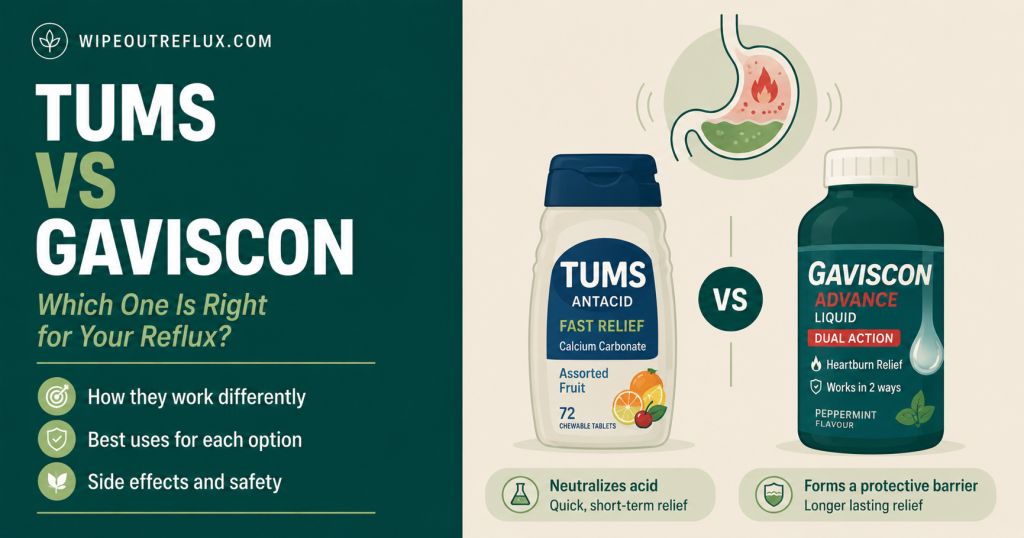
Tums and Gaviscon both treat heartburn, but they work in completely different ways — and that difference decides which one you should reach for. Tums neutralise acid. Gaviscon floats a raft on top of your stomach to physically block reflux from coming up. One buffers, the other blocks.
For a quick, occasional heartburn flare, Tums are faster and simpler. For regurgitation, night-time reflux, or throat symptoms — anything where the problem is stuff travelling up rather than just being acidic — Gaviscon’s raft does something Tums fundamentally can’t. And there’s a twist most comparisons miss: “Gaviscon” means two very different products depending on which side of the Atlantic you’re on.
So the short version: Tums for fast relief of the odd flare, Gaviscon for reflux you can feel rising and for throat-based symptoms. Here’s how to tell which fits you.
Key Takeaways
- Tums are calcium carbonate — they neutralise acid already in the stomach, working within seconds but lasting only about an hour.
- Gaviscon works mainly as an alginate, forming a floating raft that physically blocks reflux rather than just neutralising it.
- The raft addresses the volume and reach of reflux, which is why Gaviscon suits regurgitation, night-time reflux and throat symptoms far better than Tums.
- “Gaviscon” is two different products: US Gaviscon is largely an antacid with a little alginic acid; UK Gaviscon Advance packs 1,000 mg of sodium alginate per dose.
- Alginate therapy beat placebo and antacids for reflux symptom resolution with an odds ratio of 4.42 in a meta-analysis of 14 randomised trials.
- Gaviscon Advance specifically has published trial evidence in laryngopharyngeal (silent) reflux; Tums has none for the throat.
- Tums win on speed, price and simplicity for occasional heartburn.
- Neither fixes the cause — both are rescues, not cures.
How Tums work: fast acid neutralisation
Tums are calcium carbonate. When a tablet meets stomach acid it neutralises it on contact, raising the pH of whatever’s already there. It’s a chemical buffer, and it’s quick — in a randomised trial comparing over-the-counter Tums with Pepcid, the calcium carbonate antacid had a rapid onset, buffering acid almost immediately after a meal Feldman, JAMA, 1996.
The trade-off is duration. In that same study, the antacid’s effect was short-lived — roughly an hour — because your stomach keeps making acid once the tablet is spent. Antacids remain a mainstay of reflux self-treatment thanks to that speed-and-safety combination Garg et al., Journal of International Medical Research, 2022, but they’re built for breakthrough relief, not sustained control.
Crucially, Tums do one thing: lower acidity. They don’t reduce how much reflux happens, and they do nothing about pepsin, the stomach enzyme behind most throat symptoms. Hold that thought — it’s where Gaviscon pulls ahead.
How Gaviscon works: a physical raft
Gaviscon’s active principle is an alginate, which comes from brown seaweed. When it meets stomach acid it precipitates into a gel, and bicarbonate in the formula releases carbon dioxide that makes the gel buoyant. The result is a low-density raft that floats on top of your stomach contents.
That raft matters because of the acid pocket — a layer of unbuffered acid that sits at the top of the stomach after meals, right at the junction with the oesophagus, and it’s the acid that reflux draws from. This has been directly imaged: using scintigraphy, an alginate raft co-localised with the postprandial acid pocket and displaced it below the diaphragm in 71% of patients versus 21% on antacid alone, significantly cutting reflux episodes Rohof et al., Clinical Gastroenterology and Hepatology, 2013.
That’s the fundamental difference from Tums. A buffer changes how acidic the reflux is; a raft changes whether reflux happens at all and how much comes up. And the evidence for the class is solid — a systematic review and meta-analysis of 14 randomised controlled trials in 2,095 subjects found alginate therapies increased the odds of reflux symptom resolution compared with placebo or antacids, with an odds ratio of 4.42 Leiman et al., Diseases of the Esophagus, 2017.
The catch: which Gaviscon do you mean?
This trips up almost everyone, and it changes the whole comparison.
US Gaviscon
The Gaviscon on American shelves is formulated as an antacid. The Extra Strength chewable tablets list aluminium hydroxide and magnesium carbonate as active ingredients, with alginic acid appearing among the inactive ingredients DailyMed, Gaviscon Extra Strength product label. It forms some raft, but the alginate dose is low. Against Tums, US Gaviscon is much closer to a fellow antacid than most people realise — I dig into a similar match-up in Pepcid vs Gaviscon.
Gaviscon Advance (UK)
This is a genuinely different product: 1,000 mg of sodium alginate per 10 ml, with no aluminium — roughly ten times the alginate of the US version. It’s the formulation with the strongest evidence in throat-based reflux. In a randomised controlled trial, a liquid alginate suspension (Gaviscon Advance) produced significant improvement in laryngopharyngeal reflux symptoms and findings compared with control McGlashan et al., European Archives of Oto-Rhino-Laryngology, 2009. It isn’t sold in US pharmacies but is widely available as an import — I cover it fully in my Gaviscon Advance guide.
So when you ask “Tums or Gaviscon,” the honest answer depends on this: against US Gaviscon it’s a close antacid-versus-antacid call, but against Gaviscon Advance the raft mechanism gives Gaviscon a real, evidence-backed advantage for anything beyond simple heartburn.
Head to head
Speed of relief
Tums win. Calcium carbonate neutralises acid within seconds. If you want relief in the next minute, Tums are hard to beat — a raft takes a little longer to form.
Duration and staying power
Gaviscon wins. A raft lasts up to around four hours; a Tums tablet buffers for about one. For a symptom that outlasts a single tablet — particularly overnight — the raft covers far more ground.
Regurgitation and volume reflux
Gaviscon wins clearly. If the problem is contents physically coming up — a sour or bitter mouthful, regurgitation — Tums can’t help, because they don’t reduce volume. The raft is designed for exactly this.
Night-time reflux
Gaviscon wins. Lying down is when reflux travels furthest, and a short-acting buffer wears off long before morning. A bedtime raft covers the most vulnerable window, which is why it’s a staple for night-time reflux.
Throat symptoms and LPR
Gaviscon Advance wins outright. Silent reflux is driven by pepsin reaching the throat, and Tums do nothing about pepsin or volume. Gaviscon Advance is the one product with published LPR trial evidence — the same reason acid-only approaches underperform in LPR. For throat clearing, hoarseness and globus, this isn’t close.
Occasional heartburn
Tums win on simplicity. For the odd flare after a big meal, a chewable tablet is faster, cheaper and more convenient than measuring out liquid. This is Tums’ home turf.
Price and availability
Tums win in the US. They’re cheap and everywhere. US Gaviscon is easy to find too; Gaviscon Advance — the version worth having for serious reflux — has to be imported, which means higher cost and variable stock.
Pregnancy
Roughly even. Both calcium carbonate and alginates are considered among the safer reflux options in pregnancy, working locally with little absorption. Alginates avoid the extra calcium load; Tums add a little calcium. Either is reasonable — check with your midwife or doctor.
Which should you actually buy?
Choose Tums if your heartburn is occasional, you want the fastest possible relief, and you like the simplicity of a chewable tablet you can carry anywhere. For breakthrough acid now and then, they’re the efficient choice.
Choose Gaviscon (ideally Advance) if you get regurgitation, night-time symptoms, or anything throat-based — hoarseness, globus, chronic throat clearing — or if your reflux outlasts a short-acting tablet. The raft does something Tums mechanically cannot.
You can also use both. They don’t clash: Tums for instant relief when something flares, an alginate raft after meals and at bedtime to hold reflux down. If you want the fuller alginate landscape, I lay it out in alginates for acid reflux, and compare premium options in Reflux Gourmet vs Gaviscon.
Getting the timing right
Whichever you choose, timing changes how well it works — especially for Gaviscon.
- Tums: take when symptoms hit. They act on acid already present, so there’s no need to pre-empt a meal.
- Gaviscon: always after food, never before — the raft needs a meal to float on. About 30 minutes after eating is the sweet spot.
- At bedtime: a raft after your last food or drink covers the overnight window; a Tums tablet won’t last the night.
- Don’t drink for 20–30 minutes after Gaviscon — washing the raft down defeats it.
- Space either from other medicines by a couple of hours, since both calcium carbonate and alginates can affect absorption of things like iron and thyroid tablets.
Conclusion
Tums versus Gaviscon isn’t really about which is “stronger” — it’s about matching the tool to the problem. Tums are a fast, cheap acid buffer, ideal for the occasional heartburn flare and unbeatable on speed. Gaviscon works by a different mechanism entirely: a raft that physically blocks reflux from rising, which is what you actually need for regurgitation, night-time symptoms and anything involving the throat. And because “Gaviscon” spans a weak US antacid and a potent UK alginate, the version matters as much as the brand — for real reflux control, Gaviscon Advance is the one worth seeking out.
What neither does is fix the cause. Tums neutralise acid that’s already refluxed; Gaviscon caps reflux you’re still producing. Both are barriers you reapply, not treatments that reduce how much reflux your body generates in the first place — and if you’re using either most days, that underlying reflux is what needs attention.
That’s where the Wipeout Food Reference Guide comes in — the essential reference for which foods and drinks are safe with acid reflux and LPR, and their pH values, so you’re removing the triggers behind your symptoms rather than just managing the fallout. And for the full structured approach, the Wipeout Diet Plan goes much deeper. It was built first around LPR — the stubborn, throat-based form where an alginate raft matters most — but since it targets the same root mechanisms, it works just as well for GERD and everyday heartburn. Use Tums or Gaviscon as the barrier while the diet does the structural work, and you’ll reach for either far less often.
Frequently Asked Questions
Is Tums or Gaviscon better for acid reflux?
It depends on your symptoms. Tums are better for fast relief of occasional heartburn. Gaviscon is better for regurgitation, night-time reflux and throat symptoms, because its raft physically blocks reflux rather than just neutralising acid. For classic occasional heartburn either works; for volume or throat-based reflux, Gaviscon has the edge.
Can I take Tums and Gaviscon together?
Yes. They work by different mechanisms and don’t clash — Tums neutralise acid on the spot, while an alginate raft blocks reflux over a few hours. Some people use Tums for instant flares and Gaviscon after meals and at bedtime. Space either from other medicines by a couple of hours.
Why is UK Gaviscon different from US Gaviscon?
They’re different formulations under the same brand. US Gaviscon is regulated as an antacid, with aluminium hydroxide and magnesium carbonate as actives and alginic acid as an inactive ingredient. UK Gaviscon Advance contains 1,000 mg of sodium alginate per 10 ml — roughly ten times the alginate — and has the stronger raft and the better trial evidence.
Which works faster, Tums or Gaviscon?
Tums. Calcium carbonate neutralises acid within seconds, whereas Gaviscon’s raft takes a little longer to form. But Gaviscon lasts much longer — up to around four hours versus roughly one for Tums.
Are Tums or Gaviscon better for silent reflux and LPR?
Gaviscon Advance, clearly. LPR is driven by pepsin reaching the throat, and Tums do nothing about pepsin or reflux volume. Gaviscon Advance is the one product with published LPR trial evidence, making it the better-matched choice for hoarseness, throat clearing and globus.
Do Tums or Gaviscon cure acid reflux?
Neither. Both are rescue treatments — Tums buffer acid briefly, Gaviscon blocks reflux for a few hours. Neither reduces how much reflux your body produces, so lasting improvement comes from addressing the cause: diet, meal timing, weight and night-time positioning.
Research & References
- Randomised, double-blind, placebo-controlled crossover trial comparing over-the-counter famotidine (Pepcid AC) with calcium carbonate antacid (Tums), showing the antacid had rapid onset but short duration of action Feldman, JAMA, 1996.
- Systematic review and meta-analysis of 14 randomised controlled trials in 2,095 subjects finding alginate-based therapies increased the odds of gastroesophageal reflux symptom resolution compared with placebo or antacids (odds ratio 4.42) Leiman et al., Diseases of the Esophagus, 2017.
- Randomised controlled trial of a liquid alginate suspension (Gaviscon Advance) in laryngopharyngeal reflux, showing significant symptomatic and clinical improvement compared with control McGlashan et al., European Archives of Oto-Rhino-Laryngology, 2009.
- Scintigraphy study showing an alginate raft co-localised with the postprandial acid pocket and displaced it below the diaphragm in 71% of patients versus 21% on antacid alone, significantly reducing reflux episodes Rohof et al., Clinical Gastroenterology and Hepatology, 2013.
- Review of contemporary evidence on antacids, concluding they remain a mainstay of reflux self-management on the basis of efficacy, safety and over-the-counter availability Garg et al., Journal of International Medical Research, 2022.
- Official US product label for Gaviscon Extra Strength, listing aluminium hydroxide and magnesium carbonate as active ingredients with alginic acid among the inactive ingredients DailyMed, US National Library of Medicine.

David Gray
12 years living with LPR · Consultant & researcher
I've lived with LPR for twelve years — the misdiagnoses, the PPI courses that did nothing, the slow work of figuring out what actually helps. Wipeout Reflux is where I translate the research into plain terms for people stuck in the same place. Every claim here is sourced to peer-reviewed work, and I consult one-to-one with LPR sufferers.