
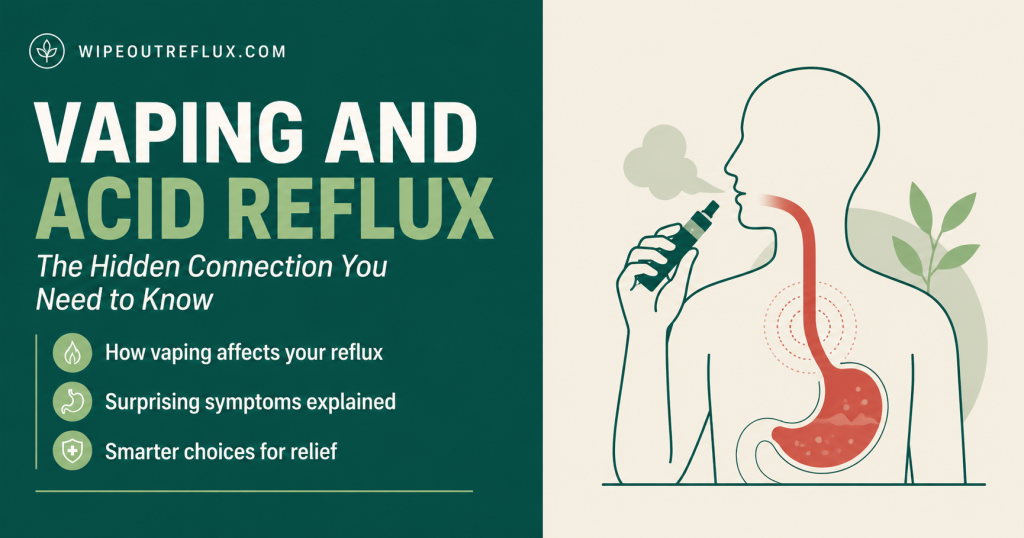
Yes, vaping can cause and worsen acid reflux — and if you switched from cigarettes expecting your reflux to clear up, the reason it didn’t is that almost none of smoking’s reflux mechanisms depend on smoke.
That’s the thing worth understanding here. When people talk about why smoking causes reflux, they picture tar and combustion. But when researchers stripped all of that away and simply put a 15 mg nicotine patch on ten healthy non-smokers, lower oesophageal sphincter pressure dropped by 31% within twelve hours. No smoke involved. The nicotine alone did it.
And there’s a second issue that I think matters more than anyone acknowledges: the way people vape is completely different from the way people smoked. A cigarette is a discrete event — you step outside, you have five minutes, you come back. A vape sits on your desk. People use it at their computer, on the sofa, and in bed. So instead of fifteen short nicotine spikes a day, your sphincter gets a more or less continuous low-grade suppression, including in the hours before you lie down. On paper that’s the safer product. For your oesophagus, the usage pattern may well cancel out the benefit.
Key Takeaways
- A 15 mg nicotine patch reduced lower oesophageal sphincter pressure by 31% in healthy non-smokers — proving nicotine alone relaxes the valve, without any smoke.
- Around 33% of e-cigarette users report dry mouth. Saliva is how your oesophagus neutralises residual acid, so less saliva means slower clearance.
- Smokers secrete only 60% of the salivary titratable base non-smokers do, and their acid clearance times are 50% longer.
- Most smoking-related reflux events happen during coughing and deep inspiration, not sphincter relaxations — and vaping involves the same deep inhalations.
- Vaping-associated oesophagitis is documented: a 25-year-old with previously well-controlled reflux developed Los Angeles Grade C oesophagitis after heavy daily vaping.
- Direct research on vaping and GERD is still thin and inconsistent. One study of 397 Saudi university students found no significant association once BMI was accounted for.
- Continuous all-day use, especially in the hours before bed, is probably the biggest difference between vaping and smoking as far as reflux is concerned.
- In smokers who quit successfully, 43.1% saw their reflux improve at one year, versus 18.2% of those who failed to quit.
What the direct evidence actually shows
I want to be straight about this, because a lot of articles on vaping and reflux state things with far more confidence than the research supports.
Vaping is new. The studies that exist are mostly small cross-sectional surveys of students, and they don’t agree with each other. One study of 397 university students in Jeddah found a GERD prevalence of 19.9% overall, but only a weak, non-significant association with e-cigarette use — and the authors suggested body mass index was doing more of the work Alturki et al., Cureus, 2023.
There is no large prospective cohort. There is no randomised trial. Anyone telling you vaping definitively causes GERD, or definitively doesn’t, is going beyond the evidence.
What we do have is excellent mechanistic evidence — studies that isolate the individual components and show exactly what each one does to your oesophagus. And those are unambiguous. So the honest framing is: we can’t yet quantify the population-level risk, but we can be confident about the mechanisms, and every one of them points the same way.
Four mechanisms that don’t need smoke
1. Nicotine relaxes the sphincter directly
This is the cleanest evidence in the whole field, and it comes from a study that had nothing to do with vaping.
Ten healthy non-smoking volunteers had oesophageal manometry at baseline, then wore a nicotine patch delivering 15 mg a day, then had manometry repeated twelve hours later. Sphincter pressure measured by rapid pull-through fell by 31%, from 17.4 to 12.1 mmHg. By station pull-through it fell 27%. Blood nicotine and cotinine, absent at baseline, were significantly elevated Kadakia et al., Digestive Diseases and Sciences, 1996.
No smoke. No tar. No combustion. Just nicotine, absorbed through the skin, and the lower oesophageal sphincter lost roughly a third of its resting pressure.
For context, the same paper notes that smoking itself decreases sphincter pressure by 19–42%. Nicotine is doing most of the work in that range.
This single finding is why “I switched to vaping so my reflux should be better” doesn’t hold. You changed the delivery system. You didn’t remove the drug.
2. Less saliva, slower clearance
This mechanism is underrated, and it’s the one that connects most directly to how vaping feels.
Your oesophagus clears acid in two stages. Peristalsis sweeps the bulk of it back down, then swallowed saliva neutralises what’s left. Saliva is mildly alkaline and rich in bicarbonate, so it’s effectively a rinse cycle. Less saliva means acid sits against the lining for longer — which is exactly the bicarbonate mechanism that protects you between reflux episodes.
Smoking wrecks this. In a study of 8 non-smokers and 16 smokers, smokers secreted only 60% of the salivary titratable base that non-smokers did, and their acid clearance times were 50% longer. Acute smoking during the study prolonged clearance and cut salivary base secretion further Kahrilas and Gupta, The Journal of Laboratory and Clinical Medicine, 1989.
Vaping does something similar by a different route. A meta-analysis of 14 studies covering 6,827 people found xerostomia — dry mouth — in 33% of e-cigarette users, higher than the 24% seen in combustible tobacco users Guo et al., Tobacco Induced Diseases, 2023.
The reason is chemical. Propylene glycol, the carrier that makes up much of most e-liquids, is hygroscopic — it binds water. Draw it repeatedly across your mouth and throat and it pulls moisture out of the tissue. Nicotine adds vasoconstriction, reducing blood flow to the salivary glands.
So if you vape and have a persistently dry mouth, that isn’t a trivial side effect. It’s a direct hit to one of your two acid-clearance systems.
3. Deep inhalation causes reflux mechanically
This is the mechanism almost nobody knows about, and it’s arguably the most relevant to vaping.
When researchers actually measured how reflux events happen in smokers, using a sphincter sleeve, a pH electrode and muscle recordings, they found something unexpected. Fewer than half the reflux events came via transient sphincter relaxations — the usual route. The majority happened during coughing or deep inspiration, where an abrupt rise in intra-abdominal pressure overwhelmed an already weakened sphincter Kahrilas and Gupta, Gut, 1990.
Now think about how people vape. A long, deep lung inhale, often deeper and longer than a cigarette draw, repeated many times per session. Plus the cough — the throat irritation from propylene glycol and high-nicotine salts makes coughing common, especially early on.
Every one of those is a pressure event across a sphincter that nicotine has already loosened. It’s a mechanical mechanism, and it doesn’t care whether the aerosol is smoke or vapour.
4. Swallowed air
A smaller factor but a real one. Any repeated inhaling-and-exhaling ritual involves swallowing air, and gastric distension is one of the most reliable triggers of the transient sphincter relaxations that let reflux through. If you notice a lot of burping when you vape heavily, that’s what’s happening — and each belch is a sphincter opening that refluxate can travel through.
Why vaping may be worse than smoking — for reflux specifically
Let me be clear about the framing here: on overall health, and particularly on lung and cancer risk, moving from cigarettes to vaping is a meaningful improvement. That’s not in question, and I’m not going to pretend otherwise.
But for reflux specifically, there’s an argument that vaping is the harder problem, and it comes down to how the two are used.
Cigarettes are self-limiting. A cigarette takes five minutes, you have to go outside, and you can’t do it at your desk or in a restaurant or in bed. A twenty-a-day smoker gets twenty discrete nicotine spikes with gaps in between — and during those gaps, sphincter pressure partially recovers.
Vaping isn’t. There’s no combustion, no smell, no ash and no social barrier, so people vape more or less continuously. Hundreds of puffs a day is normal. Which means the sphincter suppression is more or less continuous too.
Nicotine salts changed the dose. Modern disposables and pod systems use nicotine salt formulations that deliver high concentrations far more smoothly than freebase nicotine ever did. Blood nicotine levels in regular users can be comparable to or higher than in smokers.
And the biggest one: people vape in bed. Nobody smoked lying down with the lights off. Plenty of people vape right up until they close their eyes, which puts peak nicotine exposure at exactly the moment gravity stops helping you. Night-time reflux is the most damaging kind, because acid sits for far longer when you’re horizontal and swallowing less.
If you take one practical thing from this article, make it that one. Stop vaping three hours before bed and keep the device out of the bedroom.
Vaping-associated oesophagitis is a real thing
It’s rare enough that it’s still at the case-report stage, but it exists in the literature.
A 25-year-old man with reflux that had been well controlled on a proton pump inhibitor for years presented with a week of severe pain on swallowing. He had started vaping around two months earlier, with heavy daily use in the preceding weeks. Endoscopy showed Los Angeles Grade C oesophagitis — extensive mucosal breaks. Biopsies showed granulation tissue with acute and chronic inflammation, and testing ruled out candida Pasricha and Kochar, BMC Gastroenterology, 2021.
One case doesn’t establish a pattern, and I’d caution against reading too much into it. But Grade C erosive oesophagitis in a 25-year-old whose reflux had previously been controlled is the sort of thing that makes clinicians pay attention. If you’ve started vaping heavily and developed painful swallowing, that’s worth a doctor’s appointment rather than a wait-and-see.
Vaping, the throat, and silent reflux
If your reflux is the throat-based kind, vaping is a particularly awkward habit, and the reason is that the two problems produce nearly identical symptoms.
LPR symptoms are hoarseness, chronic throat clearing, a lump sensation, mucus and a nagging cough. Vaping produces throat irritation, a dry scratchy feeling, and a cough of its own. Which means people spend months unable to tell whether their throat symptoms are reflux or the vape, and often treat one while the other continues.
Both are usually contributing. Here’s how they interact:
- Propylene glycol dries the exact tissue that reflux damages. Your larynx has none of the protective mechanisms your oesophagus has — that’s why LPR does damage at exposures GERD wouldn’t. Desiccating it makes it more vulnerable, not less.
- Less saliva means less pepsin clearance. Pepsin lodged in throat tissue is the main agent of damage in LPR, and saliva is part of how you wash it away.
- Throat clearing is self-perpetuating. Irritation causes clearing, clearing causes more irritation, and it becomes a habit loop independent of either cause. Worth reading how to break the throat-clearing cycle.
- Coughing drives reflux. As above — each cough is a pressure spike, so reflux cough and vaper’s cough feed each other.
If you have throat symptoms and you vape, the only way to untangle it is to stop vaping for four to six weeks and see what’s left. Anything shorter won’t give you a clean answer, because throat tissue heals slowly.
Will quitting vaping fix it?
Nobody has studied vaping cessation and reflux directly. But we have good data on smoking cessation, and since the shared mechanism is nicotine, it’s a reasonable guide.
In a study following 191 smokers for a year, 141 successfully quit and 50 didn’t. Among those who quit, 43.1% saw their reflux symptoms improve, compared with 18.2% of those who failed. Reflux symptom frequency and health-related quality of life improved significantly only in the successful group Kohata et al., PLOS ONE, 2016.
Two honest observations about that number. First, 43% is a real effect and clearly better than doing nothing. Second, it’s not most people — over half of successful quitters saw no improvement, because nicotine was one contributor among several and removing it didn’t address the others.
A realistic expectation:
- Days one to seven. Saliva production recovers relatively quickly. Dry mouth and throat improve. Night-time symptoms often ease first, particularly if you’d been vaping in bed.
- Weeks two to four. Sphincter pressure returns to your personal baseline. Heartburn and regurgitation settle to whatever your underlying level is.
- Weeks four to eight. Throat symptoms — hoarseness, clearing, the lump sensation — start to resolve. Don’t judge before this.
Worth flagging: nicotine withdrawal raises stress and anxiety for a week or two, and stress genuinely amplifies reflux symptoms through oesophageal hypersensitivity. Some people feel worse before better. That’s the withdrawal, not evidence that the vaping was helping.
If you’re not ready to stop
Quitting nicotine is hard, and I’d rather give you something useful than a lecture. In rough order of how much difference each makes:
- Nothing within three hours of bed, and no device in the bedroom. This is the single biggest one, for the reasons above.
- Reduce the nicotine strength. The sphincter effect is dose-related. Stepping down from 20 mg/ml to 10 or 6 is a genuine reduction in exposure, and it’s usually easier than reducing frequency.
- Break the continuous grazing. Deliberate sessions with real gaps between them let sphincter pressure partially recover. Leave the device in another room between uses.
- Shallower draws. Mouth-to-lung rather than long deep direct-lung hits reduces both the pressure spikes and the coughing.
- Drink water alongside. Won’t fix the saliva problem but helps with the desiccation.
- Consider chewing gum instead of some sessions. Gum stimulates saliva rather than drying it, and it’s genuinely useful for acid clearance — the opposite effect on the same system.
- Higher VG, lower PG liquids if you can tolerate them, since propylene glycol is the more drying of the two.
And if you’re vaping in order to stay off cigarettes, don’t let reflux push you back to smoking. Combustion adds mechanisms rather than removing them.
Conclusion
Vaping affects reflux through nicotine, reduced saliva and repeated deep inhalation — three mechanisms that have nothing to do with smoke and survive the switch from cigarettes intact. The nicotine patch study is the one to remember: a third of your sphincter pressure, gone, with no combustion involved at all. Add a continuous all-day usage pattern that cigarettes never had, and it’s easy to see why people who expected vaping to solve their heartburn find it hasn’t.
What I’d do with that information is prioritise. Stop vaping in the three hours before bed and get the device out of the bedroom — that costs you almost nothing and removes the most damaging window. Then look at nicotine strength and grazing. And be aware that nicotine is rarely the only thing driving reflux; if you fix it and nothing changes, the answer isn’t that the mechanism is wrong, it’s that something else is contributing more.
That’s usually diet. Working out which foods and drinks are actually safe — and where each one sits on the pH scale, which matters enormously if you have throat symptoms — is exactly what the Wipeout Food Reference Guide is built for. It’s the essential reference for what’s allowed with acid reflux and LPR, with pH values, so you’re not guessing.
If you want the whole approach rather than a lookup table, the Wipeout Diet Plan is the deeper, structured version — sequencing, timing and the healing phase. I built it around LPR and silent reflux, the stubborn throat-based form that tends to resist standard treatment, but since it targets the same underlying mechanisms it works just as well for GERD and ordinary heartburn. If you’re dealing with throat irritation from both reflux and vaping at once, that’s the combination it was designed for.
Frequently Asked Questions
Can vaping cause acid reflux?
It can contribute to it. Nicotine reduces lower oesophageal sphincter pressure — a 15 mg patch lowered it 31% in healthy non-smokers — and vaping also reduces saliva and involves repeated deep inhalation, both of which promote reflux. Direct studies on vaping and GERD are still limited and inconsistent.
Is vaping better than smoking for acid reflux?
Marginally, at best. Removing combustion helps, but nicotine, reduced saliva and deep inhalation are the main reflux mechanisms and all survive the switch. The continuous all-day usage pattern typical of vaping may offset the benefit, especially if you vape close to bedtime.
Does nicotine-free vaping still cause reflux?
Less, but not none. Removing nicotine removes the sphincter effect and the vasoconstriction. Propylene glycol still dries the mouth and throat, and the deep inhalation and swallowed air remain. It’s a genuine improvement, not a clean solution.
Why does vaping make my throat feel worse?
Propylene glycol is hygroscopic and pulls moisture out of throat tissue, and around a third of vapers report dry mouth. If you also have silent reflux, the vape is drying the exact tissue that pepsin is damaging — and the two produce nearly identical symptoms, which makes them hard to tell apart.
How long after quitting vaping will my reflux improve?
Dry mouth and throat usually improve within days. Sphincter pressure returns to baseline over two to four weeks. Throat symptoms take four to eight weeks. In smokers who quit, 43.1% saw reflux improve at one year versus 18.2% who didn’t quit.
Can vaping cause oesophagitis?
There is at least one documented case: a 25-year-old with previously controlled reflux developed Los Angeles Grade C oesophagitis after heavy daily vaping. It appears to be uncommon, but painful swallowing after starting or increasing vaping is worth getting checked.
Does vaping in bed make reflux worse?
Almost certainly. It puts peak nicotine exposure — and therefore lowest sphincter pressure — at the point where you lose the help of gravity and swallow far less. Night-time reflux causes disproportionate damage because acid sits for much longer. Stopping three hours before bed is the single most useful change.
Does lowering my nicotine strength help?
It should. The sphincter effect is dose-related, so stepping down from 20 mg/ml to 10 or 6 reduces exposure meaningfully. For many people it’s an easier first step than cutting frequency, and it can be combined with keeping the device out of the bedroom.
Research & References
- Manometry study in 10 healthy non-smoking volunteers finding that a transdermal patch delivering 15 mg of nicotine per day reduced lower oesophageal sphincter pressure by 31% (17.4 ± 6.1 to 12.1 ± 3.3, P = 0.013) by rapid pull-through and by 27% by station pull-through, with plasma nicotine and cotinine significantly elevated at 12 hours Kadakia et al., Digestive Diseases and Sciences, 1996.
- Study of 8 non-smokers and 16 smokers finding that smokers secreted only 60% of the salivary titratable base of non-smokers and had acid clearance times 50% longer, with acute smoking further prolonging clearance and reducing salivary base secretion Kahrilas and Gupta, The Journal of Laboratory and Clinical Medicine, 1989.
- Postprandial study using a sphincter sleeve, distal oesophageal pH electrode and submental electromyography, finding that chronic smokers had significantly lower sphincter pressure than non-smokers and that fewer than half of reflux events occurred via transient sphincter relaxations, with the majority occurring during coughing or deep inspiration Kahrilas and Gupta, Gut, 1990.
- Systematic review and meta-analysis of 14 studies covering 6,827 subjects, reporting a pooled xerostomia prevalence of 26% overall, 33% (95% CI 18–48) among e-cigarette users and 24% among combustible tobacco users Guo et al., Tobacco Induced Diseases, 2023.
- Case report of a 25-year-old man with previously well-controlled reflux who developed severe odynophagia after approximately two months of vaping, with endoscopy showing Los Angeles Grade C oesophagitis and biopsies showing granulation tissue with acute and chronic inflammation, candida excluded Pasricha and Kochar, BMC Gastroenterology, 2021.
- Cross-sectional study of 397 university students finding a GERD prevalence of 19.9% by the GerdQ questionnaire, with only a weak and non-significant association with e-cigarette use once body mass index was taken into account Alturki et al., Cureus, 2023.
- Prospective study of 191 smokers followed for one year, in which 141 achieved cessation and 50 did not, finding reflux improvement in 43.1% of the successful group versus 18.2% of the failure group, with reflux symptom frequency and health-related quality of life improving significantly only in those who quit Kohata et al., PLOS ONE, 2016.

David Gray
12 years living with LPR · Consultant & researcher
I've lived with LPR for twelve years — the misdiagnoses, the PPI courses that did nothing, the slow work of figuring out what actually helps. Wipeout Reflux is where I translate the research into plain terms for people stuck in the same place. Every claim here is sourced to peer-reviewed work, and I consult one-to-one with LPR sufferers.