
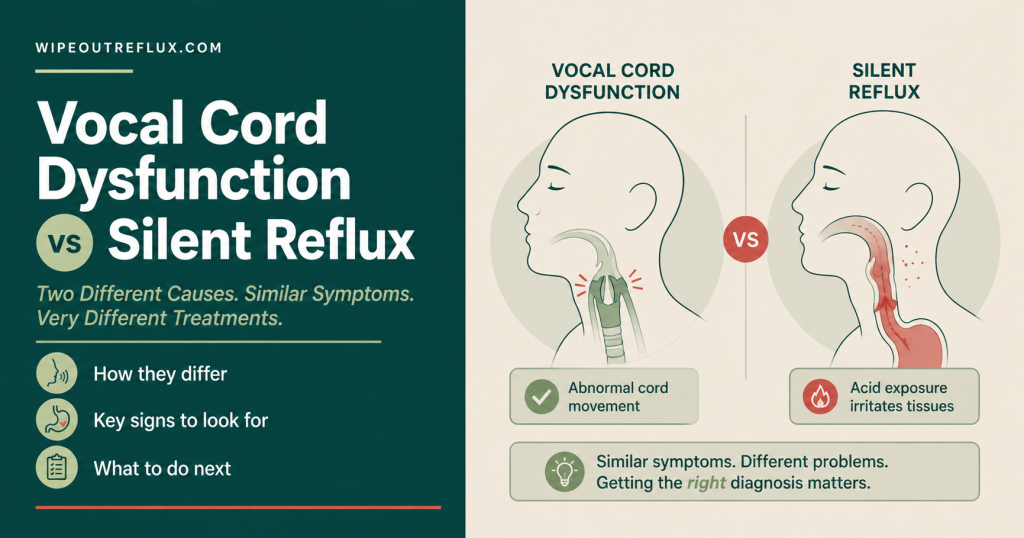
Vocal cord dysfunction (VCD) and silent reflux both cause throat and breathing symptoms, and they’re easy to confuse — but they’re different problems, and here’s the cleanest way to tell them apart. VCD is your vocal cords closing when they should open, causing sudden, frightening episodes of not being able to breathe in. Silent reflux (LPR) is stomach contents irritating your larynx, causing chronic hoarseness, throat clearing and a persistent cough.
The twist — and the reason this comparison matters so much — is that they’re often linked. Reflux is one of the leading triggers of VCD. Chronic irritation from silent reflux can leave the larynx hypersensitive and primed to spasm shut, which means many people don’t have one or the other; they have reflux that’s setting off vocal cord dysfunction on top.
So this isn’t just “which do I have?” — it’s often “is my reflux driving my breathing attacks?” Here’s how to distinguish the two, how they connect, and why sorting it out changes what actually helps.
Key Takeaways
- Vocal cord dysfunction (VCD) is the vocal cords paradoxically closing during breathing, causing sudden difficulty getting air in, throat tightness and noisy inspiration.
- Silent reflux (LPR) is reflux reaching the larynx, causing chronic hoarseness, throat clearing, cough and a lump-in-the-throat feeling — not acute airway closure.
- VCD is episodic and dramatic; LPR is chronic and low-grade. That’s the fastest way to tell them apart.
- Both are commonly mistaken for asthma, and both often fail to respond to asthma inhalers.
- They’re frequently connected: reflux is a major trigger of VCD, because laryngeal irritation makes the vocal cords hypersensitive and prone to spasm.
- VCD is diagnosed by laryngoscopy, ideally during an episode; LPR by laryngeal findings, symptom scores and sometimes reflux testing.
- VCD is treated with breathing/laryngeal-control therapy; LPR is treated by reducing reflux. When reflux drives the VCD, treating the reflux helps both.
- If breathing attacks and reflux symptoms coexist, the reflux is worth treating as a root cause, not just a side issue.
What each condition actually is
They feel related because both live in the larynx, but the mechanisms are quite different.
Vocal cord dysfunction (VCD) — also called paradoxical vocal fold motion or inducible laryngeal obstruction — is a breathing disorder. Normally your vocal cords open wide when you breathe in. In VCD they do the opposite: they adduct, or close, during inspiration, partly blocking the airway. The result is sudden episodes of struggling to get air in, a tight throat, and often a noisy, wheezy or strained sound on the in-breath. It’s an unintentional, reflex-like over-protection of the airway, and between episodes breathing is usually completely normal Kenn & Balkissoon, European Respiratory Journal, 2011.
Silent reflux (LPR) is a reflux disorder. Stomach contents — acid, but crucially also the enzyme pepsin — travel up and reach the throat and voice box, where they irritate the delicate tissue. That produces the familiar chronic cluster: hoarseness, frequent throat clearing, a persistent cough, excess mucus and a globus (lump) sensation. It’s a slow, grumbling irritation rather than an acute airway event, and I cover its full picture in LPR symptoms.
How to tell them apart
A few features separate them reliably. If you’re trying to work out which fits you, these are the questions that matter most.
1. Episodic vs constant
VCD comes in attacks — sudden episodes that flare and then settle, often within minutes, with normal breathing in between. Silent reflux is persistent — a background hoarseness or throat-clearing habit that’s there most days and builds over weeks and months. Dramatic-and-intermittent points to VCD; low-grade-and-chronic points to LPR.
2. Breathing in vs the voice and throat
The hallmark of VCD is difficulty on the in-breath — a feeling that the throat has closed and air can’t get past. LPR doesn’t close the airway; its symptoms are about the voice and throat lining — hoarseness, throat clearing, cough. If the core problem is “I can’t get air in,” think VCD; if it’s “my voice is rough and my throat’s irritated,” think LPR.
3. Triggers
VCD episodes are often provoked by specific triggers — exercise, strong smells, cold air, irritants, anxiety or stress. LPR tracks more with meals, lying down, and dietary triggers. That said, reflux itself is a common VCD trigger, which is where the two blur (more below).
4. The asthma clue
Both are frequently misdiagnosed as asthma — and both often don’t respond to asthma inhalers. In fact, VCD and asthma coexist in a large share of patients, and unrecognised VCD is a common reason “asthma” stays uncontrolled. If you’ve been treated for asthma without relief, both VCD and reflux are worth considering, a theme I explore in acid reflux misdiagnosed as asthma.
5. How the “attack” feels
A VCD episode can be genuinely frightening — a sense of choking or suffocating — but it typically resolves relatively quickly and doesn’t drop your oxygen the way a severe asthma attack can. Reflux can cause its own acute laryngeal events too, which is worth distinguishing from a full VCD attack; I cover that in reflux laryngospasm.
The crucial connection: how reflux triggers VCD
Here’s the part most comparisons miss, and it’s the most useful thing to understand.
These two conditions aren’t just look-alikes — they’re frequently cause and effect. When silent reflux repeatedly irritates the larynx, the nerves and tissues there become hypersensitive. A larynx on high alert is quick to trigger its airway-protective reflex, and that over-reactive reflex is exactly what a VCD episode is. In other words, chronic reflux can prime your vocal cords to slam shut. Reviews of VCD consistently list gastro-oesophageal and laryngopharyngeal reflux among its core contributing factors, alongside post-nasal drip and psychological stress Kenn & Balkissoon, European Respiratory Journal, 2011.
This connection is why reflux treatment has a real place in managing VCD. In a study of paradoxical vocal fold motion, a trigger-reduction approach centred on treating laryngopharyngeal reflux — using a plant-based, Mediterranean-style diet — alongside respiratory retraining was used specifically to dampen that laryngeal hypersensitivity Zalvan et al., Journal of Voice, 2021. The logic is simple: calm the reflux irritating the larynx, and you make the vocal cords less trigger-happy. It’s the same reasoning behind a Mediterranean-style anti-reflux diet.
How each is diagnosed
VCD is confirmed by looking at the vocal cords with a laryngoscope — ideally during an episode, when the paradoxical closing on inspiration can actually be seen. Because attacks come and go, doctors sometimes provoke one (for example with exercise) to catch it. Between episodes the larynx can look normal, which is part of why VCD is missed.
LPR is assessed differently: a laryngoscopy looks for the signs of reflux irritation (scored with the Reflux Finding Score), symptoms are gauged with the Reflux Symptom Index, and reflux testing — pH or impedance monitoring — may be added. I walk through the whole process in diagnosing and treating silent reflux.
When both are suspected, a good workup looks for each — the paradoxical cord movement and the reflux signs — because treating only one when both are present leaves you half-better.
How treatment differs — and overlaps
The treatments are distinct, which is exactly why the diagnosis matters.
VCD’s cornerstone is breathing therapy. A speech-language pathologist teaches laryngeal-control and rescue-breathing techniques — ways to consciously relax and open the throat and abort an episode. This retraining is the primary treatment, and it’s highly effective. The same slow, controlled diaphragmatic breathing that helps reflux-related throat symptoms overlaps with these techniques.
LPR’s cornerstone is reducing reflux — diet, meal timing, not lying down after eating, weight where relevant, and often alginates or acid suppression, all aimed at keeping reflux and pepsin away from the larynx.
Where they meet: if reflux is triggering your VCD, treating the reflux isn’t optional — it’s part of the cure, because it removes the irritation keeping your larynx hypersensitive. Managing stress helps both too, which is why the anxiety link is worth taking seriously. The practical upshot: breathing retraining calms the vocal cords in the moment, and reflux control removes what’s winding them up in the first place.
Conclusion
Vocal cord dysfunction and silent reflux can feel similar, but they separate cleanly once you know what to look for. VCD is episodic and about the in-breath — sudden attacks where the vocal cords close and air won’t come in. Silent reflux is chronic and about the voice and throat — hoarseness, throat clearing and cough that grind on day after day. Both get mistaken for asthma, and both tend to shrug off inhalers, which is often the first hint that neither is really asthma at all.
But the most important message isn’t the difference — it’s the link. Reflux is one of the biggest triggers of vocal cord dysfunction, because a larynx chronically irritated by reflux becomes hypersensitive and quick to spasm. So if you have breathing attacks and reflux symptoms, the reflux may well be the root cause feeding the VCD, and treating it does double duty. Breathing therapy handles the episodes; reflux control removes what’s provoking them.
That reflux control is where diet does the real work, by reducing the irritation reaching your larynx in the first place. The Wipeout Food Reference Guide is the essential reference for which foods and drinks are safe with acid reflux and LPR, and their pH values, so you can strip out the triggers keeping your throat inflamed. And for the complete, structured approach, the Wipeout Diet Plan goes much deeper. It was built first and foremost around LPR — the throat-based reflux that so often lies behind vocal cord dysfunction — but because it works on the same underlying mechanisms, it’s just as effective for classic GERD and heartburn. Retrain the breathing, calm the reflux, and you give a hypersensitive larynx the chance to finally settle.
Frequently Asked Questions
Can silent reflux cause vocal cord dysfunction?
Yes — reflux is one of the most commonly cited triggers of VCD. Chronic irritation from laryngopharyngeal reflux makes the larynx hypersensitive, which primes the vocal cords to close paradoxically. This is why treating reflux is often an important part of managing VCD, not just a separate issue.
How do I know if it’s vocal cord dysfunction or silent reflux?
The clearest clue is the pattern. VCD comes in sudden episodes of difficulty breathing in, with normal breathing between attacks. Silent reflux is chronic hoarseness, throat clearing and cough that persist day to day. If your main problem is “I can’t get air in,” think VCD; if it’s a rough voice and irritated throat, think LPR. Many people have both.
Why do both get mistaken for asthma?
Both cause breathing and throat symptoms that resemble asthma, and both frequently fail to respond to asthma inhalers. VCD in particular is a classic asthma mimic and often coexists with asthma, which is why “asthma” that stays uncontrolled despite treatment should prompt a look at VCD and reflux.
How is vocal cord dysfunction diagnosed?
By laryngoscopy — viewing the vocal cords with a scope, ideally during an episode so the paradoxical closing on inspiration can be seen. Because attacks are intermittent, doctors may provoke one, for example with exercise. Between episodes the larynx can look normal, which is part of why it’s often missed.
Does treating reflux help vocal cord dysfunction?
Often, yes — when reflux is a trigger. Reducing reflux removes the laryngeal irritation that keeps the vocal cords hypersensitive, making episodes less likely. Reflux treatment is typically combined with breathing/laryngeal-control therapy, which addresses the episodes directly.
What’s the main treatment for vocal cord dysfunction?
Breathing and laryngeal-control therapy from a speech-language pathologist is the cornerstone — techniques to relax and open the throat and abort an episode. Alongside that, triggers are addressed, which often includes treating reflux and managing stress. It’s a highly treatable condition once correctly identified.
Research & References
- Review of vocal cord dysfunction describing it as episodic paradoxical adduction of the vocal cords producing dyspnoea unresponsive to asthma therapy, identifying gastro-oesophageal and laryngopharyngeal reflux, post-nasal drip and psychological factors among its contributing causes, and noting substantial overlap with asthma Kenn & Balkissoon, European Respiratory Journal, 2011.
- Study of a trigger-reduction approach to paradoxical vocal fold motion disorder using a plant-based, Mediterranean-style diet to treat laryngopharyngeal reflux alongside respiratory retraining, aimed at reducing the laryngeal hypersensitivity thought to underlie the disorder Zalvan et al., Journal of Voice, 2021.

David Gray
12 years living with LPR · Consultant & researcher
I've lived with LPR for twelve years — the misdiagnoses, the PPI courses that did nothing, the slow work of figuring out what actually helps. Wipeout Reflux is where I translate the research into plain terms for people stuck in the same place. Every claim here is sourced to peer-reviewed work, and I consult one-to-one with LPR sufferers.