
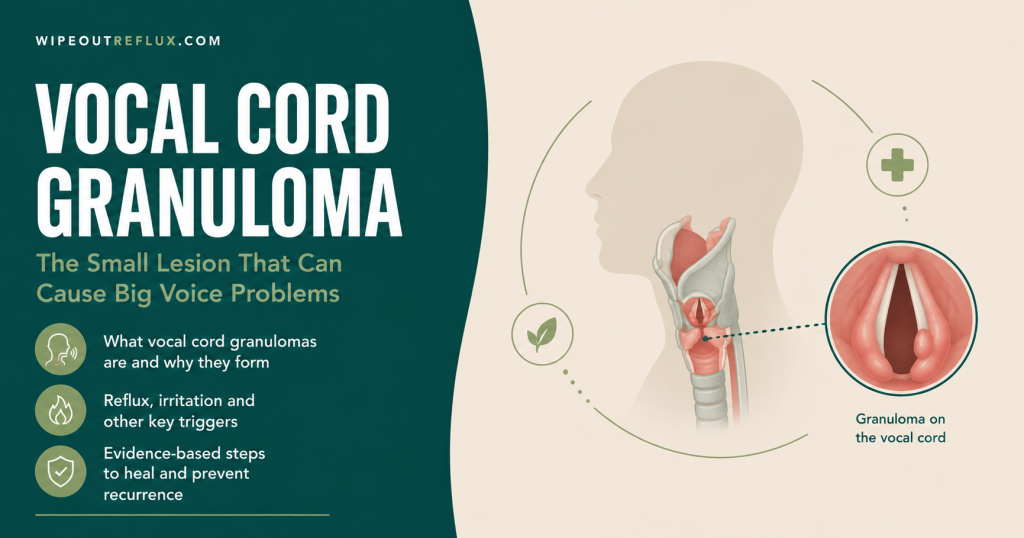
A vocal cord granuloma is a benign lump that forms at the back of the voice box, on the part of the vocal cords called the vocal process — which is why doctors also call it a vocal process granuloma or contact granuloma. It isn’t cancer, but it can be stubborn: it causes a hoarse or effortful voice, throat discomfort, and a nagging urge to clear your throat, and it has a frustrating habit of coming back.
Three things cause the great majority of them: acid reflux, trauma from a breathing tube during anaesthesia, and vocal overuse or misuse. Reflux is the biggest of the three by a clear margin. That’s important, because it shapes the whole treatment approach — these granulomas are managed conservatively first, with reflux control and voice care, and surgery is reserved for the ones that won’t settle any other way.
Here’s what a vocal cord granuloma is, the reflux, intubation and voice-overuse causes behind it, why it recurs so readily, and how it’s actually treated.
Key Takeaways
- A vocal cord granuloma is a benign (non-cancerous) lump on the vocal process at the back of the voice box, also called a contact or vocal process granuloma.
- Its three main causes are acid reflux (the most common), trauma from intubation (a breathing tube), and vocal overuse or misuse such as throat clearing and forceful talking.
- Reflux is the single biggest driver — in one series it accounted for around 60% of cases — because acid and pepsin irritate the sensitive back of the larynx.
- They’re much more common in men overall, though post-intubation granulomas are relatively more common in women.
- Typical symptoms are hoarseness, throat pain or a foreign-body sensation, and a persistent need to clear the throat.
- Treatment is conservative first: reflux control and voice therapy resolve most cases, with surgery reserved for those that fail medical treatment.
- Granulomas recur readily, so removing the underlying cause — especially reflux and throat clearing — matters more than cutting them out.
What a vocal cord granuloma actually is
Your vocal cords meet at the back of the voice box at a small pointed structure called the vocal process, part of the arytenoid cartilage. Unlike the soft, cushioned front two-thirds of the cords, this back portion has only a thin layer of tissue over cartilage — so it’s poorly padded and easily irritated. When that spot is irritated repeatedly, the body responds by building up inflammatory tissue, and a granuloma forms: a raised, sometimes stalked lump of reactive tissue. It’s benign and it isn’t contagious. It’s essentially an overgrowth of healing tissue at a spot that keeps getting re-injured — which is the key to understanding both why it forms and why it keeps returning.
The three main causes
Vocal process granulomas are almost always the result of chronic irritation to that vulnerable back portion of the cords, and three culprits dominate. In one long-term series, reflux accounted for the largest share of cases (around 62%), followed by intubation and vocal abuse Ezzat, Journal of Otolaryngology-ENT Research, 2019.
Acid reflux — the biggest cause. When stomach contents travel up to the throat, as in silent reflux (LPR), the acid and the enzyme pepsin bathe the back of the larynx — exactly where granulomas form. That chronic chemical irritation is why reflux is considered central to the condition, and why anti-reflux treatment is the cornerstone of managing it Karkos et al., Annals of Otology, Rhinology & Laryngology, 2014. It’s the same irritation that drives reflux laryngitis and the wider set of LPR symptoms.
Intubation — trauma from a breathing tube. During general anaesthesia, a tube is placed through the voice box into the windpipe, and it rests right against the vocal processes. In some people that pressure and friction injure the tissue, and a granuloma grows during healing. Post-intubation granulomas are a distinct group and, interestingly, are relatively more common in women Ezzat, Journal of Otolaryngology-ENT Research, 2019, likely reflecting the narrower female larynx.
Vocal overuse and misuse. Forceful voice habits slam the vocal processes together hard and repeatedly. Chronic throat clearing, hard glottal attacks (starting words with a forceful grunt), shouting, and heavy professional voice use all pound that back contact point. On its own, voice abuse often isn’t enough to create a granuloma, but layered on top of reflux it’s a powerful aggravator — which is why professional voice users are especially vulnerable.
In practice, these causes often overlap. Reflux inflames the tissue and makes you clear your throat, the throat clearing traumatises it further, and the granuloma is caught in the middle.
Why they keep coming back
This is the defining feature of vocal cord granulomas: they recur. Because they’re driven by ongoing irritation rather than a one-off injury, cutting one out without addressing the cause simply invites another to grow in the same spot. Reviews describe a genuine tendency to recur and disappointing long-term outcomes when the underlying triggers aren’t controlled — which is exactly why surgery alone is a poor strategy, and why anti-reflux treatment combined with voice therapy produces the lowest recurrence rates Karkos et al., Annals of Otology, Rhinology & Laryngology, 2014. The lesson is clear: fix the irritation, not just the lump.
Who gets them, and the symptoms
Vocal process granulomas are considerably more common in men — one series found roughly 80% of patients were male — with the post-intubation subgroup being the exception Ezzat, Journal of Otolaryngology-ENT Research, 2019. The usual symptoms are a hoarse, rough or effortful voice, a dull ache or foreign-body sensation in the throat (often felt on one side), a persistent urge to clear the throat, and sometimes mild pain that can refer to the ear. Because these overlap so heavily with ordinary reflux throat complaints — and with a lump-in-the-throat sensation — a granuloma is easy to miss without a proper look. Diagnosis is made by an ENT specialist examining the vocal cords with a laryngoscope, which shows the characteristic lump at the vocal process. Any hoarseness lasting more than a few weeks deserves that examination; our guide on when to see a doctor for LPR covers the warning signs.
Treatment: conservative first, surgery last
The evidence points strongly toward treating the cause before reaching for a scalpel. Most granulomas resolve with conservative measures — in one series, around 80% went into remission with non-surgical treatment Ezzat, Journal of Otolaryngology-ENT Research, 2019. The approach is layered:
- Control the reflux. This is the foundation. Reducing the acid and pepsin reaching the larynx removes the main irritant, and anti-reflux treatment is the primary strategy backed by the evidence Karkos et al., Annals of Otology, Rhinology & Laryngology, 2014. That usually means combining medication like a proton pump inhibitor with the dietary and lifestyle changes at the heart of any silent reflux treatment — the piece the Wipeout Diet Plan is built to handle.
- Retrain the voice. Voice therapy reduces the forceful contact that traumatises the vocal process and helps you break the throat-clearing habit that keeps re-injuring it.
- Botulinum toxin, in selected cases. A small injection can reduce the forceful closing of the cords and give the tissue time to heal, used as an adjunct for stubborn granulomas.
- Surgery — only for failures. Because granulomas recur so readily, surgical removal is reserved for those that don’t respond to medical treatment, that are very large, or that threaten the airway — and even then it’s paired with reflux and voice treatment to stop them returning.
Conclusion
A vocal cord granuloma is a benign lump born of repeated irritation at the vulnerable back of the voice box, and its three main causes — reflux, intubation and vocal overuse — usually overlap, with reflux the heaviest hitter. That’s why the smart approach isn’t to rush to remove it but to switch off what’s irritating the tissue in the first place. Control the reflux, calm the throat clearing, and retrain a forceful voice, and most granulomas settle without surgery — and are far less likely to come back.
Since reflux is both the leading cause and the factor you can most directly influence, it’s the natural place to start, and it comes down to what you eat and drink. The Wipeout Diet Plan is the complete, step-by-step way to bring reflux down at its source, so the acid and pepsin stop reaching and re-irritating the back of your larynx — working alongside any medication, voice therapy or surgery your doctor recommends. It was built first and foremost around LPR and silent reflux, the throat-based form most tied to these granulomas, but because it targets the same underlying mechanisms it works just as well for classic GERD and heartburn. The Wipeout Food Reference Guide is the essential companion, showing at a glance which foods and drinks are safe with acid reflux and LPR and their pH values, so you can strip out the triggers keeping your throat inflamed. Take away the irritation, and the granuloma finally has a reason to heal for good.
Frequently Asked Questions
Is a vocal cord granuloma cancer?
No. A vocal cord (vocal process) granuloma is a benign, non-cancerous overgrowth of reactive tissue caused by chronic irritation. That said, because any lump on the vocal cords and any lasting hoarseness should be confirmed, an ENT specialist will examine it to be certain of the diagnosis and rule out other causes.
What is the main cause of a vocal cord granuloma?
Acid reflux is the single most common cause. When acid and pepsin reach the back of the voice box, they chronically irritate the vocal process where granulomas form. Intubation trauma from a breathing tube and vocal overuse — throat clearing, shouting, forceful speech — are the other two main causes, and they often act together with reflux.
Do vocal cord granulomas go away on their own?
Many resolve with conservative treatment rather than surgery — controlling reflux and improving voice habits leads to remission in most cases. They can be slow to clear and may take many months. The key is removing the underlying irritation; without that, they tend to persist or recur.
Why does my vocal cord granuloma keep coming back?
Because it’s driven by ongoing irritation, not a one-time injury. If reflux continues or the throat clearing and forceful voice use don’t change, a new granuloma grows in the same spot — even after surgical removal. That’s exactly why treatment focuses on the cause, and why surgery alone has high recurrence rates.
How long does a vocal cord granuloma take to heal?
It varies widely, but conservative treatment often takes several months to work, with remission achievable within roughly two years in most cases. Consistent reflux control and voice care throughout that time are what make the difference. Persistent or enlarging granulomas should be reassessed by your ENT specialist.
Research & References
- Review of vocal process granulomas concluding that gastroesophageal reflux is central to the condition, that there is level 2A evidence anti-reflux treatment is the main treatment strategy (with surgery reserved for medical failures), and that anti-reflux therapy combined with lifestyle changes and voice therapy yields the lowest recurrence rates, while granulomas otherwise tend to recur with disappointing long-term outcomes Karkos et al., Annals of Otology, Rhinology & Laryngology, 2014.
- Long-term follow-up study of laryngeal granuloma patients reporting gastroesophageal reflux as the predominant cause (about 62%), followed by intubation and vocal abuse, a strong male predominance (roughly 80% of cases) except among post-intubation granulomas, and remission in about 80% of patients with conservative (non-surgical) treatment Ezzat, Journal of Otolaryngology-ENT Research, 2019.

David Gray
12 years living with LPR · Consultant & researcher
I've lived with LPR for twelve years — the misdiagnoses, the PPI courses that did nothing, the slow work of figuring out what actually helps. Wipeout Reflux is where I translate the research into plain terms for people stuck in the same place. Every claim here is sourced to peer-reviewed work, and I consult one-to-one with LPR sufferers.