
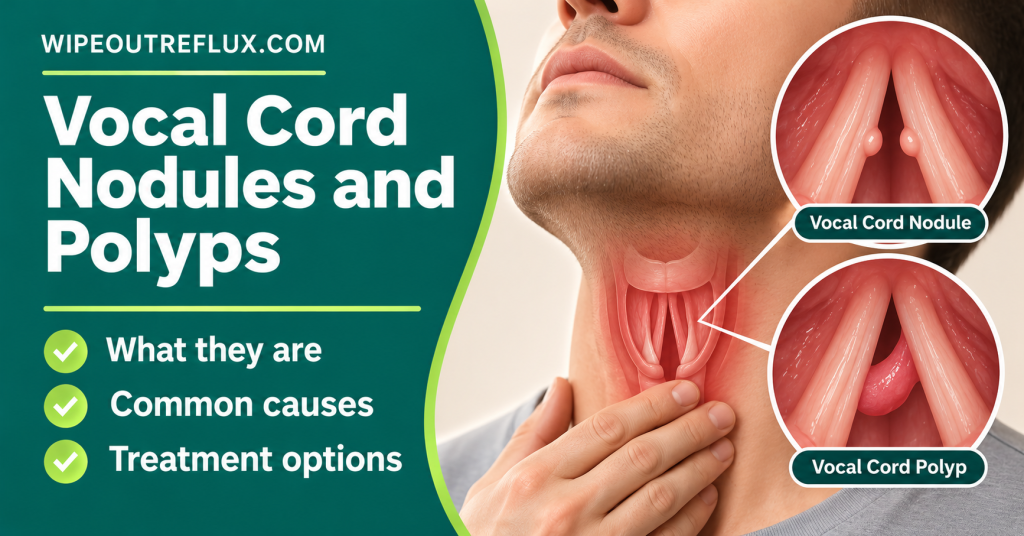
Reflux is rarely the main cause of vocal cord nodules or polyps, but it can be an important contributing factor, especially for polyps. Both lesions are caused mainly by phonotrauma: the repeated impact of the vocal cords hitting each other during loud, forceful or prolonged voice use. Reflux comes into play because acid and pepsin reaching the larynx can inflame and swell the delicate vocal cord lining. That makes the tissue more easily injured, slower to heal, and more likely to keep a lesion going.
The research matches that picture. Studies using pH probes find laryngopharyngeal reflux (LPR) more often in people with benign vocal cord lesions, and the link looks strongest for polyps and Reinke’s edema and weakest for nodules. So for most people, the answer isn’t “reflux or voice strain” but “voice strain, sometimes made worse by reflux.” Treating both gives the best chance of the lesion settling and not coming back.
Key Takeaways
- Nodules and polyps are benign growths on the vocal cords that cause hoarseness, a breathy or rough voice and vocal fatigue.
- The primary cause of both is phonotrauma: shouting, singing, heavy professional voice use or a forceful speaking style.
- Reflux is a contributing factor rather than the root cause. Acid and pepsin inflame the vocal cord lining and make it more vulnerable to injury.
- A 2024 meta-analysis found people with pH-confirmed LPR had about three times the odds of having a benign vocal cord lesion.
- The reflux link is strongest for Reinke’s edema and polyps, and weakest for nodules.
- Voice therapy is the first-line treatment, especially for nodules. Larger or persistent polyps may need surgery.
- If you have reflux symptoms too, treating reflux alongside voice therapy makes sense, but anti-reflux medication on its own rarely makes a nodule or polyp disappear.
What Are Vocal Cord Nodules and Polyps?
Your vocal cords (vocal folds) are two bands of tissue that vibrate together hundreds of times a second when you speak or sing. Their surface layer is soft and pliable, which is what lets them vibrate freely. When that layer is damaged, small growths can form that stop the cords from meeting cleanly.
Vocal cord nodules
Nodules are small, callus-like bumps, usually on both vocal cords, directly opposite each other at the point of greatest impact. They develop when overuse makes the edges of the vocal cords swell, typically between the front and middle third [InformedHealth.org, Institute for Quality and Efficiency in Health Care, NIH Bookshelf]. They’re common in teachers, singers and anyone who uses their voice loudly and often, which is why they’re sometimes called “singer’s nodes.”
Vocal cord polyps
Polyps are usually larger, soft swellings, typically on one vocal cord. They can be fluid-filled or contain small blood vessels, and they sometimes form after a single bleeding episode in the vocal cord from intense voice use. Because a polyp is a reaction in the lining rather than a true tumor, smaller ones can shrink with the right voice management.
Symptoms of vocal cord nodules and polyps
- Hoarse, rough or breathy voice
- Voice that tires quickly or gets worse through the day
- Loss of vocal range, especially high notes
- A cracking or “double” voice
- Needing more effort to speak, sometimes with neck tension or throat discomfort
- Frequent throat clearing or a feeling of something in the throat
Many of these overlap with LPR symptoms, which is one reason the two get confused. I’ve covered the reflux side in can acid reflux cause hoarseness.
What Causes Vocal Cord Nodules and Polyps?
The main cause is mechanical. Every time the vocal cords collide, they absorb impact. With heavy or forceful voice use, that repeated stress causes swelling, and over time the tissue remodels into a lesion. That’s why nodules, polyps and cysts are grouped together as “phonotraumatic” lesions.
Things that increase the strain include:
- Shouting, cheering or talking over background noise
- Singing with poor technique or without warming up
- Long hours of teaching, coaching, call-center or sales work
- A pressed or tense speaking style
- Smoking, which inflames and dries the vocal cords
- Dehydration and very dry air
- Chronic throat clearing and coughing
- Reflux
How Reflux Affects the Vocal Cords
Here’s the mechanism that most articles skip. The larynx isn’t built to handle stomach contents. Unlike the esophagus, it has very little protection against acid and none against pepsin, the digestive enzyme that comes up with reflux. Even small amounts of refluxate reaching the larynx can cause inflammation. Pepsin can also stick to the tissue and reactivate later when it meets acid from food or drink.
That inflammation affects the vocal cords in several ways that make lesions more likely:
- Swelling makes the cords heavier and stiffer. You have to push harder to make sound, which increases the impact force every time they meet.
- Inflamed tissue is more fragile. The same voice use that a healthy vocal cord shrugs off can cause injury in a swollen one.
- Healing slows down. If reflux keeps reaching an injured area, small swellings that might have resolved can persist.
- Reflux drives throat clearing and coughing. Both slam the vocal cords together, adding more phonotrauma on top.
So the most accurate way to think about it: reflux rarely creates a nodule or polyp on its own, but it can turn an at-risk voice into an injured one, and it can stop that injury from healing.
What the Research Shows About Reflux and Vocal Cord Lesions
LPR is more common in people with vocal cord lesions
The strongest evidence comes from a 2024 meta-analysis that only included studies where reflux was confirmed by pharyngeal pH monitoring, rather than just symptoms. Across 9 studies, people with LPR had significantly higher odds of benign vocal cord lesions, with an odds ratio of 3.26 [Ren et al., Otolaryngology–Head and Neck Surgery, 2024].
The link differs by type of lesion
Not all lesions are equally tied to reflux. In a study of 110 patients with benign vocal cord lesions who had 24-hour double-probe pH monitoring, pathologic LPR was found in 66% of people with nodules, 75% with polyps and 90% with Reinke’s edema, compared with 65% of controls with throat symptoms but no lesion. Only Reinke’s edema was significantly more common than in controls, and the authors concluded reflux might play a role in Reinke’s edema and polyps [Chung et al., Otolaryngology–Head and Neck Surgery, 2009].
A separate pH-monitoring study of 72 people who’d had benign vocal cord lesions removed found LPR in 75% of those with polyps and 60% of those with nodules. People with lesions also had more reflux episodes reaching the throat than people with typical GERD [Beltsis et al., European Archives of Oto-Rhino-Laryngology, 2011].
The pattern is fairly consistent. Nodules are the most purely mechanical lesion, so the reflux link is weakest there. Polyps sit in the middle, and swelling-type lesions like Reinke’s edema and vocal cord granulomas show the strongest connection. I’ve covered those two in Reinke’s edema and the granuloma article.
What these studies can’t tell us
An association isn’t proof that reflux causes lesions. Lots of people with LPR never develop a nodule or polyp, and some of these studies only tested patients whose throats already looked inflamed. The fair reading is that reflux is a common, modifiable contributing factor, not the main driver.
Does Treating Reflux Help Nodules and Polyps?
This is where the evidence gets mixed, and I think it’s important to be honest about it.
In a randomized trial of 48 people who had surgery for vocal cord polyps, giving a PPI (lansoprazole) for two months afterward didn’t improve voice outcomes compared with no PPI. Both groups improved after surgery by a similar amount [Lee et al., Clinical Otolaryngology, 2016]. That fits with what we know about why PPIs often don’t work for LPR: they reduce acid but don’t stop reflux or pepsin reaching the throat.
On the other hand, these trials tested people regardless of whether they had reflux. For someone with clear reflux symptoms, a raised Reflux Symptom Index or signs of reflux inflammation on laryngoscopy, it makes sense to treat reflux as part of the plan, especially after surgery or if a lesion keeps coming back.
Here’s the practical takeaway as I see it:
- Don’t expect reflux treatment alone to make a nodule or polyp disappear. The mechanical cause still needs addressing.
- Do treat reflux if you have it, because it removes a source of ongoing inflammation that can slow healing and encourage recurrence.
- Focus on what reaches the throat, not just acid. Diet changes and an alginate like Gaviscon Advance after meals and at bedtime target reflux reaching the larynx more directly than acid suppression does.
How Vocal Cord Nodules and Polyps Are Treated
Voice therapy
Voice therapy with a speech-language pathologist is the first-line treatment, especially for nodules. Reviews show that primary voice therapy can often prevent the need for surgery in nodules and some types of polyps [White, Current Opinion in Otolaryngology and Head and Neck Surgery, 2019]. Therapy teaches you to produce voice with less impact, improve breath support, reduce tension and build healthier vocal habits. My article on voice therapy for silent reflux explains what sessions involve.
Surgery
Polyps, particularly larger ones or those with a blood vessel feeding them, are more likely to need phonomicrosurgery, which removes the lesion under a microscope while preserving the vibrating layer. Voice therapy before and after surgery usually gives the best results.
Vocal hygiene
- Stay well hydrated, and use a humidifier if your air is dry.
- Avoid shouting, whispering forcefully and talking over noise.
- Rest your voice in short breaks through a heavy speaking day.
- Swap throat clearing for a sip of water or a hard swallow.
- Stop smoking and cut back on alcohol.
How to Reduce Reflux’s Impact on Your Voice
If you have nodules or polyps and you also have reflux symptoms (throat clearing, mucus, a lump-in-the-throat feeling, worse hoarseness in the morning), these are the steps I’d focus on:
- Stop eating at least three hours before bed. Nighttime reflux reaches the larynx most easily.
- Raise the head of your bed rather than stacking pillows.
- Cut back on the main triggers: acidic drinks, alcohol, caffeine, chocolate, mint, fatty and fried foods, and large meals.
- Use an alginate after meals and at bedtime to block reflux reaching your throat.
- Break the throat-clearing cycle. My guide to stopping constant throat clearing has techniques that also protect your vocal cords.
- Follow a structured low-acid plan. Diet is where the biggest gains for throat reflux come from, and the Wipeout Diet Plan lays it out step by step.
For singers and heavy voice users, my article on silent reflux in singers and professional voice users has more specific advice, and how to heal vocal cords from acid reflux covers the healing side.
When to Get Your Voice Checked
Nodules and polyps can only be diagnosed by looking at your vocal cords, usually with a scope in an ENT or voice clinic. Get checked if your voice has been hoarse for more than three to four weeks, especially if you smoke, if you’re losing your voice completely, if speaking is painful, or if you have trouble swallowing or breathing. Most hoarseness turns out to be benign, but it’s worth ruling out other causes. I’ve covered how to tell the difference in LPR or throat cancer.
Conclusion
Vocal cord nodules and polyps are primarily caused by voice strain, not reflux. But reflux is a genuine contributing factor, especially for polyps and swelling-type lesions. pH studies consistently find LPR more often in people with these lesions, and the mechanism makes sense: acid and pepsin inflame the vocal cord lining, make it more fragile, slow healing and trigger the throat clearing that adds more trauma.
That’s why the best results come from treating both sides. Voice therapy and good vocal habits deal with the mechanical cause. Reflux control removes the inflammation that can keep a lesion going or bring it back after surgery. Just don’t expect a PPI alone to fix it. The trial evidence for acid suppression is weak, and it does nothing to stop pepsin reaching the throat.
If reflux is part of your picture, diet is the most powerful lever you have. The Wipeout Diet Plan is my complete, step-by-step guide to calming throat reflux. It was built first and foremost for LPR, the kind that reaches the larynx and affects the voice, but because it targets the same underlying triggers, it works just as well for GERD and everyday heartburn. Pair it with voice therapy, and you give your vocal cords the best possible conditions to heal.
Frequently Asked Questions
Can acid reflux cause vocal cord nodules?
Rarely on its own. Nodules are mainly caused by voice overuse. Reflux can contribute by inflaming the vocal cords and making them more vulnerable to injury, but studies show the reflux link is weaker for nodules than for polyps or Reinke’s edema.
Can acid reflux cause vocal cord polyps?
Reflux is a recognized contributing factor for polyps. pH studies find LPR in a high proportion of people with polyps, though voice strain is still considered the main cause. Treating reflux may help prevent recurrence.
What is the difference between vocal cord nodules and polyps?
Nodules are small, firm bumps that usually appear on both vocal cords opposite each other. Polyps are usually larger, softer and on one side only, and they can contain fluid or blood vessels. Nodules often respond to voice therapy alone, while polyps are more likely to need surgery.
Will a PPI shrink my vocal cord polyp?
Probably not on its own. A randomized trial found that a PPI after polyp surgery didn’t improve voice outcomes compared with no PPI. Reflux control can help reduce inflammation, but it works best alongside voice therapy and, where needed, surgery.
Do vocal cord nodules go away on their own?
Small, early nodules can shrink with voice rest and voice therapy, especially if you also deal with contributing factors like reflux, dehydration and smoking. Long-standing, firm nodules are less likely to resolve without treatment.
Can silent reflux make me hoarse without nodules or polyps?
Yes. LPR can cause hoarseness, vocal fatigue and throat clearing by inflaming the larynx, even when there’s no lesion. Only a scope examination can tell whether there’s a nodule, polyp or general reflux swelling.
Should I stop singing if I have reflux and voice problems?
Not necessarily, but get your vocal cords checked first. A voice specialist can tell you whether you need rest, therapy or a change in technique. Controlling reflux, especially at night before performances, can make a noticeable difference.
Research & References
- [Ren et al., Otolaryngology–Head and Neck Surgery, 2024] — Meta-analysis of 9 studies using pharyngeal pH monitoring. LPR was associated with higher odds of benign vocal fold lesions (odds ratio 3.26).
- [Chung et al., Otolaryngology–Head and Neck Surgery, 2009] — Case-control study of 110 patients with benign vocal lesions. Pathologic LPR was found in 66% with nodules, 75% with polyps and 90% with Reinke’s edema, versus 65% of controls. LPR was significantly associated with Reinke’s edema.
- [Beltsis et al., European Archives of Oto-Rhino-Laryngology, 2011] — Double-probe pH monitoring in 72 patients with resected benign vocal fold lesions. LPR was found in 75% of those with polyps and 60% with nodules, with more laryngopharyngeal reflux episodes than in typical GERD.
- [Lee et al., Clinical Otolaryngology, 2016] — Randomized controlled trial of 48 patients after vocal fold polyp surgery. Lansoprazole for two months didn’t improve voice outcomes compared with no PPI.
- [White, Current Opinion in Otolaryngology and Head and Neck Surgery, 2019] — Review of benign vocal fold lesion management. Phonosurgery is effective, and primary voice therapy can frequently prevent surgery in nodules and some polyps.
- [InformedHealth.org, Institute for Quality and Efficiency in Health Care, NIH Bookshelf] — Patient information on vocal nodules, describing how voice overuse causes swelling at the vocal fold edges and nodules that form opposite each other.

David Gray
12 years living with LPR · Consultant & researcher
I've lived with LPR for twelve years — the misdiagnoses, the PPI courses that did nothing, the slow work of figuring out what actually helps. Wipeout Reflux is where I translate the research into plain terms for people stuck in the same place. Every claim here is sourced to peer-reviewed work, and I consult one-to-one with LPR sufferers.