
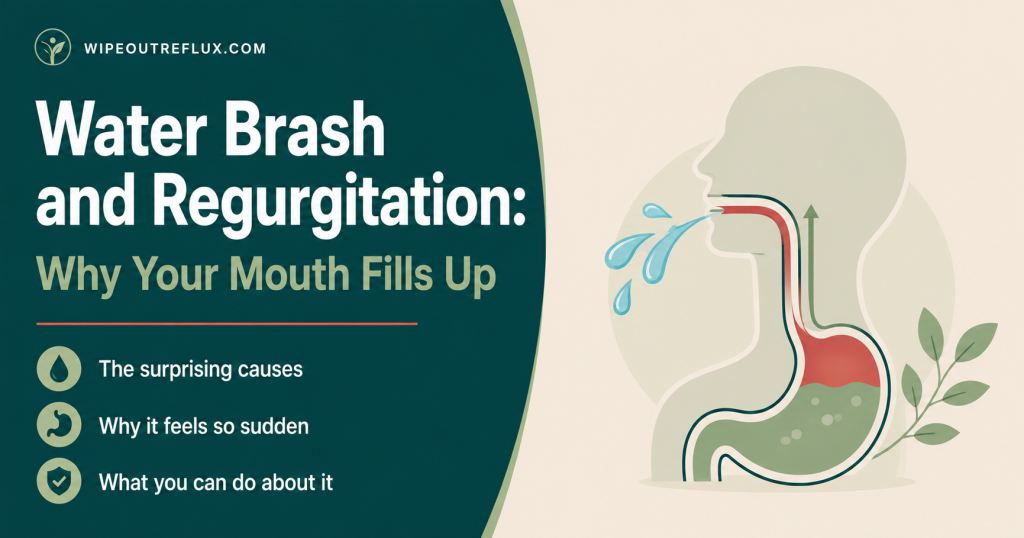
If your mouth suddenly floods with fluid, there are two completely different things that could be happening — and telling them apart is the single most useful thing you can do about it.
Water brash is a sudden rush of thin, clear, tasteless or slightly salty saliva. It comes from your salivary glands, travelling upward from your mouth’s own tissue, and it’s a reflex — your body detecting acid in the oesophagus and flooding the area with saliva to neutralise it. When researchers dripped acid into the oesophagus of people with reflux oesophagitis, saliva flow increased nearly fourfold.
Regurgitation is different. That’s stomach contents genuinely coming back up — sour, bitter, sometimes containing recognisable food. It doesn’t come from your glands. It comes from your stomach.
Both point to reflux, but they need different responses, and one of them responds poorly to the medication most people are given.
Key Takeaways
- Water brash is reflex hypersalivation — thin, clear, tasteless fluid produced by your salivary glands, not fluid from your stomach.
- Acid in the oesophagus triggers the oesophago-salivary reflex; in patients with oesophagitis, saliva flow rose nearly fourfold during acid perfusion.
- It’s protective. Saliva is alkaline and bicarbonate-rich, and it’s what neutralises the acid left behind after peristalsis clears the volume.
- Regurgitation is stomach contents rising into the throat or mouth — sour, bitter, sometimes with food.
- Regurgitation responds far less well to PPIs than heartburn does: therapeutic gain over placebo averaged just 17% across placebo-controlled trials.
- Effortless regurgitation of recently eaten food, starting within minutes of a meal, is more likely rumination syndrome than reflux — about 20% of PPI non-responders show a rumination pattern.
- Both symptoms are volume problems, so meal size, timing and position matter more than acidity.
- Water brash with severe unexplained chest pain, or with difficulty swallowing, needs a doctor rather than a diet change.
What water brash actually is
Water brash — also called pyrosis idiopathica or acid brash — is a sudden, sometimes copious flow of saliva into the mouth, usually accompanying or immediately preceding heartburn.
The key features people describe:
- Fluid appears fast, sometimes within seconds
- It’s thin and watery, not thick or slimy
- It’s clear, not yellow, green or brown
- It tastes of nothing, or faintly salty — not sour or bitter
- You often have to swallow repeatedly or spit
- It frequently comes alongside a burning sensation
That “tastes of nothing” detail is the giveaway. Stomach contents are acidic and taste distinctly sour or bitter. Saliva doesn’t.
The reflex behind it
Your oesophagus has acid-sensitive receptors, and when they detect acid they trigger a reflex that ramps up salivary secretion — the oesophago-salivary reflex.
This has been measured directly. When researchers perfused the oesophagus with hydrochloric acid, patients with oesophagitis developed heartburn within one to five minutes accompanied by increased saliva flow, and by the time the heartburn was severe enough to stop the perfusion, saliva flow had risen nearly fourfold Helm et al., Gastroenterology, 1987.
So water brash isn’t a malfunction. It’s your oesophagus calling for help, and getting it.
Why saliva matters so much
Clearing acid from the oesophagus happens in two stages. Peristalsis sweeps out the volume in one or two contractions, but that leaves a thin acidic film behind, and pH stays low until you swallow. Swallowed saliva then neutralises that residue Helm et al., The New England Journal of Medicine, 1984.
In other words, saliva is your oesophagus’s built-in antacid. That’s why dry mouth makes reflux damage worse, why chewing gum after meals helps, and why night-time reflux is so damaging — you barely produce saliva while asleep. There’s more on the chemistry in my article on saliva, bicarbonate and acid reflux, and a closer look at the symptom itself in acid reflux and excess saliva.
Water brash is uncomfortable and socially awkward, but the underlying reflex is on your side. The problem it’s responding to is what needs fixing.
What regurgitation actually is
Regurgitation is the effortless return of stomach contents into the oesophagus, throat or mouth. No retching, no nausea, no abdominal heaving — that’s vomiting, which is a different, actively driven process.
Typical features:
- Sour or bitter taste — acid tastes sour, bile tastes bitter
- Sometimes recognisable food particles
- Often triggered by bending, lying down, or straining
- Frequently follows large meals
- May come with a burning sensation in the throat rather than the chest
Mechanically, regurgitation needs more than a bit of acid slipping through. It needs volume and enough force to travel the full length of the oesophagus and get past the upper esophageal sphincter. That’s why it’s associated with large meals, a weak lower esophageal sphincter, a hiatal hernia, delayed gastric emptying and poor oesophageal clearance.
Why acid medication often disappoints
This is the part patients rarely get told. PPIs reduce how acidic your reflux is. They don’t stop reflux from happening, and they don’t reduce its volume.
Across placebo-controlled trials, the therapeutic gain for regurgitation with PPI therapy averaged 17% over placebo — more than 20 percentage points worse than the gain seen for heartburn Kahrilas et al., The American Journal of Gastroenterology, 2011.
That’s the mechanism doing exactly what you’d predict. Make the fluid less acidic and burning improves; the fluid still arrives in your mouth. If you’re on acid suppression and your heartburn settled but regurgitation didn’t, that’s expected, not treatment failure on your part — and it fits the broader picture of why reflux medication sometimes doesn’t work.
Telling them apart
Ask yourself four questions the next time it happens:
- What does it taste like? Nothing or slightly salty means saliva — water brash. Sour or bitter means stomach contents — regurgitation.
- What does it look like? Clear and thin means saliva. Cloudy, yellowish, or containing food means regurgitation.
- How much is there? Water brash tends to be a steady flooding you keep swallowing. Regurgitation tends to arrive as a distinct wave.
- What happened first? Water brash usually accompanies or follows heartburn. Regurgitation often arrives on its own, triggered by position or a large meal.
Plenty of people get both, sometimes in the same episode — regurgitation reaches the oesophagus, the acid receptors fire, and the salivary flood follows. That’s not confusing so much as informative: it tells you acid is genuinely reaching your oesophagus.
The imitator: rumination syndrome
This one is important, and it’s missed constantly.
Rumination syndrome is the repetitive, effortless, painless return of recently eaten food into the mouth, driven by an unconscious contraction of the abdominal wall rather than by reflux. People often re-chew and re-swallow it without realising the behaviour is learned.
The distinguishing features:
- Starts within minutes of eating, usually while still eating or immediately after
- The food tastes like food — recognisable, not sour, because it hasn’t been in the stomach long enough to acidify
- Effortless, with no retching or nausea beforehand
- Typically stops once the meal becomes acidic, usually within an hour or two
- Rarely happens at night or when lying down — unlike reflux regurgitation
- Doesn’t respond to acid suppression at all
This matters because it’s common in exactly the group most likely to be reading this. Around 20% of adults diagnosed with GERD who don’t respond to PPIs show a rumination pattern on postprandial high-resolution impedance manometry Halland and Pandolfino, Clinical Gastroenterology and Hepatology, 2018. Objective criteria now exist for identifying it on manometry, based on reflux events reaching the upper oesophagus in close association with an abdominal pressure rise above 30 mmHg Kessing et al., The American Journal of Gastroenterology, 2014.
The treatment is completely different — diaphragmatic breathing training rather than acid suppression — and it works well. If your “regurgitation” starts during or right after meals, tastes like the food you just ate, and no medication has ever touched it, ask specifically about rumination syndrome. It’s worth raising when you discuss oesophageal manometry or reflux testing generally.
Other causes worth knowing about
- Bile reflux. If the fluid is distinctly bitter, yellow or green, bile may be involved — particularly after gallbladder or stomach surgery. Acid suppression does little for it. See bile reflux versus acid reflux.
- Gastroparesis. Delayed stomach emptying means food sits around and comes back up hours later, often undigested. Common in diabetes and increasingly seen with GLP-1 medications. More on gastroparesis and reflux.
- Achalasia and motility disorders. If the oesophagus can’t push food down, it regurgitates undigested food, often with progressive difficulty swallowing. This needs proper investigation — see oesophageal motility and reflux.
- Pregnancy. Both hormonal sphincter relaxation and physical pressure make regurgitation extremely common, especially in the third trimester. See acid reflux and pregnancy.
- Nausea-related salivation. Saliva also floods the mouth before vomiting, which is a protective response to a completely different signal. If yours comes with nausea rather than heartburn, that’s a different pathway — see reflux and nausea.
What actually helps
Because both symptoms are largely about volume and position rather than acidity, the interventions that work are mechanical.
Reduce the volume available to come up
- Smaller meals, more often. A full stomach is the single biggest driver of both symptoms.
- Stop eating three hours before lying down — more detail in how long before bed to stop eating.
- Drink between meals rather than with them, so you’re not adding volume on top of food.
- Avoid bending forward, lifting or lying down for a couple of hours after eating.
Use gravity and barriers
- Raise the head of your bed by 6–8 inches. Extra pillows don’t work — they bend you at the waist and raise abdominal pressure.
- Sleep on your left side. Anatomy puts the junction above the pool of stomach contents in that position — see best sleeping position.
- An alginate raft after meals and at bedtime forms a physical barrier on top of the stomach contents, which targets volume rather than acidity — see alginates for acid reflux and Gaviscon Advance. For regurgitation specifically, this often outperforms acid suppression.
Protect your teeth
Don’t brush immediately after an episode — the enamel is temporarily softened by acid and brushing scrubs it away. Rinse with water or a bicarbonate of soda solution instead, and wait 30 minutes. This matters more than most people realise, given how common dental erosion from reflux is.
When to see a doctor
Book an appointment if you have difficulty or pain swallowing, food sticking, unintentional weight loss, vomiting blood or black stools, persistent symptoms despite treatment, or regurgitation of undigested food hours after eating. Water brash accompanied by severe chest pain, sweating or breathlessness needs urgent assessment — the overlap with cardiac symptoms is real, as covered in heartburn or heart attack.
Conclusion
A mouth that suddenly fills up is telling you something specific, and the fluid itself is the clue. Thin, clear and tasteless means water brash — your salivary glands responding to acid in the oesophagus with a fourfold flood of your body’s own antacid. Sour, bitter or containing food means regurgitation — stomach contents that have made the whole journey up. Recognisable food arriving minutes after you eat, effortlessly, means you should be asking about rumination syndrome rather than adjusting your reflux medication.
The practical implication runs through all three. These are volume and pressure problems more than acidity problems, which is why regurgitation responds so modestly to acid suppression and why smaller meals, timing, sleeping position and physical barriers do more of the work than another tablet will.
Getting the food side of that right is where most people struggle, and it’s exactly what the Wipeout Food Reference Guide is designed for — the essential reference for which foods and drinks are safe with acid reflux and LPR, with their pH values, so you’re not guessing at every meal. If you want the complete approach rather than a food list, the Wipeout Diet Plan goes considerably deeper. It was built first around LPR — the throat-based form where regurgitation reaching that high is precisely the problem — but because it works on the same underlying mechanisms, it’s just as effective for GERD and classic heartburn. It addresses meal volume, timing and composition together, which is what actually reduces how much fluid is available to reach your mouth in the first place.
Frequently Asked Questions
Is water brash the same as regurgitation?
No. Water brash is excess saliva produced by your salivary glands in response to acid in the oesophagus — thin, clear and tasteless. Regurgitation is stomach contents coming back up, which taste sour or bitter and may contain food.
Why does my mouth fill with clear fluid before heartburn?
Because the acid reached your oesophagus before you felt it burn. The acid-sensitive receptors trigger the salivary reflex quickly, and the burning sensation builds slightly more slowly, so the flood of saliva can arrive first.
Is water brash dangerous?
The salivation itself is protective, not harmful. What it signals — repeated acid exposure in the oesophagus — is what matters, and warrants proper management. Seek assessment for difficulty swallowing, weight loss or persistent symptoms.
Why hasn’t my PPI stopped my regurgitation?
Because PPIs reduce acid production, not reflux volume. Across placebo-controlled trials, the therapeutic gain for regurgitation was around 17%, far lower than for heartburn. Volume-focused measures — smaller meals, timing, alginate barriers, bed elevation — usually help more.
How do I know if it’s rumination syndrome rather than reflux?
The strongest clues are timing and taste: it starts within minutes of eating, the food still tastes like food rather than sour, it’s completely effortless, and it doesn’t happen overnight. Postprandial high-resolution impedance manometry can confirm it.
Can water brash happen at night?
Yes, and it’s more concerning when it does, because saliva production drops sharply during sleep and swallowing is infrequent. Waking with a mouthful of fluid, coughing or choking is worth acting on — see waking up choking from acid reflux.
Does chewing gum help water brash?
It’s a bit counterintuitive, since gum increases saliva and water brash is already too much saliva. But the extra saliva is swallowed rather than pooling, and it speeds acid clearance from the oesophagus, which addresses the trigger. Non-mint, sugar-free gum is the version to use.
Research & References
- Perfusion of the oesophagus with hydrochloric acid produced heartburn within one to five minutes in all patients with oesophagitis, accompanied by increased salivary flow that had risen nearly fourfold by the time heartburn required stopping the perfusion — evidence for a protective oesophago-salivary reflex Helm et al., Gastroenterology, 1987.
- Oesophageal acid clearance occurs as a two-step process: peristalsis empties almost all the acid volume, leaving a small residue that keeps pH low until swallowed saliva neutralises it Helm et al., The New England Journal of Medicine, 1984.
- Across placebo-controlled trials of PPI therapy in GERD, the therapeutic gain for regurgitation averaged 17% relative to placebo, more than 20 percentage points lower than the gain observed for heartburn Kahrilas et al., The American Journal of Gastroenterology, 2011.
- Review of rumination syndrome describing effortless postprandial regurgitation of recently ingested food driven by abdominal wall contraction, and noting that around 20% of patients diagnosed with GERD who fail PPI therapy show a rumination pattern on postprandial testing Halland and Pandolfino, Clinical Gastroenterology and Hepatology, 2018.
- Objective manometric criteria for rumination syndrome, based on reflux events reaching the proximal oesophagus in close association with an abdominal pressure increase above 30 mmHg during combined pressure-impedance monitoring Kessing et al., The American Journal of Gastroenterology, 2014.

David Gray
12 years living with LPR · Consultant & researcher
I've lived with LPR for twelve years — the misdiagnoses, the PPI courses that did nothing, the slow work of figuring out what actually helps. Wipeout Reflux is where I translate the research into plain terms for people stuck in the same place. Every claim here is sourced to peer-reviewed work, and I consult one-to-one with LPR sufferers.