
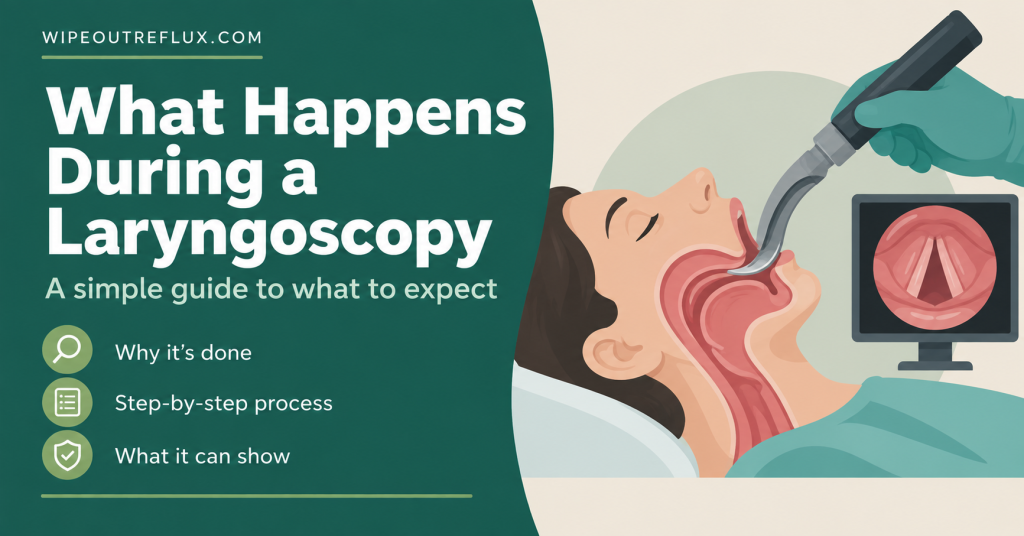
A laryngoscopy takes about two to five minutes. You sit upright in a chair, fully awake. The ENT sprays a numbing and decongestant solution into your nose, waits a few minutes, then passes a flexible scope about the width of a piece of spaghetti through one nostril, down the back of your nose and into position above your voice box. You’ll be asked to breathe normally, say “eee,” maybe cough or swallow. Then it comes out, and you go home.
No sedation. No fasting. No recovery room. Most people are back in their car within fifteen minutes of arriving.
I’m writing this because it’s the test most LPR readers actually get — and it’s the one I get the most anxious emails about beforehand. It’s also the test whose results get over-interpreted more than any other, in both directions. So I want to cover both halves: exactly what happens in the room, and what the pictures can honestly tell you afterwards.
Key Takeaways
- A flexible laryngoscopy is done awake, sitting up, and takes two to five minutes from spray to finish.
- The scope goes through your nose, not your mouth — which is why gagging is much less of a problem than people expect.
- Topical anesthetic meaningfully reduces both pain and discomfort, though it tastes unpleasant. It’s worth asking for if it isn’t offered.
- Your ENT is scoring eight specific signs: subglottic edema, ventricular obliteration, erythema, vocal fold edema, diffuse laryngeal edema, posterior commissure hypertrophy, granuloma, and thick mucus.
- A Reflux Finding Score of 7 or more is treated as consistent with LPR.
- Here’s the catch: in one study of asymptomatic non-smokers, over 80% had visible laryngeal irritation signs. These findings are common in healthy people.
- A normal scope does not rule out reflux, and an abnormal one does not prove it. It’s one input, not a verdict.
What a Laryngoscopy Actually Is
“Laryngoscopy” just means looking at your larynx — your voice box. There are three ways it’s done, and knowing which one you’re booked for removes most of the anxiety.
Flexible transnasal laryngoscopy — what you’ll almost certainly get
A thin, bendy fiberoptic or digital scope goes through your nostril. It’s the standard outpatient ENT examination, done in the clinic room with you sitting in an ordinary chair. If your letter says “flexible nasendoscopy,” “FNE,” or “fiberoptic laryngoscopy,” this is it. When people talk about having “the camera down,” this is what they mean.
Rigid transoral laryngoscopy — sometimes used for voice
A straight rigid telescope goes into your mouth while you stick your tongue out and the ENT holds it with gauze. It gives a brighter, higher-resolution image of the vocal folds, so it’s often used for voice complaints and for stroboscopy. It is more gag-prone than the nasal route, which is exactly why the flexible scope is preferred for most reflux assessments.
Direct laryngoscopy under general anesthetic — the surgical one
This is a theatre procedure, asleep, used for biopsies and to treat lesions. If you’ve been booked for a routine ENT clinic appointment about throat symptoms, this is not what’s happening. It’s worth saying plainly, because searching “laryngoscopy” throws up operating-theatre images that frighten people unnecessarily.
The rest of this article is about the flexible one.
Before the Appointment
There’s very little to do, which is part of the point.
- Eat and drink normally. No fasting is required. A light meal beforehand is fine and often better than going in hungry.
- Take your usual medication, including any reflux medication, unless you’ve been specifically told otherwise. Don’t stop a PPI on your own initiative to “get a better picture” — that isn’t how it works and it’ll just make the weeks beforehand miserable.
- Mention blood thinners and nosebleeds. The nasal lining is delicate and a little bleeding is the most common minor complication. Your ENT will want to know.
- Bring your symptom list. If you’ve scored yourself on the Reflux Symptom Index, bring the number and the date. It gives the consultation a starting point that “my throat’s been bad for ages” doesn’t.
- You can drive yourself. No sedation means no escort and no restrictions afterwards.
Step by Step: What Happens in the Room
1. The chair and the conversation (2–5 minutes)
You sit upright in an examination chair, not lying down. The ENT will ask about your symptoms — hoarseness, throat clearing, globus, cough, the usual list — and explain what they’re about to do. This is the moment to say if you’ve had a bad experience with scopes before, or if one nostril is usually blocked. They’ll use the clearer side.
2. The spray (1 minute to apply, 3–10 minutes to work)
Most clinics use a combined preparation containing a local anesthetic and a decongestant — lidocaine with phenylephrine is a common combination, often sold as a single spray. The decongestant shrinks the nasal lining to widen the passage; the anesthetic numbs it.
It is worth having. A meta-analysis of ten randomized trials covering 837 patients found that local anesthetic, alone or with a vasoconstrictor, significantly improved both pain and comfort during transnasal endoscopy — though patients consistently reported an unpleasant taste as the trade-off [Hwang et al., European Archives of Oto-Rhino-Laryngology, 2015]. The same analysis found no meaningful difference between spraying it and applying it on cotton, so however your clinic does it is fine.
Some ENTs skip the spray for a very quick look, on the reasonable grounds that the numbing is brief and the taste is worse than the examination. If you’re anxious, ask for it anyway. The evidence is on your side.
Expect the back of your throat to feel thick and slightly strange within a couple of minutes, and expect the taste to be bitter. That’s normal.
3. The scope goes in (10–20 seconds)
The ENT holds the scope near the tip and advances it along the floor of your nostril. You’ll feel pressure and a sensation of something moving at the back of your nose. It is not sharp and it should not be painful.
Your eyes may water and you may want to sneeze. Both are completely normal reflexes to something touching the nasal lining and neither means anything is wrong. The single most useful thing you can do here is keep breathing through your nose, steadily. Holding your breath makes everything tighter and slower.
4. The tasks (60–120 seconds)
Once the scope is in position above your larynx, you’ll be asked to do several things while the ENT watches:
- Breathe normally — this shows the vocal folds opening.
- Say “eee,” held out — this brings the folds together so their movement and closure can be assessed.
- Sniff sharply — another way of checking fold abduction.
- Cough or clear your throat — reveals mucus and how it moves.
- Swallow — sometimes, to check nothing is pooling where it shouldn’t.
- Count to ten or hold a pitch — if there’s a voice complaint.
This is the part that feels longest and is actually shortest. Most of it is over in a minute.
5. It comes out (5 seconds)
Straight back out the way it came. Many ENTs will then turn the screen towards you and talk through what they saw, which is by far the most valuable ninety seconds of the appointment. Ask them to.
What It Actually Feels Like
Here’s the honest version, because the leaflets undersell the weirdness and the internet oversells the horror.
It’s uncomfortable, not painful. The dominant sensation is pressure in the nose and an odd awareness of something at the back of your throat. Most people describe it as strange rather than sore.
Gagging is less of an issue than you think. The scope goes above and behind the gag-sensitive part of your mouth. Some people gag briefly as it passes the back of the nose; most don’t gag at all.
Your eyes will water. Nearly everyone’s do. It’s a reflex, not distress, and it stops as soon as the scope is out.
The taste is the worst part. That’s not a joke — in the randomized data, unpleasant taste was the most consistently reported downside of the whole procedure.
You can talk and breathe throughout. The scope is in your nose and above your voice box, not in your airway. Your breathing is not being obstructed, which is worth repeating to yourself if you feel panicky.
If you need it to stop, raise your hand. Agree a signal beforehand. Knowing you can stop it usually means you won’t need to.
What Your ENT Is Looking For
If the referral was for suspected reflux, your ENT is most likely scoring the Reflux Finding Score — eight specific signs, each graded, added into a total. In plain English:
- Subglottic edema (pseudosulcus) — swelling underneath the vocal folds that creates a false groove running along them.
- Ventricular obliteration — the small space between the true and false vocal folds gets squeezed shut by swelling.
- Erythema / hyperemia — redness, particularly at the back of the larynx where refluxate lands.
- Vocal fold edema — the folds themselves look swollen and boggy rather than crisp.
- Diffuse laryngeal edema — general puffiness across the whole larynx.
- Posterior commissure hypertrophy — thickening of the tissue at the back, between the folds. This is the classic reflux sign.
- Granuloma or granulation tissue — a lump of reactive tissue, usually from chronic irritation.
- Thick endolaryngeal mucus — sticky, ropey mucus sitting on the larynx.
A total of 7 or more is generally treated as consistent with laryngopharyngeal reflux [Jindal et al., Otorhinolaryngology Clinics: An International Journal, 2023]. If you recognize several of these on your report, that’s what they mean.
Your ENT is also ruling things out — vocal cord lesions, nodules, paralysis, and anything that needs a biopsy. That reassurance is a genuine and underrated benefit of the test, and it’s a large part of why I’d never tell someone to skip it.
What the Scope Can and Can’t Tell You
This is the part I most want you to read, because it’s where expectations go wrong.
These signs are extremely common in healthy people
In a prospective study of 52 non-smokers without reflux symptoms, laryngoscopy found irritation signs in over 80% of them [Kuo, Archives of Otorhinolaryngology-Head & Neck Surgery, 2019].
Read that again. Four out of five people with no symptoms at all have something on their larynx that could be scored as a reflux sign. Redness and mild swelling in the larynx are close to the human baseline.
Symptoms and findings correlate weakly
The same review notes only a weak correlation between LPR symptoms and endoscopic findings, and states plainly that it is not recommended to diagnose LPR on laryngoscopic results alone. Interpretation is subjective, and the scope cannot distinguish irritation caused by reflux from irritation caused by smoking, allergy, voice overuse or post-nasal drip.
That’s why two ENTs can look at the same larynx and score it differently, and why a second opinion sometimes produces a different number rather than a different truth.
A normal scope does not rule out reflux
This is the one that catches out my readers most often. You can have significant reflux reaching your throat and a larynx that looks unremarkable on the day — particularly if reflux is intermittent, or if the damage is being done by pepsin rather than acid.
Pepsin is maximally active at pH 2 and inactive at pH 6.5, but it isn’t destroyed at that point. It stays stable and can be reactivated every time the pH around it drops again [Li et al., Frontiers in Medicine, 2025]. So enzyme sitting quietly in your laryngeal tissue can be doing real damage on a schedule that a five-minute snapshot will simply miss. I’ve gone into this in detail in how pepsin reactivates in the throat.
So what is it good for?
Quite a lot, as long as you use it correctly. It rules out the things you’re actually frightened of. It gives a baseline you can rescope against in three or six months. And it shows change over time far better than it shows disease at a single point — which is the right way to use it.
Afterwards
- The numbness lasts around 20–30 minutes. Don’t eat or drink anything hot until normal sensation is back, because your swallow reflex is temporarily blunted.
- A little blood-streaked mucus is normal for the first blow of your nose. Persistent bleeding is not — call the clinic.
- Mild nasal soreness or a slightly scratchy throat for a few hours is common.
- Results are usually immediate. Unlike a biopsy, there’s nothing to send away. Ask for your Reflux Finding Score as a number and ask them to write it down.
- Ask for a copy of the image. Most systems capture stills. Having it makes any future comparison far more useful.
Questions Worth Asking Before You Leave
You get about two minutes of a specialist’s undivided attention here. Use them:
- What was my Reflux Finding Score, out of 26?
- Which of the eight signs did you actually see?
- Did you see anything that isn’t reflux-related?
- Could this pattern be caused by something other than reflux — allergy, voice use, post-nasal drip?
- Should we repeat this in a few months to see whether it’s changing?
- If my scope is fairly normal but my symptoms aren’t, what’s the next test?
That last question is the important one, and it’s the one most people think of in the car park.
If Your Scope Was Normal but You Still Have Symptoms
This happens constantly and it doesn’t mean you’re imagining things. The next steps usually look like this:
- Testing that measures reflux rather than its aftermath. Restech oropharyngeal pH monitoring and Bravo pH capsule testing record what’s actually happening over 24–96 hours rather than in five minutes.
- Salivary pepsin. Peptest looks for the enzyme itself in your saliva, which sidesteps the acid-versus-non-acid problem entirely.
- Looking further down. An upper endoscopy or esophageal manometry answers different questions about the esophagus and its function.
- Considering the mimics. Reflux is not the only cause of a chronic irritated throat. Laryngeal sensory neuropathy, vocal cord dysfunction, allergy and post-nasal drip all produce overlapping pictures.
My wider guide to how acid reflux is diagnosed lays out how these tests fit together, and when to see a doctor for LPR covers the thresholds for pushing harder.
It’s also worth saying that while you’re waiting for appointments, the behavioral and dietary side is entirely within your control and is where most of the actual recovery happens. The Wipeout Diet Plan is what I’d give someone in that gap — it works on the mechanisms rather than waiting on a scan.
Conclusion
A laryngoscopy is a short, awake, genuinely tolerable procedure that most people find much less unpleasant than they’d feared. Five minutes, a bad taste, watery eyes, and it’s done. Go, have it, and get the reassurance that nothing sinister is going on — that alone is worth the appointment.
What I’d urge you not to do is treat the result as the final word on your reflux. Signs of laryngeal irritation turn up in over 80% of people with no symptoms at all, the correlation between how a larynx looks and how a throat feels is weak, and pepsin can be causing daily damage while producing very little to photograph. A number on a page is one piece of information among several.
Whatever the scope shows, the work that actually shifts symptoms is the same, and it’s the part you do at home. The Wipeout Diet Plan is where I’d start — it’s the deeper, more complete programme, built around the mechanisms driving throat symptoms rather than around waiting for a test to give permission. I designed it first and foremost for LPR and silent reflux, the stubborn throat-based form that scopes struggle to capture and medication often fails to touch, but because it targets the same underlying causes it works just as well for GERD, heartburn and everyday acid reflux.
If you’d rather begin with the food side while you wait for appointments, the Wipeout Food Reference Guide is the lighter companion — the essential reference for which foods and drinks are safe with acid reflux and LPR, and their pH values, so you can start making the right calls today.
And do ask for your score and a copy of the image before you leave. Future you, sitting in a follow-up appointment six months from now, will be grateful.
Frequently Asked Questions
Does a laryngoscopy hurt?
It shouldn’t. The usual description is pressure and strangeness rather than pain. Topical anesthetic significantly reduces both pain and discomfort in randomized trials, so ask for it if it isn’t offered. The most commonly reported complaint isn’t pain at all — it’s the taste of the spray.
How long does a laryngoscopy take?
The examination itself is two to five minutes. Add roughly five to ten minutes for the anesthetic to take effect, and the whole appointment including the conversation is usually under twenty.
Will I be put to sleep for a laryngoscopy?
Not for a flexible one. You’re fully awake, sitting upright, and you can drive yourself home. Only direct laryngoscopy — a theatre procedure used for biopsies and surgery — involves a general anesthetic.
Can I eat before a laryngoscopy?
Yes. No fasting is needed for a flexible laryngoscopy. Afterwards, wait until the numbness wears off — usually 20 to 30 minutes — before eating or drinking anything hot.
What does a normal laryngoscopy mean if I still have symptoms?
It means your larynx looked unremarkable on that day. It does not rule out reflux. Reflux is intermittent, pepsin can damage tissue without leaving obvious visible signs, and the correlation between symptoms and scope findings is weak. The next step is testing that measures reflux over time, not a repeat of the same snapshot.
What is a good Reflux Finding Score?
The scale runs from 0 to 26, and 7 or above is generally read as consistent with LPR. Treat it as a rough indicator rather than a diagnosis — scoring is subjective, and most people without any symptoms have at least one positive sign.
Can a laryngoscopy detect cancer?
It can identify suspicious lesions, which is one of its most valuable functions, but it can’t confirm cancer on its own — that requires a biopsy. If your ENT sees something concerning they’ll arrange further investigation. For the great majority of people with reflux symptoms, the scope’s role here is to provide reassurance.
Research Sources
- [Kuo, Archives of Otorhinolaryngology-Head & Neck Surgery, 2019] — Review of LPR noting that a prospective study of 52 asymptomatic non-smokers found laryngeal irritation signs in over 80%, that the correlation between LPR symptoms and endoscopic findings is weak, and that diagnosing LPR on laryngoscopy alone is not recommended.
- [Jindal et al., Otorhinolaryngology Clinics: An International Journal, 2023] — Sets out the eight components of the Reflux Finding Score and the threshold of 7 or above as indicating LPR, and reports improvement in scores following eight weeks of antireflux therapy.
- [Hwang et al., European Archives of Oto-Rhino-Laryngology, 2015] — Meta-analysis of ten randomized trials in 837 patients finding that topical local anesthetic, with or without a vasoconstrictor, significantly improved pain and comfort during transnasal endoscopy, with unpleasant taste as the main drawback and no difference between spray and cotton application.
- [Li et al., Frontiers in Medicine, 2025] — Describes pepsin as maximally active at pH 2 and inactive at pH 6.5 while remaining stable to pH 8, and able to be reactivated whenever the surrounding pH falls again.

David Gray
12 years living with LPR · Consultant & researcher
I've lived with LPR for twelve years — the misdiagnoses, the PPI courses that did nothing, the slow work of figuring out what actually helps. Wipeout Reflux is where I translate the research into plain terms for people stuck in the same place. Every claim here is sourced to peer-reviewed work, and I consult one-to-one with LPR sufferers.