
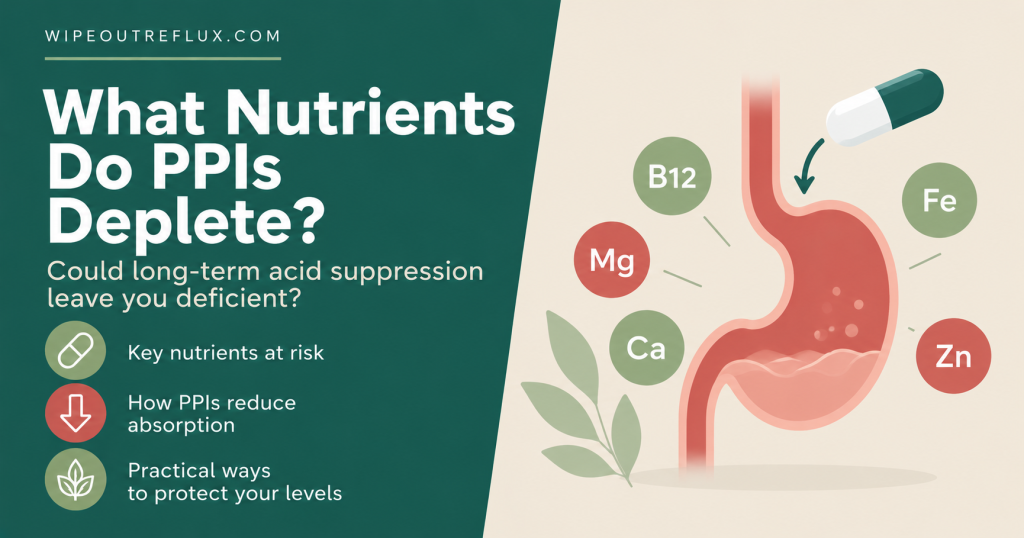
The short version: long-term proton pump inhibitors (PPIs) — omeprazole, lansoprazole, esomeprazole and the rest — can lower your levels of five nutrients in particular: vitamin B12, magnesium, iron, calcium and zinc. They do it through one shared mechanism — by suppressing stomach acid, which your gut needs to unlock and absorb these nutrients from food.
I want to be measured about this, because it’s a topic that gets fear-mongered badly. For most people on a PPI short-term, none of this is a problem. The risks show up mainly with years of continuous use, the increases are mostly modest, and they’re reversible when acid suppression stops. But they’re real, they’re well documented, and they’re a big part of why I don’t think anyone should sit on a high-dose PPI indefinitely without a reason and a review.
This is the hub piece pulling all five together. I go much deeper on the two most important ones in my dedicated guides to omeprazole and B12 deficiency and omeprazole and low magnesium — here I’ll give you the whole picture and the numbers that matter.
Key Takeaways
- PPIs can deplete five nutrients: vitamin B12, magnesium, iron, calcium and zinc — all through the same route, by cutting the stomach acid needed to absorb them.
- The risk is tied to duration and dose: it’s long-term use (roughly two years or more) at higher doses that matters, not a short course.
- Vitamin B12: two or more years of PPI use raised the odds of deficiency by about 65%, with higher doses carrying more risk.
- Iron: the strongest signal of the group — two or more years of PPI use was linked to roughly 2.5 times the odds of iron deficiency.
- Magnesium: pooled data show a modest but real increase in the risk of low magnesium; the FDA has warned about it specifically.
- Calcium: PPIs modestly raise fracture risk (hip, spine and any-site), thought to involve impaired calcium absorption and bone effects.
- Zinc: less studied, but PPI users absorb supplemental zinc far less efficiently and tend to have lower zinc levels.
- The effects are largely reversible on stopping, so the answer is rarely panic — it’s using the lowest effective dose, monitoring if you’re long-term, and having a plan to step down where possible.
Why PPIs Cause Nutrient Problems At All
Everything here comes back to one thing: stomach acid isn’t just there to cause you grief. It does real digestive work, and a big part of that work is preparing nutrients for absorption. Strong PPIs cut acid production dramatically, and that has knock-on effects further down.
Acid does three jobs that matter for nutrients. It cleaves vitamin B12 away from the food proteins it’s bound to, so it can be absorbed. It converts dietary iron into the more absorbable ferrous form. And the acidic environment helps dissolve minerals like calcium and zinc so the gut can take them up. Turn the acid right down for long enough and each of those steps becomes less efficient. That’s the whole story in one paragraph — the rest is detail on each nutrient.
It’s also why this sits alongside the other trade-offs of long-term acid suppression I write about, and why it’s worth understanding how to come off PPIs without acid rebound rather than staying on them by default — especially for silent reflux, where PPIs often don’t work well in the first place.
Vitamin B12
This is the classic one. Because stomach acid is what frees B12 from your food, long-term suppression reduces how much you absorb. In a large study, using a PPI for two or more years was associated with about a 65% increase in the odds of vitamin B12 deficiency (odds ratio 1.65), and the risk was higher at higher daily doses [Lam et al., JAMA, 2013].
B12 matters because a deficiency can cause fatigue, nerve tingling, memory and mood problems — and it can creep up slowly over years without obvious cause. If you’ve been on a PPI a long time, it’s one of the most worthwhile things to have checked. I cover testing, symptoms and what to do in full in does omeprazole cause B12 deficiency.
Iron
Iron is arguably the strongest signal of the five, and it’s under-appreciated. Acid helps convert the iron in food into the form your gut absorbs best, so suppressing it reduces uptake — particularly of non-heme (plant-source) iron. In a large study, two or more years of PPI use was associated with roughly 2.5 times the odds of iron deficiency (odds ratio 2.49), with the risk rising further at higher doses and longer durations [Lam et al., Gastroenterology, 2017].
The practical catch: if you’re low on iron and take a supplement to fix it, being on a PPI can blunt how well that supplement is absorbed too — and iron tablets can be hard on the stomach, as I discuss in do iron supplements cause heartburn. It’s worth working with your doctor on timing and form rather than just doubling the dose.
Magnesium
Low magnesium is the one regulators took seriously enough to act on — the FDA issued a specific safety warning about hypomagnesemia with long-term PPI use. Pooling the observational data, a meta-analysis of nine studies (over 115,000 people) found PPI use was associated with a modestly increased risk of low magnesium, with an adjusted odds ratio of about 1.48 [Park et al., PLOS ONE, 2014]. The evidence has real heterogeneity, so I don’t want to overstate it, but the association is consistent enough that it’s on the label for a reason.
Magnesium matters because it’s involved in muscle and nerve function and heart rhythm, and severe deficiency can cause cramps, palpitations and worse. The deeper dive — who’s most at risk, symptoms, and what to do — is in omeprazole and low magnesium.
Calcium and Bone Health
Calcium is a slightly different case, because the concern shows up as an outcome — fractures — rather than a blood level you’d routinely check. The acidic stomach helps dissolve and absorb calcium (especially calcium carbonate), and long-term suppression is thought to impair that. A meta-analysis of 18 studies found PPI use modestly increased fracture risk: about 33% higher for any fracture, 26% higher for hip fracture and 58% higher for spine fracture [Zhou et al., Osteoporosis International, 2016].
Those are relative increases on what may be a low baseline risk, so context matters — but it’s a meaningful consideration for older adults, post-menopausal women, and anyone already at risk of osteoporosis. If that’s you, it’s a strong reason to make sure you’re actually still benefiting from the PPI.
Zinc
Zinc is the least-studied of the five, so I’ll be honest that the evidence is thinner. But what exists is suggestive: in one study, when healthy controls took a zinc supplement their plasma zinc rose by 126%, while long-term PPI users managed only a 37% rise — and PPI users on a normal diet had about 28% lower plasma zinc than controls [Farrell et al., Gastroenterology Research, 2011]. Zinc matters for immune function, wound healing and taste. I wouldn’t lose sleep over it on its own, but it fits the same pattern as the rest. (For a reflux-friendly zinc option, zinc carnosine is worth knowing about.)
Who’s Most at Risk — and What to Actually Do
Pulling it together, the people who most need to pay attention are those on high doses, for years, especially older adults and anyone with extra risk factors (poor diet, malabsorption, existing low levels, osteoporosis risk). If that’s not you — a short course, a low dose, a few months — this is genuinely not worth worrying about.
If you are long-term, here’s the sensible approach, all of it with your doctor rather than solo:
- Use the lowest effective dose. The risks are dose- and duration-dependent, so the smallest dose that controls your symptoms is also the safest for your nutrients.
- Get the key levels checked. B12, iron studies and magnesium are the obvious ones to monitor if you’ve been on a PPI for years. It’s a simple blood test.
- Don’t stop abruptly. Acid rebound is real and can make symptoms flare, so any step-down should be gradual and planned — see my guide on getting off PPIs.
- Consider whether you still need it. This is the big one for silent reflux especially. If a PPI isn’t doing much for your symptoms, the nutrient trade-off has no upside to justify it.
- Ask about alternatives. For some people an H2 blocker like famotidine (which appears to carry a smaller nutrient signal) or a non-drug approach fits better — I compare them in famotidine vs omeprazole.
You’ll notice the theme: none of this says “PPIs are poison, throw them out.” They’re useful drugs. It says use them deliberately, for as long as they’re earning their place, and no longer. The other side of that coin — the supplements and diet that support you if you’re reducing reliance on acid suppression — is covered in supplements for LPR and acid reflux vitamins.
Conclusion
PPIs deplete B12, iron, magnesium, calcium and zinc by the same simple mechanism — less acid, less absorption — and the risk is real but dose- and time-dependent, largely reversible, and mostly a concern for long-term, higher-dose users. The takeaway isn’t fear; it’s intention. Use the lowest dose that works, monitor the key nutrients if you’re in it for the long haul, and keep asking whether you still need the drug at all.
And that last question is where diet earns its keep. The less you rely on suppressing acid, the less any of this matters — and the way to get there is to reduce how often reflux happens in the first place. The Wipeout Diet Plan is the complete framework I built to do exactly that: it was designed around LPR, the stubborn throat-based form, but because it works on the same underlying reflux mechanics it’s just as effective for classic GERD and heartburn. If you want a lighter place to start, the Wipeout Food Reference Guide is the essential companion — it lays out which foods and drinks are safe for reflux and LPR and where they sit on the pH scale, so you can start easing off the medication cycle sooner.
Frequently Asked Questions
What nutrients do PPIs deplete?
The five with the best evidence are vitamin B12, iron, magnesium, calcium and zinc. All are affected by the same mechanism: PPIs suppress stomach acid, and acid is needed to absorb each of them properly. The effects are most relevant with long-term, higher-dose use rather than a short course.
How long do you have to take a PPI before nutrient levels drop?
The clearest risks show up at around two years or more of continuous use, and rise with higher daily doses. Short courses of a few weeks or months don’t carry the same concern for most people. If you’ve been on a PPI for years, that’s when checking your levels makes sense.
Which nutrient is most affected by PPIs?
Iron shows one of the strongest associations — two or more years of use was linked to roughly 2.5 times the odds of iron deficiency — closely followed by vitamin B12. Magnesium and fracture (calcium) risk are more modest but well documented, and zinc is the least studied.
Are the effects of PPIs on nutrients reversible?
Largely, yes. The associations tend to weaken after stopping the drug, because the effect is driven by ongoing acid suppression rather than permanent damage. That’s a key reason the answer is usually to review and step down where appropriate, not to panic about irreversible harm.
Should I take supplements while on a PPI?
Not automatically — it depends on your levels and your situation, so it’s worth testing first rather than guessing. Bear in mind acid suppression can also blunt how well some supplements (like iron and zinc) are absorbed, so timing and form matter. Talk it through with your doctor rather than self-prescribing.
Should I stop my PPI to protect my nutrient levels?
Not abruptly, and not without advice. PPIs are useful drugs, and stopping suddenly can trigger acid rebound and a symptom flare. The better approach is using the lowest effective dose, monitoring your levels if you’re long-term, and working with your doctor on a gradual step-down if you no longer need it.
Do H2 blockers like famotidine cause the same problems?
They suppress acid less completely than PPIs, and the nutrient signal appears smaller — for example, the B12 association was weaker for H2 blockers than for PPIs. That makes them an option worth discussing for some people, though they’re not automatically better for everyone; it depends on your symptoms and needs.
Research & References
- [Lam et al., JAMA, 2013] — Case-control study finding that two or more years of PPI use was associated with a 65% higher odds of vitamin B12 deficiency (odds ratio 1.65), with a stronger association at higher daily doses.
- [Lam et al., Gastroenterology, 2017] — Found that two or more years of PPI use was associated with about 2.5 times the odds of iron deficiency (odds ratio 2.49), increasing with higher dose and longer duration.
- [Park et al., PLOS ONE, 2014] — Meta-analysis of nine studies (over 115,000 patients) finding PPI use associated with an increased risk of hypomagnesemia (adjusted odds ratio 1.48), with high heterogeneity between studies.
- [Zhou et al., Osteoporosis International, 2016] — Meta-analysis of 18 studies finding PPI use modestly increased fracture risk: any-site 33% higher (RR 1.33), hip 26% higher (RR 1.26) and spine 58% higher (RR 1.58).
- [Farrell et al., Gastroenterology Research, 2011] — Found long-term PPI users absorbed supplemental zinc far less efficiently (37% plasma rise vs 126% in controls) and had about 28% lower plasma zinc on a normal diet.

David Gray
12 years living with LPR · Consultant & researcher
I've lived with LPR for twelve years — the misdiagnoses, the PPI courses that did nothing, the slow work of figuring out what actually helps. Wipeout Reflux is where I translate the research into plain terms for people stuck in the same place. Every claim here is sourced to peer-reviewed work, and I consult one-to-one with LPR sufferers.