
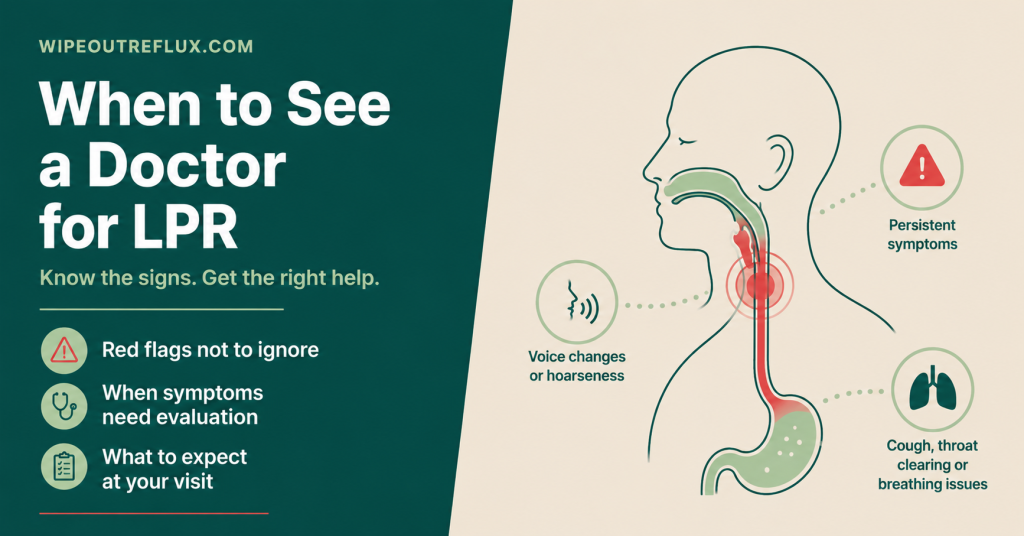
You should see a doctor for LPR (silent reflux) if your symptoms have lasted more than a few weeks despite diet and lifestyle changes, if they’re getting worse, or — most importantly — if you notice any “red flag” symptoms like persistent hoarseness lasting more than three weeks, difficulty swallowing, unexplained weight loss, a lump in your neck, or coughing up blood. Those warning signs need prompt medical assessment to rule out anything serious.
For most people, though, mild silent reflux can be safely managed at home first. The key is knowing where the line sits — when it’s reasonable to keep working on diet and lifestyle, and when it’s time to get your throat properly examined.
Having lived with LPR for over eight years, I know how easy it is to either panic over normal symptoms or, at the other extreme, ignore something that genuinely needs checking. This guide walks you through exactly when to wait, when to book an appointment, and when to seek help urgently.
Key Takeaways
- Mild LPR can usually be self-managed for 4–6 weeks with diet and lifestyle changes before seeing a doctor.
- See a doctor promptly if symptoms persist beyond that, worsen, or don’t respond to changes.
- Persistent hoarseness lasting 3+ weeks should always be checked — it’s the symptom most linked to serious causes.
- Urgent red flags include trouble swallowing, unexplained weight loss, a neck lump, coughing blood, or breathing difficulty.
- Your GP is the first stop; they can start treatment and refer you to an ENT specialist if needed.
- An ENT can perform a laryngoscopy — a quick camera exam — to look directly at your throat and voice box.
When It’s Usually Safe to Manage LPR at Home First
Not every throat symptom needs an immediate doctor’s visit. LPR is common, and its everyday symptoms — a lump-like sensation, throat-clearing, mild hoarseness, post-nasal drip, a slightly raw throat — are usually caused by reflux irritation rather than anything dangerous.
If your symptoms are mild, fairly stable, and you can link them to typical reflux patterns (worse after certain foods, worse in the morning, worse when lying down), it’s generally reasonable to try dedicated diet and lifestyle changes for a period first. That means a low-acid diet, better meal timing, and often alginate therapy like Gaviscon Advance. Many people improve significantly within a few weeks. If you’re not sure whether what you’re feeling is even LPR, my guide to LPR symptoms lays out the full picture.
The reasonable self-management window is usually around 4–6 weeks. If you’re following the changes properly and seeing real progress, it’s fine to keep going. If you’re not — that’s your signal to get it looked at.
Red Flag Symptoms: See a Doctor Promptly
This is the part that matters most. While LPR itself is benign, some of its symptoms overlap with more serious throat conditions, and a few warning signs should never be brushed off. See a doctor promptly if you experience any of the following:
- Persistent hoarseness lasting more than 3 weeks — especially if it’s constant rather than coming and going.
- Difficulty or pain when swallowing (dysphagia), or a feeling of food genuinely sticking.
- Unexplained weight loss.
- A lump or swelling in your neck.
- Coughing up blood, or blood in your saliva.
- Persistent, one-sided throat or ear pain that doesn’t settle.
The reason persistent hoarseness tops the list is that it’s the symptom most strongly associated with laryngeal problems. In one analysis of urgent hoarseness referrals, constant, persistent hoarseness carried the strongest association with laryngeal cancer, whereas fluctuating hoarseness that comes and goes was far less concerning [Chandran et al., Journal of Laryngology & Otology, 2021]. A UK primary-care study found that among patients with four or more weeks of hoarseness sent for examination, around 3.3% had laryngeal cancer [Shephard et al., British Journal of General Practice, 2019].
I want to be clear: the overwhelming majority of hoarseness is not cancer — it’s far more often reflux, a virus, or voice strain. But because early laryngeal cancer can present with hoarseness as its only sign, the safe rule is simple: any voice change lasting more than three weeks gets checked. This isn’t about fear; it’s about being sensible.
Symptoms that need same-day or emergency help
Seek urgent care immediately if you have difficulty breathing, noisy breathing (stridor), or a sudden severe problem swallowing your own saliva. These are rare with LPR but require immediate attention rather than a routine appointment.
When Self-Management Isn’t Working
Beyond the red flags, there’s a second, more common reason to see a doctor: you’ve genuinely tried the changes and they’re not enough.
If you’ve committed to a low-acid diet, fixed your meal timing, and used alginate therapy consistently for 6–8 weeks with little improvement, it’s worth getting assessed. Sometimes the issue is that symptoms attributed to reflux are being driven by something else — allergies, a sensitised throat nerve, or post-viral changes. A doctor can help sort out what’s actually going on.
It’s also worth seeing your GP if you’re relying on acid-suppressing medication that isn’t helping. This is extremely common in LPR, because silent reflux is driven largely by pepsin rather than acid alone, so acid-blockers often underperform — I explain why in why acid reflux medication isn’t working. A doctor can review whether your treatment approach actually fits LPR, or whether you’re being treated as if you have standard GERD.
What Will the Doctor Actually Do?
Knowing what to expect takes the anxiety out of booking. Here’s the usual pathway.
Step 1: Your GP
Your GP is the first port of call. They’ll take a history, ask about your symptoms and triggers, and may examine your throat and neck. In many cases they’ll start or adjust treatment — dietary advice, lifestyle changes, and sometimes a trial of medication — and see how you respond over a few weeks. If you have any red flag symptoms, or you’re not improving, they’ll refer you onward.
Step 2: Referral to an ENT specialist
An ENT (ear, nose and throat) specialist is the doctor best equipped to actually look at your larynx. The key test is a laryngoscopy — a thin, flexible camera passed gently through the nose to view your throat and voice box directly. It takes only a few minutes, is done in the clinic, and is the only reliable way to see what’s really happening down there. As clinical guidance puts it, dysphonia (voice change) lasting more than four weeks, or the presence of alarm symptoms, warrants expedited laryngoscopy to visualise the larynx directly [Feierabend & Shahram, Cleveland Clinic Journal of Medicine, 2023].
In the UK, if your GP suspects anything needing quick assessment, they can refer you urgently. Persistent unexplained hoarseness in particular is a recognised trigger for fast-track referral. Being referred does not mean your doctor thinks you have something serious — it usually means they’re being appropriately thorough.
Getting the Most From Your Appointment
A little preparation makes a big difference. Before you go:
- Track your symptoms. Note when they started, what makes them better or worse, and how they’ve changed. A pattern tied to meals or lying down points strongly to reflux.
- List what you’ve already tried. Diet changes, meal timing, alginates, medications — and how long you gave each one.
- Be specific about the throat sensations. Globus (lump sensation), throat-clearing, hoarseness, and cough all give useful clues. My articles on the globus lump-in-throat sensation and constant throat clearing can help you describe them accurately.
- Mention any red flags directly, even if they seem minor — swallowing changes, weight loss, or blood should always be flagged.
The clearer your picture, the faster your doctor can help you — and the less likely you are to be sent away with a vague “it’s probably reflux” and no real plan.
Frequently Asked Questions
Can a GP diagnose LPR, or do I need an ENT?
A GP can strongly suspect LPR from your symptoms and history, and often starts treatment on that basis. But a definitive look at the larynx requires an ENT and a laryngoscopy. Many people are managed successfully by their GP without ever needing referral — referral is mainly for red flags, uncertain diagnoses, or cases that don’t improve.
How long should I try treating LPR myself before seeing a doctor?
Around 4–6 weeks of consistent diet and lifestyle changes is a reasonable trial for mild symptoms. If you’re improving, keep going. If there’s no meaningful change, or symptoms worsen at any point, book an appointment. And don’t wait out the clock if you develop any red flag symptom — get those checked promptly regardless of timing.
Is hoarseness from LPR dangerous?
Hoarseness from reflux itself isn’t dangerous, but hoarseness is also the main early symptom of more serious laryngeal conditions, which is why persistent hoarseness lasting more than three weeks should always be examined. It’s usually reflux or voice strain — but it’s not something to guess about.
What happens during a laryngoscopy? Does it hurt?
It’s quick and generally well-tolerated. A thin flexible camera is passed through your nose to view the throat and voice box. It can feel slightly odd for a few seconds, but it’s not usually painful, takes only minutes, and gives your specialist a clear, direct view that symptoms alone can’t provide.
Should I stop my reflux diet before seeing the doctor?
No — keep doing what’s helping. But do make a note of exactly what you’ve been doing and how you’ve responded, as that information helps your doctor a great deal. If anything, arriving with a clear record of your self-management makes the appointment far more productive.
Conclusion
Knowing when to see a doctor for LPR really comes down to two things: watching for red flags, and being honest about whether your self-management is working. Mild silent reflux is usually safe to treat at home for a few weeks — but persistent hoarseness, swallowing trouble, weight loss, a neck lump, or coughing blood all mean it’s time to get checked promptly, no waiting. And if you’ve genuinely put the work in for six weeks or more without improvement, that’s a sensible point to get professional input rather than struggling on alone.
For the large majority of people, though, the single most powerful thing you can do — before, during, and after any medical assessment — is get your diet right, because diet is what addresses the root of silent reflux. That’s exactly why I created the Wipeout Diet Plan: a structured, done-for-you low-acid eating plan built specifically for LPR recovery, so you’re not left guessing which foods are safe or whether you’re giving self-management a proper trial. It’s the clearest way to know you’ve genuinely done everything you can on the diet side.
To make daily choices even easier, the Wipeout Food Reference Guide is an essential companion — it lists exactly which foods and drinks are safe for acid reflux and LPR along with their pH values, so you can check anything at a glance. Use the Food Reference Guide as your quick daily lookup and the Wipeout Diet Plan as the deeper, more complete roadmap to getting better. Trust your instincts, don’t ignore the warning signs, and give your throat the consistent care it needs to heal.
Research and References
- [Chandran et al., Journal of Laryngology & Otology, 2021] — Analysis of urgent hoarseness referrals found persistent hoarseness carried the strongest association with laryngeal cancer, while fluctuating hoarseness was far less concerning.
- [Shephard et al., British Journal of General Practice, 2019] — Primary-care case-control study; hoarseness carried the highest individual risk of laryngeal cancer, and ~3.3% of patients with 4+ weeks of hoarseness sent for laryngoscopy had cancer.
- [Feierabend & Shahram, Cleveland Clinic Journal of Medicine, 2023] — Clinical review advising that voice change lasting over four weeks, or the presence of alarm symptoms, warrants expedited laryngoscopy.

David Gray
12 years living with LPR · Consultant & researcher
I've lived with LPR for twelve years — the misdiagnoses, the PPI courses that did nothing, the slow work of figuring out what actually helps. Wipeout Reflux is where I translate the research into plain terms for people stuck in the same place. Every claim here is sourced to peer-reviewed work, and I consult one-to-one with LPR sufferers.